
UPKEEP VENDOR MANAGEMENT
Know which vendors are worth keeping
A single directory of every vendor and contractor, their insurance and compliance documents with expiry dates, and a performance record graded from your own work history rather than from opinion.
- COI and license expiry tracking
- Scores from your own history
- Shares one vendor record with Procurement








SOLUTIONS
The vendor record your spreadsheet was standing in for
Most operations know who their vendors are and almost nothing about them. This is the part that decides whether a contractor should be on site at all.
The vendor list is a spreadsheet, and three people keep their own copy.
One directory holds every vendor and contractor, the trades they cover, the sites they serve, and who owns the relationship. When a vendor changes their phone number it changes in one place.
You find out a contractor’s insurance lapsed while they are already on the roof.
Certificates of insurance, licenses, and W-9s sit on the vendor record with their expiry dates. Expiring documents surface weeks ahead, and a vendor without current cover can be blocked from being assigned work rather than merely flagged.
The annual review with a supplier starts from whoever complained loudest.
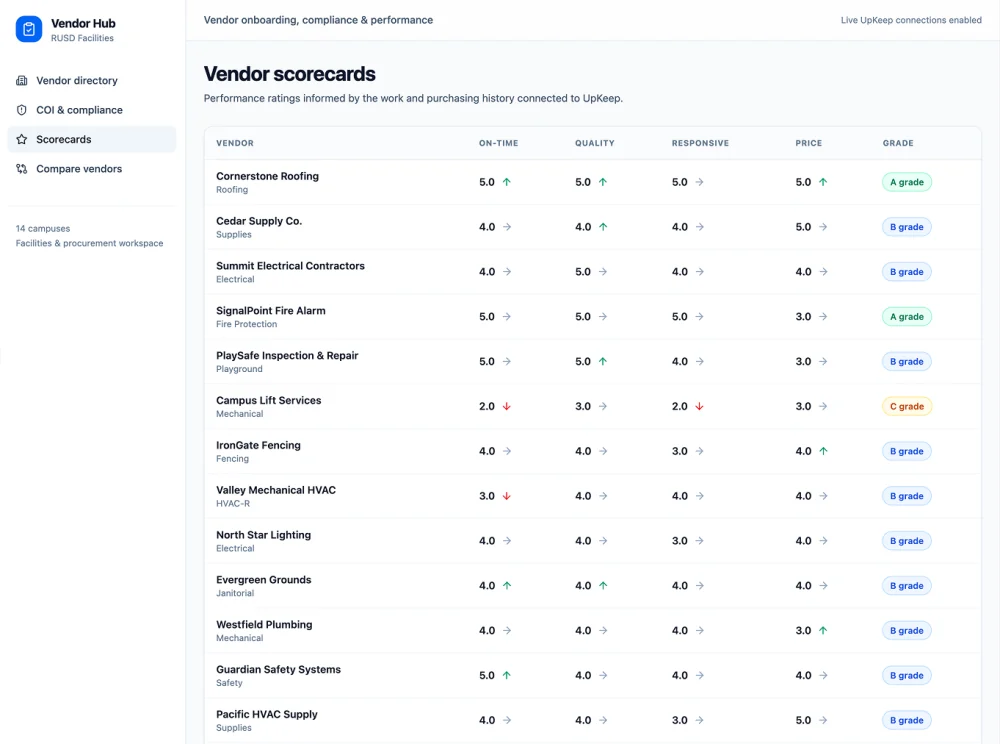
Every vendor carries a graded record built from your own history: whether they showed up when they said, whether the work held, how fast they responded, and how their pricing moved. The conversation starts from evidence.
Two vendors quote the same scope and there is nothing to compare but price.
Compare them side by side on rate, on-time record, rework, response time, and the sites each already covers, so the cheaper quote is weighed against what it has historically cost to use them.
One vendor serves eight sites and every site negotiated separately.
Spend, terms, and performance roll up across every location that uses a vendor. What looked like eight small accounts turns out to be one relationship with use in it.
A vendor stops being used and nobody notices for a year.
Activity, spend, and open work are visible per vendor, so a dormant account is obvious and the list stays the list of vendors you actually use, not everyone you have ever paid.
FEATURES
Onboarding, compliance, and performance
What you hold on a vendor, what expires, and what their record says the next time you are choosing between two of them.
Vendor directory
Every vendor and contractor with their trades, contacts, payment terms, sites served, and the internal owner of the relationship.
Insurance and COI tracking
Certificates of insurance, licenses, W-9s, and safety documents with expiry dates and warnings before they lapse.
Onboarding requirements
Set what a vendor must have on file before they can be assigned work, by trade or by site. Incomplete vendors stay visibly incomplete.
Performance scorecards
On-time, quality, responsiveness, and price scored per vendor and rolled into a grade, drawn from your own work orders and receipts.
Vendor comparison
Two or more vendors side by side on record, rate, and coverage, so an award decision is made on more than the quoted number.
Response tracking
How long each vendor takes to accept a job and to close it, measured against what the agreement says they promised.
Spend by vendor
What you spend with each vendor across sites, categories, and work types, and how that has moved year over year.
Documents and rate cards
Agreements, rate cards, scopes of work, and correspondence kept on the vendor record instead of in an inbox.
Multi-site coverage
Which vendors cover which locations, where you have a single point of failure, and which sites have no approved vendor for a trade.
CONNECTED WORKFLOWS
Built to work with the rest of UpKeep
The vendor record is only useful if it is fed by real work. These are the hand-offs that keep it current without anyone maintaining it.
Vendor Management Procurement
Procurement raises requisitions, issues POs, and receives against them. Every one of those receipts feeds the on-time and price scores here, and both applications read the same vendor record rather than keeping two vendor masters.
Explore UpKeep Procurement →Vendor Management CMMS
A work order assigned to a contractor records who did the work, how long they took, and whether it came back. That is where the quality and responsiveness scores come from, not from a survey.
Explore UpKeep CMMS →Vendor Management Providers
Providers is how a contractor gets access to the job: a portal link, no app, no license. Vendor Management is the record behind it, who they are, what they have on file, and how they have performed.
Explore UpKeep Providers →Vendor Management Contracts
The agreement that governs a vendor, term, annual value, renewal date, named owner, lives on the contract record. The performance record here is what tells you whether to renew it.
Explore UpKeep Contracts →Vendor Management Safety
Contractor incidents, required training, and site inductions attach to the vendor as well as the site, so a firm with a poor safety record is not invisible to the person assigning the next job.
Explore UpKeep Safety →Vendor Management Nova
Ask which vendors slipped on response time this quarter, or which trades have only one approved vendor at a site. Nova reads the same record the scorecards do.
Explore UpKeep Nova →CUSTOMER STORIES
Teams running maintenance on UpKeep

Organized technician workload and built a preventive schedule around cold storage equipment.
Columbia Fruit
Read the story →
Keeps kitchen equipment running across a footprint measured in thousands of sites.
Chick-fil-A
Read the story →
One operator runs maintenance across every restaurant he owns from a phone.
McDonald's
Read the story →
Moved campus crews off paper and onto digital preventive maintenance and work orders.
Caltech
Read the story →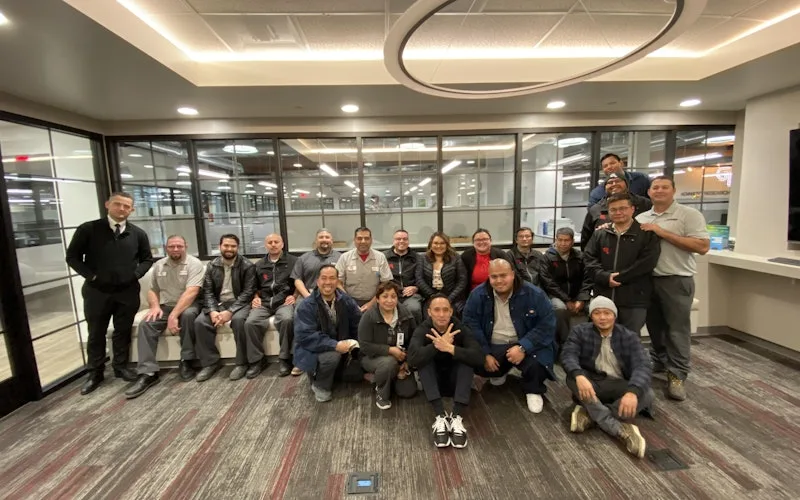
Standardized maintenance across one of the largest custom restorative labs in the world.
Glidewell
Read the story →
Moved from 60% reactive work to 20% by putting every asset on a recurring PM schedule.
Industrial manufacturer
Read the story →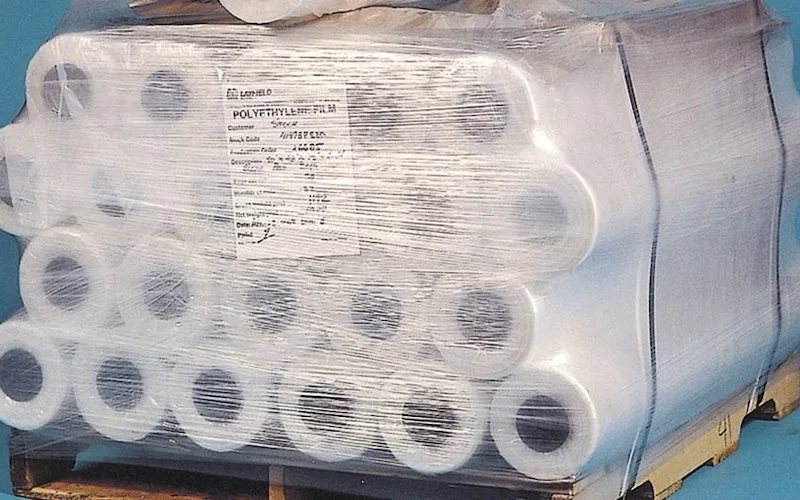
Shifted work from reactive to preventive and brought maintenance costs down with it.
Layfield Group
Read the story →
Replaced paper tracking and manual data entry across the plant using Nova.
Sprinturf
Read the story →Frequently asked questions
How is this different from UpKeep Procurement?
Procurement is the transaction: a requisition, an approval, a purchase order, a receipt, a matched invoice. Vendor Management is the relationship behind those transactions: who the vendor is, what they have on file, how they have performed, and whether to keep using them. Most teams run both, and the two share one vendor record. If you only need to buy things, start with Procurement. If your problem is compliance documents and contractor performance, start here.
And how does it differ from UpKeep Providers?
Providers is the vendor-facing side, a contractor opens a portal link, sees the job assigned to them, and updates it, with no app and no license. Vendor Management is the internal side: the directory, the documents, the scores. Providers answers "how does this contractor do the work"; Vendor Management answers "should this contractor be doing our work at all".
Do we need Procurement to use it?
No. The directory, document tracking, and comparison work on their own, and the performance record builds from contractor work orders alone. Adding Procurement enriches the scores with delivery and pricing data from receipts, which sharpens the on-time and price dimensions.
Where do the performance scores come from?
From your own operational record, on four dimensions: on-time (did the work or delivery happen when promised), quality (did it come back or require rework), responsive (how long from assignment to acceptance and closure), and price (how quoted and invoiced amounts moved against your own history). Scores roll into a letter grade so a long list is scannable. These are your numbers about your experience, not an industry rating, and not comparable to another company’s scores.
Can UpKeep Vendor Management stop a vendor with expired insurance from being given work?
Yes. Requirements are set by trade or by site, and a vendor missing a current document can be blocked from assignment rather than only flagged. Teams usually start with warnings, see how much lapsed cover they actually have, and turn on blocking once the backlog is cleared.
Can vendors keep their own documents up to date?
Yes, through the provider portal, a link opened in a browser with a magic-link or one-time code, no app and no seat. Your team can also upload on their behalf, which is what usually happens for the vendors who will never log in to anything.
Is this a third-party risk management platform?
No. It does not do financial health scoring, sanctions or watchlist screening, cybersecurity questionnaires, or ESG assessment. It covers the operational risk a maintenance and facilities team actually carries: uninsured contractors on site, unlicensed trades, and vendors who do not perform. If you need enterprise TPRM, keep that system and use this for the operational record.
Can we import the vendor list we already have?
Yes. Vendors, contacts, terms, and documents import from a spreadsheet or from your ERP, and the import flags duplicates so eight spellings of the same company do not become eight vendors. Historical work orders and POs already in UpKeep start populating the performance record as soon as vendors are matched to them.
FREE RESOURCES
Go deeper on maintenance
Practical guides and research from the UpKeep team. No cost, no sales call required.
 Guide
GuideThe Reliability Playbook: Capturing 20 Years of Know-How Before It Walks Out the Door
A fully staffed plant still loses hours to failures a retired technician would have caught in minutes. This playbook reframes the problem: knowledge is disappearing because no system was built to capture it. It lays out a three-part framework for closing that gap and shows what changed at one plant that stopped hiring its way out and instead started capturing what its people already knew.
Get the guide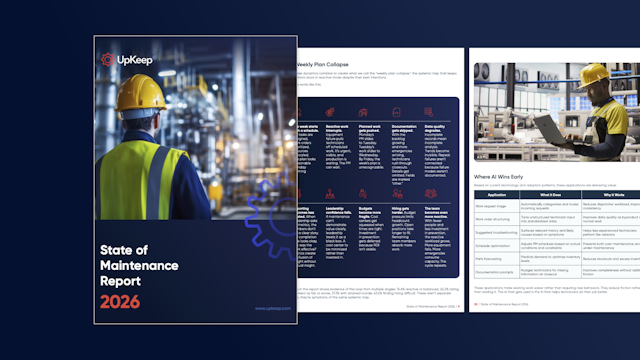 Report
The 2026 State of Maintenance Report
This year's report reflects a fundamental shift in how maintenance creates competitive advantage. While 90% of teams recognize what drives reliability, only 25% can consistently execute it. The gap between knowing and doing has become the defining challenge and opportunity of 2026.
Get the report Guide
GuideChange or Be Left Behind: The Urgent Need for Change Management in Maintenance
Effectively managing change enables maintenance teams to implement new technologies, streamline processes, and foster continuous improvement, all of which are necessary to thrive in today’s fast-paced environment. This guide outlines essential change management models
Get the guide
Start with the vendors you are least sure about
Bring your current vendor list and one contractor whose insurance status you would have to go and check. We will show you what the record looks like once it is in one place.