
UPKEEP FACILITIES
Run the building, not just the equipment in it
Spaces, occupant requests, building systems, and compliance evidence on the platform your team already works in. The same work engine, with the building modeled properly.
- Requests without a login
- Compliance evidence on demand
- Cost per building









SOLUTIONS
What changes when space is a real record
Facilities teams have been working around the absence of the building in their maintenance system. This is what closes that gap.
Requests arrive by email, text, and hallway conversation.
One intake for occupants: a portal, a QR code on the door, or email, all landing in the same queue with a location, a priority, and a response target. Requesters can see status without asking anyone.
A work order says "third floor" and the technician has to go find it.
Work is recorded against a space, not a vague location. The room, the floor, the building, and the equipment serving that room are all on the record before anyone walks over.
Compliance evidence is assembled in a panic before an inspection.
Fire extinguisher checks, life safety rounds, backflow tests, and elevator certificates run as scheduled inspections with completion records attached to the asset and the space. The evidence exists before it is asked for.
You know what the portfolio costs but not what any building costs.
Labor, parts, and vendor spend roll up per space, building, and site, so cost per square foot and chargeback by department come out of the record rather than an allocation formula.
Vendor work happens and nobody can prove it met the contract.
Janitorial, elevator, HVAC, and landscaping work is scoped, dispatched, and signed off against the contract, with insurance certificates tracked and expiring ones flagged.
The capital request for a roof is a number with a story attached.
Building and system condition accumulates from the work you do, producing a Facility Condition Index per building that supports a funding request with evidence.
FEATURES
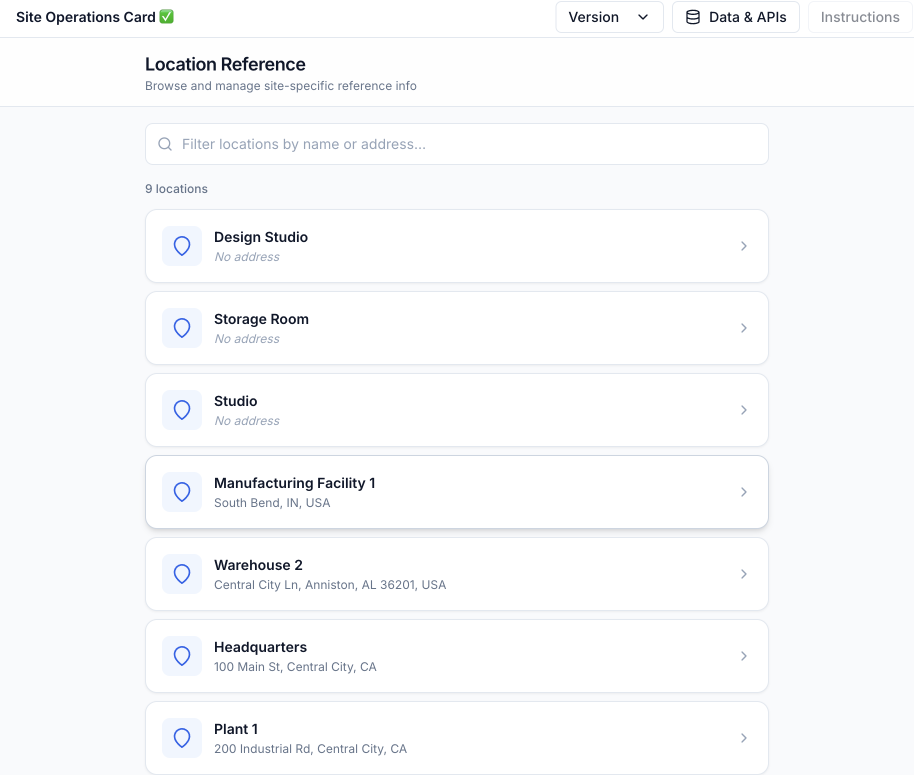
Buildings, spaces, and the work in them
Built for teams where the asset under management is the building itself.
Space and portfolio hierarchy
Portfolio, site, building, floor, and room, with floor plans. Assets attach to the spaces they serve, so a room and its RTU are connected.
Occupant request intake
Portal, QR code, email, or kiosk. No login needed to submit, with priority and response targets applied automatically by request type and location.
Building systems maintenance
HVAC, elevators, fire and life safety, plumbing, and electrical on preventive schedules, with full history per system and per building.
Inspections and compliance
Recurring rounds and inspections with the completion evidence an inspector or accreditation surveyor asks for, held against the asset and the space.
Space utilization
Occupancy and assignment, moves adds and changes, and utilization reporting for teams deciding what space is actually being used.
Vendor and contract management
Service contracts, scopes, and rate cards for outside providers, with insurance certificates, compliance documents, and expiry tracking.
Cost and chargeback
Cost per space, building, and site, with chargeback to departments or tenants and cost per square foot reported from real spend.
Condition and FCI
Building and system condition scoring, deferred work per building, and Facility Condition Index across the portfolio.
Building sensors and energy
Temperature, humidity, occupancy, and consumption from Edge sensors, triggering work when a space drifts out of range.
ROOM & RESOURCE BOOKING
The spaces you maintain, bookable
Conference rooms, training centers, event spaces, and shared equipment booked against the same space records your team already maintains. The crew that sets a room up and the crew that has to keep it available are looking at one calendar.
- A calendar per resource. Every bookable room and resource on one grid, by day, with who holds it and what for.
- Approvals where they matter. Ordinary rooms can be booked outright. Event spaces, training centers, and anything needing a setup crew can require a sign-off first.
- Maintenance and reservations see each other. A space taken out of service stops accepting reservations, and a booked room is not somewhere work gets scheduled by accident.
- Utilization from what was actually booked. Which rooms run solid and which have not been used in a quarter, the space-planning question answered from the record rather than from a walk-round.

CONNECTED WORKFLOWS
Built to work with the rest of UpKeep
Facilities is the same engine pointed at a different object model, which is why almost nothing here needs an integration.
Facilities CMMS
The whole work engine carries over. Facilities adds space as a first-class record alongside the asset, so the work orders, preventive schedules, and mobile app your team already uses now understand buildings.
Explore UpKeep CMMS →Facilities Capital Planning
Building condition and deferred work per building roll up into Facility Condition Index and the multi-year plan, turning daily facilities work into a funding argument.
Explore UpKeep Capital Planning →Facilities Providers
Outside service providers are sourced, dispatched, and held to scope and SLA on the same records, which matters because most facilities work is done by vendors rather than staff.
Explore UpKeep Providers →Facilities Safety
Life safety compliance, incident reporting, and inspection evidence share one system, so an Environment of Care or fire marshal review draws from a single record.
Explore UpKeep Safety →Facilities Edge
Sensors on building systems catch a failing unit or a space out of range and raise the work order before an occupant submits a complaint about it.
Explore UpKeep Edge →Facilities Projects
Renovations, system replacements, and building improvements run as projects against spaces, with budget and contractor work tracked the same way plant projects are.
Explore UpKeep Projects →CUSTOMER STORIES
Facilities teams running on UpKeep
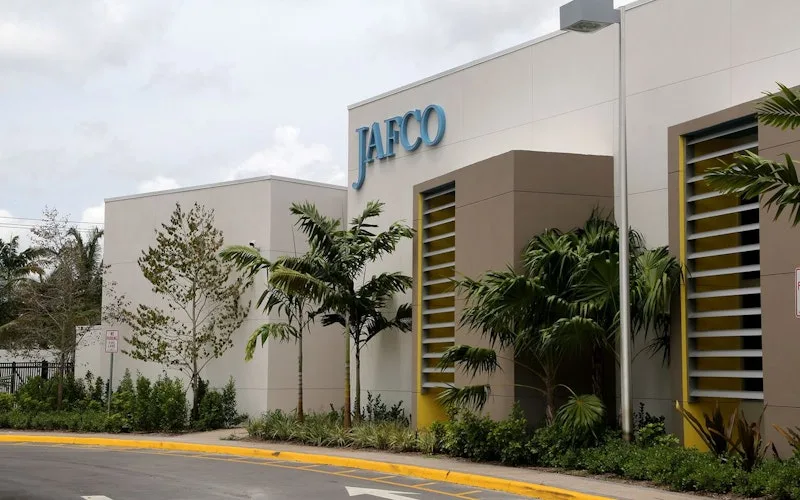
Gave a small facilities team one queue for every building request.
JAFCO
Read the story →
Gave site managers one place to log and close facility work without a maintenance team behind them.
Neighborhood Storage Center
Read the story →
Put QR codes across the property so any member of staff could report a problem on the spot.
TPC San Antonio
Read the story →
Moved campus crews off paper and onto digital preventive maintenance and work orders.
Caltech
Read the story →
Brought overtime under control by seeing where labor was actually going.
Retail shopping center
Read the story →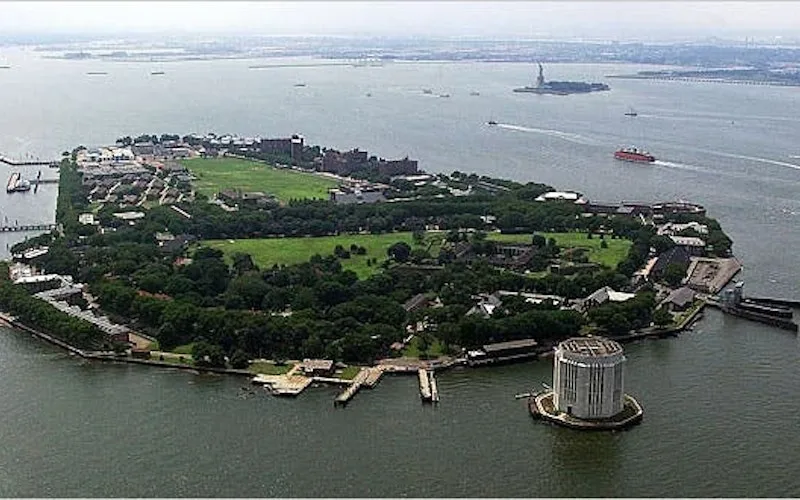
Gained visibility into where the team’s time and vehicle costs were going.
Governors Island
Read the story →
Traced a recurring building problem to its root cause instead of repairing it again.
FMLY
Read the story →
Improved communication between a maintenance team and the people relying on it.
Union Rescue Mission
Read the story →Frequently asked questions
How is UpKeep Facilities different from an IWMS like Tririga, Archibus, or Planon?
Those platforms lead with real estate and space: lease administration, portfolio strategy, and occupancy planning, sold to a corporate real estate function. They are strong there and weaker at getting work done in a building on a phone. UpKeep leads from the opposite end, with the work execution and compliance record facilities teams live in daily, and adds space above it. If your primary problem is lease accounting across a global portfolio, buy an IWMS. If it is running buildings and proving compliance, this is built closer to that.
Does UpKeep Facilities handle lease administration and lease accounting?
No, and that is deliberate. Lease administration under ASC 842 or GASB 87 is a finance discipline with its own audit requirements, and it belongs in a dedicated system or your ERP. We would rather be honest about that boundary than gesture at it.
What is the difference between this and UpKeep CMMS, which we already use for facilities?
One object: space. The CMMS models assets and locations, which works well for equipment. Facilities adds the portfolio, building, floor, and room hierarchy as real records, plus the workflows built on it: occupant request intake, space utilization, cost per square foot, chargeback, condition scoring per building, and vendor contract management. If you are running facilities on the CMMS today and it works, you may not need this. If you are working around the absence of space, this is that gap.
Which industries is this for?
Education, local government, healthcare facilities, senior living, property and commercial real estate, and hospitality. These are sectors where the asset being managed is the building itself and where occupant requests and compliance evidence are the daily work.
Can occupants submit requests without a license or an app?
Yes, and this is usually a requirement rather than a preference. A QR code on the wall or a link opens a request form with the location already identified, with no login and no download. Submitters get status updates without becoming users, so an entire building population is not a licensing problem.
Does UpKeep Facilities cover healthcare technology management or biomedical equipment?
No. Biomedical and medical device management needs a device-specific data model, ECRI nomenclature, and recall handling, and it is a genuinely separate discipline handled by dedicated products. UpKeep covers the facilities side of a healthcare site: building systems, spaces, life safety compliance, and the plant. If you need biomed, that is a different tool.
How does compliance evidence work for an accreditation survey?
Inspections and rounds run on recurring schedules with completion records, photos, and readings attached to the asset and space they relate to. When a surveyor asks for twelve months of a particular check, you filter rather than reconstruct. Standard-specific program design still belongs with your compliance team; UpKeep holds the record that makes it demonstrable.
Is the room booking a desk-hoteling system?
No. It books rooms, training and event spaces, and shared resources for organizations that already maintain them, which is why it sits next to the space records rather than beside a seating chart. It is not a workplace-experience platform: no hot-desk floor plans, no badge-swipe occupancy, no neighborhood assignment for a hybrid office population. If that is the problem you are solving, a dedicated hoteling tool is the better answer and we would say so.
When will UpKeep Facilities be available?
Facilities is in definition rather than general availability, and the scope is being decided now, including how much of it we build versus partner for. Many teams already run facilities successfully on UpKeep CMMS today. If space, occupant intake, or FCI is the thing you are missing, tell us, because that is what determines what ships.
FREE RESOURCES
Go deeper on maintenance
Practical guides and research from the UpKeep team. No cost, no sales call required.
 Guide
GuideThe Reliability Playbook: Capturing 20 Years of Know-How Before It Walks Out the Door
A fully staffed plant still loses hours to failures a retired technician would have caught in minutes. This playbook reframes the problem: knowledge is disappearing because no system was built to capture it. It lays out a three-part framework for closing that gap and shows what changed at one plant that stopped hiring its way out and instead started capturing what its people already knew.
Get the guide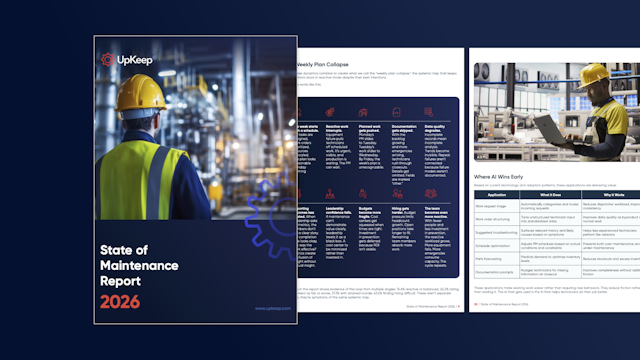 Report
The 2026 State of Maintenance Report
This year's report reflects a fundamental shift in how maintenance creates competitive advantage. While 90% of teams recognize what drives reliability, only 25% can consistently execute it. The gap between knowing and doing has become the defining challenge and opportunity of 2026.
Get the report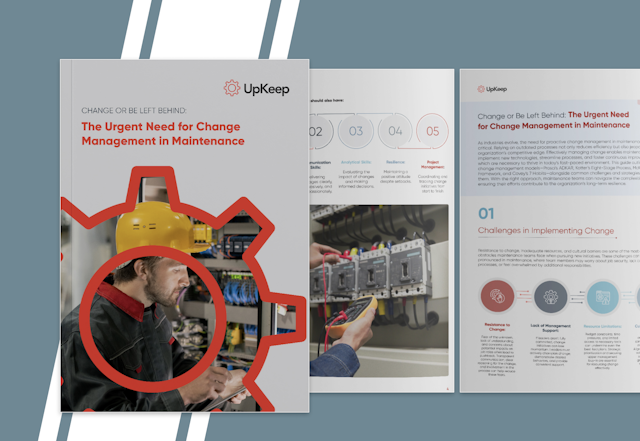 Guide
GuideChange or Be Left Behind: The Urgent Need for Change Management in Maintenance
Effectively managing change enables maintenance teams to implement new technologies, streamline processes, and foster continuous improvement, all of which are necessary to thrive in today’s fast-paced environment. This guide outlines essential change management models
Get the guide
Show us your hardest building
Bring the site with the most requests and the worst compliance paperwork. We will walk through what a month there looks like with spaces in the system.