
UPKEEP CAPITAL PLANNING
Build the capital plan from what your assets actually cost
Condition scoring, deferred maintenance backlogs, prioritization, and funding scenarios drawn from your own maintenance record. Not a condition survey that was accurate the week it arrived.
- Facility Condition Index
- Multi-year funding scenarios
- Defensible prioritization









SOLUTIONS
Turn the maintenance record into a budget argument
The hardest part of a capital request is proving the need. That proof is already sitting in your work order history.
Your condition assessment was accurate the week the consultants delivered it.
Condition here is built from maintenance records that refresh every day: what each asset actually costs to keep running, how often it fails, and what the sensors say. The plan does not go stale between assessments because the assessment never stops.
The capital request that gets funded is the one argued most persuasively.
Every request carries a score built from condition, risk, safety and regulatory exposure, and cost history. The ranking is defensible because the inputs are records rather than opinions.
Deferring maintenance looks free on this year’s budget.
The deferred backlog is a costed register that inflates forward each year. Deferring becomes a visible number with a date on it, which is the argument that actually moves a board.
You cannot answer what fits under four million dollars.
Model scenarios against funding envelopes and see which combination of projects fits, what falls out, and what changes if a grant lands or a bond fails. Before the commitment, not after.
Repair-or-replace is decided by whoever is tired of the asset.
Cumulative maintenance spend is compared against replacement value and remaining useful life, so the assets costing more to keep than to replace identify themselves.
Last year’s plan and what actually happened are two unrelated documents.
Approved items become projects, and actual spend flows back against the plan. Next year’s submission starts from what the work really cost rather than what was estimated.
FEATURES
From condition to committee
Everything between knowing an asset is failing and getting the money approved to do something about it.
Asset and facility register
Install date, purchase cost, current replacement value, expected and remaining useful life, across equipment, buildings, and building systems.
Condition scoring
Condition per asset and per building, including Facility Condition Index, calculated from repair need against replacement value rather than a manual survey.
Deferred maintenance register
Every deferred item costed, categorized, and inflated forward, so the total backlog and the cost of waiting are both a single number you can cite.
Prioritization scoring
Weighted scoring across condition, risk, safety, regulatory exposure, and strategic fit, with the weights set by you and visible to everyone reviewing the list.
Multi-year plans
Five and ten year plans with a funding envelope per year, so a request that does not fit this year lands in a specific future year instead of disappearing.
Scenario modeling
Test funding levels side by side. See which projects make the cut at each level and what the backlog and condition look like in five years under each.
Repair versus replace
Cumulative maintenance cost against replacement value and remaining life, surfacing end-of-life candidates and the assets quietly consuming the repair budget.
Request intake and approval
Capital requests raised from the sites that need them, routed for review, with a record of what was approved, deferred, or declined and why.
Board-ready output
Exports and summaries built for a board, a council, or a budget committee, with the supporting maintenance evidence attached rather than referenced.
CONNECTED WORKFLOWS
Built to work with the rest of UpKeep
This application is downstream of nearly everything else, which is exactly why it works better here than as a separate purchase.
Capital Planning CMMS
Every work order contributes labor and parts cost, failure frequency, and repair history to the asset. This is the input no capital planning tool bought separately can get at, and it is already there.
Explore UpKeep CMMS →Capital Planning Facilities
Building and system condition rolls up per building into Facility Condition Index, so a portfolio comparison uses the same data the facilities team works from daily.
Explore UpKeep Facilities →Capital Planning Edge
Sensor-based condition and degradation trends inform remaining useful life, so an asset heading for failure is visible in the plan before it fails rather than after.
Explore UpKeep Edge →Capital Planning Projects
An approved item becomes a project without being rewritten, and its actual cost returns to the plan, which is what makes the following year’s numbers credible.
Explore UpKeep Projects →Capital Planning Inventory
Critical spares for aging assets can be planned and funded as capital rather than absorbed into an operating budget that cannot carry them.
Explore UpKeep Inventory →Capital Planning Intelligence
Cost, failure, and condition trends across sites feed the analysis behind a plan, and the same dashboards answer the questions a committee asks in the room.
Explore UpKeep Intelligence →CUSTOMER STORIES
Teams running maintenance on UpKeep
Replaced paper tracking and manual data entry across the plant using Nova.
Sprinturf
Read the story →
Moved maintenance off paper and onto a system the whole team can see.
Old Trapper
Read the story →
Standardized work orders and asset records across a multi-product distribution operation.
Distribution company
Read the story →
Traced a recurring building problem to its root cause instead of repairing it again.
FMLY
Read the story →
Built a safety-focused culture on the same platform running cleanroom maintenance.
Innovative Micro Technology
Read the story →
Organized technician workload and built a preventive schedule around cold storage equipment.
Columbia Fruit
Read the story →
Keeps kitchen equipment running across a footprint measured in thousands of sites.
Chick-fil-A
Read the story →
One operator runs maintenance across every restaurant he owns from a phone.
McDonald's
Read the story →Frequently asked questions
What makes UpKeep Capital Planning different from Brightly Origin, Predictor, or a facility condition assessment consultant?
Where the condition data comes from. Those approaches start with a point-in-time assessment, which is accurate on delivery and drifts from that day onward, and refreshing it means paying for another survey. UpKeep starts from the maintenance record: what each asset actually cost to keep running, how often it failed, what was replaced, and what the sensors show. That refreshes continuously because your technicians keep working. A consultant survey is still useful for establishing replacement values and inspecting building envelopes; it is the ongoing condition picture that should not be a one-off purchase.
What if our cost data is incomplete?
Common, and it is handled as a first-class case rather than a degraded one. Where labor rates and parts costs are thin, scoring falls back to asset age against expected life, failure frequency, criticality, and inspection findings, all of which most teams do have. The plan improves as the cost data fills in, and adopting Workforce or Procurement is usually what closes that gap fastest.
Who is UpKeep Capital Planning built for?
Facilities directors, maintenance and reliability directors, and the people who have to defend a capital request. It has the strongest fit in education, local government, healthcare facilities, senior living, and property, which are the sectors where a multi-year capital plan is a formal annual obligation. Manufacturing teams use it for equipment replacement planning rather than for a board submission.
How is Facility Condition Index calculated?
Repair and deferred maintenance cost divided by current replacement value, reported per building and rolled up across the portfolio. Below roughly 0.10 is generally considered good condition, and above roughly 0.60 the economics usually favour replacement over continued repair. The deferred cost side comes from your own backlog rather than an estimate, which is what makes the ratio meaningful.
Can we model different funding levels?
Yes, and it is the feature most budget committees care about. Set a funding envelope, see which scored projects fit and which fall out, and compare scenarios side by side, including what happens to total backlog and portfolio condition over five years under each. That comparison is usually more persuasive than any single request.
Does UpKeep Capital Planning handle fund accounting, GASB, or grant tracking?
It tracks funding sources and allocations against plan years and projects, which covers what most capital planning conversations need. It is not a fund accounting system and does not produce GASB financial statements; that stays in your ERP or financial system, and UpKeep exports to it.
Do we need UpKeep CMMS for this to work?
Effectively yes, because the maintenance record is the whole advantage. Without work order history, cost, and failure data, this becomes another spreadsheet with a nicer interface, and there are cheaper ways to get one. Asset registers and replacement values can be imported, but the ongoing condition signal has to come from work actually being recorded.
When will UpKeep Capital Planning be available?
Capital Planning is in definition rather than general availability, and we would rather say that plainly than imply otherwise. If capital planning is how you are currently losing to an incumbent, we want that conversation now, because it shapes what gets built. Request a demo and we will be direct about timing.
FREE RESOURCES
Go deeper on maintenance
Practical guides and research from the UpKeep team. No cost, no sales call required.
 Guide
GuideThe Reliability Playbook: Capturing 20 Years of Know-How Before It Walks Out the Door
A fully staffed plant still loses hours to failures a retired technician would have caught in minutes. This playbook reframes the problem: knowledge is disappearing because no system was built to capture it. It lays out a three-part framework for closing that gap and shows what changed at one plant that stopped hiring its way out and instead started capturing what its people already knew.
Get the guide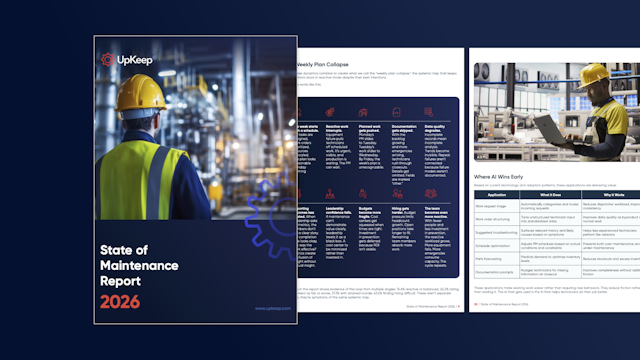 Report
The 2026 State of Maintenance Report
This year's report reflects a fundamental shift in how maintenance creates competitive advantage. While 90% of teams recognize what drives reliability, only 25% can consistently execute it. The gap between knowing and doing has become the defining challenge and opportunity of 2026.
Get the report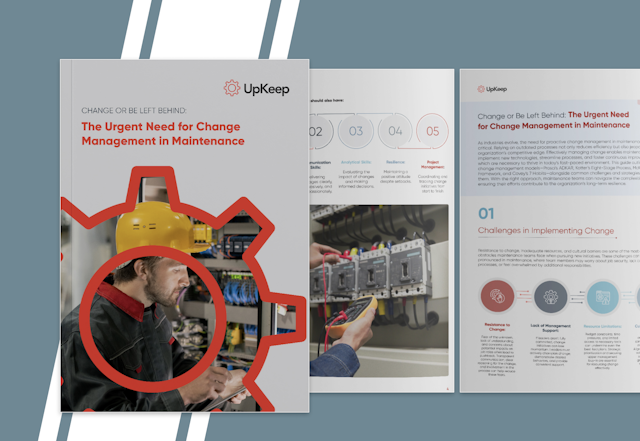 Guide
GuideChange or Be Left Behind: The Urgent Need for Change Management in Maintenance
Effectively managing change enables maintenance teams to implement new technologies, streamline processes, and foster continuous improvement, all of which are necessary to thrive in today’s fast-paced environment. This guide outlines essential change management models
Get the guide
Bring your next budget submission
Show us the request you have to defend this year. We will walk through how the same case looks when the evidence comes out of your maintenance history.