Overview
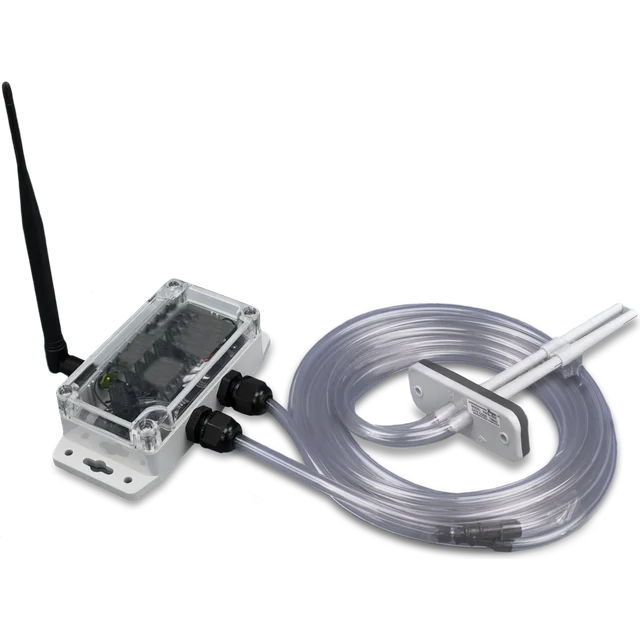
The industrial wireless air velocity sensor measures the pressure difference between two input ports, the temperature, and altitude determines the speed at which the air is moving in a system and transmits the measurement to i. The sensor measures the pressure difference between two ports. When viewing the sensor from the top, the right inlet port is the negative or low side pressure input. When the pressure on this port is greater than the left port the sensor produces a negative pressure reading. When the pressure is greater on the left port the sensor produces a positive pressure reading. Combined with the temperature and the altitude, the sensor determines at what rate the air is flowing in a system.
How They Work
- The sensor measures the pressure difference between two input ports to calculate air velocity.
- Ambient temperature and altitude are also measured for accurate velocity compensation.
- Readings are transmitted wirelessly to the UpKeep Edge gateway at configurable intervals.
- Alerts trigger when airflow falls outside acceptable ranges, indicating filter or duct issues.
Applications
- Building/Room Pressure
- Variable Air Volume Filter Status
- Duct Pressure
- Clean Rooms
- Fume Hoods
- Computer Rooms
Specifications
| SKU | MNS2-9-IN-PS-AV |
|---|---|
| Category | Environmental |
| Sensor type | Air Velocity Sensors |
| Dimensions | 5.7 × 3.1 × 1.6 in |
| Weight | 11.8 oz |
| Measurement Range | -50 m/s to 50 m/s |
| Accuracy | +/- 2°C (-10°C to +60°C) |
| Resolution | 0.1°C |
| Wireless Range | -50 m/s to 50 m/s |
| Certifications | 900 MHz product; FCC ID: ZTL-G2SC1 and IC: 9794A-G2SC1. 868 |
| Battery Life | Up to 10+ years (usage-dependent) |
| Encryption | Encrypt-RF (256-bit AES) |
Questions about this sensor
- What does the Industrial - Pressure Sensor, Air Speed/Velocity measure?
- The industrial wireless air velocity sensor measures the pressure difference between two input ports, the temperature, and altitude determines the speed at which the air is moving in a system and transmits the measurement to i. The sensor measures the pressure difference between two ports. When viewing the sensor from the top, the right inlet port is the negative or low side pressure input. When the pressure on this port is greater than the left port the sensor produces a negative pressure reading. When the pressure is greater on the left port the sensor produces a positive pressure reading. Combined with the temperature and the altitude, the sensor determines at what rate the air is flowing in a system.
- Where is the Industrial - Pressure Sensor, Air Speed/Velocity typically installed?
- Common placements include building/room pressure, variable air volume filter status, duct pressure. It uses a NEMA-rated industrial enclosure, so it holds up to wash-down, outdoor, and high-vibration locations.
- What does it need to work?
- An UpKeep Edge gateway within about 1,200 ft. One gateway supports 50 or more sensors, and readings reach UpKeep over the gateway's cellular, Ethernet, or Modbus connection.
- What happens when a reading is out of range?
- UpKeep opens a work order against the asset and notifies the assigned technician. You set the thresholds for each air velocity sensor individually.