Blog Post
What Are IIoT Services? How Connected Equipment Data Turns Into Maintenance Action
Discover what IIoT services are, how they differ from consumer IoT, how sensor data turns into maintenance work orders, and what to look for in a provider.



Key Takeaways
IIoT services connect industrial equipment, sensors, and software so teams can monitor asset health in real time and fix problems before they cause failures.
IIoT differs from consumer IoT because it needs tougher hardware, industrial data standards, and stronger security, since downtime carries real financial and safety costs.
The value of IIoT depends on sensor readings becoming assigned work orders.
The most common implementation pitfalls are installing sensors without a data plan, skipping the business case, and flooding technicians with alerts.
A strong provider integrates with your existing maintenance system, supports open standards, handles security clearly, and lets you scale from a small pilot.
Sensors on a pump or motor can tell you a great deal about how the equipment’s running. They can't repair anything on their own though. IIoT services step in here by connecting equipment on the plant floor to the software and people who can act on what it reports.
This guide covers what IIoT services include, how they differ from consumer IoT, and how a sensor reading becomes a work order. It also walks through common adoption pitfalls, what to look for in a provider, and how IIoT-enabled solutions show up across industries.
What Is IIoT?
IIoT (Industrial Internet of Things) connects industrial equipment, sensors, and software so organizations can collect real-time data and use it to monitor assets, improve operations, and support maintenance decisions. It links operational technology, like the machines and control systems on a plant floor, to information technology, like the networks and software that store and analyze data.
Data from assets on the plant floor moves through networks, edge devices, and cloud platforms so teams can see what's happening and respond faster. A typical setup has several layers: physical devices and sensors, edge gateways that process data locally, message brokers that move readings along, a central platform for device management and dashboards, and identity and security services.
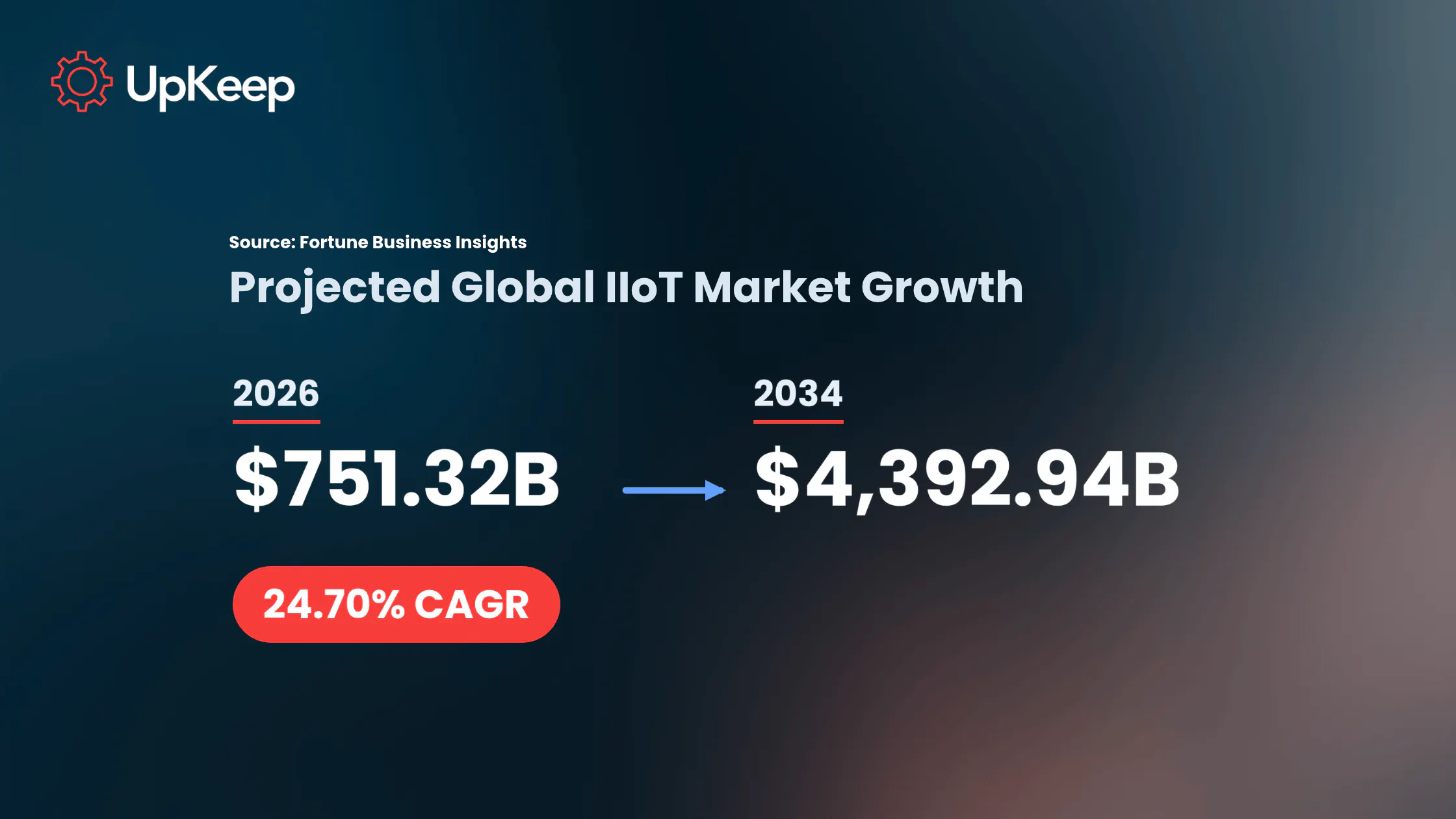
Companies are investing heavily in smart manufacturing tools like edge and cloud computing and industrial sensors, and that spending is driving market growth. Fortune Business Insights projects the IIoT market will grow from about $751 billion in 2026 to over $4,392 billion by 2034, with a 24.70% CAGR. This is largely due to smart manufacturing and Industry 4.0 adoption.
Common applications include predictive maintenance, remote condition monitoring, energy management, and real-time asset tracking. This is where a platform like UpKeep Edge really shines. It captures sensor data and feeds it directly into the maintenance workflow instead of leaving it stranded in a separate dashboard.


IIoT vs. IoT: What's the Difference?
The main differences between IIoT and consumer IoT is the usage. IIoT connects industrial equipment like pumps, motors, and conveyors, where downtime carries real financial and safety costs. Meanwhile, IoT connects everyday devices like thermostats and wearables. Industrial IoT also needs tougher hardware, industrial data protocols, and stronger security because a failure or breach can disrupt entire facilities.
In short, consumer IoT is built for convenience, and IIoT for uptime. When comparing them, IIoT stands out in three key ways:
Reliability: IIoT devices have to hold up to heat, vibration, dust, and years of continuous runtime, which a smart home gadget never faces.
Protocols: IIoT relies on industrial standards like OPC UA and MQTT, which are common languages that let machines and software share data. They prioritize low delay and data accuracy over convenience features.
Security: A compromised industrial sensor can affect production lines, safety systems, or an entire facility.
Comparing IIoT and IoT
|
Type |
IoT (consumer) |
IIoT (industrial) |
|
Devices |
Thermostats, wearables, smart speakers |
Pumps, motors, conveyors, HVAC systems |
|
Environment |
Home and everyday convenience use |
Heat, vibration, dust, continuous runtime |
|
Protocols |
Wi-Fi, Bluetooth, consumer app APIs |
OPC UA, MQTT; built for low latency |
Cost of Failure |
Inconvenient but not catastrophic; one device offline |
Downtime, safety risk, facility-wide impact |
How Organizations Benefit From IIoT Services
IIoT gives leaders a clearer picture of how equipment health affects production, energy use, and operating costs. That visibility helps them spot inefficiencies, make better maintenance and capital-investment decisions, and extend the useful life of critical assets.
These services also help teams shift from reactive maintenance to predictive. Real-time sensor data such as vibration, temperature, and pressure can flag a problem before it turns into a failure. Teams can then plan the repair instead of scrambling after a breakdown.
Live condition data also helps maintenance teams prioritize attention. By combining equipment health with maintenance history and operational context, teams can focus labor and resources where they matter most. Organizations end up doing less unnecessary maintenance and getting more out of each asset.
You’ll know it’s working when sensor data reaches the people doing the work. A bearing starts trending toward failure and the system logs it, but if that alert sits in a dashboard nobody opens, the asset will still fail. That's why UpKeep connects sensor signals directly to work orders through UpKeep Edge; instead of an ignored notification, a reading that crosses a threshold becomes an assigned task.
IIoT services also support compliance reporting by creating an automatic, time-stamped record of asset conditions and interventions. Inspectors and auditors increasingly expect that kind of documentation.
How IIoT Data Becomes a Work Order in Your CMMS
An IIoT reading translates to a work order when sensor data passes through an integration or API into a computerized maintenance management system (CMMS). The CMMS then creates a task automatically and assigns it to a technician. Clear thresholds decide which readings trigger work, so teams act on meaningful changes instead of noise.
A sensor reading that crosses a set threshold, like a bearing's vibration trending upward, is only useful if it triggers action. In a connected setup, that reading flows into the CMMS and generates a work order with no manual entry. Without that link, the data just sits in a separate monitoring dashboard.
Setting clear thresholds matters as much as the integration itself. Routing every minor fluctuation into a work order buries technicians in noise. Routing only meaningful deviations keeps the system trustworthy and the alerts worth acting on.
Common IIoT Adoption Pitfalls (and How to Avoid Them)
Most IIoT setbacks come from planning gaps rather than technological issues. To minimize your own headaches, watch for problems like:
Bolting sensors onto legacy machinery without a plan for the data. Many teams deploy sensors first and figure out the workflow later, which leads to readings that never turn into action.
The fix: Map out who receives each alert and what they're supposed to do with it before a single sensor is installed.
Introducing IIoT without a clear business case. According to Deloitte data, only 42% of manufacturing execs put together targets and a measurement plan, with value tracking and realization among the top challenges to success. Teams often roll out sensors broadly before proving value or tying the deployment to a specific, measurable cost like unplanned downtime.
The fix: Start small and quantify ROI on a handful of machines, since a prevented downtime event with a clear cost avoidance is the easiest evidence to point to. Track that ROI with common KPIs like MTTF and MTBR.
Ignoring legacy system integration. Retrofitting older machinery with modern sensors can create security gaps if it isn't planned carefully. Older operational technology wasn't originally built with cybersecurity in mind.
The fix: Work with a partner experienced in retrofits and build in network segmentation from the start.
Chasing every alert instead of prioritizing. Flooding technicians with notifications leads to alert fatigue and, eventually, ignored warnings. That’s how you end up paying for what’s essentially an expensive sound system.
The fix: Set clear thresholds and route only actionable alerts into the work order system. A connected CMMS like UpKeep takes on much of that heavy lifting.
|
Pitfall |
Fix |
|
❌Sensors bolted on with no data plan |
✅Assign who gets each alert before installation |
|
❌No clear business case |
✅Pilot machines; track MTTF/MTBR |
|
❌Legacy systems retrofitted without security review |
✅Use a retrofit partner; segment the network |
|
❌Every alert routed to technicians |
✅Set thresholds; route only actionable alerts |
What to Look for in an IIoT Service Provider
A strong IIoT service provider integrates with your existing CMMS or EAM (enterprise asset management) system, supports open standards like MQTT and OPC UA, explains its security approach clearly, and lets you scale from a small pilot. It should also be simple enough for your team to run without dedicated data science staff.
Use these criteria as a checklist when you compare providers:
Integration with your maintenance system: Choose a solution that connects to your existing CMMS or EAM system rather than replacing your maintenance workflow. Data only helps when it turns into a work order technicians can see and act on.
Open, standard protocols: Prioritize MQTT and OPC UA. Proprietary systems that lock you into one hardware vendor make it harder to scale or swap sensors later.
Ease of use: Capability means little if your team can't run the platform. Nearly half of security and operations leaders (47%) say not enough qualified personnel is their top obstacle with connected industrial systems, according to PwC. A platform your team can run on its own is worth more than one packed with features nobody uses.
Security: Ask about encryption, network segmentation, and how updates get pushed to devices in the field.
Scalability: A good partner lets you start with a pilot on a handful of critical assets, then expand site by site instead of forcing a full-facility rollout on day one. UpKeep's flexible asset and location hierarchy is built for exactly this kind of phased launch.
IIoT-Enabled Solutions by Industry
IIoT-enabled solutions encompass equipment, software, and services that use connected sensors and data platforms to monitor industrial assets in real time. Teams use them to catch problems early, plan repairs, and keep operations running across manufacturing, energy, healthcare, food and beverage, and fleet environments.
IIoT-enabled solutions look different from one facility to the next, but the goal is the same. Teams want to identify problems early and act on them. Here's how that plays out across industries:
Manufacturing: Discrete and process manufacturers are the largest adopters, using connected sensors for predictive maintenance, quality control, and energy monitoring on production lines.
Oil, gas, and energy: Operators use IIoT-enabled monitoring on pipelines, compressors, and turbines to catch corrosion, pressure anomalies, and equipment wear in remote or hard-to-access locations.
Facilities and healthcare: Hospitals and commercial facilities apply IIoT sensors to HVAC systems, backup generators, and critical medical equipment to prevent failures that could affect patient care or building safety.
Food and beverage: Temperature and humidity sensors on refrigeration and processing equipment help plants maintain compliance and catch spoilage risk before it becomes a recall.
Fleet and logistics: Connected telematics on vehicles and mobile equipment track engine health, fuel use, and maintenance needs across distributed fleets.
Get Real Value From IIoT Services
IIoT services connect industrial equipment to software so teams can see asset health as it changes and act before a failure hits. They differ from consumer IoT in the reliability, standards, and security they demand, and the market growth reflects how many companies now depend on them. The benefits only materialize, though, when readings turn into assigned work, which makes thresholds, integrations, and a clear business case just as important as the sensors themselves.
Choosing a provider that fits your existing maintenance workflow, uses open standards, and scales in phases keeps your team out of pilot purgatory. UpKeep Edge gives teams that link by sending sensor data straight into UpKeep work orders, so the people fixing equipment get the signal when it matters.
Ready to transform sensor readings into tangible outcomes from your team? Book a demo with UpKeep to see how we can seamlessly connect IIoT data to your work orders.
Frequently Asked Questions About IIoT Services
What are the biggest security risks with IIoT? How can organizations prevent them?
The biggest risks include unpatched devices, weak access controls, and older equipment that was never built with cybersecurity in mind. A compromised sensor can disrupt production or safety systems. Organizations can reduce risk through encryption, network segmentation, regular update processes, strict access controls, and by choosing partners experienced in retrofitting legacy machinery.
What industries use IIoT the most?
Manufacturing is the largest adopter, using connected sensors for predictive maintenance, quality control, and energy monitoring. Oil, gas, and energy operators monitor pipelines, compressors, and turbines in remote locations. Healthcare and facilities teams, food and beverage plants, and fleet operators also rely on IIoT to prevent failures, maintain compliance, and track maintenance needs across sites.
Do small and mid-sized companies need IIoT services?
Small and mid-sized companies don't need a large rollout to benefit from IIoT. The practical approach is to start with a pilot on a handful of critical assets, prove the savings on a prevented downtime event, and then expand site by site. That keeps up-front costs manageable and avoids a full-facility launch on day one.
How does IIoT connect to a CMMS?
IIoT connects to a CMMS through an integration or API that passes sensor readings into the maintenance system. When a reading crosses a set threshold, the CMMS automatically creates a work order and assigns it to a technician. This removes the need for manual entry and keeps sensor data from sitting neglected in a separate dashboard.
4,000+ COMPANIES RELY ON ASSET OPERATIONS MANAGEMENT
Leading the Way to a Better Future for Maintenance and Reliability
Your asset and equipment data doesn't belong in a silo. UpKeep makes it simple to see where everything stands, all in one place. That means less guesswork and more time to focus on what matters.