Blog Post
CMMS vs. EAM: How to Choose the Right System
CMMS vs. EAM comes down to the decisions your asset data must support, not asset count. Here's how to choose the right system for your operation.



Key Takeaways
The right choice between adopting a CMMS or an EAM protects both your budget and your asset visibility. These systems overlap but solve different problems, so matching the tool to what your operation actually needs prevents an expensive mismatch.
You can reach most maintenance goals without stepping up to a full EAM. Day-to-day uptime rests on work-order throughput, PM compliance, and parts control, so confirming a CMMS already covers those aspects is often enough to avoid over-buying.
A clear operational signal tells you when a team has outgrown its CMMS. Catching it early keeps life cycle and financial decisions from getting stranded in spreadsheets after the maintenance system stops keeping up.
Judging a system by the decisions it supports reveals a better fit than shopping by category label. Modern platforms blur the CMMS and EAM line, so teams need to weigh the life cycle decisions and integrations that each one enables.
Adopting the wrong asset management system eats more than just the license. A team that buys a full enterprise asset management platform to solve a work-order backlog signs up for a long implementation and a tool that most of its users never open. Meanwhile, if another stays on a basic maintenance system while managing capital planning and asset risk in spreadsheets, they lose the asset history at the exact point that finance and engineering need it. Both a CMMS and an EAM are powerful pieces of software that have specific criteria for fit. The choice between the two comes down to which decisions your asset data has to support today and which it’ll have to support next.
What Are CMMS and EAM?
A computerized maintenance management system (CMMS) runs maintenance execution. It encompasses work orders, preventive maintenance (PM) scheduling, and spare-parts inventory. An enterprise asset management (EAM) system manages the full asset life cycle, from procurement and installation through operation, maintenance, and eventual disposal.
The load-bearing difference is scope: A CMMS keeps equipment running once it's in service; an EAM governs the asset from the capital decision to buy it through the decision to retire it, tying maintenance to finance, procurement, and risk along the way. ISO 55000, the international standard for asset management, frames the discipline around realizing value from assets throughout their whole lifespans and aligning that work with organizational objectives, which is EAM’s territory.
Most EAM systems include a maintenance-management capability, so you rarely have to ask if you need work order tracking. You do. The better question is how much life cycle and financial scope has to sit around that maintenance core.
Why the Choice Matters
Because an EAM and a CMMS are so specific, the wrong choice can lead to an expensive mistake. Buy too much system, and the cost hits before any value does. A full EAM deployment carries a long implementation, a heavier price, and modules that a maintenance-led team never touches. As a result, the tool sits half-used while the backlog it was meant to fix stays where it was.
Buy too little though, and the cost lands later, quietly. A maintenance system with no life cycle scope handles work orders well, then leaves capital planning, depreciation, and asset-risk decisions to run on spreadsheets alongside it. The asset history splits across systems, and the numbers that finance needs stop matching the numbers maintenance keeps.
In both cases, getting maintenance execution right pays off first. According to studies cited by the Department of Energy's Federal Energy Management Program (FEMP), a PM program saves an estimated 12%–18% on average over a purely reactive one. That return comes from the execution layer both systems share, which is why you need to confirm a CMMS solves your immediate problem before adding scope.
CMMS vs. EAM: The Core Differences
Scope and integration depth can settle most of this decision. Scope is how much of the asset's life the system is responsible for. Integration depth comes down to how tightly it must connect to finance and procurement to do that job.
Integration depth is where the categories separate, although the line has moved. A capable CMMS can connect deeply to ERP and accounting systems, but those integrations mostly carry maintenance data and costs into the wider business. An EAM's integrations are part of governing the asset itself across finance, procurement, engineering, and planning.
Additionally, a single-site CMMS can go live in weeks, while a full EAM rollout is typically phased over months as each function comes online.
|
Consideration |
CMMS |
EAM |
|---|---|---|
|
Scope |
Maintenance execution once assets are in service |
Full asset life cycle, from procurement to disposal |
|
Primary focus |
Keeps equipment running, cuts downtime |
Optimizes asset value, cost, and risk |
|
Life cycle stage |
Operation and maintenance phase |
Design, procurement, operation, disposal |
|
Integration depth |
Integrations move maintenance data into other business systems |
Integrations govern the asset across maintenance, finance, procurement, and planning |
|
Typical users |
Technicians, planners, facility managers |
Asset managers, operations, finance, compliance |
|
Ideal fit |
Maintenance-led operations where execution is the primary scope |
Operations where the same asset data must support life cycle, capital, financial, and risk decisions across functions |
|
Typical setup |
Lighter, faster to stand up |
Longer, phased implementation |
How to Choose: What Decisions Must Your Asset Data Support?
The common instinct is that a large asset base or several sites automatically calls for an EAM. It actually doesn't.
A vending operator running twenty thousand near-identical machines might need nothing beyond disciplined maintenance execution, while a utility managing a few dozen high-value transformers may require life cycle planning, capital budgeting, and risk modeling around every one. The real line is the range of decisions the same asset data has to support.


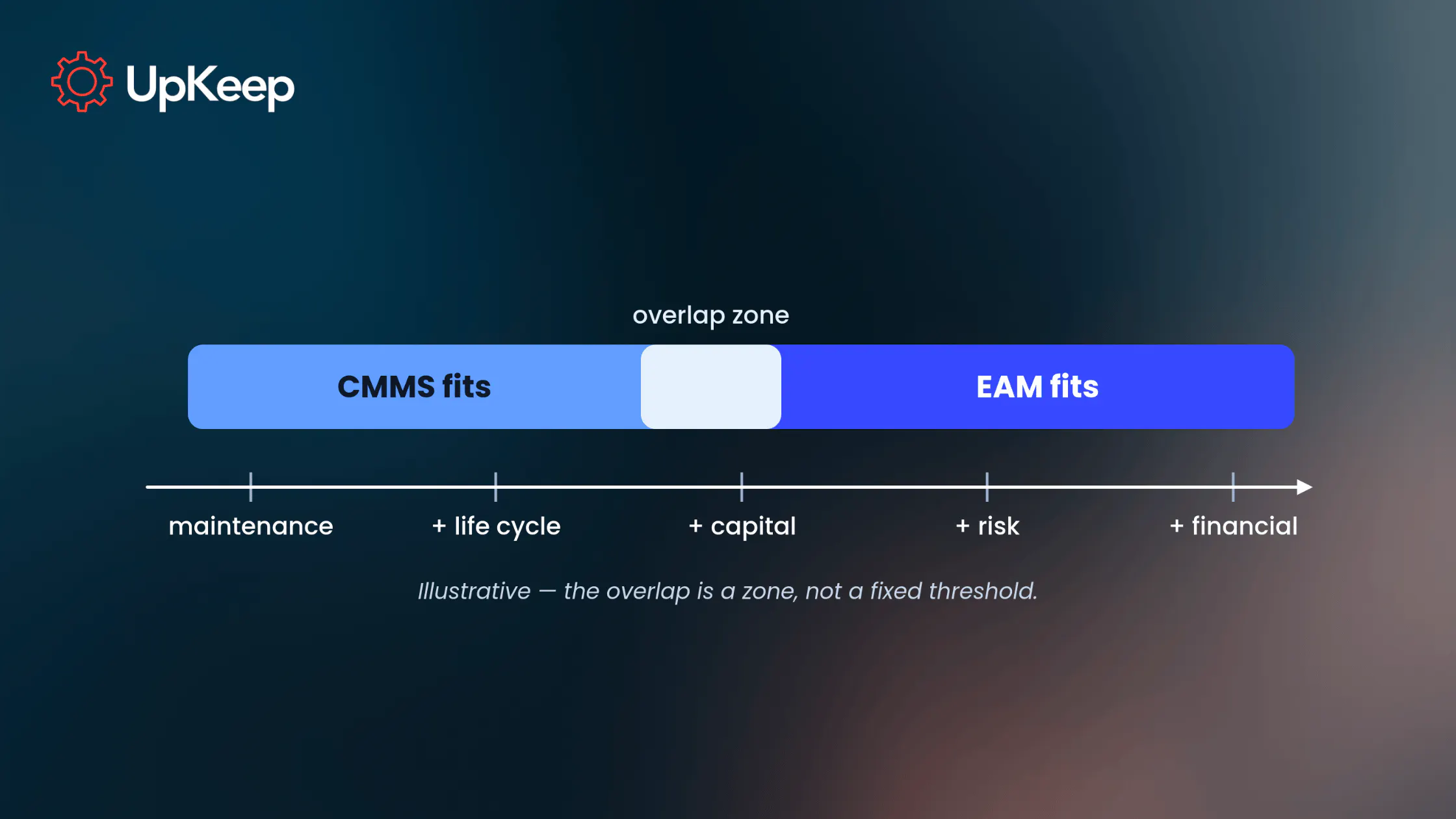
When the job is maintenance execution…
Stick with a CMMS. If the outcomes you're chasing are work-order throughput, PM compliance, parts availability, and uptime, a CMMS reaches them directly. Asset count and site count matter here as complexity signals, affecting how you configure the system, without changing the answer.
When the asset record has to drive life cycle, capital, risk, and financial decisions across functions…
You're in EAM territory. ISO 55001 puts explicit weight on asset-management decision-making, value realization, and life cycle operations. ISO/TS 55010 goes further, giving guidance on aligning the financial and non-financial sides of asset management so finance, operations, and engineering work from the same asset information.
When your decisions pull in those departments, and TCO, depreciation, and capital renewal start driving choices, the maintenance data has to feed a wider set of decisions than a CMMS is built to serve. That's the moment the decisions move from the shop floor to the balance sheet.
In the overlap zone…
Evaluate a system based on the decisions it supports. Modern platforms blur the line between the two, so match the life cycle decisions and integrations a system enables to the decisions your operation has to make. Check whether it can roll maintenance cost into total cost of ownership, feed a capital-renewal plan, and sync with the finance systems those calls depend on. Those capabilities tell you whether a platform reaches into EAM territory, no matter its category name.
Implementation: When Your Current Setup Stops Reconciling
Running maintenance in one system and asset financials in another isn't automatically a problem. Plenty of operations track work orders in a CMMS and capital in finance software for years without friction. The problem starts when maintenance, finance, engineering, and planning all need an asset’s history and can't reconcile it, so the same asset carries a different cost, condition, or service record depending on who's looking at it.
Reconciliation is, in part, a knowledge-retention problem, and teams underestimate this aspect. Asset history accumulates in shift observations, inspection notes, failure symptoms, and the judgment technicians carry in their heads. When that information stays in paper logs, handovers, or individual memory, nobody can reliably connect today's condition to what happened 18 months ago, and the knowledge leaves when the technician does.
A structured maintenance record turns those observations into an easily searchable history tied to the specific asset and component. This ensures the log survives staff changes and can inform later repair, replacement, and life cycle decisions.
As ISO 55013 emphasizes, asset management decisions depend on data that stays useful, consistent, and governed across the asset's life. When the record fragments, the decisions built on it get shakier the longer the asset runs, and the operating phase is where that compounds. For instance, IFMA research puts the operations phase of a building at 60%–80% of its total life cycle cost, so a record that drifts during operation does so during the longest and most expensive stretch of a facility's life. Closing that gap requires a maintenance record every function can rely on, connected to the financial systems that should keep owning financial data.
A mobile-first CMMS like UpKeep keeps that record current at the source, since technicians log work, parts, and conditions against the asset from the floor, and the history stays intact instead of decaying between a clipboard and a spreadsheet.
UpKeep also carries the life cycle side of that record, holding purchase cost, warranty, depreciation method, and parent-child asset hierarchy so maintenance and cost data roll up into total cost of ownership. It then syncs that data with ERP and accounting systems like SAP, Oracle, and NetSuite so finance keeps its record book while maintenance and asset data stay reconciled across both.
How to Measure the Success of Your Choice
Once you've picked the system that fits your needs, different measures tell you if it's working. A CMMS proves itself in execution. A life cycle-focused setup shows its worth through how well asset information supports longer-range decisions.
Be aware though: Neither category guarantees better asset decisions on its own. A poorly governed EAM can carry more modules and still produce weaker information than a disciplined CMMS program, because the software determines what decisions can be supported, while data quality and operating discipline determine whether teams can trust the answers. Leadership, standardized work order documentation, and accountability move a program forward as much as the platform does. The choice sets your ceiling; discipline decides how close you get to it.
|
CMMS success measures |
Life cycle and financial success measures |
|---|---|
|
PM completion rate, so scheduled work is getting done |
Asset life cycle cost visibility, so total cost of ownership is clear per asset |
|
Work order backlog age, so deferred maintenance gets caught before breakdowns |
Capital renewal planning, so replacement is planned before failure forces it |
|
Reactive-to-planned work mix, so the program keeps shifting toward planned work |
Condition and risk visibility, so high-value assets are managed by risk, not by calendar |
|
MRO (maintenance, repair, and operations) inventory turnover, so parts stay available without overstocking |
Financial and non-financial alignment, so maintenance and finance work from one asset number |
Use standardized definitions for PM compliance, work-order aging, backlog, planned-versus-reactive work, and inventory turns to keep CMMS numbers consistent enough to trend and compare.
Life cycle and financial success measurements are closer to a set of capabilities the asset record has to support. They should encompass the first, recurring, renewal, and end-of-life costs across the asset's life. Answering those questions is the more telling sign of a system’s performance.
One Reconciled Record Changes a Lot
An operation running without a reconciled asset record feels the drag everywhere at once. Maintenance works from one version of an asset's history, finance from another, and engineering from a third. As a result, a repair-or-replace call waits on three teams to agree on what the asset costs to keep. Deferred work hides in a backlog, and capital decisions are made based on whichever numbers a team trusts most, whether or not they’re accurate.
A controlled operation runs the other way, shifting from a reactive, break-fix approach to planned, data-driven work. PM completion and backlog age stay visible and inside their targets, the corrective-to-preventive ratio trends toward planned work, and one asset record carries the cost, condition, and service history every function reads the same way. The repair-or-replace call gets made using a history all three teams already share.
UpKeep is the system that holds that maintenance record together and keeps the program proactive. Each job, part, and reading is captured at the point of work, preventive schedules open work orders on time, and cost and life cycle data roll up into one asset record.That record syncs with the ERP and accounting systems finance already runs on, so maintenance and life cycle decisions work from data everyone can reconcile.
See where your asset data stands today by starting a free UpKeep trial and putting one shared record under your maintenance and life cycle decisions.
FAQ
What's the difference between a CMMS and an EAM?
A CMMS runs maintenance execution, like work orders, PM scheduling, and parts, once assets are in service. An EAM manages the asset across its whole life, from procurement and installation through operation and eventual retirement. It also connects that work to finance and procurement. Most EAM systems contain CMMS capability; the difference is how much life cycle and financial scope sits around it.
Is a CMMS or EAM better for a small business?
Business size alone doesn't settle it. A smaller operation can need EAM-level life cycle capability if high-value assets require capital, risk, and financial governance, while a large, distributed operation can be satisfied with a CMMS when the main need is maintenance execution. The deciding factor is whether the asset data has to support decisions beyond maintenance.
Are CMMS and EAM systems cloud-based?
Both CMMS and EAM systems are widely available as cloud-based software. Mobile-first CMMS platforms take it a step further, letting technicians log and access work from the floor. Cloud delivery also makes the lighter, faster setup that separates a CMMS from a full EAM implementation easier to reach.
When should you move from a CMMS to an EAM?
The decision depends on priorities more than size. When total cost of ownership, depreciation, capital planning, and cross-functional asset decisions start driving your choices, and maintenance data has to feed all of them, the asset record has outgrown what a CMMS is built to serve. Asset count alone rarely settles it.
Can one system handle both CMMS and EAM work?
Often, yes, one system can handle both a CMMS and EAM. Most EAM systems include maintenance management, and modern CMMS platforms increasingly carry asset and reporting capability. That means the practical question to ask is which life cycle decisions and integrations a given system supports, weighed against what your operation has to decide.
4,000+ COMPANIES RELY ON ASSET OPERATIONS MANAGEMENT
Leading the Way to a Better Future for Maintenance and Reliability
Your asset and equipment data doesn't belong in a silo. UpKeep makes it simple to see where everything stands, all in one place. That means less guesswork and more time to focus on what matters.






![[Review Badge] Gartner Peer Insights (Dark)](https://www.datocms-assets.com/38028/1673900494-gartner-logo-dark.png?auto=compress&fm=webp&w=336)