
UPKEEP PRODUCTION
One downtime number, not two
Production scheduling, downtime capture, OEE, and traceability built on the same platform as your maintenance. Because the reason the line stopped and the work order that fixed it are the same event.
- OEE by line, shift, and product
- Works on uninstrumented equipment
- Lot traceability









SOLUTIONS
Where capacity actually goes
Most plants measure downtime twice and trust neither number. Production fixes that by recording the event once, where the work already happens.
Production and maintenance report different downtime numbers.
One downtime event, recorded once, feeding both. OEE availability and MTBF are calculated from the same record, so the weekly meeting starts from an agreed number instead of two spreadsheets that disagree.
A line stops and nobody knows why until the shift report.
Operators log the stop with a reason code at the machine, in seconds. Supervisors see the pattern building during the shift rather than reading about it the next morning.
Preventive maintenance is a surprise to the production schedule.
Planned maintenance appears on the production schedule as planned downtime. The two teams negotiate the window in one tool, which is the difference between a scheduled four-hour stop and an argued-about one.
Usage-based maintenance runs on guesses about run hours.
Actual run hours and cycle counts from the line become meter readings on the asset, so usage-based PMs trigger on what the machine really did rather than a calendar estimate.
A quality problem takes a week to trace back to a cause.
Lot genealogy records which line, which operator, which materials, and which shift produced what. A quality investigation starts with the answer instead of a search.
You know overall output but not where it went.
OEE broken into availability, performance, and quality by line, shift, and product, so the loss is attributable. Most plants find the biggest number is not the one they were watching.
FEATURES
From the schedule to the shift report
Enough production capability to run the floor, without the multi-year implementation a full MES asks for.
Production scheduling
Schedule runs against lines and work centers. Resequence when equipment, material, or priority changes, with maintenance windows visible in the same view.
Operator station
Start, stop, and complete a run from the floor. Record good count and scrap. Built for a shared tablet and gloved hands, not a desk.
Downtime capture
Log stops against reason codes, entered by the operator or raised automatically from a sensor. Planned, unplanned, and changeover tracked separately.
OEE
Availability, performance, and quality calculated per line, shift, product, and crew, with the loss tree behind the number rather than just the number.
Changeover tracking
Time every changeover, compare against the standard, and see which product transitions are quietly costing the most capacity.
In-line checks
Quality checks at defined points in a run, with holds when a result falls out of spec so suspect product stops moving forward.
Material consumption
Draw materials against the run, by issue or backflush, so stock on hand reflects what the line actually used.
Traceability
Lot and batch genealogy across materials, line, operator, and time. Narrow a recall or an investigation to the affected lots instead of the whole week.
Work instructions
Current SOPs and setup sheets at the station, tied to the product being run, with the revision the operator saw recorded against the run.
CONNECTED WORKFLOWS
Built to work with the rest of UpKeep
Production sits next to maintenance rather than on top of it, which is what makes these hand-offs work without an integration project.
Production CMMS
A downtime event coded as mechanical or electrical raises a work order with the line, the asset, and the stop time already attached. The repair history and the production history live on one asset record.
Explore UpKeep CMMS →Production Edge
Sensors and gateways already on the equipment supply run state, cycle counts, and condition data. Downtime gets detected rather than remembered, and machine data feeds OEE without manual entry.
Explore UpKeep Edge →Production Quality
An out-of-spec check raises a nonconformance with the run, lot, and machine attached. Scrap and rework recorded on the line roll into cost of quality.
Explore UpKeep Quality →Production Inventory
The schedule becomes material demand. Consumption on the line draws stock down, and shortages surface before a run starts rather than when it halts.
Explore UpKeep Inventory →Production Workforce
Crew assignment and hours land against the run, so labor cost per unit is measured rather than allocated. Certification requirements gate who can be scheduled on which line.
Production Nova
Ask which line lost the most capacity to changeovers last month, or what usually precedes a particular stop code. Nova reads production and maintenance data together.
Explore UpKeep Nova →CUSTOMER STORIES
Teams running maintenance on UpKeep

Standardized maintenance across one of the largest custom restorative labs in the world.
Glidewell
Read the story →
Moved maintenance off paper and onto a system the whole team can see.
Old Trapper
Read the story →
Replaced paper tracking and manual data entry across the plant using Nova.
Sprinturf
Read the story →
Keeps kitchen equipment running across a footprint measured in thousands of sites.
Chick-fil-A
Read the story →
One operator runs maintenance across every restaurant he owns from a phone.
McDonald's
Read the story →
Moved campus crews off paper and onto digital preventive maintenance and work orders.
Caltech
Read the story →
Moved from 60% reactive work to 20% by putting every asset on a recurring PM schedule.
Industrial manufacturer
Read the story →
Shifted work from reactive to preventive and brought maintenance costs down with it.
Layfield Group
Read the story →Frequently asked questions
Is UpKeep Production a full MES?
No, and we would rather say so plainly. A full manufacturing execution system in the Opcenter or Plex sense goes deep into vertical-specific process control, and it is a multi-year implementation. UpKeep Production covers production visibility, scheduling, downtime, OEE, and traceability for asset-intensive plants. If you need ISA-95 level control of a pharmaceutical process, you need an MES. If you need to know where your capacity went and to stop arguing with maintenance about downtime, this is built for that.
How does UpKeep Production get data off our machines?
Three ways, usually mixed. UpKeep Edge sensors and gateways can be fitted to equipment that has no useful output of its own, which is common on older lines. Where a PLC or historian already exists, we read from it over OPC UA or MQTT. And operators can enter counts and reasons directly at the station, which is how most plants start before instrumenting everything.
Do we need UpKeep CMMS to use Production?
It is strongly recommended and it is where most of the value sits. The central argument for running production in UpKeep is that downtime, assets, and maintenance work share one record. Production can run against your existing asset and location structure, but if maintenance lives in another system you are back to reconciling two downtime numbers.
Will UpKeep Production work on older equipment without controls?
Yes, and that is a deliberate design point. A large share of mid-market plants run lines with no usable data output. Edge sensors give those machines run state and cycle counts, and operator entry covers the rest. You do not need a greenfield plant to get an OEE number you can trust.
What industries is UpKeep Production built for?
Mid-market process and discrete manufacturing, with the strongest fit in food and beverage, plastics and rubber, packaging and paper, building materials, and fabricated metal. These are plants where equipment reliability is the main constraint on output, which is where a maintenance-rooted production tool has an advantage over a scheduling-rooted one.
How does UpKeep Production handle traceability requirements for food and beverage?
Lot and batch genealogy links finished output back through materials consumed, line, operator, shift, and time, along with the quality checks recorded during the run. That covers the lot-level traceability a mock recall exercise asks for. Formal FSMA and HACCP program design still involves your quality team; UpKeep holds the record that makes it demonstrable.
Can operators use it without training on new software?
The operator station is deliberately narrow: start a run, record counts, log a stop with a reason. That is the whole surface for the person on the line. Everything more complex sits with supervisors and planners. Adoption failures in this category almost always come from asking operators to do too much.
How is UpKeep Production priced?
Production is priced per plant rather than purely per seat, since operator access is broad and the value scales with the line rather than the headcount. Pricing is being finalized ahead of general availability, so talk to us about your site count and we will be specific.
FREE RESOURCES
Go deeper on maintenance
Practical guides and research from the UpKeep team. No cost, no sales call required.
 Guide
GuideThe Reliability Playbook: Capturing 20 Years of Know-How Before It Walks Out the Door
A fully staffed plant still loses hours to failures a retired technician would have caught in minutes. This playbook reframes the problem: knowledge is disappearing because no system was built to capture it. It lays out a three-part framework for closing that gap and shows what changed at one plant that stopped hiring its way out and instead started capturing what its people already knew.
Get the guide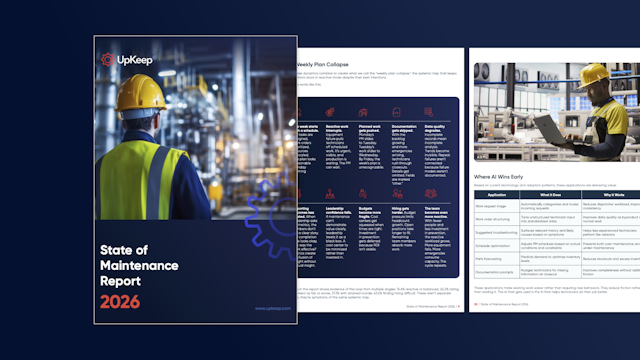 Report
The 2026 State of Maintenance Report
This year's report reflects a fundamental shift in how maintenance creates competitive advantage. While 90% of teams recognize what drives reliability, only 25% can consistently execute it. The gap between knowing and doing has become the defining challenge and opportunity of 2026.
Get the report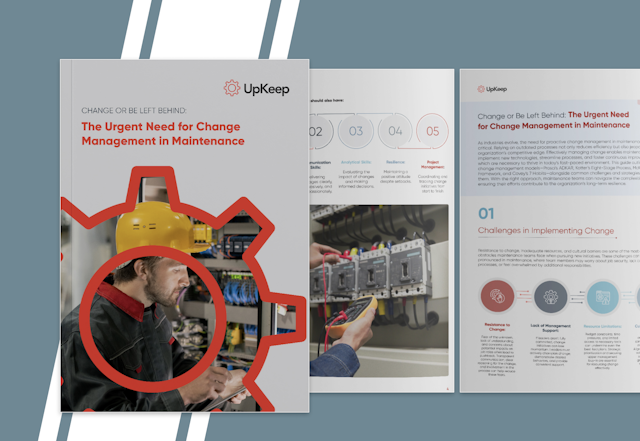 Guide
GuideChange or Be Left Behind: The Urgent Need for Change Management in Maintenance
Effectively managing change enables maintenance teams to implement new technologies, streamline processes, and foster continuous improvement, all of which are necessary to thrive in today’s fast-paced environment. This guide outlines essential change management models
Get the guide
Bring us your worst line
Pick the line that loses the most capacity and cannot explain why. We will show you what the same week looks like with the downtime recorded properly.