Blog Post
How to Create a Maintenance Request Form Template (+ Free Download)
Need a better way to track maintenance? Get our free, customizable maintenance request form template designed to reduce downtime and build an organized paper trail for your facility.



Key Takeaways
A maintenance request form is the standard way tenants, employees, and equipment operators report a problem and start the repair process.
Using a template speeds up triage, cuts down on back-and-forth clarification, and creates a paper trail that assists with warranty claims, safety audits, and insurance disputes.
A free, downloadable maintenance request form template is available here. It works as a Word doc, PDF, or printable form you can post on-site.
What Is a Maintenance Request Form?
A maintenance request form is a standardized document that tenants, employees, or equipment operators use to report a problem and ask for repair work. It captures who reported the issue, what's wrong, where it's happening, and how urgent it is. The request typically becomes a work order that a technician can track, schedule, and close out.
Common formats include paper forms posted on a bulletin board, a Microsoft Word or PDF maintenance request form template emailed to a property manager, and digital forms built into a CMMS that route straight to a technician's queue. The right format depends on how your team operates, but no matter what you choose, the goal is consistent, complete information the moment a request comes in.
Be aware, the terms "maintenance request" and "work order" get used interchangeably, but they're actually not the same thing. A request is the ask, while a work order is what the maintenance team creates to plan, assign, and document the fix. A good maintenance request form template makes that handoff smoother because it gives the technician everything they need before the work order is even written.
The Benefits of a Maintenance Request Form Template
It may seem like just another form, but taking the time to organize your maintenance process with a template brings several compounding advantages:
Structure what information comes in every time: That means fewer back-and-forth calls asking, "Which unit?" or, "What exactly is broken?" Everyone submitting a request answers the same fields, so the person triaging requests isn't chasing down basic details before they can even assign the work.
Standard fields simplify prioritization: A well-built form separates a leaking pipe from a squeaky cabinet hinge before a technician ever picks up a wrench. When priority, location, and asset details are captured up front, the team can sort urgent safety issues from routine fixes without a phone call.
Build the paper trail that regulated industries depend on: This is especially important for warranty claims, safety audits, and insurance disputes, where documentation of when a request was made and resolved carries real legal weight.
FMCSA rules, for example, require motor carriers to keep maintenance and repair records for a full year while a vehicle is in service, plus six months after it leaves the fleet. That record begins with the original request or inspection report.
Faster reporting, faster response: Under the implied warranty of habitability, for instance, a tenant generally has to give their landlord written notice of a defect and a reasonable amount of time to fix it. What counts as "reasonable" depends on the issue. A lack of heat in the middle of winter calls for a response within 24 hours, while a less urgent timeline is acceptable for something like a leaky faucet.
A clear maintenance request form starts that clock, because it gives the landlord a dated, written record of when the tenant first reported the problem.
For teams managing physical assets at scale, a template is the first step toward a well-organized and searchable maintenance request log.
How to Use a Maintenance Request Form Template
Filling out the form correctly the first time saves everyone time later. Here's what to focus on:
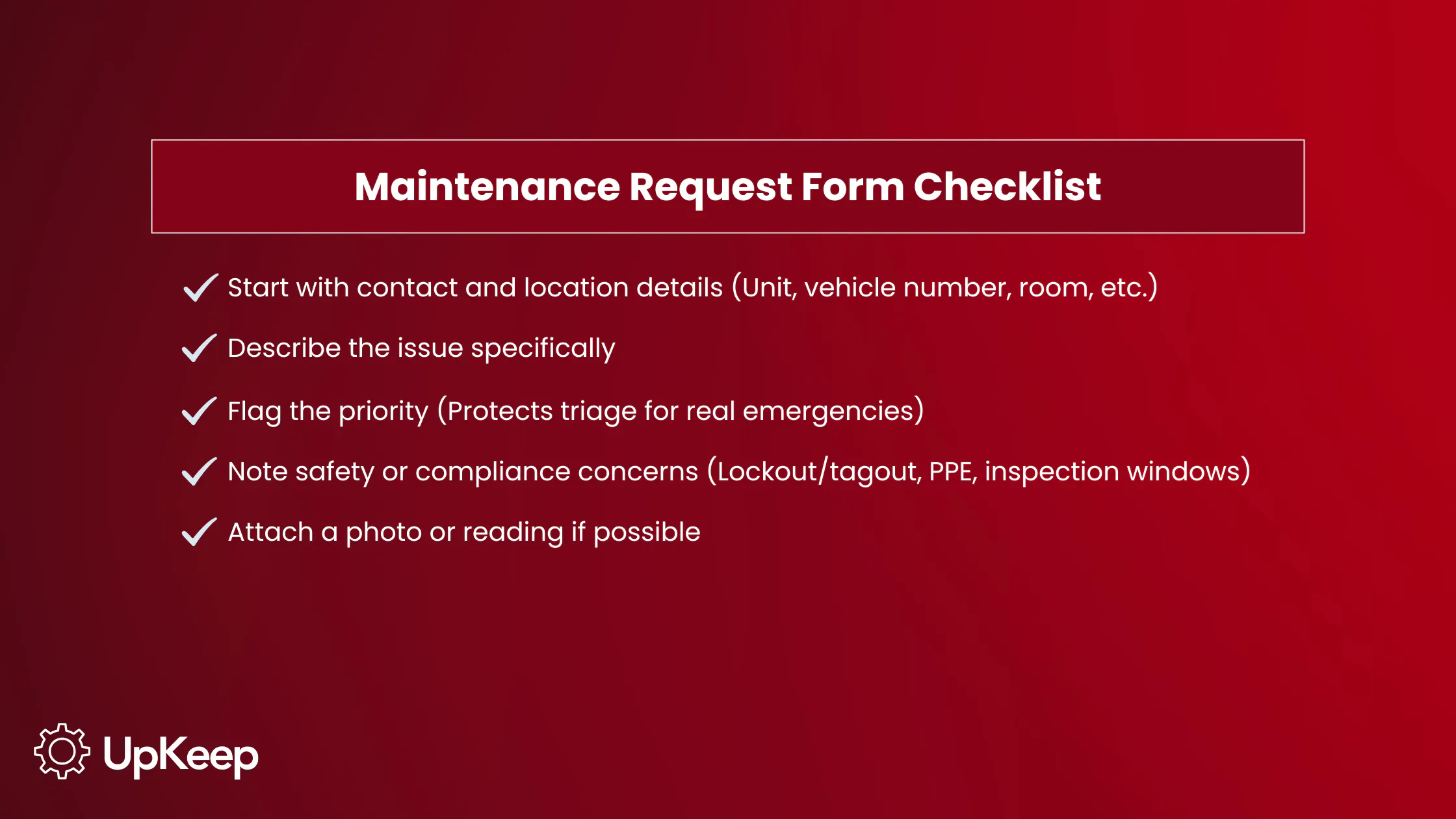
Start with contact and location details: A technician can't act on a request without knowing where to go and who submitted it, whether that's a substation number, a vehicle unit number, or a hospital room.
Describe the issue specifically: For example, "Combine losing hydraulic pressure on the header, started this morning," gets a faster response than just, "Combine broken."
Flag the priority honestly: Marking every request as urgent slows down triage for the requests that are genuinely high priority, like a downed transmission line or a life-support device alarm.
Note safety or compliance concerns up front: This includes lockout/tagout needs, PPE requirements, or if the asset is subject to a regulatory inspection window.
Attach a photo or reading if possible: A picture of a cracked hose, a relay display, or a pothole gives technicians clearer context than words alone.
A maintenance request form filled out this way looks less like a vague complaint and more like a work order that's already half-written.


Types of Maintenance Request Form Templates
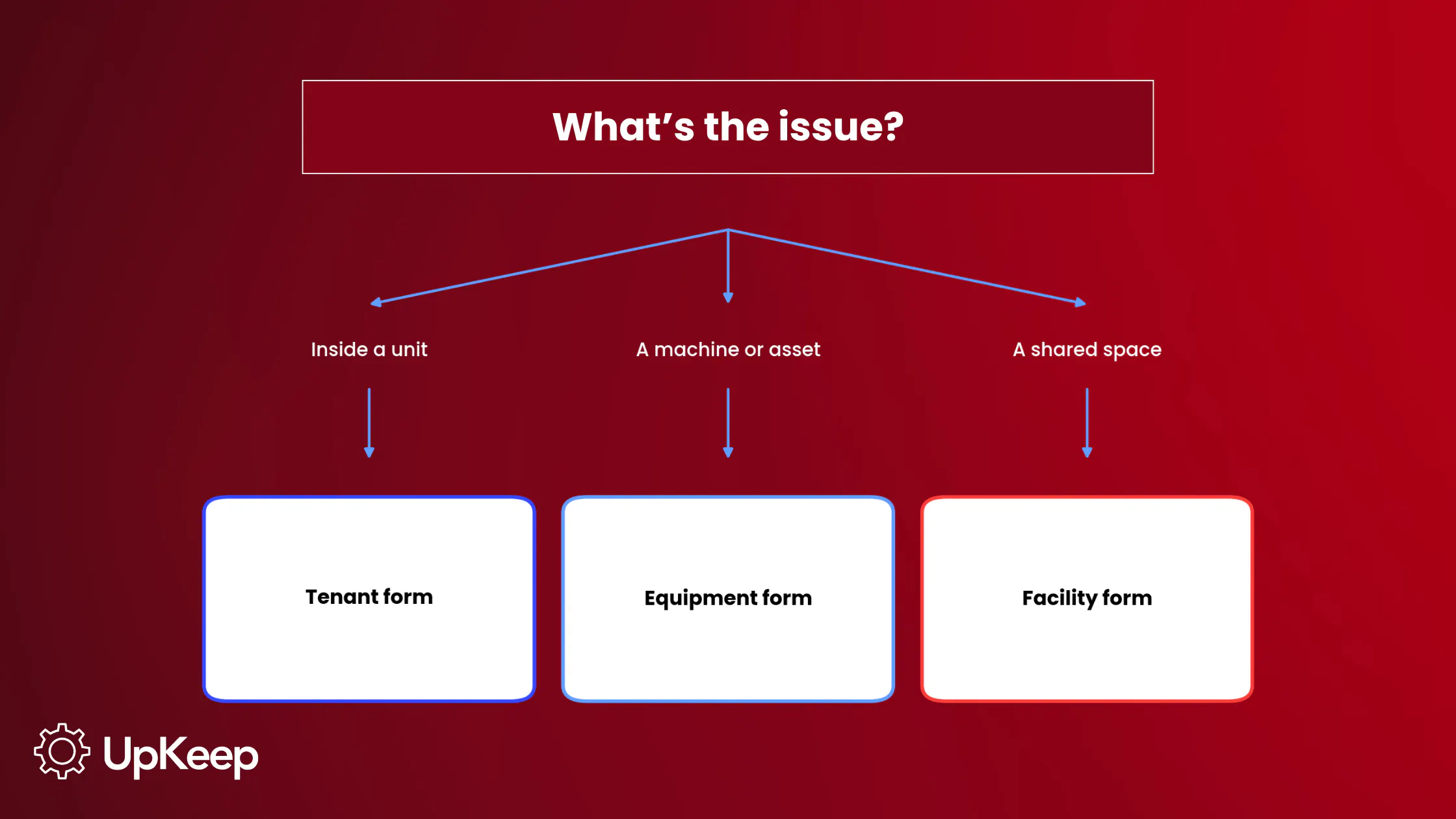
The most common types of maintenance request forms are tenant, equipment, and facility or building maintenance request forms. Each is built around a different asset, location, and priority structure.
Tenant Maintenance Request Form
An apartment maintenance request form is built for residential or commercial tenants to report issues inside a unit, like a broken appliance, a leak, or a heating problem. It should capture the unit number, issue description, preferred entry times, and whether or not the tenant will be present during the repair.
Response expectations vary by state and severity, but the general pattern holds across most of the U.S. Emergencies like plumbing or heating failures are generally handled within 24 hours of the report, while less urgent problems can take one to seven business days, depending on the situation. An apartment work order template that captures severity clearly helps property managers meet those windows instead of guessing at them after the fact.
Equipment Maintenance Request Form
An equipment maintenance request form template is designed for reporting issues with a specific machine or asset, whether that's a manufacturing line, a piece of farm equipment, or a hospital device. It needs the asset ID, category, and specific concerns so a technician can prep the right parts before arriving on-site.
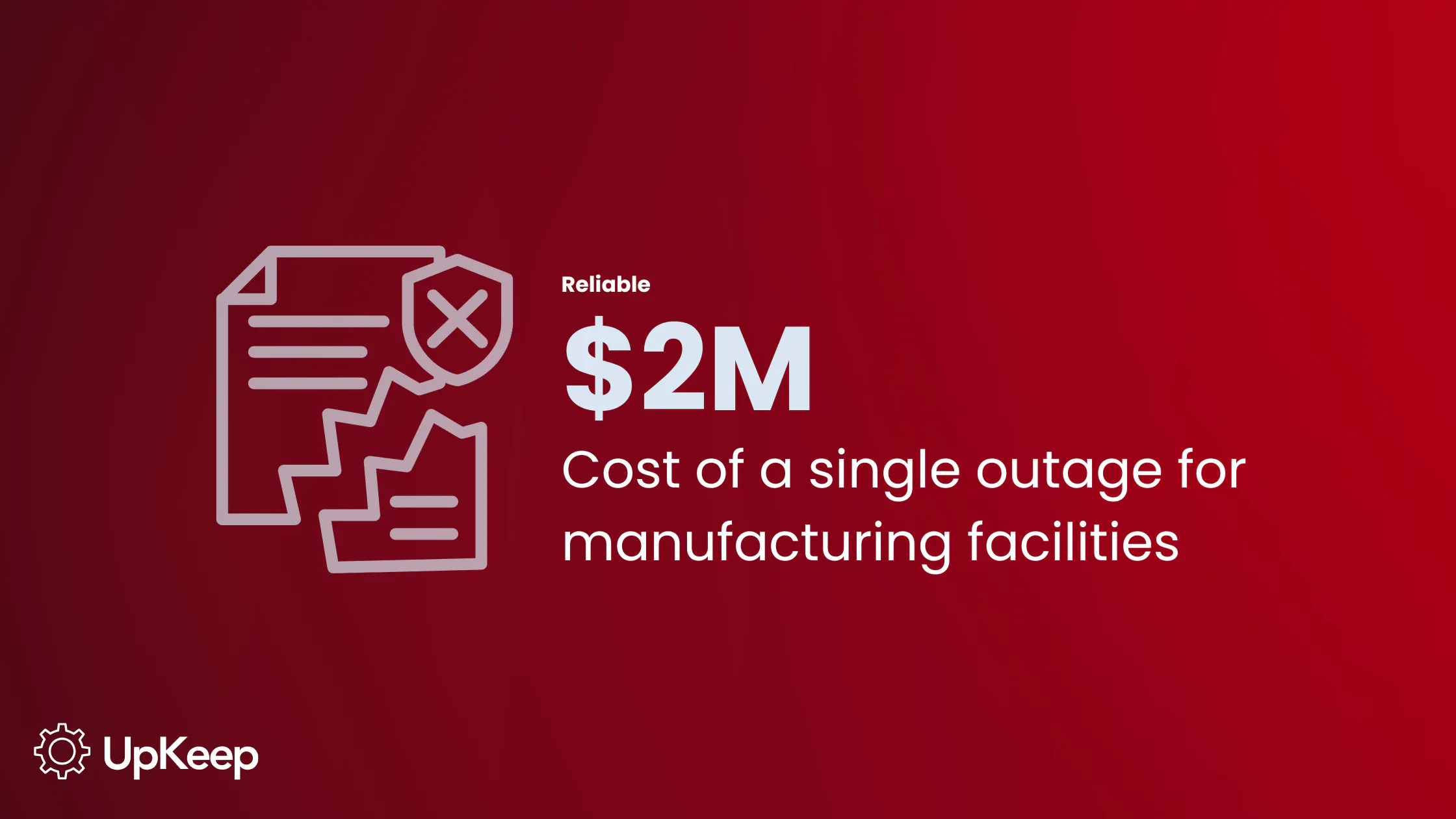
The cost of getting this wrong adds up fast. In manufacturing alone, some facilities have reported a single outage can cost them about $2 million. A maintenance repair request form template that captures the right details up front helps technicians diagnose the problem before they reach the equipment, which shortens that downtime window.
This type of form should also flag lockout/tagout (LOTO) needs where relevant. LOTO refers to the practices and procedures used to disable a machine so it can't start up unexpectedly while someone is servicing it. That means physically locking an energy source, like a power switch or valve, and tagging it to warn others not to restore power.
OSHA's Control of Hazardous Energy standard requires employers to have written procedures for this, as unexpected startup during maintenance is one of the more common causes of serious injury on a shop floor. If a request touches equipment that needs to be de-energized before anyone can safely work on it, the form should say so.

Facility and Building Maintenance Request Form
A facilities maintenance request form template covers shared or common-area issues like HVAC, elevators, lighting, or general infrastructure in office buildings, hospitals, or municipal facilities. It needs a location field broken down by building, floor, or zone, since facility issues often affect more than one occupant or department.
This type of form should also include an impact field: Does this problem affect one office, a whole floor, or an entire wing? That assessment can determine whether a fix happens immediately or gets scheduled around patient care or business hours. Recurring facility issues need to be flagged on the form itself, too, since a pattern usually points to a root cause requiring investigation rather than another one-off patch.

Best Practices for Managing Maintenance Requests After Submission
Getting the form right is only half the job. What happens after submission determines whether the form actually improves the workflow:
Set clear response time expectations by asset criticality; a life-support device, a downed traffic signal, and a leaking faucet don't belong in the same queue. Defining that hierarchy up front prevents low-priority requests from crowding out real emergencies.
Keep the requester or reporting party updated at every stage. Publishing response times and completed work on an open-data dashboard, for example, is one way public works departments build resident trust and demonstrate accountability.
Review recurring requests regularly. A substation component that continues to fail tests or a piece of equipment that keeps generating the same complaint is a sign to move from reactive repairs to a scheduled maintenance plan for that asset. It might also mean the equipment needs to be replaced entirely, depending on its age and the cost to keep repairing it.
Retain records according to the rules that apply to your industry. Retention periods vary by record type: Fleet maintenance and repair records, for instance, need to be kept for one year while a vehicle is in service, and annual inspection reports for 14 months, so a one-size-fits-all retention policy can leave gaps.
Use the data you're collecting. Patterns in request volume, common failure points, or repeat locations can guide budget and staffing decisions. This is where UpKeep's reporting turns a queue of maintenance requests into an actual planning tool, whether the audience is a plant manager, a hospital facilities director, or a public works supervisor.
Get Started With Our Free Maintenance Request Form Template
A maintenance request form template only helps if people actually use it, and that means making it easy to find, fill out, and route to the right person. Download UpKeep’s free maintenance request form template as a Word doc or PDF, print for on-site use, or build it directly into your digital workflow so it lands in a technician's queue automatically. Whichever format fits your team, beginning with a template beats starting from a blank slate every time. Curious to learn what other processes UpKeep can streamline for you? Book a demo and find out today.
Frequently Asked Questions About Maintenance Request Form Templates
Why is a maintenance request form necessary?
You need a maintenance request form because it gives everyone who submits a repair request the same set of fields to fill out, so the person triaging requests gets complete information the first time. That means fewer follow-up calls, faster prioritization, and a documented record of when the issue was reported.
Are there different types of maintenance forms?
Yes. The most common types are tenant maintenance request forms, equipment maintenance request forms, and facility or building maintenance request forms. Each is built around different fields based on the asset, location, and priority structure it needs to capture.
What details should you include in a maintenance request form?
At a minimum, a maintenance request form needs to include contact and location details, a specific description of the issue, an honest priority level, and any safety or compliance concerns, like lockout/tagout needs. Attaching a photo or reading, when possible, gives a technician even more context to work with before they arrive.
How do maintenance forms improve workflow?
Maintenance request forms cut down on the back-and-forth needed to gather basic information, make it easier to prioritize urgent issues over routine ones, and create the documented paper trail that assists with warranty claims, safety audits, and regulatory compliance. An organized form makes the broader maintenance process more systematic, which supports less reactive repairs and drives a preventive approach.
4,000+ COMPANIES RELY ON ASSET OPERATIONS MANAGEMENT
Leading the Way to a Better Future for Maintenance and Reliability
Your asset and equipment data doesn't belong in a silo. UpKeep makes it simple to see where everything stands, all in one place. That means less guesswork and more time to focus on what matters.






![[Review Badge] Gartner Peer Insights (Dark)](https://www.datocms-assets.com/38028/1673900494-gartner-logo-dark.png?auto=compress&fm=webp&w=336)