Blog Post
8 IIoT Applications That Turn Industrial Data Into Action
Explore eight IIoT applications, real industrial examples, and a practical way to choose a pilot, measure its value, and connect alerts to action.



Key Takeaways
When choosing how to deploy IIoT, start with the operating decision and the response it calls for, then choose the sensors, connections, and analysis needed to support them.
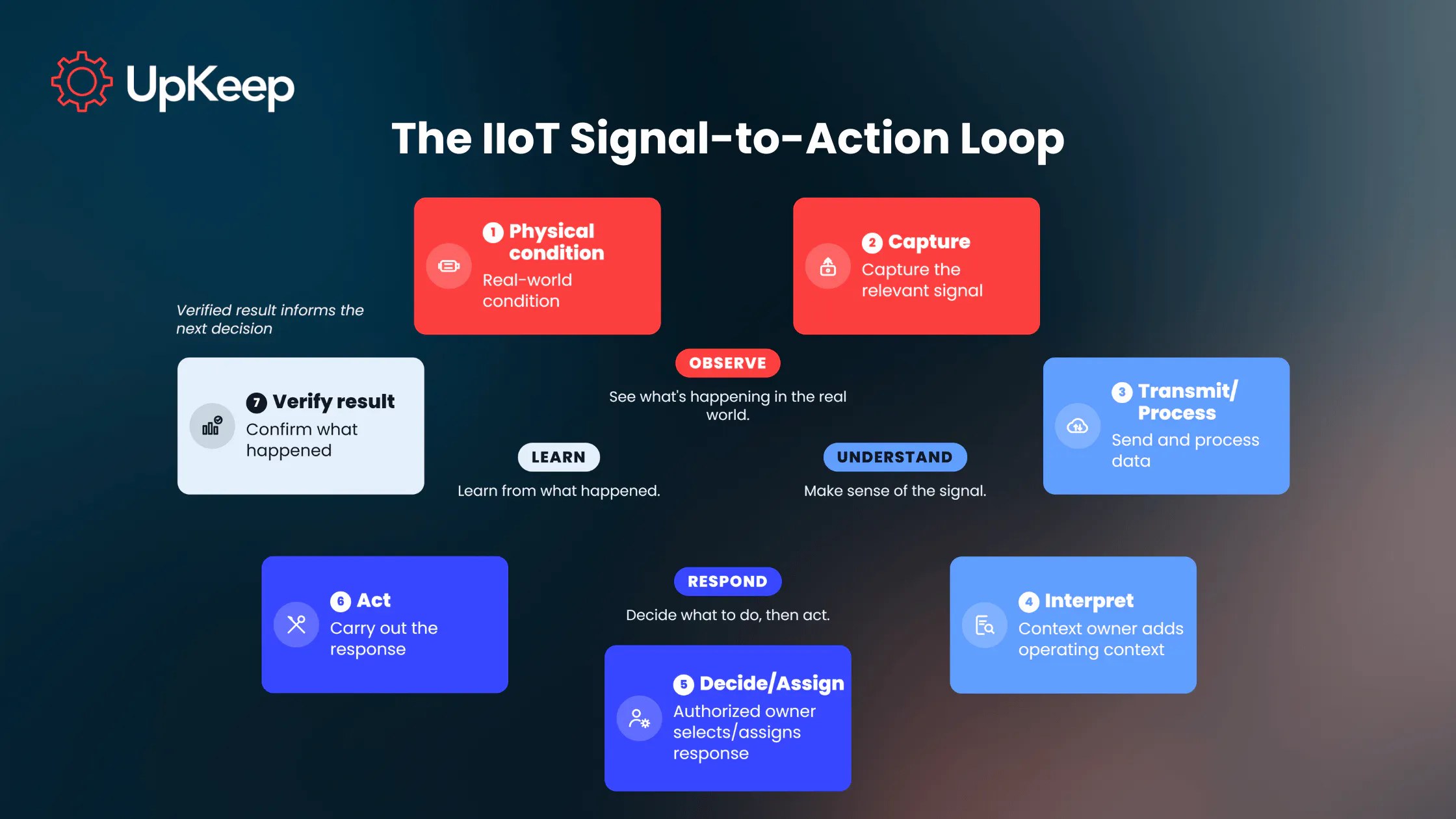
Follow a physical signal through interpretation, authorized action, and a check of the result. Then use that result to guide the next decision.
Run a pilot to check response time, whether the action helps, and how the system recovers from failure. Compare the measured benefit with the full cost of ownership.
Across more assets and operating conditions, check data quality and the baseline used to measure value. Confirm who responds, who can authorize control changes, and how fallback works.
Major problems often start as small annoyances: A conveyor starts drawing unusual current during the night shift, a freezer stays warmer than expected after defrosting, or a vision system flags a surface deviation before the next assembly step.
Each signal gives a team a different job, such as inspecting the conveyor, investigating the temperature rise, or deciding whether to hold the part. If you ignore the signals though, they’ll inevitably balloon into expensive breakdowns. IIoT applications help teams catch those signals, make sense of them, and turn them into the right response before the problem snowballs.
What Is an IIoT Application in Practice?
An Industrial Internet of Things (IIoT) application connects industrial equipment data with a specific decision and response. It encompasses actions like scheduling maintenance, coordinating remote operations, containing a defect, and adjusting energy use. Sensors, software platforms, edge computing, analytics, AI, and digital twins can enable or form part of that application.
The broader IIoT stack offers ways to capture, move, process, and interpret industrial data. Protocols, for instance, connect equipment, gateways aggregate signals, edge or cloud systems process them, and connectivity options like industrial 5G carry data under application-specific performance requirements. Meanwhile, digital twins can represent equipment or processes for analysis and decision support, while AI can classify, estimate, or optimize.
A complete loop also returns evidence from the response, such as:
A technician records a finding
A process variable settles after a setpoint change
A quarantined part passes a downstream test
An autonomous vehicle completes a recovery sequence.
Teams then use that feedback to revise thresholds, operating context, models, and work instructions for the next event.


8 IIoT Applications and Use Cases by Operating Decision
The same temperature alert can support both equipment maintenance and inventory protection. Maintenance staff use it to plan an inspection, while the site team decides whether to move stock to working freezers. The signal may be the same, but what happens next depends on the problem in front of them. The table below shows eight common IIoT applications and the practical questions each one can help answer.
|
Application |
Decision it supports |
|
1. Equipment monitoring and maintenance |
Is inspection or repair needed, and when? |
|
2. Remote monitoring and operations |
Can the issue be resolved remotely, or is on-site work needed? |
|
3. Process optimization and control |
Which adjustment would move the process toward its target within operating limits? |
|
4. In-line quality inspection |
Should the unit be held, sorted, reworked, or corrected before moving downstream? |
|
5. Asset, material, and cold-chain visibility |
Does the item need moving, protection, rerouting, or a custody check? |
|
6. Safety and environmental monitoring |
Which authorized response is needed for the detected condition? |
|
7. Energy and resource management |
What should be adjusted or repaired to reduce resource waste? |
|
8. Robotics and autonomous material handling |
Which route should the vehicle take, and when should it stop or recover? |
1. Equipment Condition Monitoring and Maintenance
Condition data changes what the maintenance team does while there’s still time to act. In condition-based maintenance, a reading shows what’s happening with the equipment now, and triggers an inspection or repair when the condition hits a pres-set threshold.
Predictive maintenance goes a step further by estimating how the equipment’s condition is likely to change or when intervention may be needed. A temperature threshold can tell maintenance it’s time to take a closer look without pretending to predict when the component will fail.
Maintenance teams can use vibration, temperature, current, pressure, acoustic data, or controller readings to spot a changing trend, apply a diagnostic rule, check a threshold, or make a forecast. Those findings guide decisions about inspection, repair timing, and the operating plan.
BMW Group’s Regensburg plant exemplifies what that looks like on a real production line: The system uses data the conveyor controls already produce, watches those readings for irregularities, and alerts the maintenance control center when something looks wrong. The issue then goes to the technician on duty, and affected conveyor components can be pulled from the line and repaired away from production. As a result, BMW reports an average of about 500 minutes of vehicle-assembly disruption avoided per year at the plant.
For your own pilot, follow the alert all the way to the wrench. Compare what the signal suggested with what the technician actually found, then check the readings after the work is complete. Did the alert give the team useful time to act? Did it send technicians chasing a bunch of false alarms? Poor sensor placement, bad calibration, changing operating conditions, or too little reliable failure data can muddy the picture.
2. Remote Monitoring and Operations
Remote monitoring lets a team assess equipment conditions from a distance and decide when work is needed on site. Using secure telemetry, the team can troubleshoot, make adjustments within its authority, or arrange local work. Returned readings help confirm the result.
For instance, the maintenance team for global restaurateur HMSHost at LA’s international airport had relied on location managers’ scheduled freezer inspections to discover problems. After implementing UpKeep temperature sensors though, the team could review conditions remotely and investigate persistent high readings.
One freezer investigation uncovered a failed exhaust fan and depleted refrigerant, and a similar check on a walk-in cooler found a broken part. The team configured temperature alerts to create work orders, which the maintenance manager could then assign to the appropriate technician.
How old is the reading when the remote team sees it? Track that age alongside acknowledgment time, the share of issues resolved remotely, and how well on-site work is dispatched. Stale readings, a lost connection, or an unclear handoff can leave the team acting on an outdated equipment state. Before expanding, test recovery after communications loss, local fallback control, and the conditions that trigger it.
3. Process Optimization and Advanced Control
Process optimization uses production data to figure out what needs adjusting and make the change (when it’s allowed to act automatically). A model compares what the process is doing now with its target and works out which adjustment is most likely to help without pushing the process past its limits. That might mean recommending a new setpoint, sequence, or speed to an operator, or changing it automatically. New readings show whether the adjustment did what it was supposed to do.
Bosch’s Qingdao plant put that loop into practice after adding AI control to its chilled-water system. Using data from the Energy Platform, the AI predicted how much cooling the plant would need over the next few hours and adjusted the chilled-water system automatically. Bosch also compared those forecasts with actual demand each month to guide further model training.
Automatic control raises a harder question though: How far should the system be allowed to go on its own? Which limits can it never cross? When should an operator step in, and which changes still need human approval? Failure needs its own plan. If the control software or network goes down, who or what takes over?
The model has to fit the conditions it runs in, and the network has to match the control task. Some controls need a minor delay, reliable delivery, and timing that doesn’t jump around. If communication slows down or drops out, a defined backup has to take over. For industrial 5G applications, performance testing shows whether the network can meet those demands.
Judge the control based on the conditions it’ll face:
Does the process stay close to target?
How often does it cross a limit?
How often do operators have to step in?
How much time does it spend in the intended operating range?
Before scaling, retest the control rules and verify that the handoff to an operator or local controller works when needed.
4. In-Line Quality Inspection and Control
In-line quality inspection enables organizations to contain, sort, rework, or correct a defect before the unit moves farther downstream. Images, geometry, torque, force, acoustic signatures, and process traces can reveal a deviation. The type of deviation, where it is, and how serious it is guide what happens to the unit next. A later test supplies the reference result used to check the inspection rule or model.
At BMW Group Plant Munich, cameras and AI identify pinpoint deviations in the paint shop and record them digitally. The detected deviations then guide automated surface processing during production. Being able to catch even minute flaws has helped increase the plant’s output as a result.
During your pilot, look at three aspects:
How many defects slip through unnoticed?
How often does the system reject a good part?
How long does it take to go from detection to action?
A detection application can look accurate on paper and still cause trouble on the line if product variants shift, lighting changes, the camera moves, labels are weak, or the review queue backs up.
5. Asset, Material, and Cold-Chain Visibility
Visibility applications help protect assets and materials by informing the person responsible about an identity, location, custody, or condition exception with enough time to act. The normal state provides a reference point. An exception rule or human judgment identifies the problem, and the response may move inventory, reroute material, investigate custody, or protect an asset. A later scan or condition reading confirms where the item went and whether the intervention succeeded.
As a concrete example, during a compressor incident for Icon Entertainment, a temperature notification helped their team assess the situation and move inventory to other freezers and locations. Icon Entertainment reported about $8,000 in product was protected in that incident.
The team needs to trust item identities and spot duplicate or missing events. Calibration, connectivity, and assigned responsibility at each handoff also shape how well the application works. Track acknowledgment time, how long the exception lasts, how severe it is, the documented response, and which product or asset was moved or protected.
6. Worker Safety, Leak Detection, and Environmental Monitoring
Safety and environmental monitoring may use similar gas, pressure, optical, atmospheric, or location signals, and yet the ensuing decisions will differ. An acute worker exposure event or leak can require isolation, evacuation, and immediate repair. Longer-horizon environmental monitoring may demand localization, quantification, mitigation, documentation, and reporting across weather and operating conditions.
The people relying on the alarm need to know what the system can detect, where its blind spots are, and what happens if the signal never gets through. If an alarm fires, the next step should be obvious to whoever receives it, especially when a missed detection could leave people exposed or let a leak or emission keep running unnoticed.
Verify the following safety and failure-readiness conditions before expanding the pilot:
Detection and localization remain effective across expected operating and weather conditions, with blind periods identified.
Calibration, communications, and power availability are monitored, and a failed sensing path produces an actionable state.
Response authority is explicit for isolation, evacuation, investigation, repair, mitigation, and reporting.
Continued measurement or an independent check confirms the safe state after the response.
Track detection time, blind periods, false alarms, calibration uptime, response time, and confirmation of the safe state. Keep engineered safeguards in place and follow required safety or compliance procedures during the pilot and any scale-up.
7. Energy and Resource Management
Energy monitoring helps a team find consumption it can shrink through a schedule, setpoint, load, or leak repair. To hone in on that opportunity, compare meter and submeter readings with the plant’s production level, product mix, weather, schedule, and equipment state. A normalized baseline accounts for these drivers and helps distinguish an efficiency gain from lower output or milder weather. It can also reveal an improvement that higher production would otherwise hide.
If energy use starts creeping above the baseline, something’s changed. A leak may have opened up, a control setting might’ve drifted, or equipment could be running when it doesn’t need to. After the fix, compare the new readings under similar conditions and see whether the excess consumption actually disappeared.
At Bosch’s Qingdao plant, the team also used the Energy Platform to decide which heat sources should run first. The platform combined building-management data with machine-sensor readings, and an analysis of the hot-water supply led the team to prioritize solar thermal energy and heat recovered from compressors. With the Energy Platform in place, Bosch was able to reduce the plant’s energy usage by 380 MWh.
To evaluate your own project, define which equipment and energy flows the meters cover. Check for missing or backfilled readings, account for external drivers, and confirm the team can change the load being measured. Track how large a deviation is, how long it lasts, which waste events were verified, and whether the reduction persists after the intervention.
8. Smart Robotics and Autonomous Material Handling
Autonomous material handling coordinates the movement of parts and materials between work areas. A robot or vehicle combines its position and orientation, nearby obstacles, and the state of other robots or vehicles with its task, load, and battery state. Local perception and fleet logic then use those inputs to guide its next move. It may choose a route, yield, stop, pick up, carry, or drop off a load, recharge, or enter recovery. Events from the production line confirm the result.
Local safety and fleet optimization do different jobs. A vehicle may need to stop if its positioning becomes unreliable or communication drops, even when the fleet controller wants traffic to keep moving. Human override, traffic-control authority, recovery from a failed mission, and the handoff between the vehicle and fleet controller therefore need to be tested during the pilot.
At BMW Group Plant Regensburg, when an assembly-line employee signals that parts need replenishing, there’s an immediate response. A cloud-based traffic-control system coordinates deliveries by a mixed fleet of automated tugger trains and Smart Transport Robots. BMW describes how the system uses delivery priorities to guide routes, manage parking, and keep vehicles charged.
Evaluate a fleet pilot through mission completion, human intervention and recovery frequency, controlled and emergency stops, task cycle time, and safe operation when positioning or communications degrade. Use those results to decide whether the fleet can take on more routes and tasks or needs changes to its operational and recovery procedures first.
How to Choose an IIoT Application Worth Scaling
Choose an IIoT application that solves a problem with a clear action on the other side of the data. Better readings should help someone inspect, adjust, repair, hold, or protect something with enough time to change the outcome. Then compare the measurable benefit with the full cost of ownership over the same period. If the system keeps working as conditions change and the benefit still justifies the cost, the application has a solid case for a larger rollout.
An energy pilot, for example, has a clear starting point when meter readings can be matched to production and the team can adjust the load. For a maintenance pilot, it’s when condition readings give technicians enough time to inspect or repair equipment. When both are feasible, give priority to the problem with the greater operational impact. Whichever problem you choose, the team needs to be able to respond, measure its effect, and accept the cost and risk.
1. Define the Decision and Who Responds
Define the decision and who will respond before selecting the data path. Identify the person, team, controller, or workflow that will receive the interpreted signal, what they’re allowed to do, and how much time they have to act. Decide what happens if the signal or connection becomes unreliable. An alert sent to an unstaffed inbox won’t trigger an inspection or repair, and a recommendation outside the operator’s authority will stall before anything changes.
Set the pilot’s boundaries by identifying the assets, operating conditions, and current decision process. Include the consequences of acting too early, too late, or on a false signal.
2. Prove the Signal-to-Action Loop
Follow one event from the physical condition to a verified result. Trace how its data was captured, transmitted or processed, and interpreted to support a decision. An alert can be acknowledged while the work is still waiting for assignment. Record the time at each handoff and who’s expected to act next, all the way through tangible action and verification. That makes delays, lost data, unclear responsibility, and unfinished work easier to spot. Judge the alert by whether it led to a useful inspection or another appropriate action.
A pilot that only behaves on a good day hasn’t proved genuine value. Plan disruptive tests with the people responsible for operations and safety to gauge its accuracy. Run them in a simulation or isolated setup before moving to live equipment under approved procedures.
Change the conditions: Run the test across different shifts, product variants, weather, and maintenance states. See whether the thresholds, models, and baselines still hold up.
Feed it known normal and abnormal cases: Compare what you expected with what actually happened. Look for missed events, nuisance alerts, and inconsistent responses.
Cut connectivity or power in a planned test: See whether local fallback kicks in, how stale the available data gets, how cleanly the system recovers, and who owns the response while the connection is down.
Then repeat the workflow with the people who’ll actually run it after the pilot, including escalation and shift handoffs. That’s where you find out whether the process holds together in the real world or starts falling apart between shifts. Be sure to tighten the training, handoffs, or recovery steps before you scale.
3. Evaluate Value, Total Cost, and Scale
Match the value measure to the decision:
A realized benefit is a measured improvement or cost reduction over a defined period.
Avoided cost estimates a cost that would plausibly have occurred without the intervention.
Value at risk is the production, revenue, or inventory exposed if a failure occurs.
A projection estimates a future effect using stated assumptions and a time horizon.
Cost estimate needs to extend beyond sensors and software. Add retrofit and installation, integration, data engineering, connectivity, calibration, replacements, cybersecurity, training, subscriptions, and the ongoing upkeep of devices, models, and workflows. Put the full expense beside the result you’re trying to improve, whether that’s downtime, energy use, scrap, or response time; if the benefit can’t carry that cost, the business case is on shaky ground.
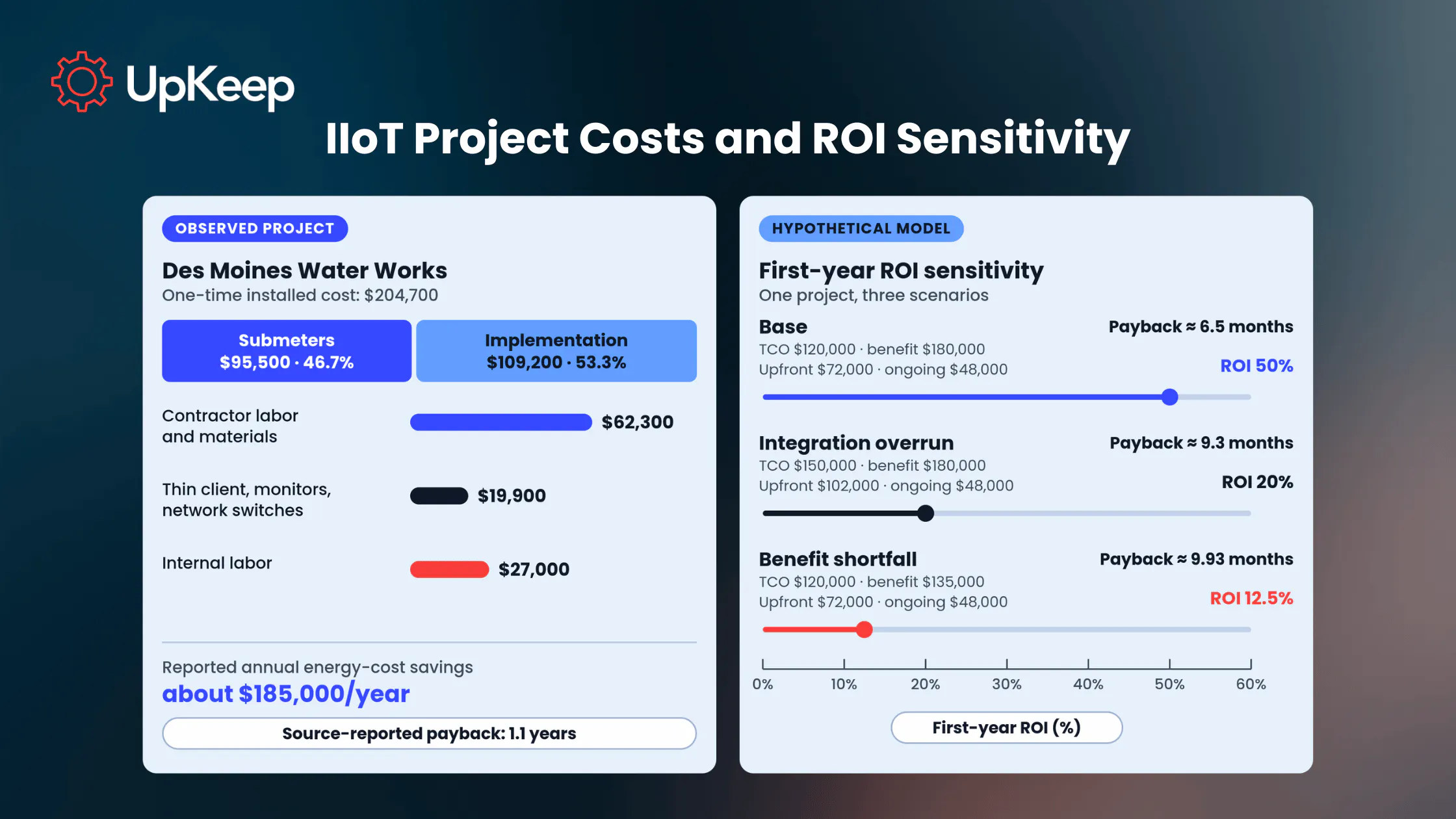
When Des Moines Water Works installed electric submeters, the price tag wasn’t just the meters: The disclosed installation cost came to $204,700. Submeters accounted for $95,500, contractor labor and materials $62,300, a thin client, monitors, and network switches $19,900, and internal labor another $27,000.
More than half the bill came from everything around the meters.
So, if you budget only for the devices, more than half this project’s installed cost disappears from the estimate. That being said, Des Moines Water Works also reported about $185,000 in annual energy cost savings and 1.1-year simple payback. Budget correctly so your investment pays off.
The table below stress-tests one hypothetical first-year IIoT project. The base case assumes $72,000 in up-front costs, $48,000 in annual ongoing costs, and $180,000 in first-year cash benefit. One scenario adds a $30,000 integration overrun, while another cuts the benefit to $135,000. Up-front expenses are paid at the start, while benefits and ongoing costs accrue evenly over the next 12 months. Benefits are cash savings before ongoing costs, and simple payback excludes financing, taxes, and discounting.
|
Model input or result |
Base case |
Integration overrun |
Benefit shortfall |
|
Up-front cost |
$72,000 |
$102,000 |
$72,000 |
|
Annual ongoing costs |
$48,000 |
$48,000 |
$48,000 |
|
First-year total cost |
$120,000 |
$150,000 |
$120,000 |
|
First-year cash benefit |
$180,000 |
$180,000 |
$135,000 |
|
Monthly net benefit |
$11,000 |
$11,000 |
$7,250 |
|
First-year ROI |
50% |
20% |
12.5% |
|
Simple payback, in months |
≈ 6.5 |
≈ 9.3 |
≈ 9.93 |
To calculate the ROI of an IIoT application, use this formula:
ROI = (Realized benefit − Total cost of ownership) ÷ Total cost of ownership
For this example, monthly net benefit is the annual cash benefit minus annual ongoing costs, divided by 12. Simple payback is the up-front cost divided by monthly net benefit.

For an inventory incident, record the value saved and the action that protected it. To estimate annual avoided cost, a team also needs a credible estimate of how often comparable incidents occur and what would have happened without intervention. Keep that estimate separate from measured benefits though. An annual ROI calculation needs benefits and full ownership costs for the same period, with inventory or production at risk recorded separately as exposure.
What the Numbers in IIoT Case Studies Tell You
Case study numbers can look more comparable than they really are. About 500 minutes of avoided disruption per year isn’t the same as $8,000 of product protected in one incident or a 380-MWh energy reduction reported for one plant in a single year.
They may sit neatly side by side, but they’re not speaking the same language. One measures time saved, one captures value protected in a single event, and one reports a plant-wide energy result over a year. Each number tells a different story, so it matters what sits behind it before you use it to judge your own project.
|
Case-study figure |
What it describes |
Question to ask before using the figure |
|
BMW Regensburg |
An average annual outcome reported for one named plant |
How does the plant define and track avoided assembly disruption? |
|
Icon Entertainment |
The value protected in one documented event |
How often do comparable failures occur, and what loss would each cause without a response? |
|
Bosch Qingdao |
A site-and-year energy result attributed to the Energy Platform |
What were the baseline, output, and operating conditions? |
Adding more assets brings new operating conditions, sensor placements, network paths, response teams, permissions, and maintenance needs. Before expanding beyond the pilot, check that data quality remains sound, teams know who responds, control authority is clear, and fallback works. The benefit still has to justify the full cost, and the team needs the capacity to support the larger system.
Recommended Listen
In this episode of Masterminds in Maintenance, host Ryan Chan, UpKeep’s founder and CEO, speaks with Graham Fonseca, business unit manager of Online Solutions at UE Systems, about IIoT in a working reliability program. Fonseca describes remote monitoring as a first pass that helps guide closer inspection with handheld tools. When Chan raises the training question, Fonseca recommends working with suppliers who help the team interpret the readings and develop its own expertise.
How UpKeep Edge Connects IIoT Alerts to Maintenance Work
With UpKeep Edge, we connect supported sensor readings to the asset and maintenance records a team uses to investigate a problem. Readings pass through a compatible gateway, and the team sets the threshold, duration, notification recipients, and any alert schedule.
When the configured conditions are met, Edge creates an alert and an incident record that tracks the event until readings return to normal. The team can then use the incident to create a work order carrying the sensor details, associated asset or location, and incident data.

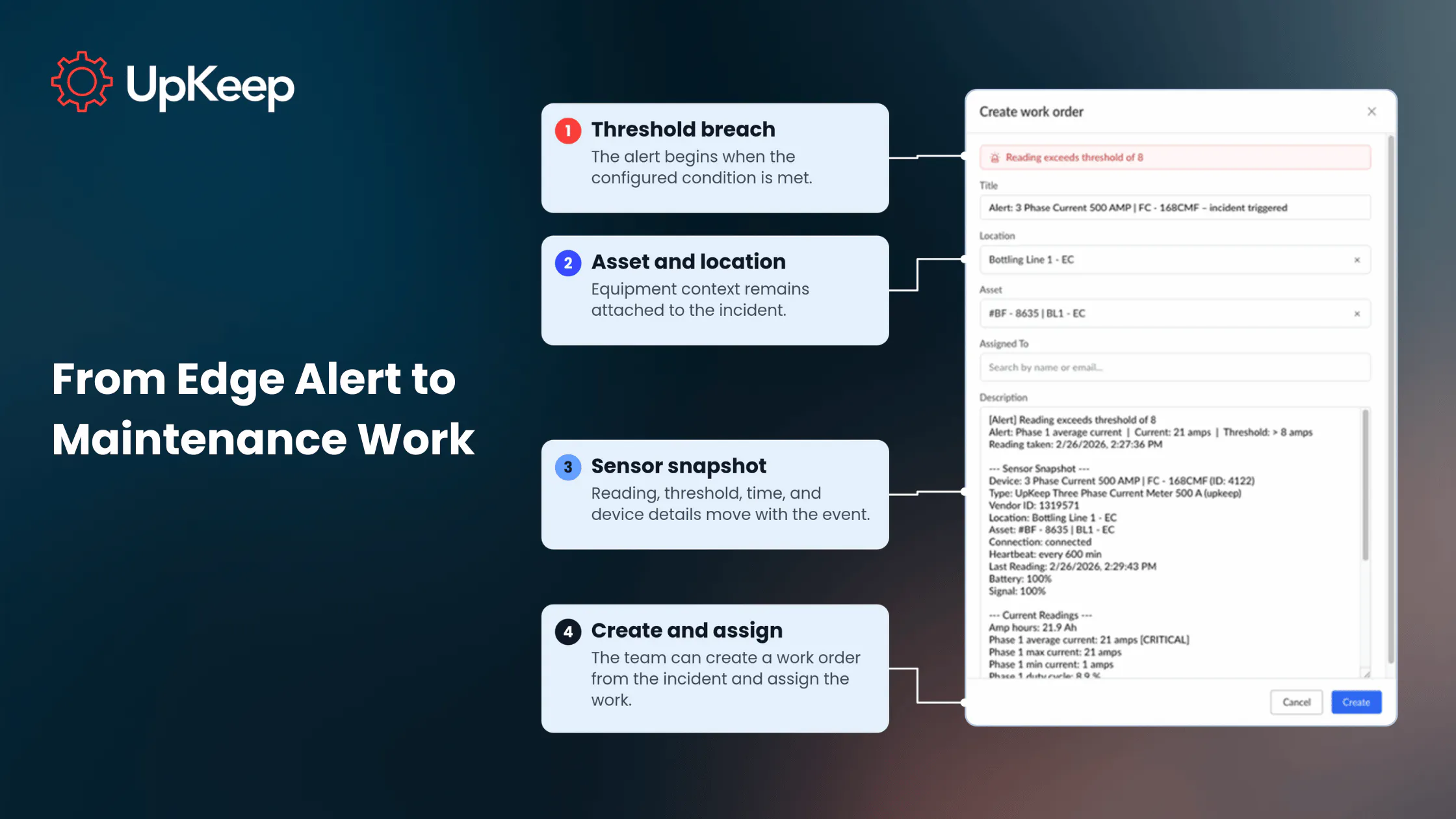
Here’s how a facilities team might handle a cold-storage alert:
A cold-storage sensor records a temperature above the configured threshold for the required duration during an active alerting period.
Edge creates an incident and notifies the designated facilities manager.
The manager reviews the trend to distinguish a normal defrost cycle from a condition that needs investigation.
The manager creates a work order from the incident and assigns the inspection.
The technician records the finding and completed maintenance against the asset.
The team can then compare the alert with the technician’s findings and the readings after the response. That record helps it decide whether to adjust the threshold, change the response, or investigate a recurring equipment problem.
From Pilot Evidence to Scale
IIoT applications solve different problems but all face the same test: What changes after the signal arrives? Does someone inspect the right machine, move inventory, adjust a process, cut the waste, or send a vehicle where it needs to go? And does that improvement survive bad connections, shifting conditions, and the full cost of keeping the system running? If the result survives all of that, you have something worth scaling.
Book a demo with UpKeep to see how IIoT alerts can connect with the assets, people, and maintenance workflows you already rely on.
IIoT Applications FAQs
What is an example of IIoT in manufacturing?
In-line quality inspection is a good manufacturing example. Cameras or process data can flag a flaw while the part is still on the line, giving production a chance to hold, sort, rework, or correct it before it travels any farther. A later test then shows whether the inspection rule or model got the call right.
Is predictive maintenance an IIoT application?
Yes. Predictive maintenance uses connected condition data to estimate how equipment is likely to change and when intervention may be needed. That forecast can give maintenance time to inspect sooner, plan a repair, or keep a closer watch on the asset before a failure. A current reading that triggers an inspection or repair is condition-based maintenance. Predictive maintenance adds an estimate of what may happen next and when.
Are digital twins and AI IIoT applications?
Digital twins and AI can form part of an IIoT application. A twin might represent an asset or process, while AI can spot patterns, estimate what may happen next, or recommend an adjustment. In practice, those capabilities might support maintenance scheduling, process adjustments, defect detection, or energy control.
How should a company choose its first IIoT pilot?
A good first pilot has a clear path from signal to action. Someone knows what to do, has enough time to do it, and can compare the result with a baseline. Keep the consequences of a wrong call manageable. Then prove the whole loop under realistic operating and failure conditions, count the full ownership cost, and decide in advance what would justify expanding to more assets, sites, shifts, or product variants.
4,000+ COMPANIES RELY ON ASSET OPERATIONS MANAGEMENT
Leading the Way to a Better Future for Maintenance and Reliability
Your asset and equipment data doesn't belong in a silo. UpKeep makes it simple to see where everything stands, all in one place. That means less guesswork and more time to focus on what matters.






![[Review Badge] Gartner Peer Insights (Dark)](https://www.datocms-assets.com/38028/1673900494-gartner-logo-dark.png?auto=compress&fm=webp&w=336)