Blog Post
What Are the Four Pillars of a Safety Management System?
Learn how the four pillars of a Safety Management System (SMS)—policy, risk management, assurance, and promotion—work together to improve workplace safety across industries.



Key Takeaways
A safety management system (SMS) organizes safety work into four pillars: safety policy, safety risk management, safety assurance, and safety promotion.
The framework originated in aviation, formalized by the International Civil Aviation Organization (ICAO), but it now applies broadly across industries.
Each pillar breaks down into 12 total elements that make the framework actionable in everyday practice.
Connecting safety findings to a maintenance system, like a CMMS, helps close the loop between identifying a hazard and actually fixing it.
Ask five safety professionals what "safety management"means and you'll likely get five different answers. The four pillars framework was designed to eliminate that inconsistency. Instead of treating safety as a loose collection of policies, audits, and training sessions, the framework organizes everything into four connected parts that reinforce each other.
But what is the four pillars framework? It includes policy, risk management, assurance, and promotion.
The concept started in aviation but has since become a widespread practice across industries. Its structured approach to safety applies to worker well-being everywhere. Skipping or under-investing in any of these factors weakens the entire system though. This article breaks down each pillar, how they connect, and what the framework looks like in different fields.
Defining a Safety Management System (SMS) and Its Origins
A safety management system is a structured, top-down approach to managing safety risk. It treats safety management as an ongoing business process, rather than a one-time compliance exercise.
That approach didn't start on the factory floor. SMS took shape in aviation, where Transport Canada's James P. Stewart helped create the framework and the International Civil Aviation Organization (ICAO) formalized it into an international standard. What started as a way to codify safety practices across airlines eventually became the model for other high-risk industries, and to great success.
Today, a safety management system guides safety programs in manufacturing, oil and gas, utilities, facilities management, and other industries. After all, a plant manager and an airline safety officer often ask different versions of the same questions: What could go wrong? How do we know if our controls are working? Are people actually engaged with safety, or just checking a box? Those questions are exactly what the four pillars of an SMS are designed to answer.
Safety and maintenance data usually live in the same system when a team uses a computerized maintenance management system (CMMS). Platforms like UpKeep connect work orders, inspections, and asset history so safety issues don't sit in a separate silo from the work that fixes them.
What Are the Four Pillars of SMS?
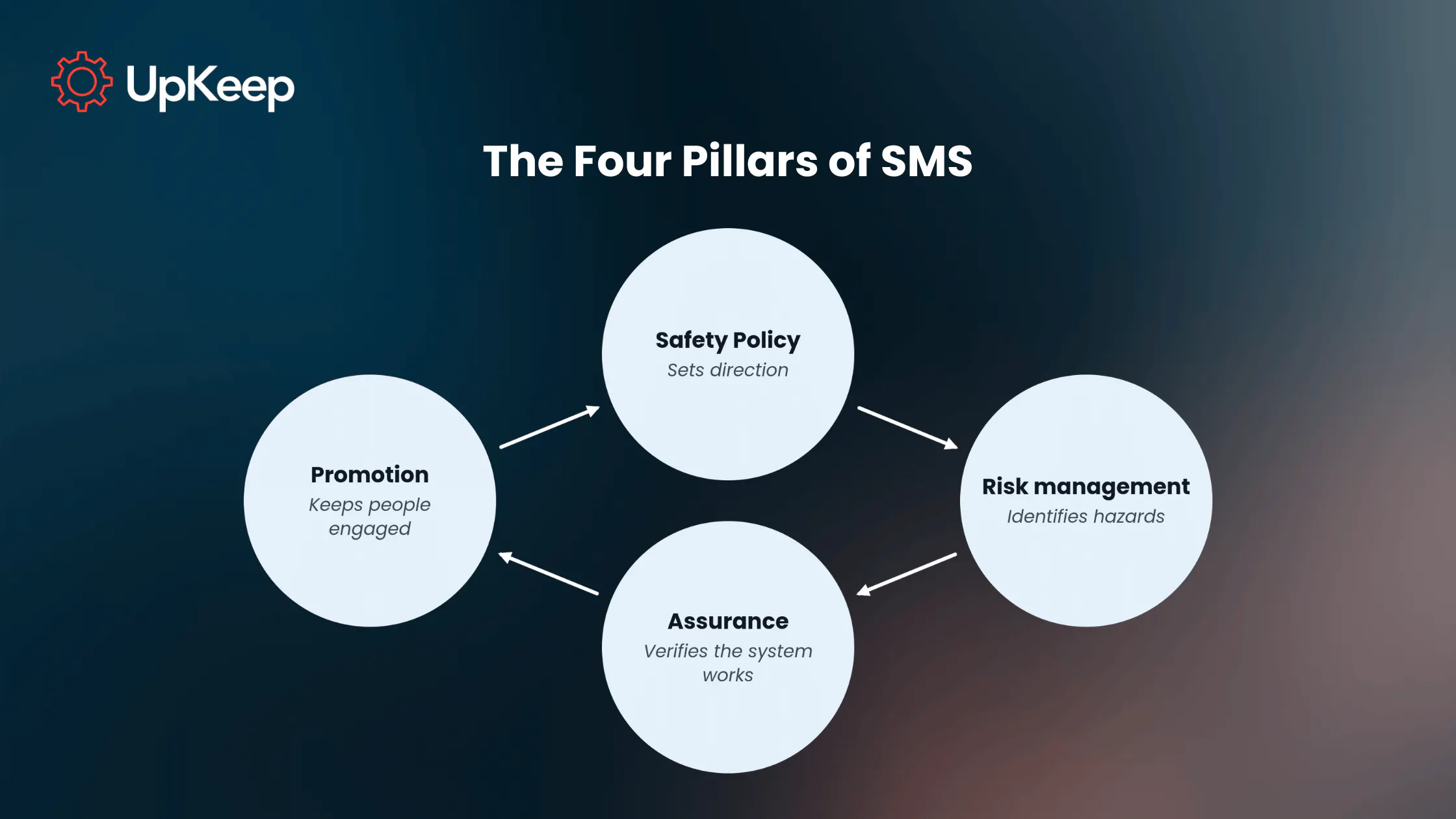
The four pillars are safety policy, assurance, risk management, and promotion, and together, they function as a closed loop. Policy sets direction, risk management identifies hazards, assurance checks whether controls actually work, and promotion keeps people engaged with the whole process. Remove any one piece, and the loop breaks down.
The Federal Aviation Administration (FAA) also lists the thread that runs through all four pillars: safety culture. It shows up most directly in the promotion pillar, but it touches every part of the system and helps build a secure environment for workers at all levels.
Safety managers most often shortchange safety policy and promotion while over-focusing on risk management and assurance. The latter two produce visible, measurable outputs, like audits and hazard logs, while policy and promotion can feel harder to quantify. However, each is of equal importance.


Pillar 1: Safety Policy and Objectives
This pillar establishes senior management's documented commitment to safety, including clear objectives and the organizational structure needed to meet them. It defines who's accountable for safety outcomes, from the accountable executive down to frontline supervisors. Without that clarity, safety responsibility tends to get diffused until no one actually owns it.
A written policy alone isn't enough though (especially since it tends to get stuffed into a binder and forgotten). Policy needs regular review cadences and visibility across the organization to shape day-to-day behavior.
Elements under this pillar typically include:
Safety accountability across leadership and frontline roles
Appointment of key safety personnel
Coordination of emergency response planning
Pillar 2: Safety Risk Management
Safety risk management (SRM) identifies hazards, then determines whether new or revised controls are needed based on an assessment of acceptable risk.
Hazard identification pulls from reactive, proactive, and predictive practices so teams don't react only after something has gone wrong.
For example, reactive practices could see a near miss, such as a loose conveyor guard nearly catching an operator's sleeve. After reporting and investigating the incident, the team’s findings prompt technicians to inspect the guards on every similar conveyor. They end up finding additional loose guards, leading to a proactive repair. Meanwhile, vibration data reveals a motor bearing trending toward failure as part of predictive practice, enabling the team to schedule a replacement before it overheats. Each practice catches something the others would have missed.
Once a hazard is flagged, teams can assess how likely it is to cause harm and potential consequences, whether that's an injury, equipment damage, or a compliance violation. They then communicate any findings with those who would act on them, such as supervisors and technicians in the affected area, the safety committee, and the managers who can approve new controls. Higher-risk hazards also go to senior leadership, since they own the resources and accountability. That targeted communication keeps the right people informed without burying everyone else in alerts.
A maintenance management platform like UpKeep is a great asset here. When a technician flags a hazard during an inspection, UpKeep can turn that finding directly into a work order so the risk is tracked and resolved instead of sitting in a spreadsheet no one revisits.
Pillar 3: Safety Assurance
Safety assurance monitors whether the SMS itself is working. It essentially audits the auditors. The process involves performance monitoring, change management, and continuous improvement of the SMS as conditions shift over time.
For instance, when assurance activities spot a gap, it doesn't always mean the risk controls in Pillar 2 failed outright. Sometimes the root cause traces back to a weak safety policy, like unclear accountability or a review cadence that never happens. Assurance is often where that kind of root cause actually surfaces.
The stakes here are real. Every year, U.S. businesses lose about $170 billion to workplace injuries and illnesses. Effective safety and health management systems help cut down on that figure.
Operational analytics and customizable reporting give safety and reliability teams a real-time view of incident trends, near misses, and audit trails. That turns assurance into a living process so no one has to pull together a report once a quarter.
Pillar 4: Safety Promotion
Under ICAO Annex 1, states are expected to actively encourage safety awareness across their aviation community and support the exchange of safety information between operators, regulators, and other stakeholders. This applies to work sectors in general too. Ongoing, transparent communication helps keep safety improvements aligned over time and retains a stronger safety culture industry-wide.
SMS understanding tends to degrade over time without regular reinforcement. That’s why the best facilities continue ongoing promotion rather than offering one session during onboarding.
Without communication, trust breaks down as well. Osha, for instance, found that just 22% of workers feel "very safe" at work, and only 26% say their safety concerns are always taken seriously by management. These results are due to both faulty risk management and poor promotion.
Initiatives like recognition programs, safety talks, and visible leadership involvement help close that trust gap. They show workers that safety conversations actually go somewhere.
Four Pillars of SMS vs. 12 Elements: What's the Difference?
The four pillars are the broad categories. Each one then breaks down further into a total of 12 elements that take the framework from theory to actionable, day-to-day practices. The pillars tell an organization what to build, and the elements tell them how to build it.
The 12 elements and their corresponding pillars are as follows:
4 Pillars of SMS |
12 Elements |
|
|
|
|
|
|
|
4. Hazard identification |
|
5. Safety risk assessment |
|
|
6. Risk mitigation |
|
|
7. Performance monitoring |
|
8. Change management |
|
|
9. Continuous improvement |
|
|
10. Training |
|
11. Education |
|
|
12. Safety communication |
How the Four Pillars Work Across Different Industries
Since aviation is where the four-pillar framework originated, naturally, it’s the most codified version today. ICAO Annex 19 is the universal standard for safety management, establishing uniform rules for managing risk across the global aviation industry. However, as previously discussed, this approach applies more broadly as well:
In manufacturing, the same four pillars translate into familiar, everyday practices. Shift-start briefings cover safety promotion, machine guarding and lockout/tagout audits handle risk management, and root cause reviews after near misses fall under assurance. The pillars don't change, just the specific activities that fill them.
Multi-site operators, whether in facilities management, utilities, or oil and gas, tend to lean heavily on the risk management and assurance pillars. That focus helps them catch a hazard trend at one location before it repeats somewhere else in the network.
Formal safety programs see a significant payoff. In fact, OSHA reported that worker injury and illness rates dropped from 10.9 per 100 workers in 1972 to 2.4 per 100 in 2023. Meanwhile, worker deaths decreased from an average of about 38 per day in 1970 to 15 a day by 2023.

Bringing the Four Pillars Together
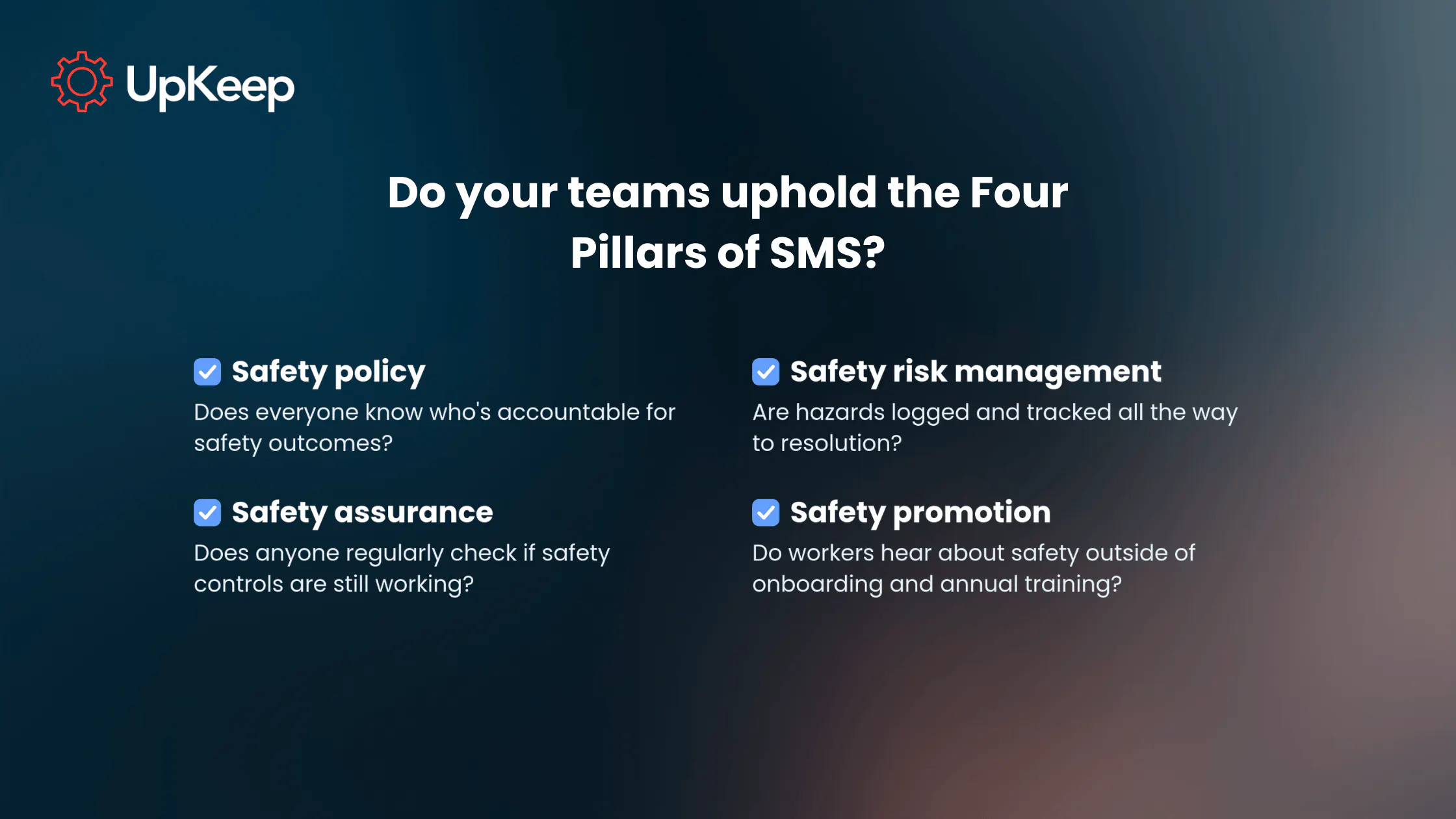
A safety management system only works when all four pillars carry equal weight. Policy sets the tone and accountability structure, risk management catches hazards before they escalate, assurance checks whether those controls actually hold up, and promotion keeps the whole organization engaged instead of letting safety fade into the background. The 12 elements underneath each pillar turn that framework into specific, repeatable actions, whether that's an aviation operator following ICAO Annex 19 or a manufacturing plant running shift-start briefings.
For this to work well though, a system must connect safety to maintenance operations matters. UpKeep helps teams translate inspections and hazard reports into tracked work orders, keep an audit trail for compliance reviews, and give leadership the visibility they need to promote safety with hard data instead of guesswork. If your SMS is strong on paper but disconnected from day-to-day maintenance work, that's your gap.
Hazard reports, work orders, and audit trails don't have to live in separate systems. Request a demo with UpKeep to see how your team can turn safety findings into tracked, resolved work, without adding another disconnected tool into the mix.
Frequently Asked Questions About the Four Pillars of Safety Management Systems
What is an SMS?
A safety management system, or SMS, is a structured, top-down approach to managing safety risk within an organization. It treats safety as an ongoing business process rather than a one-time compliance task. An SMS combines policy, risk management, assurance, and promotion so hazards are identified, evaluated, and addressed before they cause harm.
What makes a good safety management system?
A good safety management system balances all four pillars instead of over-investing in one. It needs a documented policy that leadership actually follows, a risk process that catches hazards early, honest assurance checks, and promotion that keeps safety top of mind. Without all four working together, gaps appear during an audit or, worse, an incident.
Which SMS pillar is most important?
No single pillar carries an SMS on its own. Safety policy sets the direction, but without risk management and assurance, that policy stays theoretical. Safety promotion is the pillar most often overlooked, even though it's what keeps the other three alive from day to day. A weak pillar anywhere will weaken the whole system.
Can SMS software integrate with a CMMS?
Yes. Many organizations connect their SMS to a CMMS so hazard reports turn into work orders with ease. That link matters because a flagged risk that never becomes a scheduled repair is just data sitting in a dashboard. UpKeep, for example, lets teams route safety findings into the same workflow they use for maintenance.
Is SMS mandatory for all aviation operators?
It depends on the country and type of operation. Under ICAO Annex 19, member states must require SMS implementation for certain operators, including airlines and approved maintenance organizations. Smaller operators may fall outside the mandate depending on local regulations. It's worth checking with the relevant civil aviation authority to confirm specific requirements.
4,000+ COMPANIES RELY ON ASSET OPERATIONS MANAGEMENT
Leading the Way to a Better Future for Maintenance and Reliability
Your asset and equipment data doesn't belong in a silo. UpKeep makes it simple to see where everything stands, all in one place. That means less guesswork and more time to focus on what matters.