Blog Post
Implementing a Safety Management System: How-To Guide
Implement a Safety Management System to reduce workplace incidents, improve employee safety, and boost operational efficiency through structured risk management and ongoing training.



Key Takeaways:
A safety management system (SMS) helps organizations identify hazards, manage risks, and meet safety standards consistently.
SMS is built on 4 main pillars: safety policy, safety risk management, safety assurance, and safety promotion.
Successful implementation starts with strong leadership, employee participation, clear risk controls, and ongoing training.
Regular monitoring and feedback make it possible to improve safety programs and keep operations compliant.
A safety management system (SMS) makes safety a part of everyday operations, fostering consistency, accountability, and continuous improvement. According to the American Society of Safety Professionals (ASSP), “Organizations with true safety cultures go well beyond complying with OSHA regulations,” adopting the latest best practices and technology. Implementing advanced SMS frameworks strengthens risk management, builds organizational resilience, and supports long-term success.
What is a Safety Management System?
An SMS is an organization-wide approach to managing safety risks and meeting regulations. It combines policies, procedures, and practices that help identify hazards, assess risks, and apply controls. The focus is on preventing problems before they happen by embedding safety into daily operations.
The American Society of Safety Professionals highlights ISO 45001 as a global standard for implementing SMS across industries. It provides a comprehensive framework for continuously managing risks, complying with laws, and protecting worker safety.
The 4 Pillars of the Safety Management System Framework


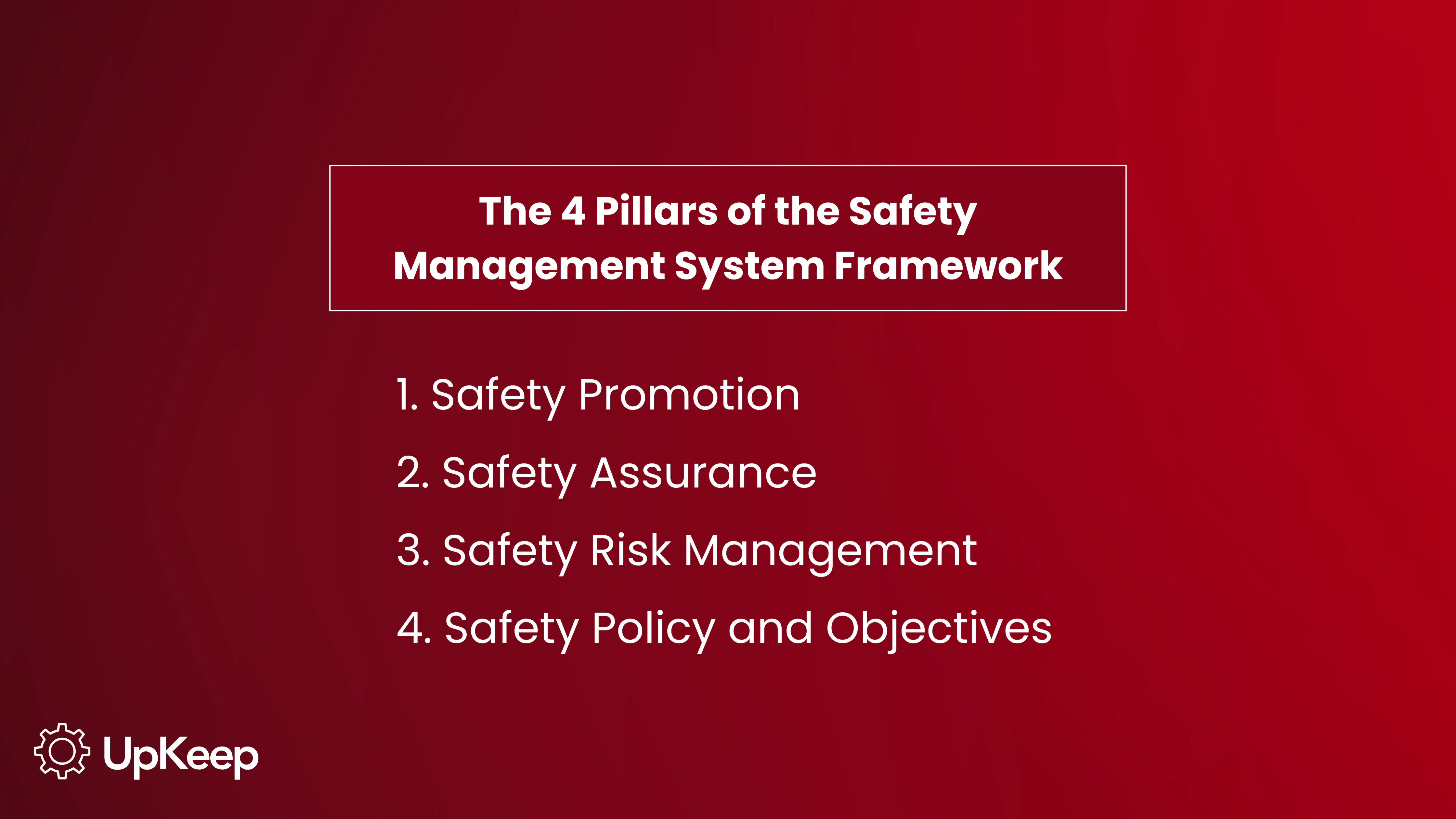
The SMS framework rests on 4 pillars: Safety Policy and Objectives, Safety Risk Management, Safety Assurance, and Safety Promotion. These pillars form the organizational foundation for safety governance and continuous improvement, defining the core functions needed to manage safety effectively at a strategic level.
Safety Policy and Objectives
This pillar establishes leadership's commitment to safety and sets clear, measurable goals. It communicates safety expectations across the organization and holds everyone accountable for meeting these objectives.
Safety Risk Management
This involves identifying workplace hazards, assessing risks, and implementing controls to reduce the likelihood and impact of incidents. It ensures risks are actively managed through systematic processes.
Safety Assurance
This pillar verifies the effectiveness of safety measures through regular monitoring, audits, and performance analysis. It provides feedback to drive timely corrective actions and continuous improvement.
Safety Promotion (or Safety Culture)
Safety Promotion fosters a positive safety culture through communication, training, and employee engagement. It encourages hazard reporting and ongoing education to maintain safety awareness across all levels.
The 7 Elements of an Effective Safety Management System
The 7 Elements operationalize the 4 Pillars—turning strategy into day-to-day practices, tools, and measurable improvements. This framework provides the detailed steps needed to implement an effective safety program, transforming high-level goals into specific actions that drive continuous safety progress.
Management and leadership engagement
Active involvement from leadership fosters a safety-first culture and ensures resources are prioritized. Executives set clear policies, define measurable objectives, and hold all levels accountable, shaping workplace safety across the organization. OSHA offers detailed Management Leadership guidance on this.
Worker participation
Employee involvement brings vital firsthand knowledge of hazards and challenges. Encouraging open communication and active participation shares safety ownership organization-wide. OSHA emphasizes this in its Worker Participation recommendations.
Hazard identification and assessment
Systematic hazard recognition, risk assessment, and incident analysis form the SMS’s data-driven foundation. Thorough documentation supports effective decision-making. See OSHA’s Hazard Identification resources for methodology.
Hazard prevention and control strategies
Risk assessments guide preventive measures like engineering controls, administrative policies, and protective equipment use. OSHA’s Hazard Prevention outlines best practices for effective risk reduction.
Education and training for all personnel
Continuous training ensures employees understand hazards, safety procedures, and their roles in maintaining workplace health. OSHA details this in its Education and Training guidance.
Program evaluation and improvement processes
Ongoing monitoring, audits, and safety performance analysis identify gaps and enable program improvements. Guidance is available from OSHA’s Program Evaluation.
Communication and coordination for host employers, contractors, staffing agencies
Maintaining safety standards across all parties onsite requires coordinated communication and collaboration. OSHA’s Communication and Coordination recommendations address this critical interface.
Implementing a Safety Management System
Successful SMS implementation follows a structured approach focused on leadership commitment and employee engagement. Clear communication and alignment builds collective ownership and momentum.
Key steps in SMS implementation:
Secure Leadership Buy-In: Obtain visible, sustained commitment from senior management to prioritize safety as a strategic goal.
Engage Employees: Encourage participation at all levels to leverage frontline insights and build a culture of shared responsibility.
Identify Hazards and Assess Risks: Conduct regular hazard identification and risk assessments tailored to your organization.
Develop Hazard Prevention Plans: Translate risk assessments into actionable controls, with frequent reviews to adapt to changing conditions.
Provide Comprehensive Training: Equip employees with necessary safety knowledge and skills to ensure compliance and promote safer behaviors.
Monitor and Improve: Use performance metrics and analytics to evaluate the SMS continuously, promoting ongoing refinement and effectiveness.
Supporting Resources:
OSHA’s 10 Ways to Get Your Program Started outlines these steps and other important actions that can be taken, along with additional resources.
ASSP’s 5-Step Action Plan for Safety Management offers an internationally recognized framework that emphasizes compliance and continual improvements.
Benefits of Using a CMMS Safety Management System
Processing Magazine highlights how digital CMMS solutions complement SMS frameworks to achieve safety compliance and improve outcomes. And Gallup found that a strong safety culture engages employees, leading to increased profitability and customer ratings, while reducing employee no-shows and incidents.
Core benefits of a CMMS safety management system:
Incident reduction and employee safety
Cost savings through fewer accidents and insurance claims
Operational efficiency and uptime improvements
Regulatory compliance made easier
Enhanced reputation and market credibility
Boosts employee engagement, morale, and productivity
Resources for SMS Implementation and Overcoming Challenges
Successfully implementing a safety management system depends on practical tools and proven templates that guide organizations through complex processes. The following resources support SMS deployment and help overcome challenges:
Implementation Checklist: A comprehensive guide to ensure all key SMS components are systematically addressed, helping track progress and maintain compliance. Available from OSHA’s Implementation Checklist.
Program Audit Tool: Facilitates thorough evaluation of safety program effectiveness through structured audits, identifying gaps and opportunities for improvement. Access the OSHA Audit Tool.
Job Hazard Analysis Worksheet: A standardized form for documenting hazard identification, risk assessment, and controls, supporting proactive risk management. Download the Hazard Analysis Worksheet.
Example Safety & Health Program Template: A detailed template demonstrating core program components, useful for designing or benchmarking an SMS. See the Example Program PDF.
Overcoming Challenges: Expert insights on addressing common SMS and CMMS implementation obstacles, practical tips to avoid failure, and strategies for driving adoption and success. Learn more from UpKeep Insights.
Additional Tools and Guidance: A rich collection of resources, regulatory information, and practical aids organized by OSHA to support ongoing program development and compliance. Explore more at OSHA Explore Tools.
Frequently Asked Questions about Safety Management Systems
What is in a safety management system?
A formalized framework including leadership commitment, risk management, performance monitoring, and promotion of safety culture.
What are the 4 pillars of a safety management system?
Leadership/policy and objectives, risk management, monitoring/performance measurement, and culture/promotion.
What are the 7 elements of a safety management system?
Management leadership, worker participation, hazard identification/assessment, hazard control, education/training, program evaluation, and communication.
How Can a Safety Management System Drive Continuous Improvement?
Through systematic monitoring, data-driven feedback loops, and agile program adjustment.
What is an example of recommended practices for Safety & Health Programs?
OSHA provides a detailed example of a safety and health program.
Creating a Safer, More Efficient Workplace with UpKeep’s CMMS
A mature SMS combined with advanced digital tools improves safety outcomes. UpKeep’s CMMS centralizes safety data, automates workflows, and instantly delivers insightful analytics wherever your team is. Our technology empowers leadership and operational teams to anticipate hazards, optimize maintenance strategies, and foster a sustained safety culture. Integrating UpKeep into SMS frameworks moves organizations beyond compliance towards operational excellence.
4,000+ COMPANIES RELY ON ASSET OPERATIONS MANAGEMENT
Leading the Way to a Better Future for Maintenance and Reliability
Your asset and equipment data doesn't belong in a silo. UpKeep makes it simple to see where everything stands, all in one place. That means less guesswork and more time to focus on what matters.






![[Review Badge] Gartner Peer Insights (Dark)](https://www.datocms-assets.com/38028/1673900494-gartner-logo-dark.png?auto=compress&fm=webp&w=336)