Blog Post
Food Manufacturing EHS Software: 6 Top Options Compared
Food manufacturing EHS software needs to catch equipment failures before they turn into compliance events. See how six leading options actually compare.



Key Takeaways
Food manufacturing EHS software is essential to mitigate safety and health risks in food production.
Automated temperature sensing can catch a deviation sooner than a periodic manual check.
Corrective actions are easier to manage when they connect to the maintenance record behind the problem. If equipment contributed to the deviation, quality and maintenance usually need to review the same history.
Preventive maintenance can support food-safety controls on the plant floor. Deferred maintenance on refrigeration, sanitation equipment, and production assets can affect controls that depend on that equipment operating as intended.
If a cooler in a food plant drifts out of range overnight and goes unnoticed until the next scheduled check, that leads to a major headache. Once someone notices, the company needs to evaluate the affected product, correct the problem, and document what happened.
That gets harder when a plant runs separate systems for food-safety documentation and equipment maintenance. Quality control may have the monitoring and corrective action records, while maintenance has the asset history, work orders, and repair details. Someone has to connect the two, which wastes their time and extends any outages while the products in question remain under scrutiny. Even a routine equipment problem can create extra work during an investigation or audit.
The fix for this hassle (and your headache)? EHS software for food manufacturing.
What Is Food Manufacturing EHS Software?
Food manufacturing EHS software helps plants manage environmental, health, and safety risks while supporting the additional compliance demands of food production. Like EHS software in other manufacturing environments, it handles incident reporting, inspections, corrective actions, worker safety, and regulatory compliance. In food manufacturing, those workflows often overlap with safety, quality, and equipment reliability.
That’s why food manufacturing EHS software is a necessity. A refrigeration failure can affect product temperature, a sanitation problem can create contamination risk, and poorly maintained equipment can undermine a control that depends on that asset working properly. Food manufacturing EHS software helps teams document those events, connect the response across quality control and maintenance, and keep the resulting records traceable. If quality records a deviation, and maintenance repairs the equipment, the inspection, corrective action, asset history, and completed work are easy to trace later.
Additionally, the FDA requires each freezer and cold-storage compartment used for food capable of supporting microorganism growth to have an indicating thermometer, temperature-measuring device, or temperature-recording device that accurately shows the compartment temperature. Instruments and controls used to measure, regulate, or record conditions such as temperature, pH, acidity, or water activity also need to be accurate, precise, and adequately maintained. When a food-safety control depends on equipment working properly, the maintenance history is crucial.
Why Running Compliance and Maintenance Separately Costs More in Food Manufacturing
When compliance and maintenance run in separate systems, the extra work spreads quickly across the plant. A deviation can involve quality, maintenance, production, and sometimes trigger product disposition work or recalls. Each team may hold a different part of the record, making the response harder to coordinate and the history harder to reconstruct later.
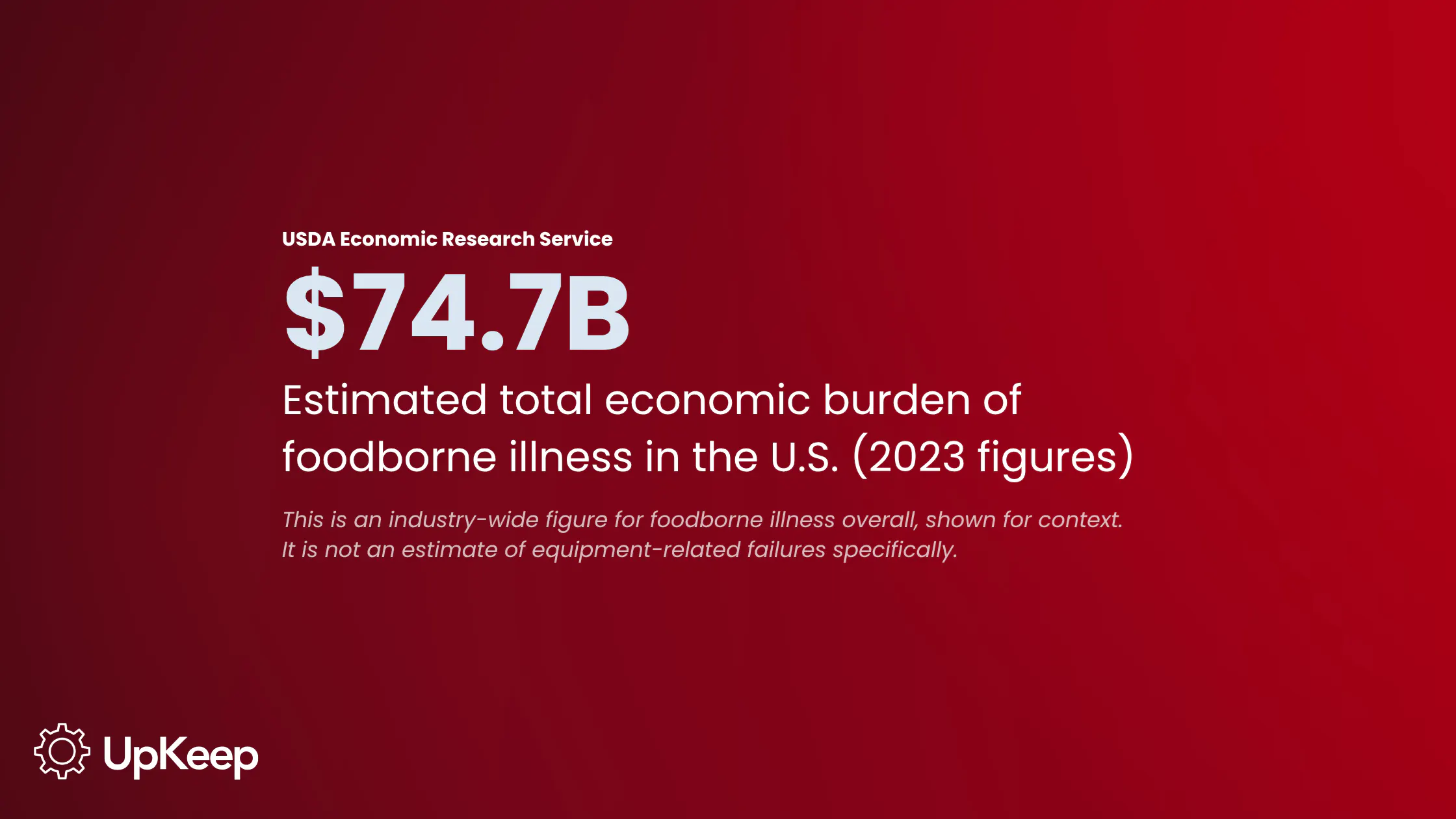
The USDA's Economic Research Service estimates the total economic burden of foodborne illness in the U.S. at $74.7 billion in 2023 dollars. That figure covers foodborne illness overall; it’s not attributed specifically to equipment failures. But it does show the scale of the risk food manufacturers are working to control.


At the plant level, a smaller equipment problem can set off a chain reaction. Say preventive maintenance on a sanitation line slips. The line keeps running, and a deviation appears later. Quality control may need to evaluate or hold affected products, maintenance may need to inspect and repair the equipment, and the plant may need to document the investigation and corrective action.
When those records are split across systems, someone has to piece the timeline together. The quality control team may have the deviation and product records, while maintenance has the asset history and repair. During an audit, that history has to be reconstructed. If the event leads to a recall, teams need the same information quickly to identify affected products, communicate the recall, verify its containment, and document product disposition.
That adds operational expenses through staff time, downtime, product holds or disposition, audit preparation, and recall work. Recall-related costs specifically include notification, product retrieval, storage and destruction, customer reimbursement, business interruption, and lost sales. A connected system makes the evidence easier to retrieve and the response easier to coordinate.
How Food Manufacturing EHS Software Helps
Certain software features matter most when food safety, equipment, and compliance overlap. If you’re considering adopting EHS software in your manufacturing setup, look for the following capabilities:
Equipment and Inspection Evidence: If a deviation involves a freezer, filler, sanitation system, packaging line, or another asset, you should be able to pull its inspections, calibration records, maintenance history, and completed work without hunting through separate files.
Cold-Chain and Temperature Monitoring: A manual temperature log captures the condition at the time of the reading. Sensors on refrigeration and freezer equipment can help reduce the gap between a sustained deviation starting and someone seeing it.
Corrective Actions Connected to Maintenance: If equipment contributed to the problem, the corrective action record should lead you to the repair and asset history. You shouldn’t have to cross-reference separate systems every time.
Sanitation, Changeover, and Equipment-Maintenance Workflows: Sanitation and allergen controls often involve equipment, especially during product changeovers. Keeping cleaning, inspections, and maintenance tied to the same line or asset makes recurring problems easier to investigate.
Mobile and Offline Plant-Floor Access: Operators and technicians should be able to enter readings, inspections, photos, and completed work where the activity happens. If offline operation matters in your facility, confirm that the specific product, plan, or workflow supports it.
Audit-Ready Food-Safety Records: Part 117 of the Food Safety Modernization Act says records generally need actual values or observations where applicable, timestamps, responsible personnel, and enough identifying detail to reconstruct the activity later. Electronic records maintained specifically to satisfy Part 117 are generally exempt from FDA Part 11 unless another applicable regulation independently makes Part 11 apply.
These features don’t establish compliance on their own, but they do support the controls and procedures a facility needs to carry out that moves them closer to compliance.
|
Regulatory or Operational Need |
What the Rule Establishes |
Software Capability That Can Support It |
|---|---|---|
|
Cold storage and equipment condition (21 CFR 117.40) |
Relevant cold storage needs appropriate temperature measurement; instruments controlling specified conditions need to stay accurate and maintained |
Equipment history, calibration and PM records, temperature monitoring |
|
Preventive-control monitoring (21 CFR 117.145) |
Monitoring procedures need a defined frequency, and monitoring must occur often enough to provide assurance the control is consistently performed |
Manual, digital, or automated monitoring matched to the control |
|
Corrective actions (21 CFR 117.150) |
Facilities need to identify and correct problems, address recurrence when necessary, evaluate affected food, and prevent unsafe affected food from entering commerce |
Corrective action workflows linked to the asset or process involved |
|
Environmental monitoring (21 CFR 117.165) |
Environmental monitoring applies when contamination of ready-to-eat food with an environmental pathogen is a hazard requiring a preventive control |
Environmental-monitoring records and trending where applicable |
|
Food-safety recordkeeping (21 CFR 117.305) |
Records need actual values or observations where applicable, concurrent documentation, and enough detail to show the history of work performed; qualifying Part 117 electronic records are generally exempt from Part 11 |
Time stamped and attributed digital records |
|
USDA HACCP (9 CFR 417, meat and poultry) |
HACCP plans specify CCP monitoring procedures and frequency, corrective actions, verification, and records |
CCP records, deviation documentation, corrective action workflows |
|
Anhydrous ammonia has a 10,000-pound threshold under both programs. OSHA PSM applies at or above the threshold; EPA RMP generally applies when a process contains more than the threshold quantity |
Mechanical-integrity inspections, maintenance schedules, and records |
Top Food Manufacturing EHS Software Options
The platforms below cover different parts of the same plant workflow. Some focus more heavily on equipment and maintenance, whereas others emphasize food safety, quality, production, or supplier compliance. The right fit depends on where most of the work sits in your facility.
|
Software |
Pricing |
Best for |
|---|---|---|
|
UpKeep |
From $24/user/month |
Equipment, maintenance, sensors, inspections, and corrective actions |
|
SafetyChain |
Custom monthly pricing per facility; unlimited users |
Food-specific quality, production, machine data, and maintenance |
|
Allera |
Contact Allera for current pricing. |
FSQA digitization, document control, and supplier workflows |
|
FoodReady |
Quote-based |
Food-safety software plus consulting |
|
TraceGains |
Starts around $20,000/year |
Supplier, ingredient, quality, and compliance management |
|
FoodDocs |
$99/site/month monthly or $79/site/month billed annually for Lite |
HACCP, digital monitoring, traceability, and connected temperature data |
1. UpKeep: Best for Maintenance-First Food Manufacturers
UpKeep is our maintenance-first pick for food plants where equipment sits at the center of the workflow. A refrigeration unit drifting out of range, a sanitation asset needing work, or a recurring packaging-line problem can all be tied back to the asset history and maintenance response.
The CMMS handles preventive maintenance, work orders, asset history, parts, and maintenance execution. UpKeep Edge adds condition monitoring for temperature, humidity, vibration, pressure, water, and other conditions. Its quality features, meanwhile, cover nonconformance, CAPA, calibration, audits, and other QMS workflows, and its Safety module supports broader EHS processes.
Best for: Food plants where refrigeration, sanitation equipment, packaging lines, or other production assets sit at the center of the maintenance and compliance workflow.
Pricing: The Essential plan starts at $24 per user/month, and Premium at $55 per user/month. Professional and Enterprise plans use custom pricing.
User feedback: Capterra currently rates UpKeep 4.6/5 from 1,330 reviews, with ease of use and mobile workflows among the recurring positives.
2. SafetyChain: Best Food-Specific Alternative
SafetyChain brings food quality, production, machine data, and maintenance into the same system. The platform covers food quality, production, HACCP monitoring, CAPA, supplier compliance, and plant operations.
Its maintenance tools include one-off work orders, recurring maintenance, and calibration. The Ignition integration can bring machine data such as temperature, pressure, flow, and line speed into quality and production workflows as well.
Best for: Food manufacturers that manage much of their plant workflow through quality and production and also need maintenance visibility.
Pricing: Custom monthly SaaS pricing per facility, with unlimited users.
User feedback: G2 reviewers currently rate SafetyChain 4.5/5 from 118 reviews. Ease of use, customer support, and real-time data are among the commonly cited positives; some reviewers mention slow performance or a learning curve.
3. Allera: Best for Fast FSQA Digitization
Allera fits teams that still manage FSQA forms, supplier records, and document control across paper files or spreadsheets. The platform includes digital FSQA forms, AI-assisted document control, supplier management, and corrective action workflows. It lets small and mid-sized manufacturers digitize those processes without implementing a broader plant-management platform.
Allera’s current materials emphasize digital FSQA forms, document control, and supplier management, with Web, iOS, and Android access listed in its product comparisons. Allera markets implementation in 30 days or less.
Best for: Small and mid-sized manufacturers looking to digitize food-safety documentation, forms, and supplier workflows.
Pricing: Must contact sales for a custom quote.
User feedback: Independent review coverage is still limited. G2, Capterra, and similar sites currently show no published user reviews for Allera.
4. FoodReady: Best for Software Plus Food-Safety Consulting
FoodReady combines food-safety software with hands-on consulting. That can be useful for manufacturers that need help building, documenting, or maintaining the food-safety program alongside the software itself.
The platform covers HACCP and preventive-control programs, traceability, quality management, supplier records, corrective actions, inventory, and support for FDA-, USDA-, and GFSI-related systems such as SQF and BRCGS. FoodReady also supports multi-facility deployments, and its mobile app can pair with Bluetooth thermometers to record temperature readings.
Best for: Manufacturers that want food-safety software and access to outside food-safety expertise in the same offering.
Pricing: Quote-based for manufacturing packages.
User feedback: G2 reviewers currently rate FoodReady 4.7/5 from 20 reviews. Several reviewers highlight the food-safety expertise and support behind the software.
5. TraceGains: Best for Supplier and Ingredient Compliance
TraceGains is strongest when the compliance work centers on suppliers, ingredients, specifications, COAs, and traceability. Its platform handles supplier information, ingredient and document management, COA workflows, traceability, and broader food-and-beverage compliance.
TraceGains Quality Management extends onto the plant floor with HACCP workflows, audits, corrective action requests, and quality records. The platform also publishes a REST API and integrations with enterprise systems.
Best for: Food manufacturers managing large supplier networks, ingredient documentation, COAs, specifications, and traceability requirements.
Pricing: TraceGains lists its starting price around $20,000 per year, with final cost varying by usage and solution scope.
User feedback: G2 reviewers currently rate TraceGains 4.1/5 from 8 reviews. Supplier-document collaboration and traceability receive positive feedback, while some reviewers mention friction with document management and customization.
6. FoodDocs: Best for Accessible Food-Safety Monitoring
FoodDocs focuses on running and documenting food-safety programs. It combines HACCP, digital monitoring, traceability, corrective actions, recalls, and food-safety management in a relatively accessible package.
Its AI-assisted HACCP builder is one of the product's more prominent features. FoodDocs also supports smart fridges and temperature sensors. Sensor readings can then be sent through its published sensor API and incorporated into monitoring records.
Best for: Smaller and mid-sized operations that want HACCP, digital monitoring, traceability, and connected temperature data without a heavier maintenance platform.
Pricing: Lite costs $79 per site/month billed annually, Standard is $167 a month, Professional is $250 per month, and Enterprise has custom pricing. All plans include unlimited users.
User feedback: G2 reviewers currently rate FoodDocs 4.9/5 from 18 reviews. Ease of use and customer support are recurring positives.
The pricing models for these solutions aren’t directly comparable. UpKeep primarily prices the CMMS per paid user, whereas SafetyChain prices its SaaS subscription per facility, and FoodDocs prices per site with unlimited users. Compare the cost based on the number of plants, users, modules, integrations, and implementation services you would need.
How to Build This Into Your Maintenance and Compliance Workflow
Centralize the records that need to connect. Sanitation, changeover, inspections, corrective actions, and equipment maintenance don’t have to start in the same module. When something goes wrong though, the person investigating it should be able to follow the records without rebuilding the history manually.
Connect temperature-critical equipment where automated sensing makes sense. Refrigeration and freezer sensors can fill gaps between scheduled manual checks. The monitoring procedure and frequency still come from the facility's own control plan. Automated sensing gives the team more visibility into what the equipment is doing between those checks.
Link corrective actions to the equipment involved. If a refrigeration, sanitation, or production asset contributed to the deviation, the maintenance record should be easy to reach from the corrective action record and vice versa.
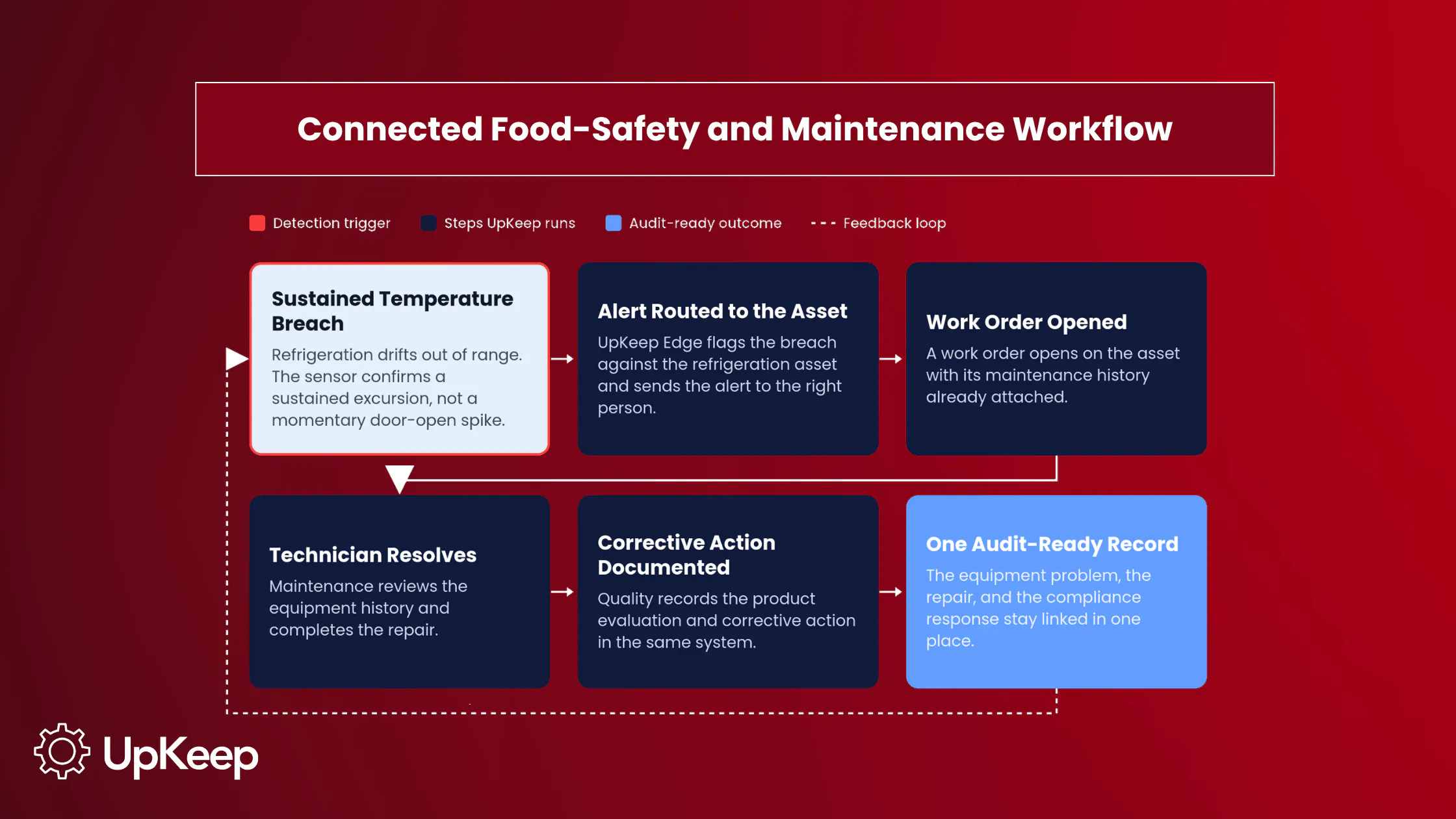
Use alert logic that separates normal variation from a condition that needs investigation. A freezer door opening briefly can cause a temperature spike, and a failing compressor can create a sustained excursion. Configure thresholds, durations, and follow-up workflows around the conditions your process requires you to investigate.

Before choosing a vendor, ask these four practical questions:
Does the system receive equipment or temperature data directly, or does someone have to enter the readings?
If equipment causes a deviation, can I move easily between the corrective action and the maintenance record?
If an auditor or manager asks what happened six months later, can I pull the history without rebuilding it manually?
What does this solution cost given my number of users, facilities, modules, and integrations?
Those answers will help you pinpoint the right fit better than a long feature list.
Show Food Safety and Maintenance Metrics Are Connected
The below metrics can reveal if maintenance problems are building around equipment that food-safety controls depend on. Read them alongside inspection, quality, production, and compliance data to identify patterns that need attention.
|
Metric |
What It Tracks |
Why It Matters |
|---|---|---|
|
PM completion rate |
% of scheduled preventive maintenance completed on time |
Deferred maintenance on sanitation and refrigeration equipment can affect controls that depend on that equipment |
|
Reactive-to-preventive maintenance ratio |
Ratio of unplanned repairs to scheduled preventive work |
A rising ratio can indicate that more equipment problems are reaching the reactive stage |
|
Work order backlog age |
How long open maintenance work remains unresolved |
Aging work on temperature- or sanitation-critical equipment can extend the time an identified operational risk remains open |
|
Critical refrigeration uptime |
% of scheduled operating time temperature-critical refrigeration is available |
Tracks availability of equipment used to maintain required product temperatures |
|
Corrective action closure time |
Time from corrective action opening through closure and verification |
Longer closure times can leave an identified compliance or operational issue unresolved |
Treat these metrics as part of the wider operating picture. Pair maintenance data with inspection findings, deviations, corrective actions, and production records to see where equipment problems may be starting to affect operations or compliance.
From Two Disconnected Systems to One Audit-Ready Record
A plant with disconnected systems creates inevitable reporting gaps. They may have digital food-safety forms in one platform, work orders in another, sensor data somewhere else, and a corrective action record that tells only part of the story. Someone then has to piece the incident together.
A connected workflow is easy to follow. A temperature deviation shows up for a refrigeration asset, and the appropriate person gets the alert. Maintenance can see the equipment history and make the repair. The quality control system can then document the product evaluation and corrective action. The equipment event and compliance response stay connected. If someone reviews the incident six months later, they can see what happened, what was fixed, and how the plant responded without rebuilding the history. This also prevents future recurrences of the same issue.
That connection is where UpKeep fits in. Edge supplies condition data, the CMMS logs preventive maintenance and asset history, and the quality and safety modules support related quality and EHS workflows. As a result, the plant keeps a clear record of what happened, what was done, and what needs to be shown afterward while avoiding repeat problems and shrinking asset downtime.
If food-safety and maintenance records still live in separate systems at your plant, you need a unifying system pronto. Try UpKeep free today and see how we can get all your systems onto the same page.
FAQs
Is food safety software the same as EHS software?
No. Food-safety software typically focuses on areas like HACCP, preventive controls, supplier records, sanitation, quality, and traceability. EHS software traditionally focuses on worker health and safety, environmental compliance, incidents, and risk. In a food manufacturing plant, the workflows can overlap quickly when equipment, sanitation, worker activity, and product safety are part of the same event.
How much does food manufacturing EHS software cost?
Pricing varies significantly by product and billing model. For example, UpKeep's Essential plan CMMS plan starts at $24 per user/month, while FoodDocs Lite tier costs $79 per site/month billed annually, and TraceGains’ solutions start at about $20,000 per year. Other options, like SafetyChain and FoodReady, use custom pricing for their manufacturing packages.
Does EHS software need to integrate with equipment maintenance software?
Although EHS software doesn’t necessarily need that integration, it’s a big help. When equipment condition affects a food-safety control and an investigation starts, maintenance is brought in as a key source of evidence. Connecting maintenance history with monitoring and corrective action records can make corrective work and audit preparation easier.
How does real-time temperature monitoring work in food manufacturing?
Sensors take readings from refrigeration or other temperature-controlled equipment and send those measurements to a monitoring system. Depending on the platform and configuration, the system can display the findings, identify conditions outside configured thresholds, send alerts, or start follow-up workflows. Automated sensing can help identify deviations between scheduled manual checks.
What's the difference between a HACCP plan and EHS or maintenance software?
A HACCP plan identifies hazards, critical control points, critical limits, monitoring procedures and frequencies, corrective actions, records, and verification procedures. EHS, quality, and maintenance software help teams carry out and document parts of that work, including equipment inspections, monitoring, maintenance, and corrective actions. While some software might help create and manage an HACCP plan, it can’t replace it entirely.
4,000+ COMPANIES RELY ON ASSET OPERATIONS MANAGEMENT
Leading the Way to a Better Future for Maintenance and Reliability
Your asset and equipment data doesn't belong in a silo. UpKeep makes it simple to see where everything stands, all in one place. That means less guesswork and more time to focus on what matters.





![[Review Badge] Gartner Peer Insights (Dark)](https://www.datocms-assets.com/38028/1673900494-gartner-logo-dark.png?auto=compress&fm=webp&w=336)