Blog Post
Facility Maintenance for Pulp and Paper Manufacturing
Learn how facility maintenance for pulp and paper manufacturing protects uptime, from PM schedules and condition monitoring to CMMS workflows.


Key Takeaways
Investing in facility maintenance for pulp and paper manufacturing protects continuous production, where one unplanned stop can idle the entire line.
Chemicals, steam, and constant moisture wear mill assets faster than calendar-based schedules can track.
Facility systems beyond the paper machine carry their own downtime and compliance risk.
A CMMS turns mill maintenance records into failure trend data. Logging every inspection and repair against the asset builds the history that tells you which rolls, pumps, and conveyors to rebuild at the next shutdown.
Teams that move from reactive repair to planned, data-driven maintenance cut downtime measurably.
A paper machine that stops without warning stalls everything downstream of it. Digesters keep cooking, steam keeps flowing, and order commitments keep aging while crews trace the failure. In a continuous-process mill, the recovery often takes longer than the repair itself.
The environment works against the equipment: Process chemicals corrode pipes and valves, moisture attacks structures and electrical systems, and high-speed rotation wears bearings and rolls around the clock. Assets in a mill degrade faster than the same assets would in a dry plant, and production schedules leave few windows to service them.
That combination makes facility maintenance in this industry a scheduling and data problem as much as a mechanical one. Mills that enjoy a healthy uptime plan and work around shutdowns, monitor conditions between them, and track every repair against the asset.
What Is Facility Maintenance in Pulp and Paper Manufacturing?
Facility maintenance in pulp and paper manufacturing covers the production assets (digesters, paper machines, press sections, dryers, etc.) and the broader systems that keep them supplied and legal to run. That means steam generation, compressed air distribution, water treatment, power distribution, and structures. This is a wider scope than commercial building maintenance, which typically stops at HVAC, plumbing, and safety systems without touching production equipment.
A computerized maintenance management system (CMMS) makes it manageable though by centralizing those systems. Every asset, work order, and inspection lands in one system. Records that live in a maintenance office, control room, and in the minds of whoever remembered what happened during the last shutdown extend downtime in pulp and paper plants. A CMMS provides much-needed organization.
Maintenance Is Critical in Pulp and Paper Facilities
The continuous production of pulp and paper facilities leaves almost no tolerance for failure. Kraft mills run digesters, recovery boilers, and paper machines as one connected system, so a failure on any of them stops the others. Downtime costs then compound due to idle crews, lost production hours, and raw material already committed to a batch that can't finish.
Environmental permits further raise the stakes. Wastewater treatment and emissions monitoring equipment have to run continuously to keep a mill's discharge inside its permit limits, so a maintenance gap there is a compliance exposure on top of a production one.
Machine condition ultimately feeds product quality and overall equipment effectiveness (OEE). A bearing that's starting to fail shows up as vibration and heat before it shows up as a jam or tear; catching it there keeps machine downtime costs from compounding.
|
Maintenance Component |
Reactive Approach |
Planned Approach |
|
Failure response |
Crews respond after a breakdown halts the line |
Condition data flags wear before it interrupts production |
|
Service windows |
Repairs compete with production for any window available |
Repairs scheduled into planned shutdowns |
|
Parts posture |
Critical spares sourced under pressure, often at rush pricing |
Lead-time-aware ordering tied to failure history |
|
Cost profile |
Emergency labor, rush freight, and idle-crew hours stack up per incident |
Labor and parts spend planned into the shutdown budget |
|
Compliance exposure |
Treatment and monitoring equipment run unmonitored between failures |
Permit-critical systems inspected on a fixed schedule |
|
Downtime profile |
Unplanned stops; duration set by failure severity |
Downtime concentrated in scheduled shutdown windows |
Common Maintenance Challenges in Pulp and Paper Mills
The unique environment of pulp and paper mills leads to specific obstacles that make maintenance difficult:
High-Speed Wear on Rolls and Bearings: Paper machines run continuously at high speed, so bearing and roll degradation is constant rather than episodic. The program has to catch it between shutdowns.
Corrosion From Steam, Water, and Process Chemicals: Pipes, valves, and structural steel corrode at a pace that a standard industrial plant never sees, which shrinks the safe interval between inspections.
Aging Infrastructure and Parts Sourcing: Older mills run equipment whose OEM support has thinned, so planned repairs depend on lead-time-aware parts management.
Technician Shortage: Fewer skilled techs on-site means the program has to prioritize by criticality instead of covering every asset equally.
Production Competes for Equipment Access: Maintenance windows exist only where the production schedule allows them, which makes shutdown planning the core scheduling discipline.
Preventive Maintenance Strategies for Paper Mill Equipment
Preventive maintenance (PM) in a mill starts with the master schedule. Everything else builds down from it. To drive uptime for paper mill equipment, consider the following solutions:
Build the schedule around planned shutdowns first. Add routine servicing on rolls, bearings, and drive systems into the planned service windows to spare crews from fighting for time they don't have.
Inspection cadences for rolls, felts, and drive systems should follow manufacturer intervals. Tighten these based on observed wear once a mill has a few cycles of failure history to work from.
Perform forming-section cleaning. This prevents fiber and chemical buildup that would otherwise throw off base weight and sheet quality long before anyone opens a work order for it.
Lubricate equipment according to manufacturer spec to protect the bearings and drives that fail fastest under continuous high-speed operation.
Train and encourage operators to report early warnings. A strange sound, a hot spot, or a smell is still the first detection layer in most mills, ahead of any sensor.
How quickly a report translates into a work order comes down to the quality of the preventive maintenance plan. Tools alone won’t ensure a fast return to production.
Predictive Maintenance Technology in Pulp and Paper Plants
Predictive maintenance goes a step further than its preventive counterpart. Condition monitoring adds a layer that PM schedules can't cover on their own: catching the wear that develops between inspections. Vibration analysis on rotating assets (pumps, fans, and drive motors) spots bearing wear and misalignment while the fix can still go on the schedule.
Thermal imaging on motors, drives, and electrical panels, meanwhile, uncovers hot connections and overloaded circuits before they trip a breaker or start a fire. In recovery boilers and digesters, robotic inspection reaches surfaces that technicians can't safely access during operation, extending condition data to vessels that would otherwise only get checked during a shutdown.
None of that data is useful sitting in a spreadsheet. Feeding vibration, thermal, and inspection findings into a system that prioritizes them by failure consequence turns condition monitoring into an open work order instead of a folder of reports nobody reads.


Facility Systems That Need Dedicated Attention
Wastewater Treatment: Discharge from a pulp or paper mill runs against the EPA's effluent guidelines for the pulp, paper, and paperboard category (40 CFR Part 430), so a treatment equipment failure carries legal ramifications beyond the downtime itself.
Roof and Building Envelope: Moisture infiltration damages the production equipment underneath it. That puts envelope inspection in the equipment-protection column ahead of routine housekeeping.
Compressed Air and Steam Distribution: Leaks and failed traps drain energy continuously and rarely announce themselves. The U.S. Department of Energy estimates leak losses reach as high as 20%–30% of a compressor's output in poorly maintained systems.
Fire Suppression: Water-based systems in high-temperature mill areas need inspection and testing that follows the NFPA 25 schedule, which runs from routine visual checks up to a full annual system test.
Electrical Infrastructure: Switchgear and transformer maintenance prevents the outages that stop production without any production asset failing. Every inspection and repair against these systems belongs in the same audit-ready record as production equipment, since compliance reviewers don't distinguish between a production asset and the power feeding it.
|
System |
Dominant Failure Risk |
Inspection Focus |
Compliance Tie |
|
Wastewater treatment |
Pump or aerator failure interrupting treatment |
Flow, aeration, and discharge monitoring equipment |
EPA effluent guidelines (40 CFR Part 430) |
|
Roof and building envelope |
Moisture infiltration damaging equipment below |
Membrane condition, drainage, flashing |
Equipment protection, not code-driven |
|
Compressed air and steam distribution |
Leaks and failed traps draining capacity |
Trap function, line pressure, leak surveys |
Energy cost exposure |
|
Fire suppression |
Corroded or obstructed sprinkler components |
Valve, gauge, and sprinkler head condition |
NFPA 25 inspection and testing schedule |
|
Electrical infrastructure |
Switchgear or transformer failure stopping production |
Thermal scans, connection torque, load balance |
Audit-ready maintenance records |
Metrics That Indicate Mill Maintenance Control
The following metrics reveal whether a mill maintenance program is actually controlling risk or just staying busy. Track them by asset class, rotating equipment and facility systems separately, since a strong number in one area can mask a weak one in another.
Direction matters more than any single reading. What counts is whether each metric is trending the right way month over month, rather than where it sits today.
|
Metric |
What It Shows |
Direction & Benchmark |
|
Unplanned downtime hours |
How much production time failures are costing, independent of cause |
Should decrease. No single number fits every mill, since baseline downtime depends heavily on asset age and process type. Track the trend against your own mill's history rather than an outside figure. |
|
PM completion rate |
Whether the schedule that crews commit to gets run |
Should increase. Many maintenance programs target completion above 80%, with high-performing programs clearing 85% or higher. |
|
MTBF on critical rotating assets |
Whether reliability on the assets that matter most is improving or eroding |
Should increase. Benchmarks vary too widely by asset type and duty cycle to set one universal target. Compare each asset against its own trailing history instead. |
|
Work-order backlog age |
Whether deferred maintenance is accumulating faster than crews can clear it |
Should decrease, or at minimum hold flat as new assets join the register. A backlog that grows month over month signals the program is falling behind, regardless of its starting size. |
|
Corrective-to-preventive ratio |
How much of the program is still reactive versus planned |
Should shift toward preventive. Industry benchmarking commonly points to roughly an 80/20 split between planned and reactive work for asset-intensive operations. |
|
OEE |
Whether equipment condition is translating into production output, not just uptime |
Should increase. "World-class" OEE is generally put around 85%, a benchmark that traces back to the original Total Productive Maintenance research. Most plants run well below that, commonly in the 40%-65% range. |
How to Build a Mill Maintenance Program
Every mill is unique and has highly specific systems in place that need to be accounted for. But you can still follow certain steps to create and launch your own maintenance program, then tweak it as you collect data.
1. Construct an asset register and rank criticality
Enter every asset with its service history and assign a criticality classification. Criticality in a mill isn't just about which failure stops production first. A recovery boiler, for instance, carries a documented explosion risk if water reaches the molten smelt inside the furnace. That earns its pressure parts and water-detection systems a safety-critical designation that has nothing to do with how often the boiler causes downtime. That explosion risk is also why boiler tube condition gets tracked on its own program, separate from rotating-equipment monitoring (covered in Step 3).
A redundant auxiliary blower with a backup on standby sits at the other end of the register, since its failure doesn't stop production at all. Older mills often carry decades of undocumented rebuilds, faded or missing nameplate data, and equipment mixed across multiple vintages. This step frequently turns into a physical walk-down before anyone can rank anything with confidence. Without that ranking, a short-staffed team spreads effort evenly across assets that don't carry equal downtime risk.
2. Align the master PM schedule with planned shutdowns
Shutdown windows are a scarce resource in continuous production, so maintenance schedules are designed around them. A mill running one or two planned outages a year has to sort every PM task into work that needs the shutdown (e.g., roll grinding, internal boiler inspection, gearbox teardown), and work that can happen while the line runs (e.g., lubrication rounds, external visual checks, vibration surveys).
Cramming too many shutdown-dependent tasks into one outage window is a common mistake. It extends the outage and often costs more money than the maintenance work saves. Mill clothing (felts, wires, and screens) runs on its own replacement cycle, with vendor lead times often measured in weeks. Shutdown planning has to reserve a slot for whichever piece is next in that cycle, not just whichever machine component is due.
3. Put condition monitoring on the critical rotating set
With vibration and temperature data on the assets that halt production when they fail, faults are caught while the repair can still be scheduled. That includes refiner bearings, main drive motors, and high-speed fan and blower bearings.
Mill environments are hard on the sensors themselves. Heat, humidity, and airborne fiber dust shorten the life of standard equipment, so sensors need a rating built for actual mill conditions. Baseline readings also need to account for the constant background vibration of a running paper machine. Otherwise, normal operation starts tripping false alarms.
4. Run mobile work orders at the point of discovery
A finding logged from the floor opens a ticket with a timestamp and an asset link the moment an operator scans the equipment tag. That could be a felt starting to wear thin on the wet end, or an unfamiliar bearing whine on a refiner.
Mill buildings, especially around the recovery boiler and digester house, are often steel-enclosed spaces where wifi and cell signal are weak or nonexistent, so the tool needs to capture that finding offline and sync once the technician is back in range. Paper that’s logged instead of scanned faces the same problem a clipboard note does: It doesn't survive a shift change, and mills run crews around the clock.
UpKeep connects the asset register, meter- and condition-based PM triggers, mobile work orders, downtime logging, and asset-level history in one platform, so a vibration alert on a critical pump and a technician's floor finding both land in the same record, regardless of which shift caught it.
5. Review failure trends at every shutdown
The asset history that accumulates between shutdowns decides what will be rebuilt in the next one. A mill that keeps replacing the same dryer felt every six weeks without asking why is just treating symptoms instead of finding the root cause.
Trend data usually points to a specific can running hot or a misaligned roll driving the wear. Wood furnish also shifts with seasons. Moisture content and species mix change what the pulping equipment is actually processing. A failure pattern that looks stable in the fall can shift by spring. Trend review needs to account for that instead of assuming a flat failure rate year-round. That then turns each cycle into a better-planned version of the last.
From Reactive Repairs to a Controlled Program
A mill running reactive maintenance sees crews chasing failures between runs, shutdown windows consumed by emergency work instead of planned repairs, and wastewater or emissions equipment running unmonitored until something trips an alarm. Every one of those failure modes compounds the others, since a crew pulled into an emergency repair isn’t performing the inspection that would’ve caught the next one.
A mill that adopts preventive or predictive maintenance looks different. Shutdown work is planned based on trend data, the critical rotating set stays under condition monitoring, and the corrective-to-preventive ratio shrinks. In fact, UpKeep customers report 26% less downtime after centralizing their work orders, PM schedules, and asset history in one system, and that shift from reacting to a controlled approach is where the reduction is born.
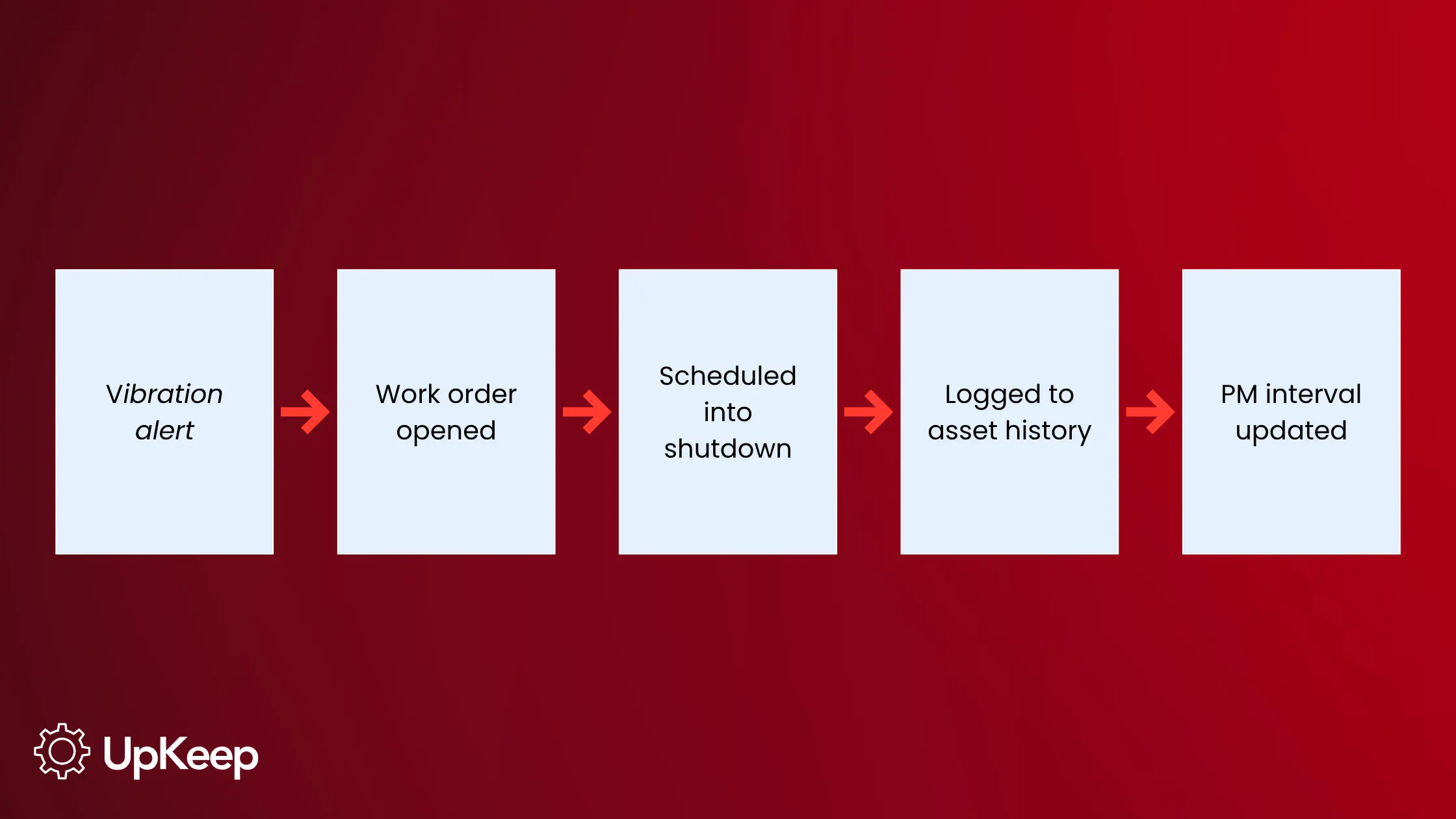
A condition alert sounds on a bearing or a treatment pump, a work order opens automatically with the right checklist and parts attached, the repair goes into the next shutdown window, and the record logs against the asset, where it feeds the next shutdown's priorities. That’s the UpKeep workflow. Schedule a demo to learn how UpKeep can help your pulp or paper mill maintain a strong uptime.
FAQ
How do technicians maintain pulp and paper machines day to day?
Technicians run scheduled PM tasks (lubrication, roll and felt checks, drive inspections), log meter readings for usage-based triggers, and respond to floor findings through work orders instead of verbal handoffs. Larger repairs, rebuilds, and anything requiring an extended outage get queued for the next planned shutdown window.
Is predictive maintenance worth the investment in a paper mill?
Yes, for the critical rotating assets that stop the whole line when they fail. Vibration and thermal data catch wear early enough to schedule the repair before it becomes a breakdown, and mills that concentrate predictive maintenance on their highest-risk equipment see the fastest return. Blanket sensor coverage across every asset rarely justifies the cost.
What does outsourcing plant maintenance cover, and what stays in-house?
Mills commonly outsource specialized work: vibration analysis, thermal imaging surveys, and major mechanical rebuilds that need equipment or expertise the plant doesn't keep on staff. Day-to-day PM, work order response, and asset record-keeping typically stay in-house, since that work depends on knowing the specific equipment and production schedule better than an outside contractor can.
How often do facility systems like fire suppression need testing?
Fire suppression follows the NFPA 25 schedule covered above, so the standard sets the frequency for the mill. Wastewater treatment and compressed air systems don't follow one fixed standard. Testing frequency there should follow manufacturer guidance and the equipment's condition history instead of a calendar guess.
4,000+ COMPANIES RELY ON ASSET OPERATIONS MANAGEMENT
Leading the Way to a Better Future for Maintenance and Reliability
Your asset and equipment data doesn't belong in a silo. UpKeep makes it simple to see where everything stands, all in one place. That means less guesswork and more time to focus on what matters.






![[Review Badge] Gartner Peer Insights (Dark)](https://www.datocms-assets.com/38028/1673900494-gartner-logo-dark.png?auto=compress&fm=webp&w=336)