Blog Post
Maintenance Teams Are Adopting AI Before Their Companies Do
Discover how maintenance teams are driving AI adoption from the floor up ahead of formal corporate rollouts, and learn how operations can strategically plan their first AI projects to tackle everyday paperwork.


Maintenance Teams Are Adopting AI Before Their Companies Do
Learn More About How AI is Changing the Work You Do.
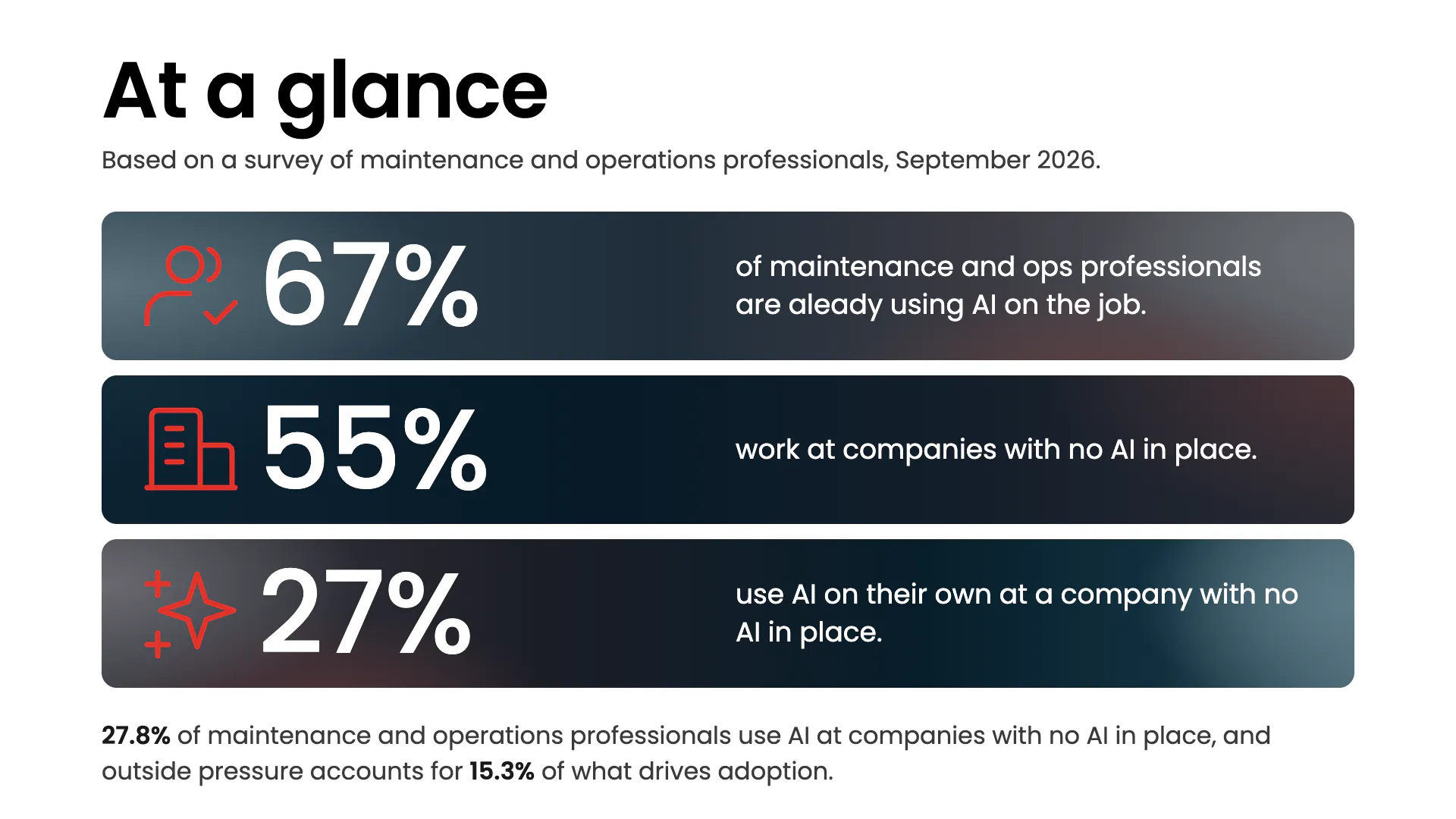
Plenty of maintenance supervisors already draft work orders with AI or use it to pull answers out of an equipment manual, and many of them work at companies with no AI plan for maintenance at all. In a September 2026 UpKeep survey of 518 maintenance and operations professionals, 27.8% said they use AI at least occasionally at an organization that hasn't rolled it out in maintenance or operations (UpKeep, AI In Operations: Teams Are Leading The Way survey, September 2026).
That gap between the floor and the front office should shape how an operation plans its first AI project. The findings below come from the full report, AI In Operations: Teams Are Leading The Way, which drew respondents from UpKeep's customer and prospect lists across eight industries.
AI adoption in maintenance is starting on the floor
Technicians and supervisors are trying AI tools on their own, well ahead of any formal rollout their employers approve for maintenance or operations.
Because trying a chatbot on a phone takes a few minutes and a company rollout waits on a security review and a purchase order, individual use moves much faster. One maintenance supervisor at a small manufacturer with no AI in place described building tools without any help.
"I can build my own apps.... I can talk to my documents and it will share the information and pictures the reply requires."
The people who approve AI budgets see the least of this activity. Directors and VPs of Operations reported the sharpest rise in worry about falling behind on AI over the past year, and they were also the least likely of any role to work somewhere AI is part of day-to-day work. For a director, the employees already using AI offer the quickest way in, since they have tested which tasks it handles well and which it gets wrong.
Efficiency drives maintenance AI adoption more than outside pressure
Asked for the single biggest reason their organization would adopt AI, respondents chose working more efficiently far more often than every outside pressure combined, from competitors to regulators.
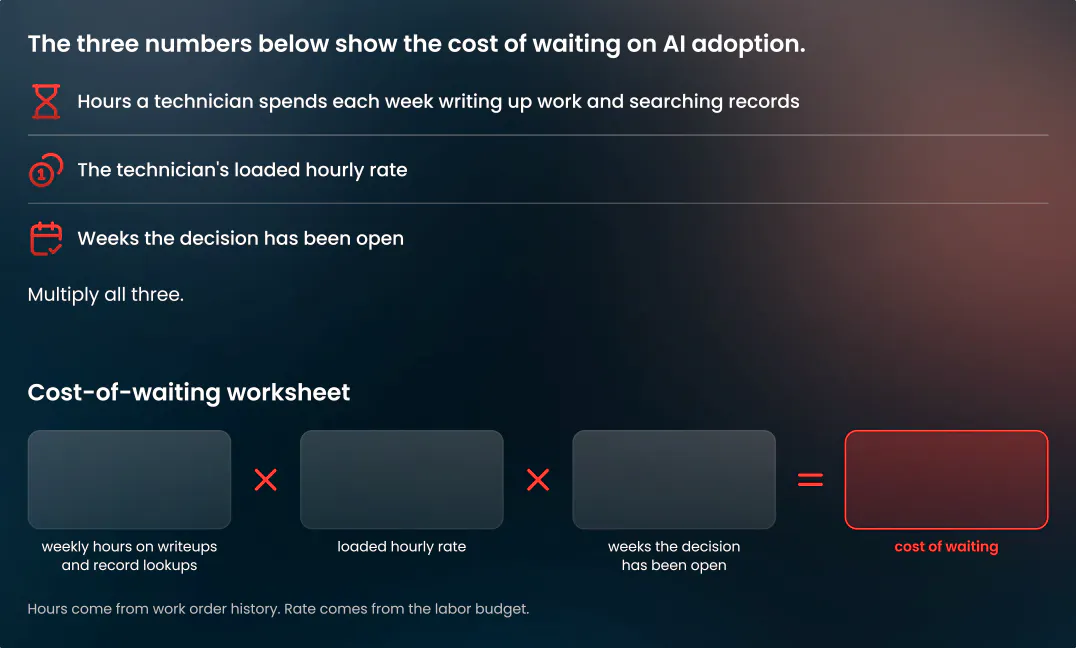
The survey also asked whether five pressures had changed over the past year, including leadership pressure for an AI strategy and budget for automation tools. On all five, the most common answer was no change. A budget request that leans on competitor moves or an expected mandate is therefore built on something that, at most sites, has held still. A stronger case comes from two figures the operation already keeps. Hours spent on write-ups and record lookups sit in the work order history, and the technician's loaded hourly rate sits in the labor budget.
Multiplied by the weeks the decision has stayed open, those figures give a cost of waiting that finance can check line by line.
Weekly hours on write-ups and record lookups × loaded hourly rate × weeks the decision has been open = cost of waiting


The first AI project in maintenance should take on paperwork
When respondents named where AI would help most, 43.1% picked paperwork such as writing up work orders, finding past records, and reporting to leadership, against 13.7% who picked diagnosing equipment (UpKeep, AI In Operations: Teams Are Leading The Way, September 2026). Paperwork led in every role and every industry the survey covered, and Directors of Operations favored it by the widest margin of any role.
“Nine years ago, when we adopted UpKeep, I said my goal was eventually to get the machines to write work orders for us. That’s still the goal, and I think it’s even more realistic as we enter this age of AI. … Instead of finding better ways to listen, we can actually give our machines a voice to talk to us.”
On the floor, the preference makes sense. When AI drafts a bad work order, the technician fixes it with one edit before saving. A wrong diagnosis can send someone across the plant for nothing and cost the tool the crew's trust, which takes far longer to win back than a few minutes of typing.
Write-ups also sidestep the retraining problem. Most crews already bend their process to fit their software at least some of the time, so a project that changes how the job gets done piles a second adjustment on top of a new tool. With AI drafting the record a technician was already going to write, nobody has to learn a new way of doing the job.
How an inventory supervisor at Axon replaced a parts search
At Axon Enterprise's New Mesa facility, eight robotic production lines run equipment up to 150 feet long, built from small components that all need replacing eventually.
"The techs would come in and look through the drawers for a part, usually with a picture pulled up on their phone."
Technicians often pulled a few likely matches to test, and every part that went unlogged pushed the system's parts count further from what was actually on hand. Stewart spent eleven months building a fix and keeps refining it.
He called it Dewey.
When a technician holds a part under a camera, Dewey identifies it and gives the exact drawer and slot where it belongs. Each night it sends Stewart a report of the parts used while he was off shift. In his spare time, he is now replacing the spreadsheet Axon uses to order and receive parts, where purchase orders and quantities are still typed in by hand.
Survey respondents who had built their own apps tell the same story in aggregate. Most said the work would otherwise have stayed manual or never happened, and only a small share would have filed a feature request or an IT ticket. For a director, the practical first step is finding the tasks on site that still run by hand and the people already doing them.
A three-level AI rollout for maintenance operations
A maintenance AI rollout holds up best when it moves through three levels, with each level running on the records the one before it produces.
Write-ups that need no retraining. AI drafts the work order from the job record, and the technician edits and saves it. Before starting, time how long it takes to close out a work order and to find a past record for a similar job, since those averages feed the cost-of-waiting math.
Workflows with a person at each decision point. Steps that only move information, like updating the parts count when a part leaves the crib, run on their own. Steps that need judgment, such as approving a large parts order or pushing a PM to next week, go to the right supervisor with the work order history attached.
A system that learns from its own workflows. Logged approvals show, over a few months, which ones slow work down and which are predictable enough to run without sign-off, while larger orders and safety steps keep a supervisor involved. Connected workflows can also flag the parts a scheduled job will need while there's still time to order them.
Most operations belong at Level 1, where one recurring write-up is enough to start this quarter. For sites running UpKeep, Nova builds Level 1 and Level 2 apps on the asset records and work order history already in the system, including years of free-text notes that older software couldn't put to use.
Maintenance supervisors make the strongest first builders
Supervisors and managers were the most common role among survey respondents who had built a working app, well ahead of every other group. Because they lead the crew day to day, they see where a process slows people down, and many still assemble recurring reports by hand. When that work runs late, the extra hours get logged as regular labor, so leadership sees an ordinary week and the process stays as it is.
"Now the person who knows the workflow best can describe what they need and build it that same day."
Among respondents who had never used Nova, many either didn't know building was an option or couldn't picture what they would make. A first build shown at a shift meeting answers both, because the crew sees a working tool made by someone who does their job.
Operations that give one supervisor time to automate one weekly write-up in 2027 will head into the following year with a working tool on the floor and a clearer list of what to build next. The full AI In Operations: Teams Are Leading The Way report breaks out every result by role and industry and includes a fill-in version of the cost-of-waiting worksheet.
4,000+ COMPANIES RELY ON ASSET OPERATIONS MANAGEMENT
Leading the Way to a Better Future for Maintenance and Reliability
Your asset and equipment data doesn't belong in a silo. UpKeep makes it simple to see where everything stands, all in one place. That means less guesswork and more time to focus on what matters.






![[Review Badge] Gartner Peer Insights (Dark)](https://www.datocms-assets.com/38028/1673900494-gartner-logo-dark.png?auto=compress&fm=webp&w=336)