Blog Post
HVAC Predictive Maintenance: How Condition Monitoring Cuts Downtime and Repair Costs
HVAC predictive maintenance detects faults before failure. Learn how condition monitoring and CMMS integration reduce downtime, cut energy costs, and extend equipment life.



Key Takeaways
HVAC predictive maintenance catches developing faults before they turn into failures.
Reactive HVAC programs hide their real cost until an emergency repair hits the budget.
Most facilities still run reactive programs even after they’ve realized planned work pays off. About three-quarters of maintenance programs remain reactive in day-to-day practice, since the next emergency keeps pushing planned jobs off the schedule.
CMMS integration turns a sensor alert into a closed work order. Without it, diagnostic data just sits in a dashboard while the fault keeps developing.
Predictive maintenance carries the highest up-front cost of any maintenance strategy but also the greatest long-term return.
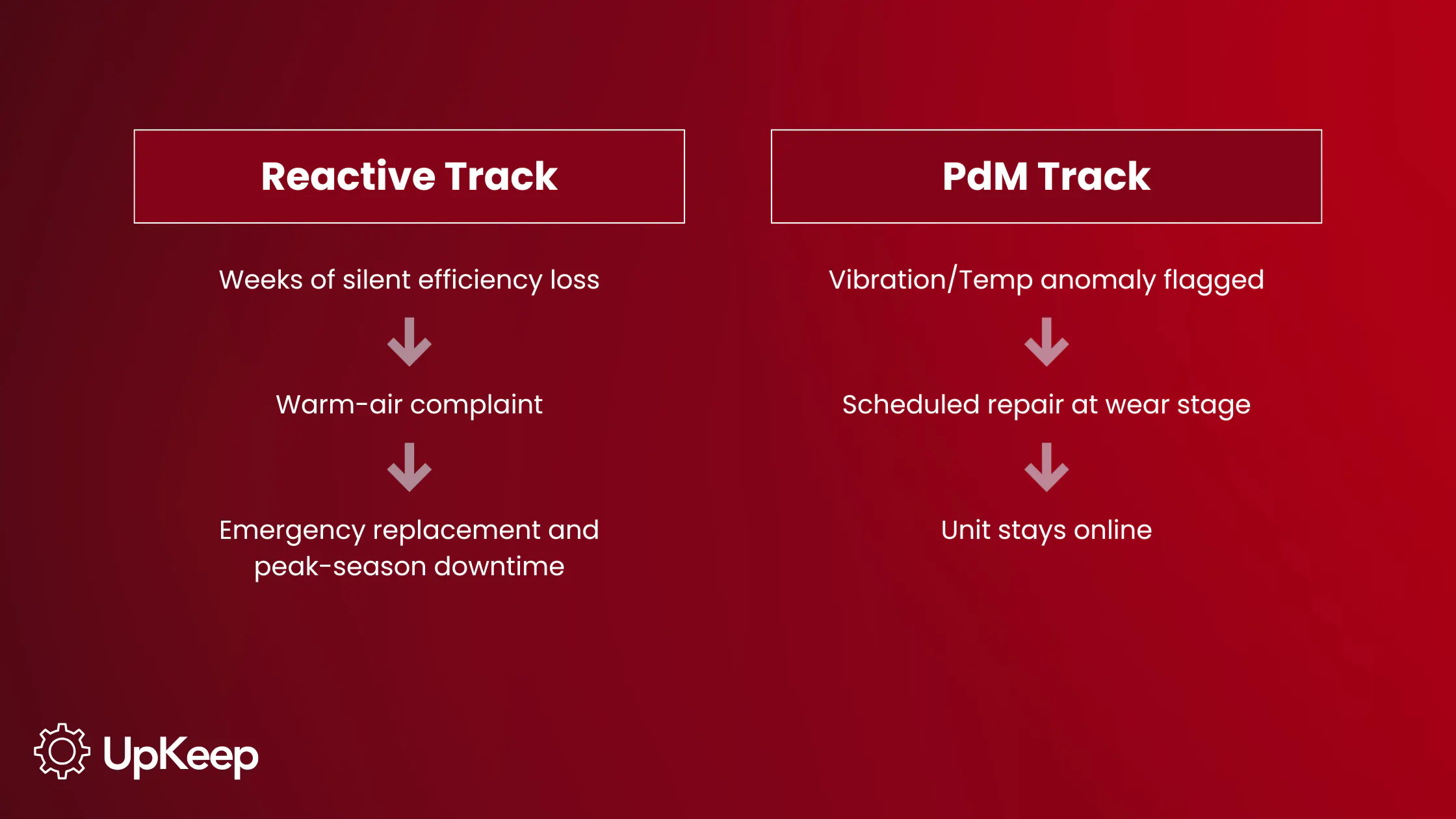
The first heat wave of the season is when reactive HVAC programs show their true cost. A rooftop unit that’s been drifting out of range for weeks finally seizes on a 95-degree afternoon, and a building engineer drops three planned jobs to chase the emergency. Tenants call while a server room climbs toward its thermal limit. The compressor that failed could’ve been repaired at the wear stage for a fraction of what the emergency replacement now costs.
The frustrating part is that most facilities teams already know planned maintenance pays off. Research from UpKeep found that 90% of maintenance professionals recognize the value of preventive maintenance, yet 74.6% still run programs that are reactive-dominated or hybrid (which is really reactive in practice because planned work keeps getting displaced). HVAC predictive maintenance closes that gap by changing the trigger for a repair from a calendar date to a condition reading, so the work order opens while the fault is still developing.
What Is HVAC Predictive Maintenance?
Predictive maintenance (PdM) uses condition data to schedule repairs around the actual state of an asset. Sensors monitor temperature, pressure, vibration, and motor current, and the system flags a developing fault before it becomes a failure. That’s the line separating it from preventive maintenance (PM), which triggers service on a fixed time or runtime interval whether the equipment needs it or not. A quarterly belt inspection runs on the calendar regardless of condition, while a vibration alert sounds only once the bearing actually starts to go.
Most facilities run both, applying PM to low-consequence units and reserving condition monitoring for the assets where a surprise failure hurts. Predictive maintenance is still early in adoption; UpKeep’s data shows only 19% of teams use predictive tools proactively, which means the real challenge is execution, since the strategy itself is already well understood.
Why the Cost of Reactive HVAC Adds up
Heating and cooling already make up the single largest energy expenditure in commercial buildings at roughly 35% of total energy consumption, according to the U.S. Department of Energy. Reactive maintenance quietly inflates that line item, and the energy penalty is only one of several money drains.
The same repair costs more when it’s unplanned. An emergency call-out results in overtime labor pay, expedited parts, and the premium a contractor charges to show up the same day. A compressor swap scheduled at the wear stage is a line on next month’s plan, whereas an identical job after a mid-summer failure runs on overtime with parts flown in.
Faults cost money before they ever grow into a breakdown. A refrigerant leak, a fouled coil, or a worn bearing forces the system to work harder for weeks or months, and that degraded efficiency lands on the energy bill the whole time. Because the unit keeps running, nothing flags the problem until comfort drops or the equipment quits, by which point the building has already expended the extra energy.
HVAC failure in an occupied building can quickly become a tenant complaint or a lease conversation. In regulated environments, it carries real teeth: A hospital that loses pressure control in an isolation suite or a food facility that can’t hold cold-storage temperature faces fines, failed inspections, and, in the worst case, a forced shutdown until the system is brought back into spec.


What Predictive Maintenance Catches Early
Rather than waiting for parts or machines to break, predictive maintenance can bring several benefits to your business. It gets ahead of the game by identifying small issues like:
Refrigerant Leaks: Pressure and temperature readings drift before a leak is large enough to affect comfort. Catching it at that stage limits the fix to a new seal and a recharge. Once the charge runs low enough to show up as warm air at the vents, the repair usually entails a unit pulled from service in peak season, after weeks of the compressor running hot on a starved system.
Compressor Wear: Vibration anomalies and a rising discharge temperature show up well before a compressor quits. Compressor replacement is one of the most expensive HVAC repairs in the building, so the distance between a planned intervention while it’s still just wear and an emergency swap after failure is measured in thousands of dollars and days of downtime.
Filter and Coil Fouling: Rising fan-motor load and falling airflow are measurable long before the system visibly struggles. That’s the efficiency drain showing up as a signal you can act on. Clean or replace at the alert, and the efficiency loss never gets to run for months unnoticed.
Bearing Failure: Vibration monitoring spots early-stage bearing wear in motors and fans before any audible noise or heat appears. Replacing a worn bearing on a planned schedule is inexpensive; letting it seize takes the motor or the shaft with it and turns a small part into a major repair.
Heat Exchanger Fouling: A declining delta-T across the exchanger, tracked over time, signals fouling well before heat transfer degrades enough to generate complaints. A scheduled annual inspection can miss it entirely, since the unit may look fine on the one day someone checks. A continuous trend line catches the drift as it happens.
From Sensor to Work Order: How the Workflow Closes
A sensor reading is only the start of the work. A facilities manager actually wants to know what happens after the alarm. For instance, how does a vibration anomaly at 2 a.m. become a dispatched technician with the right parts by morning?
In a lot of buildings, it doesn’t. The alert fires in a building automation system (BAS) dashboard that the facility manager checks two days later. A work order is then opened manually, with no asset history attached. The technician arrives guessing at the cause thanks to the missing maintenance record that would tell them this is the third bearing on that unit in 18 months. The diagnostic data was there the whole time; there just wasn’t a path connecting it to a technician who could act.
The integrated version closes that loop. The operational payoff is in the handoff that follows the alert:

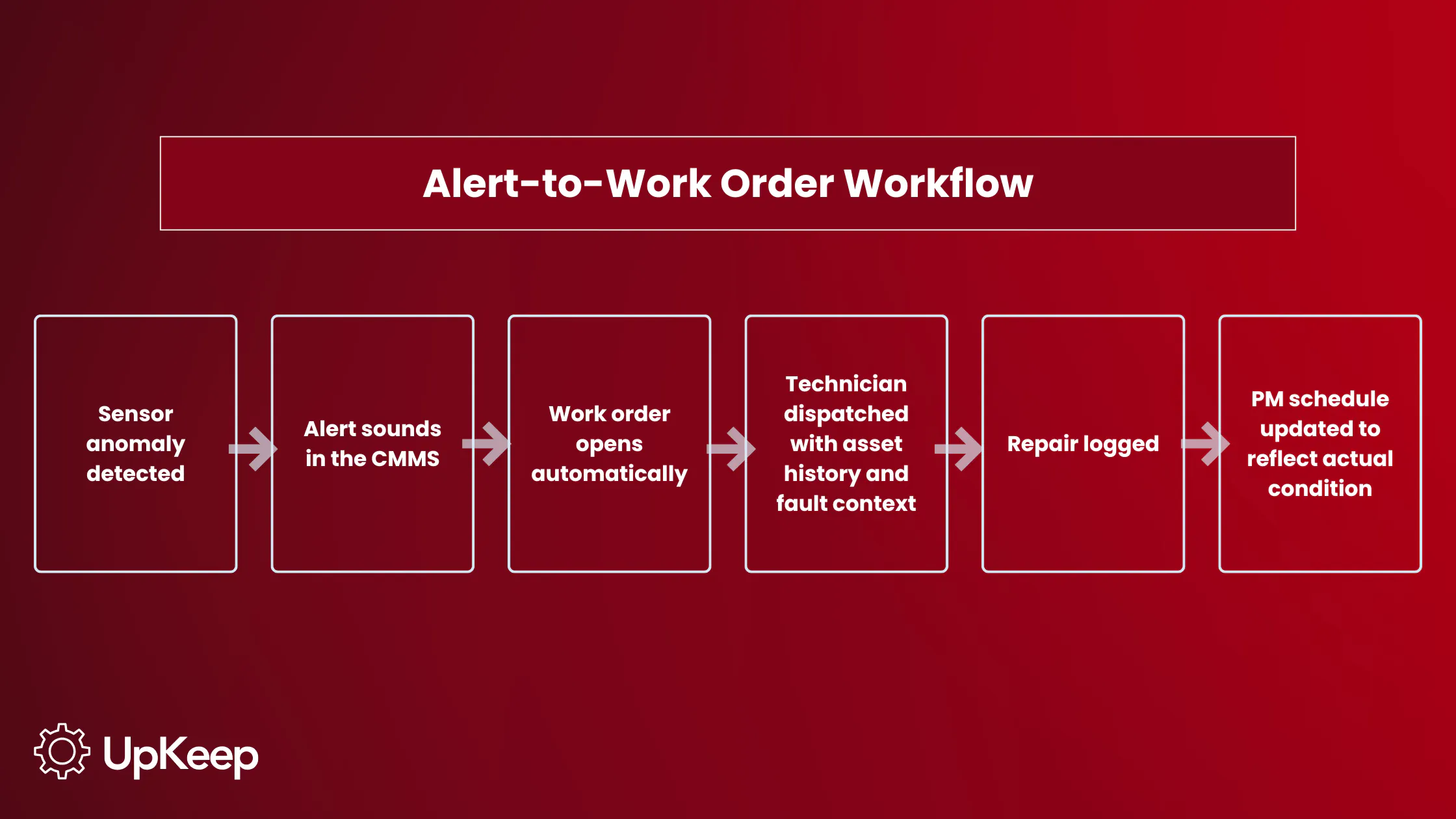
Every step in that chain used to require a human to notice, interpret, and re-enter data, and each handoff was an opportunity for the process to stall. Automating the chain means the fault that sounded in the middle of the night is a scheduled repair by the morning shift, with the right part already pulled.
Where the Stakes Are Higher
The true cost of an HVAC failure depends on the building’s function. In some environments, the calculation is stark enough to change which assets justify condition monitoring.
Hospitals
In a hospital, an HVAC system holds pressure differentials in isolation rooms and ORs, temperature stability in medication storage, and air quality for immunocompromised patients. A chiller degrading toward failure mid-summer is a patient safety and accreditation risk. That draws regulatory scrutiny and can close a unit until it’s corrected. Condition monitoring buys lead time that calendar-based PM can’t because it works from the asset’s real-time condition while the calendar only knows the service date.
Data Centers
Data centers build cooling redundancy precisely because a thermal event can take down entire racks. Monitoring chillers and CRAC units lets the team spot degradation in a redundant unit before the redundancy gets called on and isn’t there. The cost of that event shows up in lost hardware and interrupted service and is much higher than the price of the HVAC repair that would have prevented it.
Temperature-Controlled Environments
For food and cold storage, a temperature excursion spoils both product and uptime. A refrigeration unit that degrades over 48 hours before the compressor quits can take out an entire warehouse bay of inventory, while a broken cold chain could result in a regulatory hold or a destroyed lot. Condition monitoring reads that degradation curve early enough to act. A fixed inspection scheduled for next month does nothing for a unit that fails during the current week.
KPIs to Track
Proper monitoring means the program is working. These metrics show whether condition data is actually improving maintenance procedures and protecting uptime, and they double as the baseline you compare against after each repair.
|
KPI |
What It Measures |
Why It Matters for HVAC PdM |
|
MTBF |
Average time between unplanned failures on monitored assets |
Primary indicator of whether the program is extending equipment run time |
|
Planned-to-reactive ratio |
Proportion of work orders that were planned vs. emergency |
Shows whether the program is actually shifting the maintenance mix |
|
MTTR |
Average time from fault detection to asset back in service |
Faster detection plus pre-staged parts shortens repair windows |
|
Energy consumption per sq. ft. (kWh) |
HVAC energy draw normalized to conditioned space |
Spots efficiency degradation before failure and confirms repair impact afterward |
|
PM compliance % |
% of scheduled PM tasks completed on time |
Baseline metric; PdM builds on it without replacing it |
|
First-time fix rate |
% of work orders closed without a return visit for the same fault |
Improves when technicians arrive with diagnostic context instead of guessing at cause |
How to Get a Program Running
1. Criticality Assessment: Start by ranking HVAC assets according to what a failure would actually cost. A rooftop unit over a server room and one over a storage corridor sit at opposite ends of that range, so sensor budget should track the consequence of failure and leave the low-stakes units on a standard schedule.
2. Sensor Selection and Placement: Match the sensor to the failure mode you’re watching for: vibration on compressors and fans, temperature and pressure on refrigerant circuits, current sensors on motors, etc. Placement matters as much as type, since a vibration sensor on the wrong mounting point generates noise that buries the real signal.
The goal at this point is to match hardware to the specific faults the criticality ranking flagged as worth catching. What turns these readings into action comes later, once the alerts route into the CMMS.
3. Baseline Collection: Run monitored assets for at least 30 days before you set anomaly thresholds. A chiller behaves differently in July than in November, and a baseline built on a short or single-season window throws false alerts that erode technician trust fast. Bad thresholds lead to a system ignored.
4. CMMS Integration: Connect the diagnostics platform to the CMMS so an alert opens a work order on its own, without waiting for someone to spot the dashboard. This is the step that converts sensor data into action. The work order should carry the asset’s history, fault context, and a priority so the technician is dispatched already knowing what they’re walking into.
UpKeep’s Edge IIoT integration handles this handoff inside one system. The threshold breach opens the work order, attaches the maintenance record, and pushes the dispatch to the technician’s phone.
5. KPI Tracking and Threshold Refinement: Review alert accuracy quarterly. Both false positives and missed detections call for threshold adjustment, and treating that fine-tuning as routine program upkeep prevents the team from reading early noise as proof the system doesn’t work. The thresholds you set on day one are a starting point, and the program gets sharper as the data accumulates.
What a Monitored Program Looks Like
Reactive HVAC programs build their exposure quietly. The energy bill climbs for weeks before anyone connects it to a fouling coil, a compressor that a vibration alert would have caught early gets replaced on overtime after it seizes, and a chiller fails on the hottest afternoon of the year because nothing and no one saw it degrade. The cost is the repair plus everything the building loses while the system is down, and in a regulated facility, it can spiral into federal fines or a total shutdown.
A monitored program changes what you can measure:
MTBF extends on the assets carrying sensors.
The planned-to-reactive ratio moves as emergency work stops crowding out the schedule.
Energy use per square foot settles back down after a repair on the same dashboard that flagged the problem.
UpKeep ties that loop together through its Edge IIoT integration: A reading crosses a threshold, the work order opens with the asset's history attached, the technician gets the dispatch on their phone, and the PM schedule updates to match real conditions. Predictive monitoring builds on a working preventive program so the HVAC maintenance checklist that anchors your baseline still does its job underneath the sensors.
If you want to see what that handoff looks like on your own assets, start a free UpKeep trial or book a demo.
FAQ
What’s the difference between HVAC predictive maintenance and preventive maintenance?
Preventive maintenance runs on a schedule, usually a set calendar or runtime interval, regardless of how the unit is actually doing. Predictive maintenance works the other way, with sensors watching the asset and flagging a repair once the data shows a fault developing. Most facilities use both, putting PM on low-consequence units and PdM on the assets where an unexpected failure is expensive or dangerous.
Which HVAC assets should be prioritized for condition monitoring first?
The ones where a failure costs the most in money, downtime, or risk. Chillers, large rooftop units, and any equipment serving a critical space like a server room, an OR, or cold storage come first. A unit serving a low-traffic corridor can stay on a standard PM schedule. Rank by failure consequence before you spend on sensors.
Can predictive maintenance be added to existing HVAC equipment, or does it require new systems?
It can usually integrate with equipment you already have. Most condition monitoring uses external sensors for vibration, temperature, pressure, and current that mount on assets you already own and feed data into a CMMS, so start by putting sensors on the right units and routing the alerts somewhere a technician will act on them.
What’s a realistic ROI timeline for an HVAC PdM program?
The fastest return shows up on high-criticality assets, where avoiding a single emergency chiller or compressor failure can cover the sensor and integration cost outright. Energy savings from catching efficiency faults early accrue more gradually, month over month. Programs that start by monitoring their most expensive failure modes tend to see the math work sooner than ones that spread sensors thin across low-consequence units.
How does CMMS integration work with HVAC monitoring platforms?
The monitoring platform watches sensor data and applies thresholds. When a reading crosses one, the platform sends an alert to the CMMS, which raises a work order with the asset’s history and a priority already on it, then dispatches a technician. The integration is the piece that turns a reading into a repair, so without it, the data just accumulates in a dashboard nobody acts on fast enough.
What does HVAC predictive maintenance cost to implement?
It runs higher up front than any other maintenance strategy due to sensors, integration, and the time to set baselines and adjust thresholds. That cost is concentrated at the start, then the return builds over the asset’s life through avoided failures and lower energy draw. Concentrating sensors on the highest-consequence assets keeps the up-front spend proportional to the risk it’s buying down.
4,000+ COMPANIES RELY ON ASSET OPERATIONS MANAGEMENT
Leading the Way to a Better Future for Maintenance and Reliability
Your asset and equipment data doesn't belong in a silo. UpKeep makes it simple to see where everything stands, all in one place. That means less guesswork and more time to focus on what matters.






![[Review Badge] Gartner Peer Insights (Dark)](https://www.datocms-assets.com/38028/1673900494-gartner-logo-dark.png?auto=compress&fm=webp&w=336)