Blog Post
Is Predictive Maintenance Worth It? Pros, Cons, and ROI Explained
Predictive maintenance is gaining in popularity, but is it right for your business? Discover its strengths and drawbacks to decide for yourself.



Key Takeaways
Predictive maintenance uses real-time condition monitoring and AI to identify equipment failures before they occur, reducing unplanned downtime by up to 25% and cutting maintenance costs by 25%–30%.
The primary disadvantages of predictive maintenance include high up-front costs, specialized staffing requirements, and implementation complexity, but these are best evaluated against total cost of ownership.
Organizations that connect predictive insights directly to work orders, inventory, and compliance workflows realize the greatest operational returns and ROI.
If given the option to maintain your most critical assets, which would you choose: picking up after failures, following rigid inspection schedules, or using real-time data to predict and prevent problems before they occur? The third option is all predictive maintenance (PdM), and it’s rapidly reshaping how organizations manage their assets.
Like with any strategic investment, PdM comes with meaningful trade-offs worth considering before you commit. This guide breaks down what predictive maintenance is, why it matters, and takes an honest look at both its advantages and disadvantages so your teams can make informed decisions about how best to maintain your equipment.
A Brief Explanation of Predictive Maintenance
Predictive maintenance uses real-time condition monitoring to anticipate equipment failures before they occur, rather than waiting for breakdowns (reactive maintenance) or following fixed inspection schedules (preventive maintenance).
PdM continuously monitors the actual condition of assets and flags anomalies before they escalate. Common condition-monitoring techniques include:
Vibration analysis to detect imbalances or bearing wear in rotating equipment
Infrared thermography to identify electrical hotspots or insulation failure
Acoustic emission monitoring to detect cracks, leaks, or structural changes
Oil analysis to measure contamination or lubricant degradation
The process follows five core steps:
Monitoring asset condition and performance over time using IoT sensors and condition-monitoring tools
Analyzing that data with machine learning algorithms to detect anomalies
Planning with the data-driven insights to optimize inventory for maintenance, repair, and operations (MRO)
Triggering a work order automatically when the system detects a condition that requires intervention, routing the relevant data to the right technician
Performing the repair or service during planned downtime


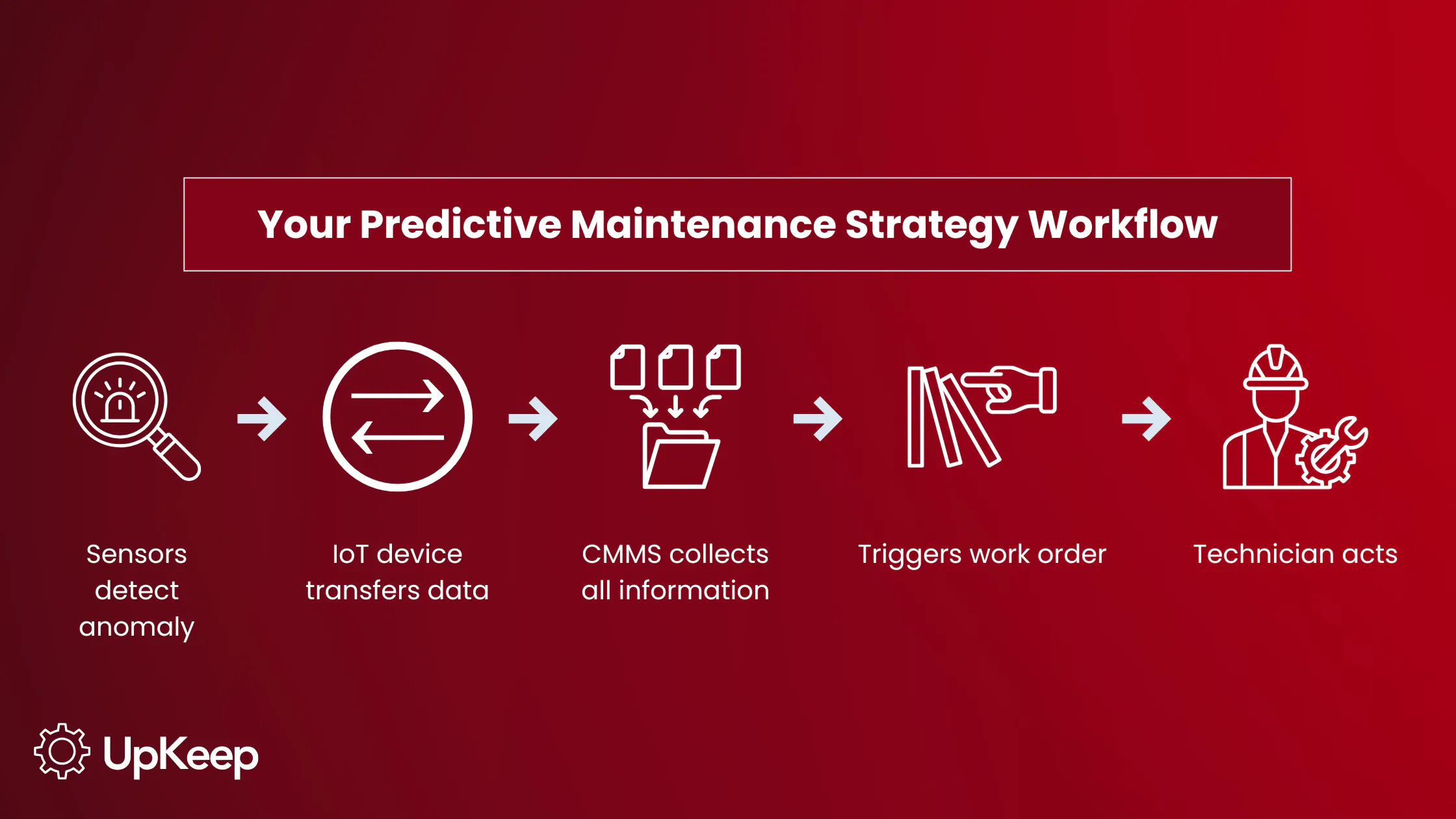
The result is a data-driven system that doesn’t just tell you something will fail, but when and what to do about it.
Getting Ahead: The Advantages of Predictive Maintenance
Reduced Unplanned Downtime
Unexpected equipment failure disrupts production, strains teams, and carries significant financial consequences. AI-driven PdM can decrease unplanned downtime by 25% by identifying failure signatures before they become breakdowns.
For capital-intensive industries like manufacturing, aerospace, and fleet operations, that reduced downtime directly translates to higher throughput, fewer missed commitments, and better customer outcomes.
Extended Asset Lifespan
Predictive maintenance optimizes the total lifespan of equipment. By detecting abnormalities early, teams can address developing issues before they become serious damage. This shifts maintenance from a corrective activity to a preservation strategy.
Only servicing equipment on an as-needed basis also avoids the unnecessary wear and disruption that comes with over-maintenance. The result is assets that perform longer and deliver more value over their operational life, deferring the need for expensive capital expenditures.
Cost Efficiency Over Time
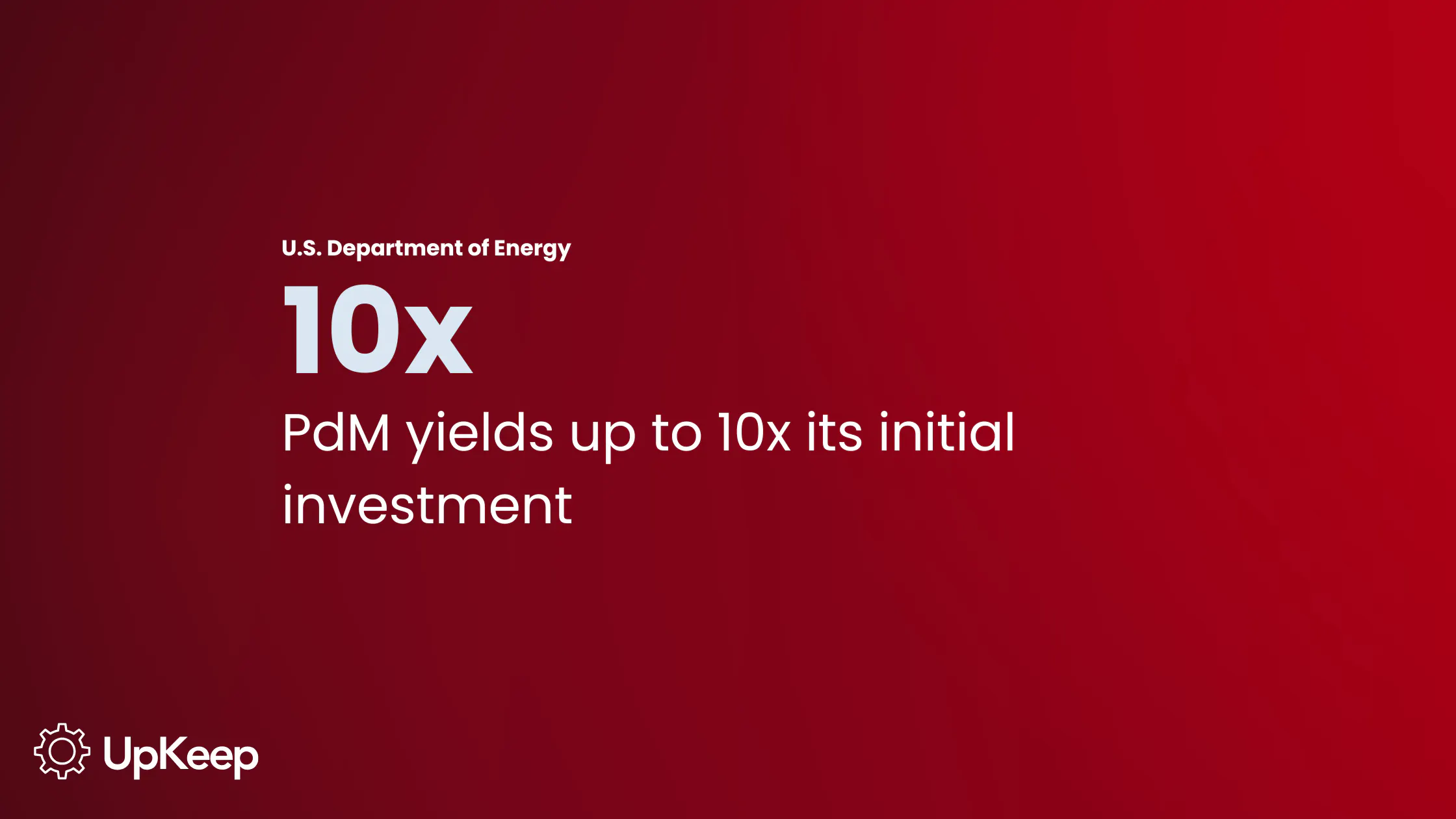
Predictive maintenance makes a compelling financial case as well thanks to fewer emergency repairs, lower parts consumption, and optimized technician scheduling. Organizations that implement PdM effectively report returns of up to 10 times their initial investment.

Improved Workplace Safety
Staying ahead of breakdowns creates better and potentially life-saving working conditions for technicians and operators. When a pump, conveyor, or pressure vessel fails unexpectedly, the consequences can extend well beyond downtime. Predictive maintenance shifts teams from high-pressure emergency situations to controlled maintenance activities, creating an inherently safer environment.
Equipment failure and machinery issues are in the 10 most common sources of OSHA violations, and the associated fines represent only a fraction of the potential losses from unsafe conditions. By identifying equipment issues before failure occurs, predictive maintenance programs help facilities protect both workers and your bottom line.
Data-Driven Continuous Improvement
PdM systems do more than monitor for equipment degradation and failure. They generate a continuous record of how assets behave over time. That data becomes a foundation for operational improvement beyond maintenance itself. Unusual patterns or deviations in production can point to areas where process optimization is needed.
The data collected over time by a PdM program can inform strategic budget planning, supplier decisions, design changes, and workforce development.
Sustainability and Energy Efficiency
Inefficient motors, compressed air leaks, and degraded insulation all increase energy consumption and the costs that come with it. PdM identifies these weaknesses early, enabling corrective action that reduces operating costs, energy waste, and environmental impact. For organizations with environmental, social, and governance (ESG) commitments, predictive maintenance is an increasingly important operational tool.
Putting in the Investment: The Disadvantages of Predictive Maintenance
High Up-Front Costs
Predictive maintenance is an expensive program to start. Its condition monitoring infrastructure can include IoT sensors, printed electronics, cloud-based analytics platforms, and management dashboards. The cumulative investment can be significant, particularly for organizations with distributed asset fleets.
The labor required to deploy and configure these systems also adds up. Organizations should evaluate predictive maintenance with a long-term financial view, but shouldn’t underestimate what getting started actually costs.
Specialized Skills and Staffing
A predictive maintenance program is only as effective as the team interpreting the data it generates. This requires dedicated upskilling for existing staff or investing time and money into hiring workers with specialized expertise. Vibration analysts, data scientists, and reliability engineers are both high in demand and hard to retain.
Implementation Complexity
Integrating predictive maintenance tools with existing infrastructure and workflows requires cross-departmental coordination. Maintenance, IT, and operations teams each have a stake in how data flows, how systems communicate, and how insights translate into action. Without deliberate planning and governance, PdM implementations can become siloed monitoring tools that require manual handoffs.
The complexity increases in multi-site environments, where consistent data governance and interoperability across facilities become critical challenges.
Risk of Over-Reliance on Technology
Machines aren't foolproof. There’s a real risk that teams may begin to trust sensor data over their own experience and judgment, potentially ignoring visible signs of equipment issues that the monitoring system fails to flag. PdM tools may miss an untwisted bolt, for example, because it doesn't affect machine activity, but a routine inspection could catch the problem.
The most effective predictive maintenance programs treat technology as an augmentation of human expertise, not a replacement. Experienced technicians remain essential for interpreting ambiguous data and catching what sensors can’t see.
Predictive Maintenance Pros and Cons
|
PdM Pros |
PdM Cons |
|
Reduces unplanned downtime by up to 25% |
High up-front costs for hardware and software |
|
Extends asset lifespan through early issue detection |
Requires specialized skills and ongoing training |
|
Delivers 25%–30% cost savings vs. preventive maintenance |
Complex integration across departments and systems |
|
Improves workplace safety through planned, controlled maintenance |
Risk of over-reliance on technology at the expense of experience |
|
Generates data for continuous operational improvement |
May miss physical issues that sensors don't detect |
|
Supports sustainability and ESG commitments |
Slower ROI realization in low-utilization environments |
Predictive Maintenance Examples Across Industries
Manufacturing: Smart factories use IoT sensors and AI analytics to monitor rotating equipment and integrate data into inventory and logistics planning, improving lead times on key components. The convergence of AI and the Industrial Internet of Things (AIoT) enables real-time sensing and learning that informs fault detection and asset lifespan estimation.
Aerospace: Sensors stream data to cloud-based analytics platforms where AI monitors engine health in real time. Digital twin technology allows teams to simulate and optimize engine performance across its life cycle, predicting maintenance needs before they become in-flight disruptions.
Fleet and Transportation: Logistics fleets use PdM platforms to identify underperforming vehicles, prioritize critical repairs, and avoid expensive unplanned downtime. With route reliability directly tied to vehicle availability, predictive maintenance is a competitive advantage.
Healthcare and Diagnostics: Pharmaceutical manufacturers and diagnostics labs deploy PdM to maintain instrument calibration and uptime. In this industry, the cost of instrument failure for both compliance and patient impact makes reduced downtime well worth the investment.
Looking Ahead: The Future of Predictive Maintenance
Trends Shaping Predictive Maintenance Technology
The next generation of predictive maintenance is about AI that acts, not just alerts. In addition to flagging equipment degradation, it recommends the specific repair action, optimal timing, and required parts.
UpKeep's Nova AI already moves in this direction, automating repetitive work order creation and letting technicians trigger changes through natural language. That means teams spend less time on dashboards and more time on the floor, where work actually gets done.
Augmented reality is increasing in industrial maintenance adoption, allowing technicians to view IoT sensor data overlaid directly onto equipment, receive step-by-step maintenance procedures, and collaborate with remote experts. It’s particularly valuable for complex procedures on critical equipment.
Digital twins, or virtual replicas of physical machinery, are on the rise, which allow real-time simulation and deeper insight into equipment behavior. Teams can model and practice failure scenarios without safety risk or operational disruption, then apply those learnings to maintenance planning.
How to Evaluate Predictive Maintenance Tools
1. Prioritize mobile-first platforms
Field teams don't work at desks. Platforms that meet technicians where they already work, such as through a purpose-built mobile app, make it easier to act on predictions in real time rather than returning to a desktop.
2. Assess security and data governance rigorously
Unified learning and hybrid AI models enhance responsiveness, privacy, and adaptability. This matters especially for multi-site organizations that need to train predictive models across facilities without centralizing sensitive operational data. Evaluate whether a platform meets enterprise-grade privacy and data protection standards before scaling across multiple sites.
3. Favor platforms built for the full asset life cycle
Evaluate any new tools against the total cost of ownership (TCO) rather than purchase price alone. How many pieces of software will you need? For instance, UpKeep's unified platform spans CMMS, EAM, EHS, Fleet, and Edge, connecting predictive insights directly to work orders, inventory, compliance workflows, and reporting.
4. Prioritize open integrations and customization
As you evaluate vendors, ask how their platform integrates with existing ERP, EHS, and fleet systems. Look for seamless options like UpKeep's Studio, which is an app builder that lets clients create custom applications designed around their own systems and workflows. It also features a library of pre-built apps ready to deploy. Studio’s flexibility reduces manual workarounds and ensures your maintenance platform can grow alongside your operation.
Look Ahead With Predictive Maintenance
Predictive maintenance represents a fundamental shift in how organizations think about asset management with intelligent, data-driven decision-making. The advantages are substantial, spanning reduced unplanned downtime, extended asset lifespans, improved worker safety, and long-term cost savings.
Like any strategic initiative though, PdM requires honest planning around up-front costs, staffing needs, and integration complexity. The key to maximizing its value lies in choosing a platform that connects predictive insights to real operational workflows rather than leaving teams to manually bridge the gap between data and action.
Organizations that treat PdM as a system-wide strategy, supported by the right technology and empowered teams, consistently outperform those that treat it as just another monitoring tool. As AI, digital twins, and augmented reality continue to mature, the ceiling for what predictive maintenance can deliver will only rise.
UpKeep's unified platform connects condition monitoring, AI-driven insights, work order management, and inventory all in one place. Whether you're just starting your predictive maintenance journey or scaling across multiple sites, UpKeep gives your teams the tools to act faster, work smarter, and keep your most critical assets running.
Book a tour today or sign up for a free trial.
Frequently Asked Questions about Predictive Maintenance Advantages and Disadvantages
Why use predictive maintenance?
Predictive maintenance allows organizations to shift from reacting to failures to preventing them, which in turn lowers downtime, controls costs, improves safety, and extends the lifespan of critical assets. For organizations with high asset utilization and significant downtime expenses, it delivers attractive returns.
What is the biggest disadvantage of predictive maintenance?
The most common challenge to PdM is the high up-front investment required, as it entails sensors, software, integration, and the specialized talent needed to act on data effectively. Organizations should evaluate ROI over the full life cycle of the program, not just the initial deployment cost.
How long does it take to see ROI from predictive maintenance?
ROI timelines vary by industry, asset criticality, and implementation scope. High-utilization environments such as pharmaceutical manufacturing, aerospace, and large fleet operations often offset implementation costs quickly due to the massive savings from avoiding unplanned downtime. Broader deployments may take one to two years to demonstrate positive return.
4,000+ COMPANIES RELY ON ASSET OPERATIONS MANAGEMENT
Leading the Way to a Better Future for Maintenance and Reliability
Your asset and equipment data doesn't belong in a silo. UpKeep makes it simple to see where everything stands, all in one place. That means less guesswork and more time to focus on what matters.






![[Review Badge] Gartner Peer Insights (Dark)](https://www.datocms-assets.com/38028/1673900494-gartner-logo-dark.png?auto=compress&fm=webp&w=336)