Blog Post
The Future of Predictive Maintenance: What Changes for Your Team
Predictive maintenance is moving from condition monitoring to autonomous action. Here's what that shift means operationally and what your team needs in place to benefit from it.



Key Takeaways
The future of predictive maintenance lies in workflow. Sensors are already generating the data. What most operations lack is the layer that turns a fault alert into a dispatched technician without manual triage in between.
PdM is moving toward prescriptive maintenance, and the CMMS is what makes that shift operational. Predictive systems flag a developing fault; prescriptive ones recommend or trigger the repair.
Maintenance technicians aren’t being replaced by AI, but their role is shifting. Pattern recognition moves to the model, while diagnosis and the hands-on fix stay with people. Skilled-trades demand is actually climbing as AI expands.
The biggest barrier to a working PdM program is data quality. Models trained on incomplete asset histories produce unreliable predictions, so the teams that benefit are the ones building clean logs now.
The corrective-to-preventive ratio is the clearest signal of program maturity. A falling ratio over 12 to 18 months confirms reactive work is dropping; if it stays flat or climbs, the alert isn't reaching the execution layer.
Walk into most maintenance operations today and you’ll find sensors already streaming condition data somewhere in the building.
The signal is there, but it’s missing the link to the work order system that turns a reading into a repair. A bearing starts trending toward failure, the system logs it … and the alert sits in a dashboard nobody opens until the asset quits.
That gap is what predictive maintenance is working toward next. The sensors and models keep improving and getting cheaper. The advantage goes to the operations that connect a fault signal to a technician on the way to fix it, whatever hardware they’re running.
Where Predictive Maintenance Stands Today
Predictive maintenance has moved from an emerging idea to active investment. MarketsandMarkets projects the market will grow from $13.89 billion in 2026 to $23.79 billion by 2031. The spend is real. The question is where it’ll land.
Most of it goes toward monitoring, such as sensors, gateways, and the analytics platforms that read them. Far less spend goes toward the workflow that acts on what this equipment finds. Condition data piles up, dashboards fill, and the operation keeps running reactively because nothing connects the alert to the work order. UpKeep found that 90% of maintenance professionals say they recognize the value of planned maintenance. Yet, 74.6% still run reactive-dominated or mixed programs.


The Shift From Predictive to Prescriptive Maintenance
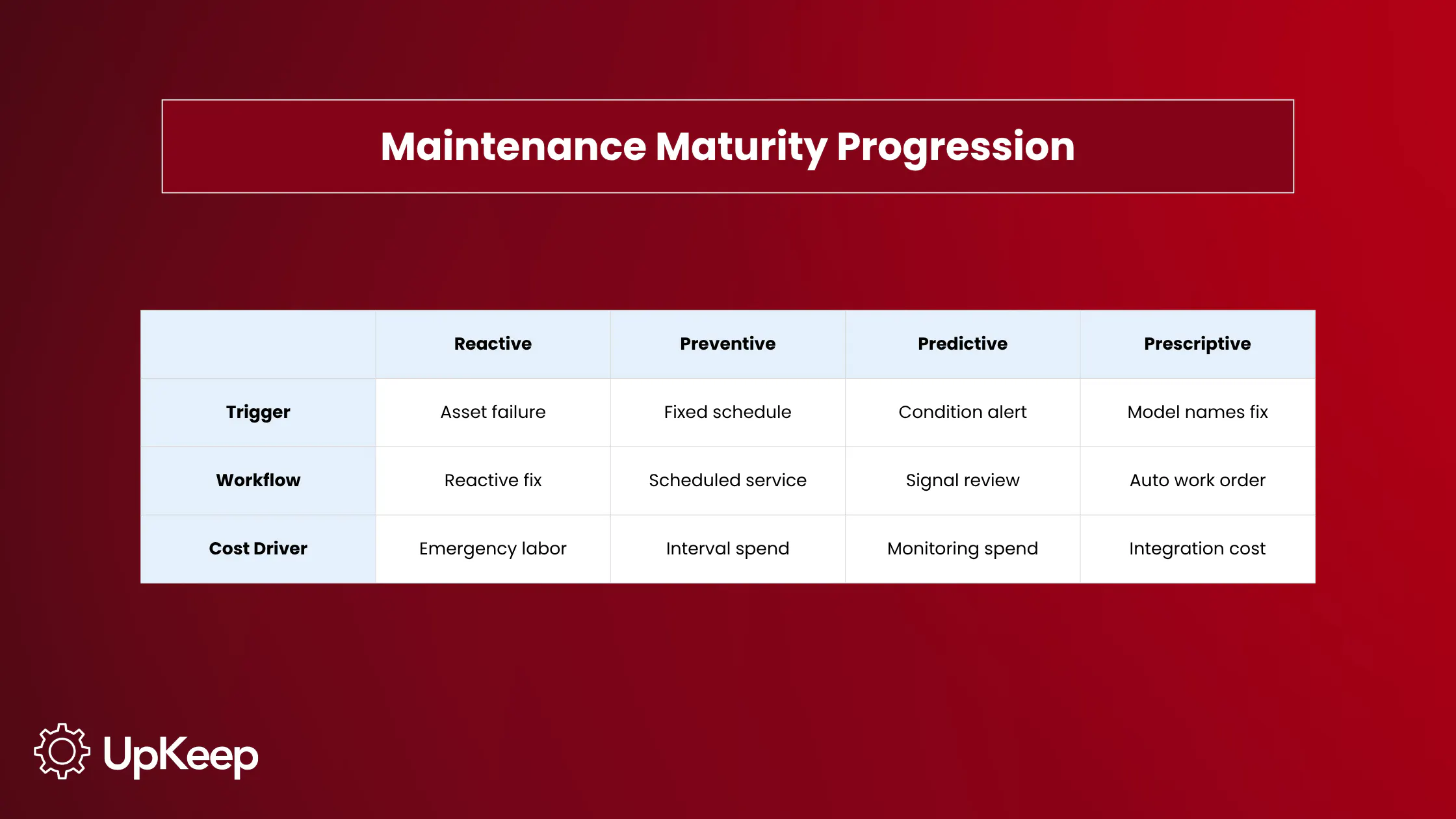
Predictive maintenance answers the question, “When is this asset likely to fail?”
Prescriptive maintenance picks up from there. It recommends what to do about the fault and, more and more, starts doing it. That second step is the shift that defines the field’s next phase.
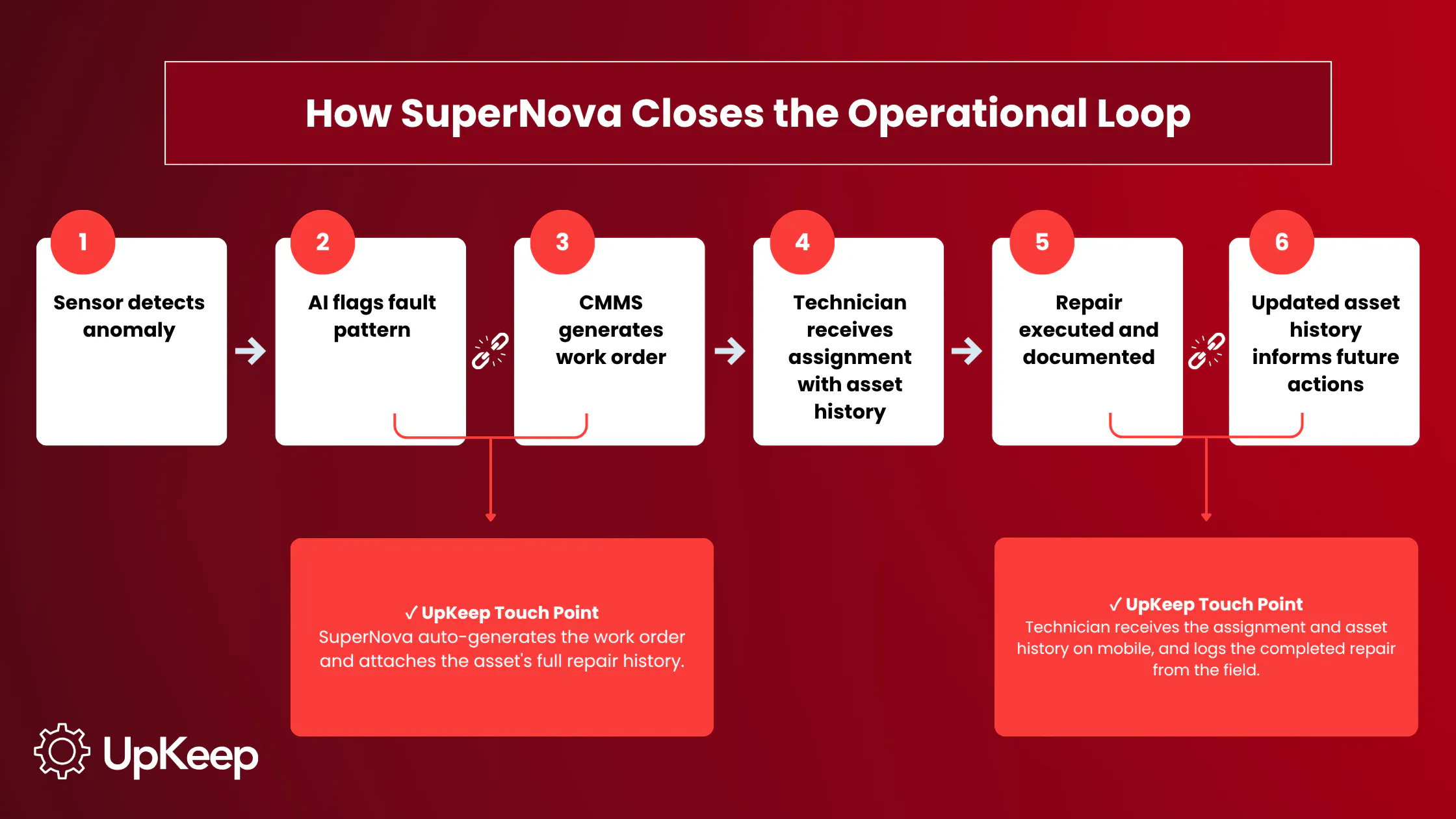
When everything works as intended, a sensor detects an anomaly in motor current, and a model flags it as an early-stage bearing fault. The CMMS opens a work order, attaches the asset’s repair history, and routes it to a technician. The tech shows up already knowing the context, makes the fix, and logs it. That outcome feeds the next prediction.
In most operations, though, almost every arrow in that chain is a break point. The signal stops at a dashboard. Someone has to notice it and decide what to do, and the work order is manually created hours later, missing the history that would have sped up the fix.
Prescriptive maintenance fixes those breaks. It wires the chain together so a signal that used to stall now moves straight into a work order.
Where Agents Take Over the Busywork
AI is naturally gaining traction here. Agentic systems take a sequence of actions toward a goal, with a person signing off on the consequential ones. Instead of waiting, an agent can open the work order, assign it, and follow up on its own.
UpKeep’s SuperNova is built along these lines: It creates, assigns, and manages work orders across the tools a team already uses, runs PMs on a schedule, and surfaces downtime as it happens, with the team approving the calls that matter.
Its assistant, Nova, sits inside the platform to answer questions, read back work order history, and generate inspection checklists on demand. Both remove the manual triage that sits between a known fault and the work that clears it.

Key Technologies Shaping the Next Five Years
Four technologies stand out as foundational for the future of predictive maintenance. Each one has an operational barrier that comes down to how your data is captured and connected:
AI and machine learning turn your failure history into early warnings. Train a machine learning model on a few years of work orders, sensor readings, and repair outcomes, and it'll flag a degradation pattern long before anyone catches it on a walkthrough. The hard part is the training data. The algorithms are already strong; what’s weak is the clean record of what failed and why, which most operations don’t keep consistently.
IoT sensors and edge computing supply the raw signal. Sensors stream vibration, temperature, and current readings around the clock, and edge computing crunches them on-site so a decision doesn't wait on a round trip to the cloud. The tech is mature, and it keeps getting cheaper. Integration is the stumbling block. A sensor feeding a platform that's cut off from your work order system just generates alerts nobody acts on.
Digital twins build a virtual replica of a real asset so you can simulate a failure and test fixes without touching production. But a twin is only as good as the data behind it. Research on next-generation predictive maintenance frameworks (IEEE) ties a twin's accuracy mostly to the quality of the data feeding it. One built on thin maintenance history just models a machine that doesn't quite exist.
Prescriptive and agentic systems sit on top of prediction. Rather than just flagging a fault, they recommend or trigger the fix and route it for approval. This is the layer that needs the cleanest data of the four, and it's the riskiest to get wrong; a system acting on bad predictions can cause real damage before anyone notices.
What This Means for Maintenance Teams
Technician roles stay but change
The worry that AI will replace technicians misunderstands the technology. Pattern recognition at scale moves to the model. The physical diagnosis, the judgment calls, and the repairs that need a person on-site stay human.
The numbers back up the staying power of this role, with the U.S. Bureau of Labor Statistics projecting employment of industrial machinery mechanics and maintenance workers to grow 13% from 2024 to 2034. That’s noticeably quicker than average, and automation itself is named as a driving force. More automated equipment means more equipment to keep running after all.
Data from UpKeep makes the same prediction from the employer's side, with 63.6% of teams saying they're struggling to attract skilled talent. AI isn’t taking away jobs; it’s adding them, and encouraging upskilling at that.
Managerial roles shift from scheduling to judgment
As the system takes over the routine scheduling, your job tilts toward interpretation: Which alerts are worth acting on? What are the trends actually telling you? Treating the output as a black box is how you leave value on the table. Teams that build real data literacy get the most out of these systems. Make that investment early, and it’ll compound.
Data infrastructure is the quiet prerequisite
Your first real investment in predictive maintenance is a connected CMMS that steadily builds asset history over time. Sensors come later.
Data quality depends on workflow. Techs in clunky systems skip documentation under pressure, and those gaps degrade the records a model depends on. Clean history is the raw material a future program is built on, so capturing that information needs to start now.
Barriers to Adoption and What Actually Solves Them
Predictive maintenance operations usually stall due to one of these issues:
Incomplete Asset History: A model is only as good as the records it learns from, and most operations don't have the proper logs to train one yet. The fix is unglamorous: Start the CMMS discipline now. 12 to 18 months of consistent documentation, covering failure modes, parts used, and repair outcomes, gives you the data that makes predictions worth trusting. Fleet operations hit the same wall across scattered assets, often on a bigger scale though.
Disconnected Systems: Every handoff between the sensor layer and the CMMS is a potential place where the signal can die. A reading triggers an alert, the alert lands on some separate platform, but nothing opens a work order. Connecting the monitoring layer to the work order system is the most important technical investment you can make, ahead of any sensor upgrades.
Alert Fatigue: False positives are the fastest way to lose a technician's trust. After a handful of alerts that lead nowhere, people stop acting on them, and it no longer matters how accurate the system is on average. Cutting the false-positive rate matters as much as raising detection accuracy.
Entry Cost and Complexity: The cost of a predictive program encompasses hardware, integration, and the analytics layer, and the hardware is rarely the obstacle. Integration and a standalone analytics platform are what push it out of reach for smaller teams. A CMMS-integrated approach like UpKeep Edge folds both into the system already running your work orders, which lowers the entry point.
Workforce Skill Gaps: Predictive systems push analytical work onto the people reading the output. A tech who’s spent a career turning wrenches now has to read a degradation trend and decide whether it's worth a service visit. Closing that gap takes real training, not just handing someone the tool. It’s the barrier most operations underestimate, even though their own priorities point right at it. In fact, UpKeep found that 73% of teams rank workforce training as their top investment area, ahead of AI and automation by about three to one.
Cybersecurity in Connected Systems: Every sensor streaming to the CMMS is one more networked end point, so tying operational technology to IT widens the attack surface. If you're routing equipment data through cloud analytics, that pipeline is part of your security perimeter and so needs segmentation and a vendor security review from day one. The risk stays invisible right up until there’s a breach, which is why companies keep putting it off.
KPIs for a Future-Ready Predictive Maintenance Program
Model-level metrics aren’t just where a program proves itself. These five operational KPIs tell you whether the predictive layer is actually changing how work gets done. Track these before you start fine-tuning the model.
|
KPI |
What It Measures |
Why It Matters for PdM Maturity |
|---|---|---|
|
MTBF |
Average operating time between asset failures |
Rising MTBF confirms predictive interventions are working. Flat or declining suggests faults aren't being caught early enough. |
|
Unplanned Downtime % |
Proportion of total downtime that was unscheduled |
Mature programs shift downtime from unplanned to planned. This ratio is the most direct measure of program effectiveness. |
|
Alert-to-Work-Order Rate |
% of system-generated alerts that result in a work order |
Low rates signal alert fatigue or disconnected systems. High false-positive rates show up here before in downtime data. |
|
PM Compliance Rate |
% of scheduled PMs completed on time |
A predictive program built on low PM compliance inherits the same asset-history gaps that undermine model accuracy. |
|
Corrective-to-Preventive Ratio |
Reactive repairs versus planned maintenance work orders |
A falling ratio over 12 to 18 months confirms reactive work is giving way to planned work. |
Building Toward a Future-Ready Program
Moving from reactive maintenance to a predictive approach requires a deliberate plan that aligns assets, data, workflows, and people around a common goal.
Map your assets by criticality first. Score each asset on two things: what a failure costs you in downtime, safety, and repair, and how likely that failure is. The assets that rate high on both are where the sensor and monitoring spend goes first, which keeps you from wiring up low-stakes gear ahead of the equipment that can actually stop production.
Build clean asset histories before you add predictive tech. Get into the habit of capturing work orders consistently. A model can only learn from records that show what actually broke and how it got fixed, and that history takes time to build up.
Pilot using two or three bad actors. Pick assets with documented failure histories so you can measure against a baseline you already know. A controlled test on known problem assets gives you the proof-of-value data that supports an organization-wide rollout.
Wire sensor alerts straight into the CMMS work order system. An alert that never reaches the work order system is where predictive programs lose their value, so integration isn't optional. When done right, an alert turns into a work order on its own.
Train the team to act on what the system uncovers. A connected program only pays off if your technicians and managers trust the alerts and know what to do with them. Build the interpretation into onboarding: how to read a degradation trend, when an alert is worth a service visit, how to log the outcome so the model keeps learning. That training also banks institutional knowledge before your experienced people retire.
Track the corrective-to-preventive ratio over 12 to 18 months. This is the number that tells you whether the program is working, well before the model-level metrics mean much, and it's the read on maturity you can take to leadership.
From Reactive to Connected
In a reactive operation, the sensor data exists but lives in isolation, away from the work. Alerts pile up in a dashboard, someone has to triage each one, and the same failures keep coming back because the warning never reaches the repair. That results in unplanned downtime, emergency parts orders, and assets aging before their time.
A connected operation runs the whole loop. An alert fires, a work order opens on its own with the asset's history attached, and a prepared technician makes the fix, with each repair feeding back to sharpen the next prediction.
This is what a CMMS-integrated approach is built to run. UpKeep Edge turns sensor alerts into work orders, and SuperNova picks up the routine coordination, assigning the job, scheduling the follow-up PM, and logging the downtime, while the team approves the calls that matter. After a year or 18 months, the corrective-to-preventive ratio should drop, downtime should ease, and the lag between spotting a fault and acting on it will just about close.
That's the direction the whole category is moving. The prediction and the repair finally sit on the same thread, and the operations wiring them together now are the ones that come out ahead as the rest catches up.
Frequently Asked Questions
Will maintenance technicians be replaced by AI?
No. AI takes over the pattern-spotting across thousands of data points, but the hands-on judgment and the physical repair stay with technicians. Labor projections show maintenance roles growing as automation spreads. What changes is the emphasis, more interpreting and acting on what the system reveals.
What is prescriptive maintenance, and how does it differ from predictive maintenance?
Predictive maintenance tells you when an asset is likely to fail. The prescriptive layer takes that answer and acts on it by recommending or triggering the fix and often opening a work order for approval on its own.
Why is predictive maintenance important for the future of operations?
It shrinks the gap between a fault that's developing and the repair that heads it off, which is where unplanned downtime, emergency costs, and shortened asset life all come from. As labor gets tighter and assets become more instrumented, closing that gap is what keeps cost and downtime under control.
What does a team need in place before predictive maintenance is viable?
Teams need a clean asset history and a connected work order system before purchasing a single sensor. Models trained on thin records hand back unreliable predictions, which is why 12 to 18 months of disciplined CMMS documentation is the real starting point.
How does a CMMS support predictive maintenance?
It's the layer that turns a prediction into action. The CMMS holds the asset history that trains the models and takes in the alerts the sensors generate. It opens the work orders those alerts call for, then captures the repair outcomes that sharpen the next prediction. Without it, your predictive data has nowhere to go.
4,000+ COMPANIES RELY ON ASSET OPERATIONS MANAGEMENT
Leading the Way to a Better Future for Maintenance and Reliability
Your asset and equipment data doesn't belong in a silo. UpKeep makes it simple to see where everything stands, all in one place. That means less guesswork and more time to focus on what matters.






![[Review Badge] Gartner Peer Insights (Dark)](https://www.datocms-assets.com/38028/1673900494-gartner-logo-dark.png?auto=compress&fm=webp&w=336)