Blog Post
Asset Operations Management: Operate Together, Align Goals
The first pillar of Asset Operations Management is: maintenance, reliability, and operations must operate together and align on achieving a common coal.



Over the past few weeks, we’ve shown what Asset Operations Management means for maintenance, reliability, and operations teams. Now it’s time to go deeper. For the next eight weeks, we’ll outline the eight pillars of Asset Operations. These are the core ideas behind the larger concept, and they’ll provide a better understanding of what Asset Operations truly encompasses.
Today we’re covering the first pillar: Maintenance, Reliability, and Operations Must Operate Together and Be Aligned on Achieving a Common Goal.
The Old Ways Are Not Working
Currently, organizations are split into three teams: maintenance, reliability, and operations. These teams are all working on the same equipment and assets in parallel, but the teams aren’t working together. Maintenance is focused on repairs, reliability is thinking about what’s going to happen tomorrow, and operations is concentrated on what’s happening today.
This separates everything these teams are doing for their assets and equipment into silos.
Data Is Siloed
Teams now have access to more technical data than ever before, yet what we’re seeing in the market is that this data isn’t shared across platforms and teams. The data is fragmented across all the different systems, resulting in misaligned perspectives across the business.
Siloed Data Causes Information Gaps, Which Turns Into Rework
Disjointed systems and teams aren't just a problem around data silos; it’s actually causing problems within businesses. What we’re seeing is siloed data causing information gaps that turn into rework. Something we’ve read and seen consistently is that about 20% of work done in the field is actually rework. This is work repeated because the original job was done incorrectly.
That’s 20% of our productivity going down the drain. But we don’t believe this is the employee’s fault. It’s because they don’t have the right access to information to get it right the first time.
The Impact of Disjointed Systems and Teams
The absence of accurate, accessible data leads to maintenance, reliability, and operations teams being reactive–and it leads to waste.
Lack of visibility: 70% of companies lack complete awareness of when equipment is due for maintenance or upgrade.
Unplanned downtime: About 44% of all unscheduled equipment downtime results from aging equipment, making it the leading cause of unscheduled downtime.
Wasted productivity: Factories lose anywhere from 5% to 20% of their productivity due to downtime.
On top of that, each team has different measures of success. Everyone’s operating the same assets, but approaching their work with misaligned goals. An organization wants to improve the bottom line as much as possible; so, why do they work so independently to achieve this?
Asset Operations Management Provides Company-Wide Intelligence
Asset Operations Management threads together an organization’s maintenance management, passive and active data about assets, and its unique operational blueprint to make it easier and faster for every employee to get what they need to do their jobs successfully.
This system combines cost, revenue, and asset data within a centralized command center; unifying maintenance, reliability, and operations teams, so they can work together to support business outcomes.


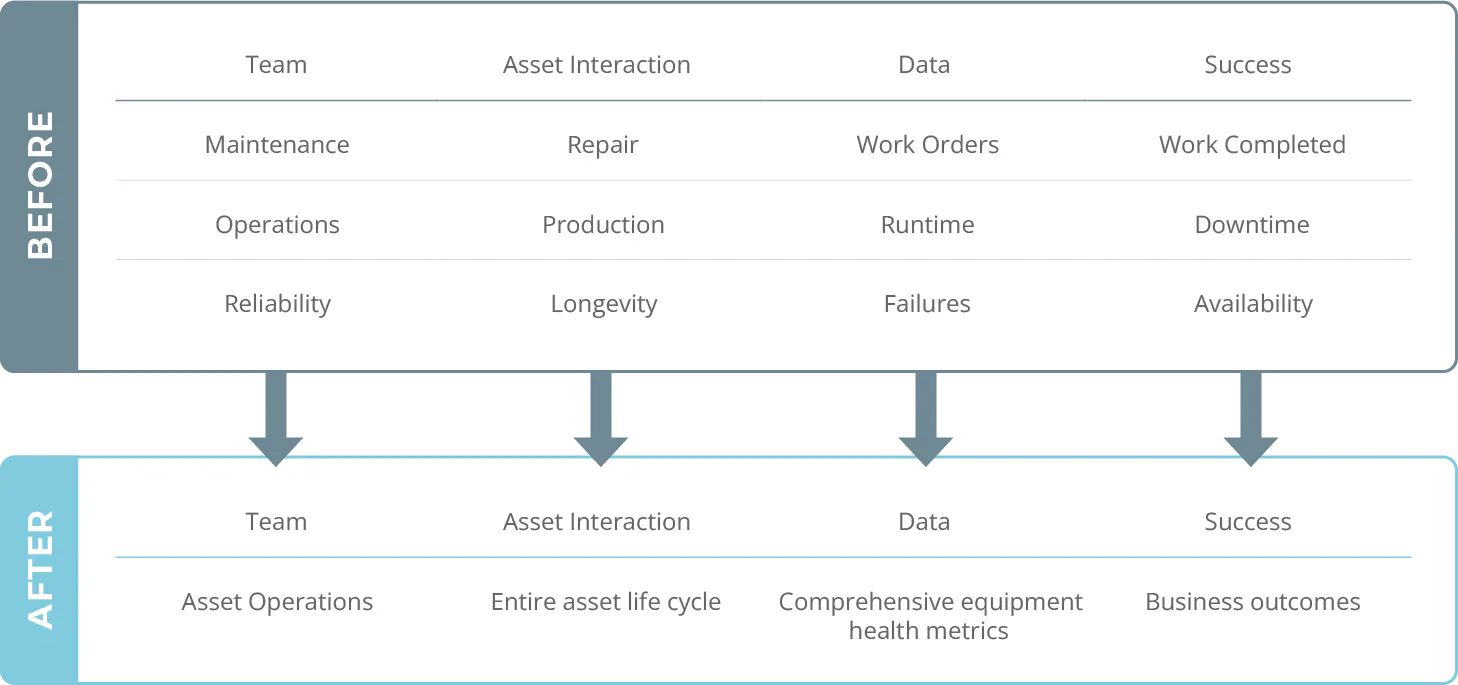
Employs an Ecosystem Approach
By utilizing this system with this thinking, an employee moves from interacting with an asset from a repair/production perspective to thinking about the asset across its entire life cycle. Additionally, one even starts to think about their role in that life cycle.
Data is also thought about differently. It’s no longer simply in terms of work orders and failures, but, “What do comprehensive health metrics look like? What does that dashboard look like for an executive or a technician?”
This is a huge shift because now employees are thinking about their work and their contribution in a different light. It’s going from turning a wrench to actually contributing to the bottom line.
Asset Operations Management in Practice
Across our 3,000+ customers, we’ve averaged out the results we’ve seen from Asset Operations Management. On average, organizations see a $23/hr savings on labor costs, a $5,000 savings on parts costs, and anywhere between a 10% to 40% reduction in unplanned downtime. And that’s just scratching the surface.
One of our customers was even able to save $680K over three years, as cited in our Forrester Total Economic Impact Report.
Bridge the Gaps Between Maintenance, Reliability, and Operations
Asset Operations Management is a unified view of everything–assets, teams, schedules, devices–all creating data and insights that can be easily consumed and analyzed. It’s not a team-centric, point solution; it’s purpose-built for the way all teams work.
With one team, as Asset Operations, employees can now focus on the optimization of assets, and not just looking at one small piece of the pie. Suddenly, success shifts from how much did I get done today to how much value did I add to the business.
Shifting our thinking is the first step in a positive chain of events that will kickstart the next generation of work.
Click here to learn more about Asset Operations Management!
Want to keep reading?



Article
Asset Operations Management for Operations Teams


Article
Improve the Reliability of Your Equipment with UpKeep


Article
Sensors for Cold Storage Management in Manufacturing
4,000+ COMPANIES RELY ON ASSET OPERATIONS MANAGEMENT
Leading the Way to a Better Future for Maintenance and Reliability
Your asset and equipment data doesn't belong in a silo. UpKeep makes it simple to see where everything stands, all in one place. That means less guesswork and more time to focus on what matters.






![[Review Badge] Gartner Peer Insights (Dark)](https://www.datocms-assets.com/38028/1673900494-gartner-logo-dark.png?auto=compress&fm=webp&w=336)