Blog Post
Electrical Predictive Maintenance: Tools & Benefits
Electrical predictive maintenance uses thermal, ultrasonic, and partial-discharge data to catch failures early and cut unplanned outages.


Key Takeaways
Electrical predictive maintenance replaces fixed inspection schedules with condition data so crews act on an asset's actual state rather than the calendar.
Condition-based intervention stops the parts and labor expended on healthy equipment. Crews service an asset when its readings call for it so technicians aren't sent to gear that's running fine while a degrading unit waits.
Routing condition alerts straight into a CMMS closes the gap between a reading and a dispatched technician. An alert that opens a work order with the asset's full history attached moves faster than one sitting in an inbox.
Correcting chronic stressors like overheating and harmonic distortion extends the service life of motors, transformers, and switchgear.
Electrical assets rarely give the slow, visible warning that a worn mechanical part does. A connection runs hot for weeks with no outward sign, then a breaker, a bus, or a transformer fails and takes out a line or a floor with it. The cost lands all at once in the form of lost production, damaged downstream equipment, and a crew diagnosing under pressure.
Fixed-schedule inspections don't close that exposure. An inspection can give an asset a clean pass on a Tuesday and miss the fault that takes it offline on Friday because a calendar confirms a given state on one day and says nothing about the one developing the next. The financial hit is only part of it though. Undetected electrical degradation carries arc flash and shock hazards, which opens a safety gap as much as an uptime one.
What Is Electrical Predictive Maintenance?
Electrical predictive maintenance uses condition data from sensors and inspections to forecast electrical failures, then act inside the detectable window before an asset reaches functional failure. The work addresses transformers, switchgear, motors, cables, panels, and motor control centers based on their actual condition.
That state-based trigger separates it from alternative service approaches:
Preventive maintenance runs according to time or usage. A service interval comes due, and the work happens whether the asset needs it or not. Reactive work waits for failure and absorbs the consequences.
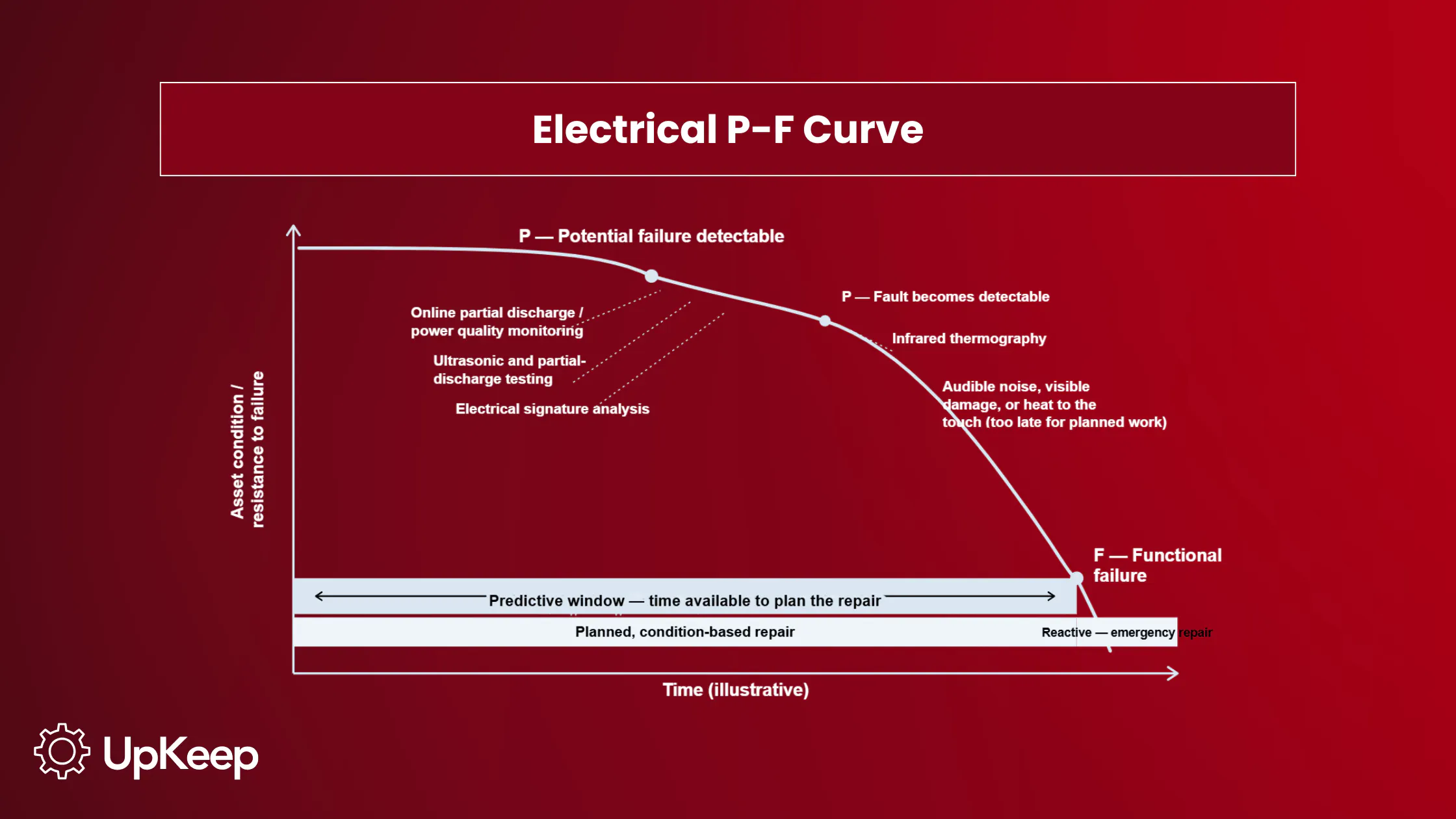
Predictive sits between them on the P-F curve, in the interval between the point where a fault becomes detectable and the point where the asset actually fails. Condition-based maintenance shares that logic, reading live indicators to decide when intervention is justified.


Why Electrical Predictive Maintenance Matters
Electrical failures tend to be catastrophic with little to no warning, which makes the reactive penalty steep. A deteriorating connection or a breakdown in insulation gives few visible signs, then fails in a way that drags down an entire line, floor, or facility. In an uptime-critical environment, a data center, a hospital, or a production line, that outage carries secondary damage to downstream equipment and results in hours of unplanned downtime before the asset returns to service.
The safety exposure rides alongside the operational one. Arc flash and electrocution are the potential failure modes that result from a missed electrical fault, and the techs are the ones who face that consequence. A calendar inspection only confirms an asset's condition on the day someone looks at it; it offers no read on the fault forming the next week.
The business case is strongest when measured against the disruption a failure avoids. In a NIST-backed analysis of U.S. manufacturers, facilities that relied more on predictive maintenance than preventive maintenance saw 18.5% less unplanned downtime and 87.3% fewer defects, while reactive-heavy facilities had far worse downtime and quality outcomes. For electrical systems, that difference can be the gap between a planned repair and an outage that stops critical operations.
Structured electrical maintenance is also an expectation the field now documents. NFPA 70B, the consensus standard for electrical equipment maintenance, was reissued in 2023 in mandatory language, and it frames condition-informed upkeep as standard practice the field is expected to follow. Read alongside the arc flash obligations in NFPA 70E, it sets a bar a maintenance program is measured against, whether or not a local jurisdiction adopts it directly.
Predictive Maintenance Technologies for Electrical Systems
No single method covers every electrical failure mode, so a working program layers a few, each matched to what it detects best:
Infrared Thermography: Thermal imaging spots abnormal heat at connections, panels, and switchgear. A loose or overloaded termination runs hotter than its neighbors long before it fails, so a scan uncovers it while the fix is still a scheduled tightening, before it becomes an emergency.
Electrical Signature Analysis: Current and voltage waveforms carry the signature of a motor's mechanical health. Degradation, bearing wear, imbalance, and misalignment all show up in the electrical signal, which lets a tech read a motor's condition without taking it apart.
Ultrasonic and Partial-Discharge Testing: Arcing, corona, and loose connections in high-voltage gear emit ultrasonic sound and partial discharge well before they're visible or audible to a person. The instruments hear what the ear can't.
Power Quality Monitoring: Harmonics, voltage sags, swells, and transients degrade insulation quietly over time. Monitoring power quality uncovers the electrical stress that shortens equipment life before the damage hardens into a fault.
Online Partial Discharge Testing: For energized high-voltage assets, online partial discharge testing reads insulation health without taking the equipment offline, so the asset keeps running while the program watches its condition.
|
Method |
Best-Fit Assets |
What It Detects |
|---|---|---|
|
Infrared thermography |
Panels, switchgear, MCCs, cable terminations |
Loose or overloaded connections showing as abnormal heat |
|
Electrical signature analysis |
Motors and their driven loads |
Winding degradation, bearing wear, imbalance, and misalignment |
|
Ultrasonic and partial-discharge testing |
Switchgear, transformers, high-voltage cables |
Arcing, corona, and loose connections in energized gear |
|
Power quality monitoring |
Drives, MCCs, distribution panels |
Harmonics, sags, swells, and transients that erode insulation |
|
Online partial discharge testing |
Energized transformers, switchgear, HV cables |
Insulation breakdown read without taking the asset offline |
How Electrical Predictive Maintenance Works
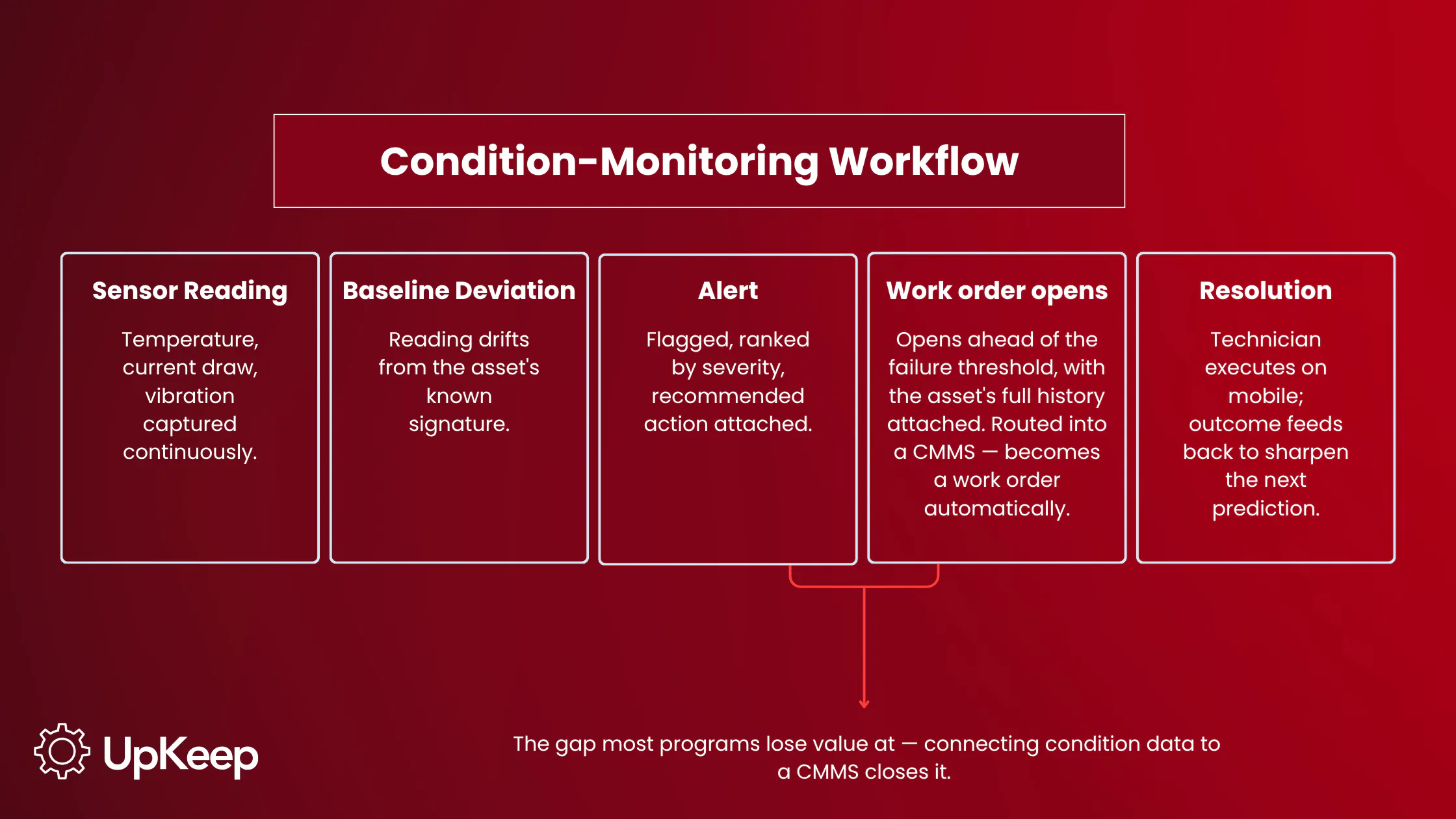
A predictive program runs as a loop. Sensors collect condition data continuously via temperature at a connection, current draw on a motor, or vibration on a rotating asset, then stream it against a known baseline. When a reading drifts outside that baseline, the system flags the deviation, ranks it by severity, and estimates how much useful life the asset has left before the fault crosses into failure.
From there, the deviation becomes action: An alert sounds with a recommended response, a work order opens ahead of the failure threshold, and a technician arrives with the asset's history already attached. Once the repair is logged, the outcome feeds back into the baseline so the next prediction is sharper than the last. Each pass tightens the model's read on what “normal” looks like for that specific asset.

Where Electrical Predictive Maintenance Delivers the Most Value
The return on a predictive program scales with what a failure costs, so it lands hardest in environments where electrical downtime stops something expensive:
Manufacturing: Motors, drives, and control panels sit in the critical path of a production line, so a single failure idles the whole line and everyone on it.
Healthcare: Power reliability is a patient-safety question. Life-safety systems and critical-care equipment can't tolerate an unplanned electrical outage, which makes early fault detection a clinical concern as much as a maintenance one.
Utilities: Substation transformers, switchgear, and grid assets carry load for thousands of downstream customers, so a fault that goes unspotted propagates well past the asset that caused it.
Data Centers: Power distribution ties directly to uptime SLAs, where minutes of outage convert to contractual penalties and lost revenue.
Commercial Real Estate: Electrical failures translate into tenant disruption and emergency spend, and they complicate the long-horizon budgeting property managers answer for.
KPIs to Track
The right metrics tell you whether a predictive program is shifting work from reactive to planned or just generating alerts no one acts on. Reliability measures like MTBF and MTTR earn their keep as a direction of travel, so track these across asset classes over time and watch the trend they form.
|
Metric |
What It Measures |
Why It Matters |
|---|---|---|
|
PM completion rate |
Share of scheduled condition checks completed on time |
Falling completion is the leading signal of deferred risk |
|
Corrective-to-preventive ratio |
Reactive work orders vs. planned ones |
Tracks the shift from break-fix to condition-based |
|
MTBF |
Mean time between failures per asset class |
Rising MTBF confirms early intervention is working |
|
Unplanned outage hours |
Downtime from electrical failures |
The core financial and operational exposure |
|
Anomalies caught before failure |
Faults flagged inside the detectable window |
Measures whether the program is finding problems early |
|
Maintenance cost per asset |
Parts and labor by asset over time |
Pinpoints assets approaching repair-versus-replace decisions |
How to Build an Electrical Predictive Maintenance Program
A predictive program comes together in sequence, and each step produces feeds into the next one.
Run a criticality assessment. Rank assets by what their failure actually costs in downtime, safety exposure, and downstream damage. NFPA 70B builds that judgment from an equipment condition assessment that weighs an asset's physical condition, its criticality to operations, and the environment where it operates, with the worst of the three setting how often it needs attention. The ranking tells you where monitoring investment earns its return and where periodic checks are still good enough.
Match the monitoring method to each asset and failure mode. Thermography for connections and panels, signature analysis for motors, partial-discharge testing for high-voltage gear. The method has to fit how the asset fails in practice, or the data it produces won't mean anything.
Set baselines during normal operation. A deviation only carries information against a known reading, so capture each asset's healthy signature before the program starts treating drift as a fault.
Connect condition data to a CMMS. Most programs lose their value at this step. An alert that lands in an inbox waits on manual triage. A reading routed into a CMMS instead becomes a work order the moment it crosses threshold, and the asset's repair history moves along to whoever picks it up. UpKeep handles that handoff inside one system. It centralizes asset history, opens work orders from incoming alerts, and puts the job on a tech's phone for mobile execution. That turns work order management from a clipboard exercise into a closed loop.
Define KPIs and track program ROI. MTBF, maintenance cost per asset, and anomalies caught before failure tell you whether the program is shrinking reactive work or just adding monitoring overhead.
Turning Electrical Failures Into Planned Work
Running a reactive program perpetuates electrical failures: The connection no one saw running hot, the breaker that drops a floor at 4 a.m., the crew learning an asset's condition at the moment it fails. Every one of those is detectable before it becomes an outage, but if nothing reads the asset between inspections, it balloons into an expensive failure.
A controlled program changes what the team sees and when. Anomalies are spotted inside the detectable window, and interventions land on a planned shift before they turn into emergencies. Unplanned outages thin out, and arc flash risk drops because someone found the degrading connection while it's still just warm. The asset's condition stops being a surprise.
UpKeep carries that shift through one workflow: a condition alert turns into an open work order, the asset's service record travels with it, the technician runs the repair on mobile, and the closed record sharpens the next prediction. The loop runs without a reading ever stalling in someone's inbox.
See how UpKeep turns electrical condition data into dispatched work by booking a demo.
FAQ
What's the difference between preventive and predictive maintenance?
Preventive maintenance runs on a clock or a usage count: The interval comes due and the work happens. Predictive maintenance keys off measured condition, so the work happens when an asset's readings warrant it. One runs service on a schedule, the other on evidence.
What are the three types of electrical maintenance?
The field splits into three: reactive, preventive, and predictive. Reactive fixes a failure after it happens, preventive services on a fixed schedule, and predictive acts on condition data before the failure lands.
What are the most common electrical predictive maintenance techniques?
Infrared thermography, electrical signature and vibration analysis, and ultrasonic or partial-discharge testing. Thermography uncovers heat at connections and panels, signature analysis reads motor health, and ultrasonic and partial-discharge testing hear arcing in high-voltage gear before it's audible.
What are the advantages of predictive maintenance for electrical systems?
The benefits of predictive maintenance for electrical systems include fewer unplanned outages, lower arc flash risk, and parts and labor that go to an asset only when its condition calls for it. Catching a fault early also extends equipment life, since gear that runs within its rated limits degrades more slowly.
How do you start an electrical predictive maintenance program?
Start with your critical assets, set baselines while the gear is running normally, match a monitoring technique to each asset's failure mode, and route the findings into a work-order system so an alert becomes a dispatched repair. The criticality ranking comes first, since it tells you where to spend.
4,000+ COMPANIES RELY ON ASSET OPERATIONS MANAGEMENT
Leading the Way to a Better Future for Maintenance and Reliability
Your asset and equipment data doesn't belong in a silo. UpKeep makes it simple to see where everything stands, all in one place. That means less guesswork and more time to focus on what matters.






![[Review Badge] Gartner Peer Insights (Dark)](https://www.datocms-assets.com/38028/1673900494-gartner-logo-dark.png?auto=compress&fm=webp&w=336)