Blog Post
What Is Asset Life Cycle Management? Stages, Types, and Use Cases
Discover the essentials of asset life cycle management. Learn the 5 key stages, industry use cases, and how to maximize asset value while minimizing risk.



Key Takeaways
Asset life cycle management is the process of managing an asset from its initial identification and acquisition through to its retirement or disposal.
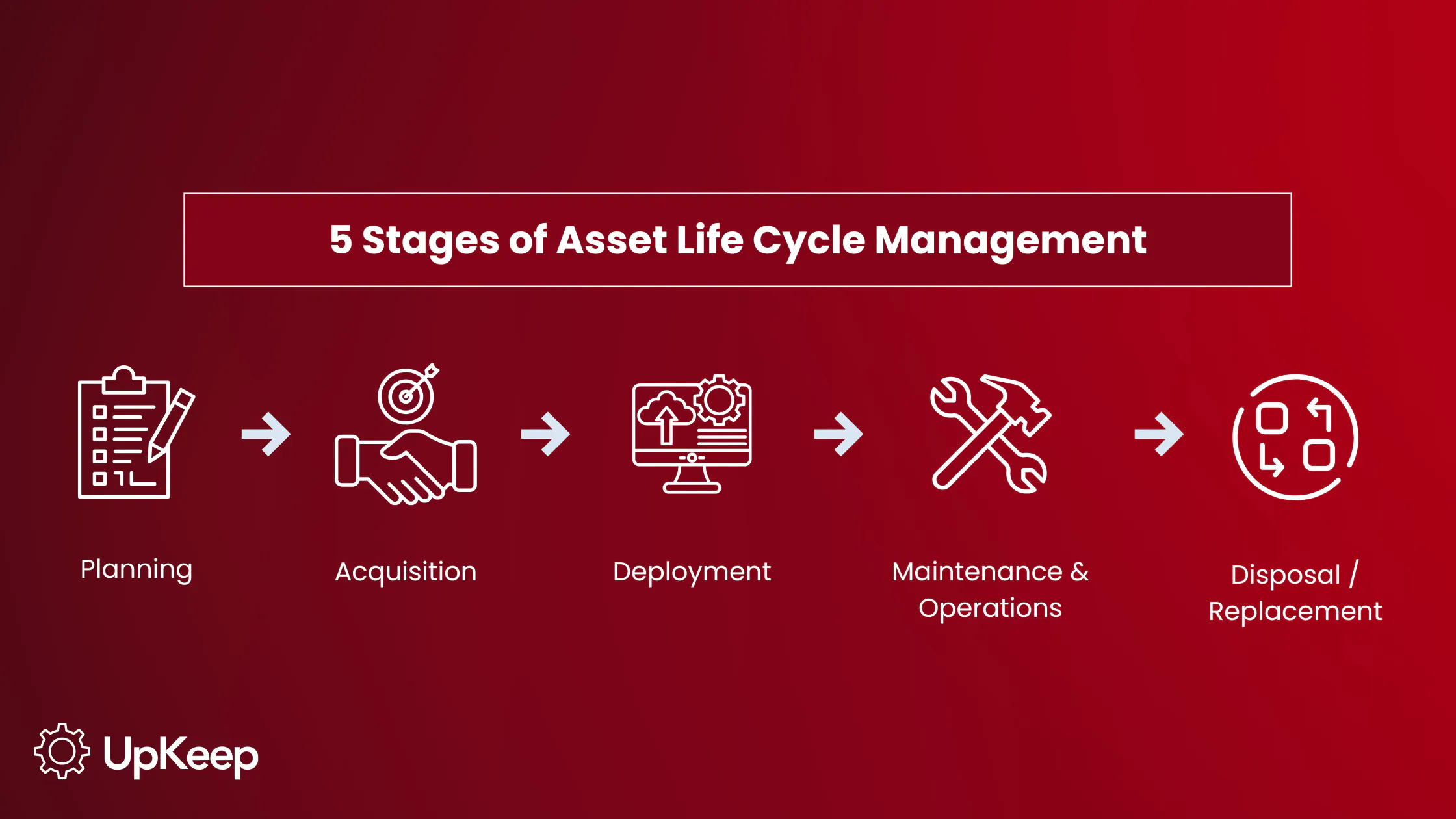
Effective asset life cycle management follows a five-step procedure of planning, acquisition, deployment, maintenance, operations, and disposal or replacement.
ALM principles apply universally across asset-intensive sectors like energy, manufacturing, and healthcare, and execution relies heavily on targeted KPIs and modern technology.
Computerized maintenance management systems, IoT sensors, and predictive analytics serve as the operational backbone, turning raw asset data into actionable, cost-saving insights.
Every organization depends on assets to deliver products and services, but without a structured approach to manage them from start to finish, companies risk costly breakdowns, compliance failures, and wasted capital. That's why asset life cycle management has become a cornerstone discipline across industries worldwide.
This guide dives into this concept and explains what asset life cycle management is, why it matters, the key stages involved, and how organizations in diverse sectors apply it to drive measurable results.
What Is Asset Life Cycle Management?
Asset life cycle management (ALM) is the process of managing an asset from its initial identification and acquisition through to its retirement or disposal. The goal is to extract maximum value at the lowest possible cost while minimizing risks at every stage of the asset’s operational life.
Effective asset management requires organizations to holistically consider the costs, performance, and risks associated with their assets.
They can be anything of value to an organization, including industrial equipment, IT hardware, software licenses, vehicles, buildings, or even pipelines. Regardless of type, every asset passes through a predictable series of life stages, and the intentional management of those phases is what separates high-performing organizations from reactive ones.
Why Managing the Asset Life Cycle Is Important
Poor asset management risks severe consequences:
Unplanned downtime disrupts operations, erodes customer confidence, and drives up repair costs.
Untracked software licenses create compliance risks.
Aging equipment left in service past its optimal life drains maintenance budgets and increases the likelihood of failure.
A disciplined approach to ALM addresses all of these vulnerabilities. It transforms the process from a reactive, break-fix model to a proactive, data-driven strategy.
ALM helps organizations gain full visibility into the total cost of ownership (TCO), enabling more informed, defensible maintenance decisions. It also supports regulatory compliance, improves workplace safety by reducing the risk of equipment failure, and helps organizations allocate capital more strategically.
In asset-intensive industries like energy, utilities, and manufacturing, well-executed ALM can have a marked impact on finances and operations.


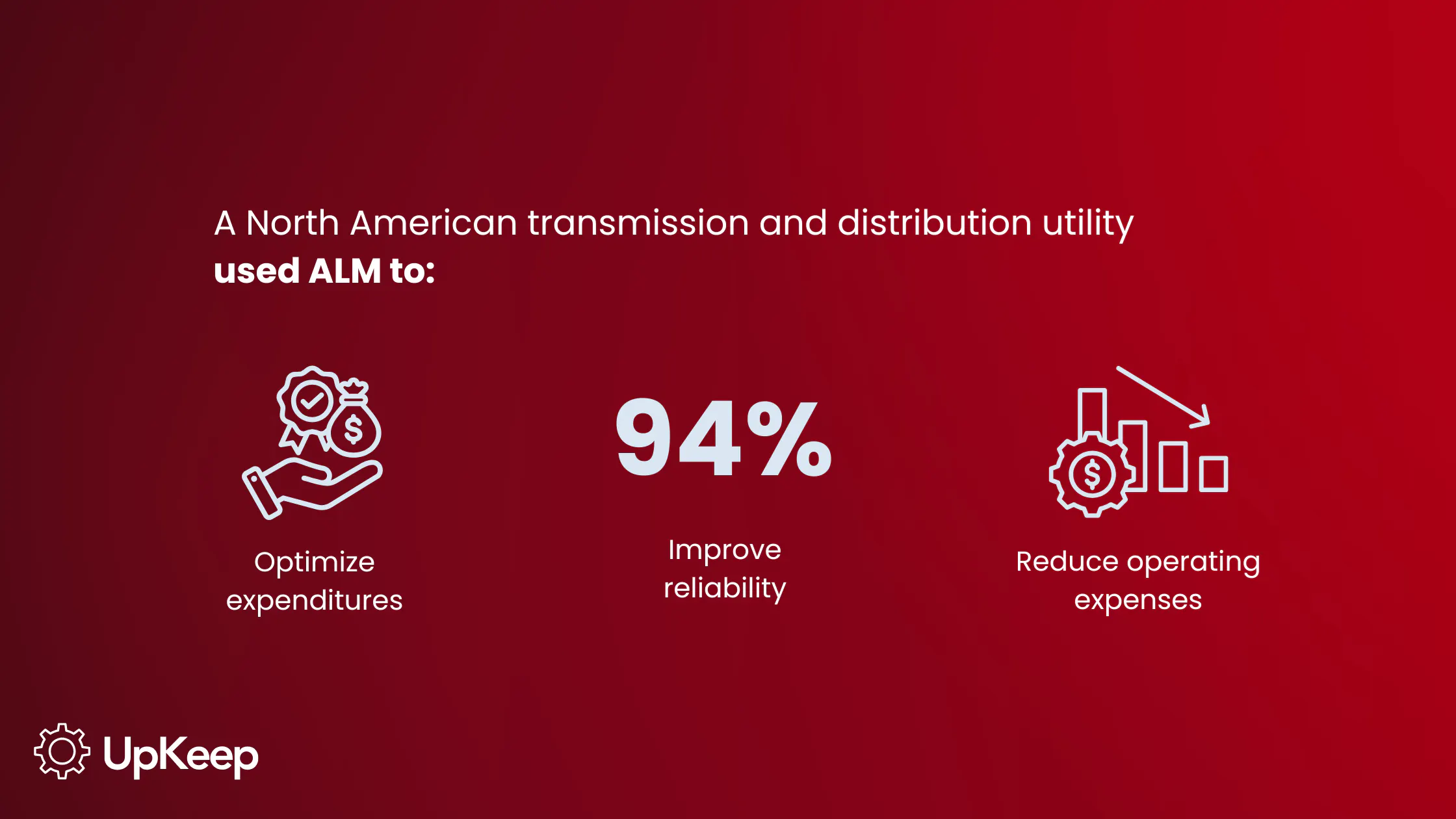
A McKinsey report outlined how a North American transmission and distribution utility used ALM to:
Optimize expenditures by enabling higher reliability at the same costs
Improve reliability by about 94% through risk‑based, cross‑asset optimization of replacement decisions.
Lower both preventive and corrective maintenance operating expenses by creating maintenance policies and replacing high‑risk assets.
Types of Asset Life Cycle Management
Organizations classify ALM into distinct types based on the nature of the resources they track and maintain. Managing physical infrastructure requires workflows different from those for tracking digital subscriptions. To optimize their specific operations, businesses focus on three primary categories of asset management:
Software
Hardware and physical assets
IT
Software Asset Life Cycle Management
Software ALM focuses on managing an organization's software portfolio from procurement through decommissioning. The primary concerns here are license compliance, version control, security patching, and cost optimization. Software assets tend to have compressed life cycles due to rapid technological change, so without careful tracking, organizations can easily find themselves facing an excess or lack of licenses or running outdated versions that expose them to security vulnerabilities.
Hardware/Physical Asset Life Cycle Management
Physical ALM governs tangible items such as machines, vehicles, tools, buildings, and infrastructure. The emphasis here is on mechanical condition, preventive maintenance, and operational reliability. Physical assets typically have longer life cycles than software, but are subject to wear, degradation, and obsolescence that must be anticipated and managed.
IT Asset Management (Software + Hardware)
IT asset management (ITAM) combines both software and hardware life cycle management under a unified framework. It tracks and optimizes all technology assets to maximize their ROI, minimize risk, and ensure compliance. ITAM is particularly critical in organizations where IT infrastructure is central to operations and so requires a coordinated approach to managing both the physical devices and the software running on them throughout their lifespans.
Stages of Asset Life Cycle Management
While terminology can vary across industries and frameworks, most ALM programs organize the life cycle into five core stages. Each one presents distinct challenges, decisions, and opportunities, and the quality of execution at each one directly shapes the cost and performance outcomes of the asset’s entire life.

Stage 1 – Planning
Before an asset is acquired, organizations must assess whether it’s needed, the total cost of ownership, and how it aligns with broader strategic objectives. Organizations that invest thoroughly in planning consistently avoid the expensive surprises that come from reactive, unstructured acquisition decisions.
This stage involves three crucial types of analysis:
Demand analysis to identify the specific operational needs
Cost-benefit analysis that accounts for acquisition, operation, maintenance, and disposal costs
Risk analysis to identify potential failure points or obsolescence risks
Planning also requires defining the asset's expected performance requirements and service life targets up front:
What capacity does it need to meet?
What operational conditions will it face?
What integration requirements must be satisfied?
The answers to these questions influence what’s purchased and how it will be maintained and eventually replaced.
A centralized record of all existing assets is an invaluable reference during this stage, helping teams determine whether they can be repurposed or upgraded before new procurement is initiated.
Thorough planning prevents the costly mistake of buying the wrong asset or acquiring more capacity than is required. It also lays the groundwork for all subsequent life cycle stages by establishing baseline expectations for performance, budget, and service life.
Stage 2 – Acquisition
Once the planning stage has confirmed the need and defined the requirements, the organization moves to acquisition.
This phase encompasses vendor evaluation, procurement negotiations, contract management, and purchase. It’s important to go beyond the price and evaluate the total cost of ownership, including delivery, installation, training, warranty coverage, and anticipated maintenance costs over the asset's projected service life.
Vendor selection deserves particular attention. Organizations must assess the reliability of the supplier's support infrastructure, the availability of spare parts, and the vendor's track record with similar clients. Service level agreements (SLAs) negotiated at the acquisition stage can provide important cost protections and performance guarantees throughout the asset's operational life.
For software assets, acquisition involves selecting the license type and ensuring its terms align with the organization's anticipated usage patterns. Over-licensing is a common and costly mistake when this analysis is skipped.
Manager’s Pro Tip
This stage is one of the highest-leverage investments in the ALM process, so it’s crucial to nail it.
Choosing a vendor with weak support, selecting a model that doesn't integrate with existing systems, or failing to negotiate favorable terms creates problems that cascade through the remaining asset life cycle.
Stage 3 – Deployment
During this stage, the asset is installed, configured, tested, and formally registered in the organization's asset management system.
Physical assets are tagged with barcodes and QR codes to enable precise tracking throughout their operational life, while IT assets are configured for security, assigned appropriate user access, and integrated into monitoring systems.
Every asset entering service should have a complete deployment record that captures installation date, configuration settings, warranty start date, responsible owner, and physical or network location. This baseline documentation serves as the foundation for the maintenance records that follow, and its accuracy at this stage directly impacts the quality of life cycle decisions made years down the line.
A thorough deployment process ensures the asset enters service in optimal condition and that all relevant stakeholders are informed of its location, specifications, and intended use. Investing time here prevents the critical data gaps that complicate maintenance planning, compliance audits, and disposal decisions later in the life cycle.
Stage 4 – Maintenance & Operations
The maintenance and operations stage is typically the longest and most resource-intensive stage of the asset life cycle. This is where the asset earns its value and where the difference between proactive and reactive management becomes most visible.
Effective maintenance programs during this stage draw from several complementary strategies.
Preventive maintenance involves scheduled, calendar- or usage-based servicing designed to prevent failure before it occurs.
Predictive maintenance uses real-time condition-monitoring data from IoT sensors, vibration analysis, thermal imaging, and other diagnostic tools to anticipate failure patterns and schedule maintenance precisely when needed.
Corrective maintenance (repairing failures after they occur) is unavoidable in any program, but its frequency and expenses are dramatically reduced when preventive and predictive strategies function well.
The cost of planned maintenance is a fraction of that of unplanned breakdowns when you factor in production losses, emergency labor, expedited parts procurement, and downstream disruptions. Preventive maintenance programs can reduce total maintenance costs by 12%–18% compared with predominantly reactive strategies.
This stage also encompasses operational performance monitoring, tracking key metrics such as uptime, throughput, energy consumption, and error rates against established benchmarks. This data informs day-to-day maintenance decisions, supports capital budgeting, and builds a record that supports evidence-based end-of-life decisions. Thorough work order documentation throughout this phase is essential to capture the full cost and effort history of each asset.
Stage 5 – Disposal/Replacement
Every asset eventually reaches the end of its economically useful life. The signals that this point is approaching include:
Rising maintenance costs
Declining performance despite servicing
Difficulty sourcing replacement parts
A growing cost gap between maintaining the existing asset and replacing it with a more efficient alternative.
A mature asset life cycle management program monitors these indicators continuously and establishes clear threshold criteria that trigger a formal end-of-life review.
The disposal process itself requires careful consideration. You can decide to resell on secondary markets, trade in toward a replacement purchase, donate to charitable organizations, recycle, or outright decommission and scrap. The right approach depends on the asset's residual value, condition, and type.
For IT assets, secure data wiping or physical destruction of storage media is a non-negotiable step before disposal to prevent data breaches and protect organizational and customer data.
For physical and industrial assets, environmental regulations often govern the handling and disposal of hazardous materials such as lubricants, refrigerants, batteries, and similar substances.
Knowledge transfer should also be a key component of every disposal decision:
What did this asset's maintenance history reveal about the accuracy of the original life cycle cost estimates?
Did it last longer or shorter than projected?
Were there recurring failure modes that a different maintenance approach might have prevented?
Capturing and acting on these insights directly improves the quality of planning decisions for the next generation of assets.
Manager’s Pro Tip
When the disposal stage is carried out well, it makes the organization smarter about every asset that follows.
Asset Life Cycle Management Use Cases
ALM transforms how various industries monitor, maintain, and replace their critical infrastructure. Targeted maintenance and KPI tracking help operations teams maximize equipment life and ensure compliance.
Oil, Gas, and Energy
Energy providers manage volatile and expensive assets spread across remote locations, so operations teams must monitor pipeline integrity and refinery equipment to prevent catastrophic failures. Proactive maintenance in this sector ensures safety and minimizes revenue loss from unplanned outages.
KPIs to track in energy asset operations include:
Safety incident rates
Mean time between failures (MTBF)
Utilities (Electricity, Water, Gas)
Utility companies maintain sprawling networks of grid infrastructure, water treatment plants, and distribution lines. Maintenance managers rely on centralized asset data to coordinate field technicians and respond to service interruptions quickly.
Essential metrics for utility asset management are:
System average interruption duration index
Preventive maintenance compliance
Asset uptime
Manufacturing and Industrial Production
Manufacturing facilities run complex production lines where every minute of downtime costs money. Plant managers thus use computerized maintenance management systems (CMMS) to centralize asset history, track spare parts, and automate work orders. Reducing reactive maintenance in manufacturing environments directly boosts production throughput and operational efficiency.
Critical manufacturing KPIs to monitor include:
Mean time to repair (MTTR)
Unplanned downtime percentage
Pharmaceutical and Healthcare
Healthcare facilities and pharmaceutical plants operate under strict regulatory standards. ALM provides audit-proof digital logs for compliance with agencies like OSHA and the FDA. Reliable asset operations guarantee that life-saving medical equipment functions flawlessly.
Top KPIs for healthcare and pharmaceutical maintenance include:
Audit pass rate
Calibration compliance rate
Preventive maintenance completion rate
Transportation and Logistics
Logistics companies manage fleets of vehicles, material handling equipment, and warehouse infrastructure. A unified platform that tracks fleet maintenance helps coordinate repairs and parts inventory seamlessly. That then keeps transport assets in optimal condition, prevents delivery delays, and extends vehicle life.
Fleet and logistics operations track KPIs like:
Fleet availability rate
Cost per mile
Scheduled maintenance adherence
Infrastructure and Construction
Construction firms deploy heavy machinery, tools, and temporary infrastructure across multiple job sites. Teams use mobile-first tracking to maintain visibility over asset locations and service histories. Proper life cycle management prevents project delays caused by equipment breakdowns.
Key infrastructure metrics encompass:
Asset utilization rate
Equipment breakdown frequency
Maintenance cost per asset
Mining and Heavy Equipment
Mining operations subject heavy equipment to extreme wear and tear, so reliability engineers use predictive analytics and condition monitoring to identify risks before breakdowns happen. Tracking asset health in harsh environments maximizes safety and avoids expensive equipment replacements.
Mining maintenance KPIs focus on:
Asset reliability index
Cost of reactive maintenance
Component lifespan
Telecommunications
Telecom companies oversee vast networks of cell towers, fiber optic cables, and data center servers, meaning IT and field teams must collaborate to maintain signal strength and network reliability. Monitoring these distributed assets prevents dropped coverage and improves customer satisfaction.
Telecom infrastructure operations measure:
Network uptime
Mean time to resolve network faults
Asset life cycle cost
Real Estate and Facilities Management
Facilities managers oversee building systems, HVAC, plumbing, and safety equipment across residential or commercial properties. A unified system helps coordinate vendors, technicians, and daily inspections, and that streamlined facility maintenance ensures tenant safety and preserves property value over time.
Facilities management tracks several vital KPIs:
Work order completion time
Tenant satisfaction score
Maintenance cost per square foot
Government and Public Sector
Municipalities and government agencies maintain public infrastructure like parks, roads, and municipal buildings. Leaders require enterprise-grade security and transparent reporting to justify budget requests and operational spending. By managing public assets efficiently, local governments are able to deliver better services with limited tax dollars.
Public sector maintenance teams evaluate:
Public complaint resolution time
Budget variance for maintenance operations
Asset condition index
Improve Asset Life Cycle Management With CMMS Solutions
CMMS software has become the technological backbone of modern ALM programs. A CMMS serves as a central repository for all asset data, from acquisition cost and warranty information to full work order histories and depreciation records.
Advanced CMMS platforms integrate with IoT sensors, SCADA systems, and business intelligence tools to create a real-time, contextualized view of asset health and performance. This enables condition-based maintenance scheduling, automated work order generation, and deep reporting on maintenance costs, asset utilization, and life cycle trends.
Organizations that move from paper-based or spreadsheet-driven asset management to a CMMS like UpKeep typically see significant gains in maintenance efficiency, data accuracy, and decision-making speed. The return on investment compounds over time as asset data accumulates and the organization's ability to forecast maintenance needs and optimize replacement timing improves.
Frequently Asked Questions
How can technology improve asset life cycle management?
Technology tools such as CMMS software, IoT sensors, RFID tracking, and AI-powered analytics provide real-time visibility into asset condition, automate maintenance scheduling, and generate the data insights needed to make smarter life cycle decisions. These tools replace manual, error-prone processes with accurate, up-to-date information available at every stage of the asset’s life cycle.
What are the KPIs for asset life cycle management?
Common ALM KPIs include overall equipment effectiveness (OEE), mean time between failures (MTBF), mean time to repair (MTTR), planned maintenance percentage, total cost of ownership per asset, asset utilization rate, and return on assets (ROA). The right KPIs to track depend on the industry and the specific goals of the ALM program.
How do I get started with asset life cycle management?
Start by conducting a complete asset inventory to establish what you own, where it is, and what condition it's in. Then, define life cycle policies for each asset category, select appropriate tracking and management technology, and implement a phased rollout starting with your highest-value or most critical assets. Building on a strong data foundation is essential to long-term ALM success.
How does asset life cycle management reduce costs?
ALM reduces costs by:
Preventing expensive unplanned breakdowns through proactive maintenance
Optimizing the timing of asset replacement to avoid excessive investing in aging equipment
Eliminating redundant or underutilized assets
Improving procurement decisions through better demand forecasting and total cost of ownership analysis
How can asset life cycle management improve decision-making?
ALM creates a continuous, data-rich record of every asset's performance, maintenance history, and cost profile. That information empowers decision-makers to evaluate repair versus replacement trade-offs objectively, justify capital budget requests with evidence, prioritize maintenance resources strategically, and align asset investment decisions with broader organizational goals.
4,000+ COMPANIES RELY ON ASSET OPERATIONS MANAGEMENT
Leading the Way to a Better Future for Maintenance and Reliability
Your asset and equipment data doesn't belong in a silo. UpKeep makes it simple to see where everything stands, all in one place. That means less guesswork and more time to focus on what matters.






![[Review Badge] Gartner Peer Insights (Dark)](https://www.datocms-assets.com/38028/1673900494-gartner-logo-dark.png?auto=compress&fm=webp&w=336)