Preventive vs. Predictive Maintenance: Which Strategy Wins in 2026?
SHARE ARTICLE
Key Takeaways
The fundamental difference between both lies in the trigger. Preventive maintenance (PM) relies on fixed schedules or usage intervals (time-based), while predictive maintenance (PdM) uses real-time IoT sensor data and machine learning to intervene only when failure is imminent (condition-based).
While PdM offers higher long-term savings (25%–30% reduction in costs versus 12%–18% for PM), it requires a significantly higher up-front investment in technology, a longer implementation timeline (12–24 months), and specialized technical staff.
Preventive maintenance is most effective for assets with linear wear patterns and low-to-medium criticality, whereas PdM is reserved for high-value, strategic assets where unplanned downtime costs are extreme.
Instead of choosing one over the other, the most effective strategy is a hybrid approach. Organizations should establish a solid PM foundation for general operations and layer PdM capabilities onto their top 10%–20% most critical assets to maximize ROI.
Unplanned equipment downtime is one of the most expensive problems in modern operations. A 2024 report by Siemens estimated that prolonged unplanned downtime at the world’s top 500 companies results in $1.4 trillion in annual losses, and this number touches every industry.
The good news is, most unplanned downtime is preventable. However, many companies are torn between using predictive or preventive maintenance to avoid the damages that come with unexpected service needs.
Both strategies are designed to reduce equipment failures and increase asset reliability. Both involve scheduling work before something breaks. But the differences between them (in cost, technology, implementation, and long-term ROI) are significant. This guide breaks it all down so you can make the right call for your operation.
Preventive vs. Predictive Maintenance: Key Differences at a Glance
Here’s a quick comparison of the two leading maintenance strategies, preventive maintenance and predictive maintenance (PdM). The differences highlighted below cover the core concepts, implementation, cost, and effectiveness of each approach.
Feature
Preventive Maintenance (PM)
Predictive Maintenance (PdM)
Core Concept
Time- or Usage-Based: Maintenance is performed at regular, fixed intervals.
Condition-Based: Maintenance is performed only when data suggests a pending failure.
Trigger
Calendar dates, operating hours, or manufacturer guidelines.
Real-time sensor data (vibration, heat, oil analysis).
Initial Investment
Low: Requires computerized maintenance management software (CMMS) and labor.
High: Requires IoT sensors, data infrastructure, and AI and machine learning models.
Complexity
Simple; easy to plan, budget, and execute.
High; requires technical expertise in data analysis and sensor integration.
Risk Factor
Often replaces perfectly good parts, wasting labor and materials.
A sensor failure or data lag can lead to missed maintenance windows.
Asset Lifespan
Extends life through routine care but may miss random failures.
Maximizes life by intervening at the optimal point before catastrophic failure.
Typical Savings
~12%–18% cost savings over reactive maintenance.
~25%–30% cost savings over reactive maintenance.
Ideal For
Assets with predictable failure patterns or low-criticality equipment.
High-value, critical assets where unplanned downtime is extremely costly.
Key Fact
A study by the United States Department of Energy revealed that moving away from reactive maintenance and implementing preventive or predictive maintenance can significantly lower costs, with preventive maintenance seeing a 12%–18% reduction and predictive maintenance a 25%–30% decrease.
What Is Preventive Maintenance?
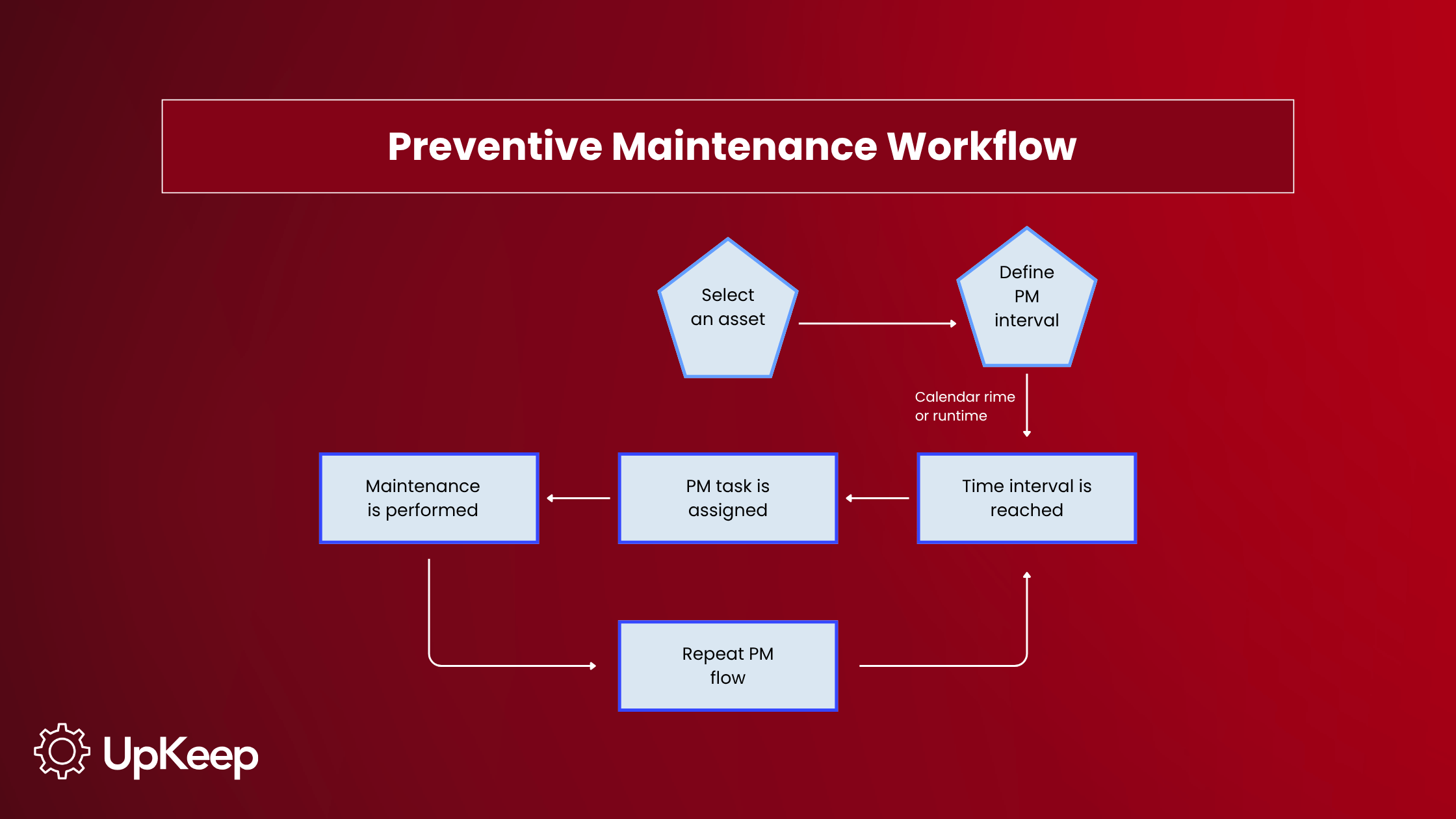
Preventive maintenance (PM) is work that’s scheduled based on a fixed time interval, calendar date, or equipment usage cycle regardless of the asset’s current condition. This maintenance strategy works on the premise that servicing equipment on a regular schedule decreases the likelihood of unexpected failure.
Think of it like an oil change for your car. You’re expected to change your oil every 5,000 miles because that’s what the manufacturer recommends to keep the engine running well. Preventive maintenance works on the same principle, applied to industrial, commercial, and facility assets.
Real-World Preventive Maintenance Examples
To bring this home, we’ve outlined some examples of how preventive maintenance plays out in the real world:
HVAC systems: A property management company replaces air filters in all of its commercial buildings every 90 days, regardless of the air quality readings. Coils should be cleaned annually. This schedule prevents most system failures and keeps energy costs predictable.
Food and beverage manufacturing: A beverage bottling plant lubricates conveyor belt bearings every 500 operating hours per the original equipment manufacturer (OEM) specification. Technicians also inspect belt tension and motor brushes on the same schedule. The fixed routine is easy to plan around production shifts.
Healthcare facilities: Hospitals and other healthcare facilities are expected to replace ventilator filters on a quarterly schedule and calibrate infusion pumps every six months. Because equipment failure can directly affect patient outcomes, PM is non-negotiable even if the device appears to be functioning normally.
Fleet management: A logistics company services its truck fleet every 10,000 miles. This includes oil changes, brake inspections, tire rotations. The schedule keeps drivers safe and helps the company avoid costly roadside breakdowns.
•Predictable costs make budgeting and staffing easier.
•It’s dramatically better than reactive (run-to-failure) maintenance.
•It creates a strong documentation and maintenance history trail.
Limitations of Preventive Maintenance
Risk of over-maintaining: Servicing equipment on a fixed schedule means you’ll sometimes perform maintenance on assets that don’t need it. Over-lubrication, for example, can actually damage seals and bearings.
Blind to rapid faults: PM can’t catch failures that develop quickly between scheduled intervals like an electrical fault that emerges three weeks after an inspection.
Preventive maintenance can be labor intensive: Work orders are generated on a schedule, not need, which means your team is always busy but not necessarily with the right things.
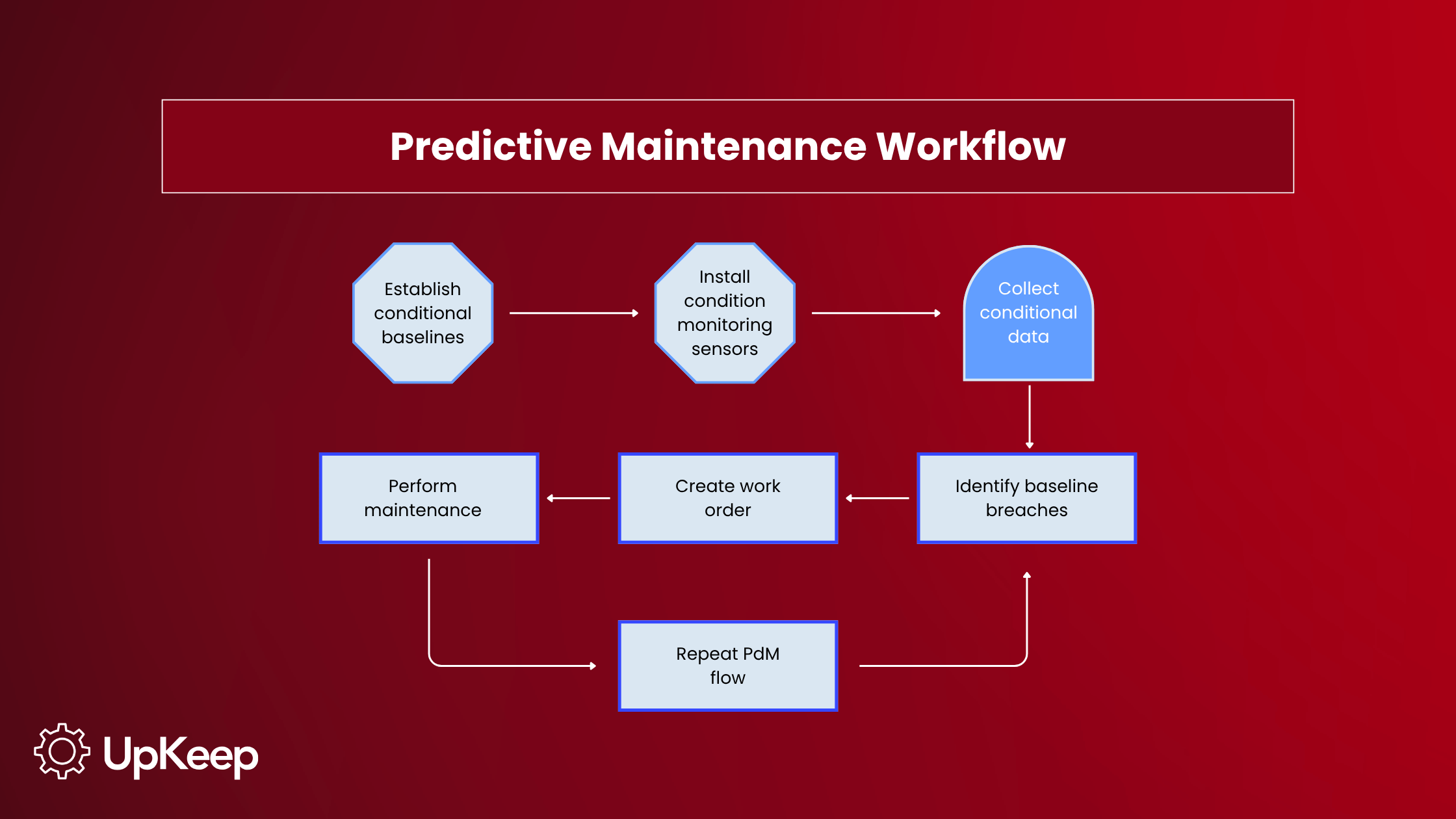
In predictive maintenance (PdM), work is scheduled only when real-time data from sensors and monitoring tools indicates an asset is approaching a failure threshold. Instead of asking, “When is this asset’s next service due?” it asks, “What does this asset’s data tell us about its current health?”
The technology stack typically includes IoT sensors (vibration, temperature, ultrasound, and oil analysis), a CMMS or asset management platform that ingests the data, and a machine learning layer that identifies anomalies and triggers work orders automatically.
Predictive maintenance is often confused with condition-based maintenance, but they’re different in execution.
The global predictive maintenance market reached $10.93 billion in 2024 and is projected to reach $70.73 billion by 2032, growing at a CAGR of 26.5%. That growth reflects how aggressively industries are adopting condition-based monitoring to stay competitive.
Manufacturing: A large automotive parts manufacturer installs vibration sensors on the electric motors across its plant floor. When the amplitude reading on a specific motor exceeds a defined threshold, an alert fires in the CMMS and it automatically generates a work order. The bearing is replaced six weeks before projected failure.
Aviation: Commercial aircraft engines carry hundreds of sensors that continuously stream performance data to ground-based analytics systems. Airlines use these systems to identify anomalies in fuel burn, vibration, and temperature. Parts are replaced proactively during scheduled gate time before a fault that could come up mid-flight.
Healthcare: Apredictive maintenance system monitors MRI machines by tracking helium levels, cooling system performance, and magnetic field stability. The system reduces MRI downtime, which is critical in hospitals where scanner outages can delay hundreds of procedures.
Commercial real estate: Major elevator manufacturers now offer IoT-enabled predictive monitoring. Sensors track door opening cycles, motor temperature, and ride quality. Maintenance is dispatched when data trends suggest a component is wearing, rather than waiting for the quarterly PM visit or a tenant complaint.
Benefits of Predictive Maintenance
Maintenance is performed only when needed, eliminating unnecessary labor and parts costs.
It catches random and non-linear failures that PM schedules would miss entirely.
It generates rich asset health data that feeds continuous improvement programs.
Limitations of Predictive Maintenance (PdM)
Higher up-front cost: Implementing PdM is typically more expensive than other maintenance programs. The initial investment covers sensors, data infrastructure, software, and training.
Longer implementation timeline: A full PdM program takes longer (about 12–24 months) to function properly, compared to two to six months for preventive maintenance.
Skills gap: PdM requires data scientists, reliability engineers, and IT staff who can integrate sensor platforms with your CMMS. A lot of maintenance teams aren’t staffed for this.
Not every asset justifies the investment: A $500 pump doesn’t need a $5,000 sensor. PdM is most valuable on high-criticality, high-value assets where failure is expensive.
Preventive vs. Predictive Maintenance: Which Should You Choose?
The right choice depends on your assets, your maintenance budget, and where you are in your operational maturity. Here’s how to think through the decision.
Choose Preventive Maintenance if…
You’re transitioning away from reactive maintenance and need a solid foundation to build your operations on.
Your equipment has predictable, linear wear patterns like belts, filters, seals, or lubricants.
Your maintenance budget is under $100,000.
Your team lacks data analytics or reliability engineering capabilities.
Asset failure impact is low to medium, and your assets aren’t critical to revenue or safety.
OEM service intervals are well-documented and reliable.
Choose Predictive Maintenance if…
The assets are strategic, failure is less predictable, and the business impact of failure is high.
Downtime costs exceed $100,000 per incident.
You have a mature, documented PM program and are ready for the next level.
You have (or can hire) IT, data science, and reliability engineering expertise.
The asset generates operational data that can be practically monitored.
You can justify a 12–24-month payback period on the implementation investment.
Our Recommendation: A Hybrid Approach
For most mature organizations, the answer isn’t either one or another but both. The smartest maintenance programs use preventive maintenance as the baseline for low- to medium-criticality assets, and layer predictive maintenance on top for the assets where failure would be catastrophic or very costly.
A practical path forward is to start by identifying your top 10–20 most critical assets. Pilot predictive monitoring on them for 6–12 months, measuring downtime reduction, maintenance cost reduction, and labor savings. Use that ROI data then to justify expanding the predictive maintenance program to additional asset classes.
65% of maintenance teams say they plan to incorporate AI into their maintenance programs by the end of 2026, which is a strong signal that the industry is moving toward hybrid, data-driven programs rather than choosing one approach over the other.
The Bottom Line
Both preventive and predictive maintenance are significant improvements over waiting until something breaks. Preventive maintenance is accessible, affordable, and effective for most organizations but isn’t as forward-looking. Predictive maintenance is more powerful, precise, and cost-effective at scale, but it demands a meaningful investment of time, money, and expertise.
The question is less about choosing preventive or predictive and about where to begin and when to evolve. Start with a strong PM foundation, using your CMMS to build a documented history of asset performance. As your program matures and your data grows, layer predictive capabilities onto the assets where the return on investment is clearest.
Ready to build a smarter maintenance program? UpKeep’s CMMS is built to support both strategies from simple PM scheduling to predictive IoT-connected maintenance.
What is the main difference between preventive and predictive maintenance?
Preventive maintenance is scheduled on a fixed time or usage interval, regardless of asset condition. Predictive maintenance is scheduled based on real-time condition data from sensors and monitoring tools, and work is only triggered when that data indicates the asset is approaching a failure point. The core difference is the trigger: time versus condition.
Which is more cost-effective: predictive or preventive maintenance?
Predictive maintenance saves more over the long term (25%–40% in maintenance cost reductions compared to 12%–18% for preventive maintenance) However, predictive maintenance requires a much higher up-front investment and takes more time to implement. For organizations with limited budgets or simpler assets, preventive maintenance delivers better near-term ROI.
Can you use both predictive and preventive maintenance together?
Yes, and for most mature organizations, a hybrid approach is the recommended strategy. Preventive maintenance handles routine, lower-criticality assets while predictive maintenance is layered onto high-value or safety-critical assets. The two strategies are complementary, not mutually exclusive.
What industries benefit most from predictive maintenance?
Manufacturing, aviation, healthcare, energy (wind, oil, and gas), commercial real estate, and transportation logistics see the highest returns from predictive maintenance. These industries share common characteristics, including high asset values, expensive downtime, and equipment that generates actionable sensor data.
How do you transition from preventive to predictive maintenance?
The recommended path is phased:
Ensure you have a solid CMMS and documented PM program in place.
Identify your 10–20 highest-criticality assets.
Pilot IoT sensors and condition monitoring on those assets for 6–12 months.
Measure ROI using downtime reduction, cost savings, labor efficiency.
Use the results to build the business case for broader PdM expansion.
What tools are needed for predictive maintenance?
A full predictive maintenance program typically requires: IoT sensors (vibration, temperature, acoustic, and oil analysis), a CMMS capable of integrating with sensor data and generating condition-based work orders, and trained staff, namely reliability engineers, data analysts, and IT personnel who can manage the infrastructure.
4,000+ COMPANIES RELY ON ASSET OPERATIONS MANAGEMENT
Leading the Way to a Better Future for Maintenance and Reliability
Your asset and equipment data doesn't belong in a silo. UpKeep makes it simple to see where everything stands, all in one place. That means less guesswork and more time to focus on what matters.






![[Review Badge] Gartner Peer Insights (Dark)](https://www.datocms-assets.com/38028/1673900494-gartner-logo-dark.png?auto=compress&fm=webp&w=336)