Blog Post
CMMS Software for Automotive Manufacturing: The Complete Guide to Smarter Maintenance
Unexpected downtime and equipment failure can be expensive in the automotive industry. Learn how CMMS software can stop those problems in their tracks.


Key Takeaways
CMMS software for the automotive industry centralizes maintenance workflows, asset histories, and parts inventory in one platform.
Automotive manufacturers using CMMS software to shift from reactive repairs to proactive maintenance strategies can reduce unplanned downtime by 30%–50%.
Modern automotive CMMS platforms integrate with IoT sensors, ERP systems, and mobile devices to give maintenance teams real-time equipment visibility, predictive failure alerts, and the data they need to make smarter decisions at every level of the organization.
On the plant floor, every minute counts. A single conveyor failure, a paint line malfunction, or a robotic arm going offline can trigger a cascade of delays, labor disruptions, and financial losses. For automotive manufacturers operating in an era of razor-thin margins and accelerating production demands, efficient maintenance gives organizations a competitive edge.
That's when CMMS software for the automotive industry becomes a must. A computerized maintenance management system (CMMS) gives maintenance teams the tools to move beyond manual, paper-led processes and into a connected, data-driven approach that keeps equipment running.
This guide breaks down what CMMS software does for automotive manufacturers, why the industry's challenges make it essential, and how to evaluate the ROI of implementing one.
What Does CMMS Software Do for the Automotive Industry?
CMMS software centralizes the information and workflows that maintenance teams rely on every day. Work orders, asset maintenance histories, preventive maintenance (PM) schedules, and spare parts inventory are all in one place, accessible from both a desktop workstation or a mobile device on the plant floor.
In automotive environments with large plants, complex assets, and high-stakes for equipment failure, centralized information is key. Without it, maintenance data lives in silos, making it nearly impossible to spot patterns, anticipate failures, or consistently execute PM across shifts. CMMS platforms take over robotics management, conveyor systems, paint lines, CNC machines, and other high-value production equipment that directly impacts uptime.
Modern platforms go further by integrating with IoT sensors, ERP systems, and mobile devices to connect maintenance data with broader production operations. This integration offers an intelligent maintenance platform that can support predictive maintenance (PdM) by revealing equipment health trends, flagging anomalies before they become failures, and giving managers a real-time view of what's happening across the facility.
Automotive Maintenance Challenges and How CMMS Helps
Automotive manufacturing is among the most demanding environments for maintenance teams. According to Forbes, the cost of unplanned downtime for automotive manufacturers can be up to $22,000 per minute, and data from Fluke shows 61% of manufacturers experienced at least one unplanned downtime event in the past year.
Several challenges drive this problem:
Disconnected maintenance data: When work order history, equipment manuals, and parts inventory exist in separate systems or manual processes, technicians waste time searching for information instead of getting to the root of an issue.
Reactive maintenance cycles: Without visibility into equipment health trends, most teams end up only addressing issues after something breaks. This approach is expensive, as emergency repairs cost more, production interruptions are harder to work around, and critical assets wear out faster.
Spare parts shortages: Automotive plants run complex inventories. When a critical part isn't stocked and a machine goes down, the delay adds up quickly. Poor inventory tracking is one of the most common, yet most preventable causes of extended downtime.
Labor and workforce pressures: As skilled maintenance technicians become harder to recruit and retain, plants need tools that help existing teams work more efficiently. Mobile maintenance software, automated workflows, and digital checklists reduce the administrative burden on technicians and help newer team members get up to speed faster.
CMMS software addresses all of these challenges by centralizing workflows, improving asset visibility, automating preventive maintenance schedules, and giving technicians instant access to the information they need wherever they are.
What Does Automotive Maintenance Need From CMMS Software?
Not every CMMS platform is built for the demands of automotive manufacturing. The scale of the environment, the complexity of the equipment, and the financial consequences of downtime mean that gaps in features can translate directly to production losses. Here's what actually matters:
The ability to move from reactive to proactive: Preventive and predictive maintenance capabilities are the foundation of any CMMS investment in automotive. Scheduling recurring maintenance based on time, usage, or equipment condition keeps assets running longer and reduces the frequency and cost of emergency repairs. When those capabilities extend to predictive tools that can flag anomalies before they become failures, maintenance teams gain the lead time they need to respond.
Mobile-first design for the plant floor: A CMMS that lives only on a desktop in the maintenance office isn't serving the technicians who need it most. Mobile access lets teams complete work orders, pull up equipment manuals, and update asset records from wherever they're working across a large facility. That accessibility in turn cuts response times, reduces errors from memory, and keeps maintenance data current in real time.
Smarter parts and inventory management: Spare parts shortages are a widespread but easily preventable cause of extended downtime in automotive plants. CMMS platforms with barcode scanning, automated inventory tracking, and reorder triggers give maintenance managers real-time visibility into parts availability for when a critical component is needed.
Pair that with analytics dashboards that identify trends in parts consumption and equipment health, and teams can make informed stocking decisions rather than reactive ones.
Deep integration with plant systems: A CMMS that operates in isolation from those ERP, SCADA, and IoT systems means maintenance teams are working without the full picture. Integration connects production schedules with maintenance planning, provides data on equipment health from sensors directly in the maintenance workflow, and ensures actions on the plant floor match what's actually happening across the operation.
UpKeep Edge is a prime example of how connected sensor technology and maintenance platforms converge. It feeds real-time equipment data directly into the workflows teams already use to manage work orders and asset health.



The ROI of Implementing CMMS in Automotive
Downtime-related disruptions can cost manufacturers up to $852 million per week, according to Fluke, making maintenance efficiency a major financial priority for organizations. CMMS software addresses that problem from multiple directions by reducing unplanned downtime, improving labor efficiency, and extending the life of critical production equipment.
Companies gain the most immediate ROI by shifting from reactive to proactive maintenance. Predictive maintenance tools can identify potential equipment failures days before a breakdown occurs, giving maintenance teams time to plan repairs, order parts, and schedule work during planned windows rather than scrambling through a production crisis. When integrated with real-time monitoring, this approach can slash downtime by up to 30%, boost asset efficiency by 20%, and lower anomaly rates by 15%.
Amsted Automotive put this into practice at scale, decreasing downtime to 1% across the majority of their 15 global manufacturing facilities while achieving a 96% work-order closure rate. The company’s implementation demonstrates what a mature predictive maintenance program can deliver in a real production environment.
Quantifying Time and Cost Savings
Beyond downtime prevention, CMMS software sees productivity gains on the plant floor. Automated scheduling and digital work orders reduce the administrative burden on technicians, freeing them to spend more time on high-value maintenance tasks. Tools like UpKeep Studio enable mobile access to manuals, checklists, asset histories, and work orders, which means less time hunting for information and faster response when equipment needs attention.
Centralized maintenance data also improves coordination between maintenance, production, and inventory teams. Manufacturers who still rely on disconnected systems often find that meaningful downtime reductions remain out of reach precisely because their maintenance and automation operations don't share data.
To measure whether a CMMS investment is delivering results, automotive manufacturers should track KPIs like mean time to repair (MTTR), overall equipment effectiveness (OEE), and preventive maintenance compliance. These metrics make the value of CMMS software visible and auditable, providing the baseline for continuous improvement as predictive maintenance programs mature and scale across facilities.
CMMS KPIs to Watch
|
KPI |
Definition |
Formula |
Mean time to repair (MTTR) |
Measures how long it takes to repair a system or part after it fails |
MTTR = maintenance time / number of repairs |
Overall equipment effectiveness (OEE) |
Measures productivity within manufacturing based on the quality of the end products, performance of manufacturing processes, and availability of assets |
OEE = quality x performance x availability |
Preventive maintenance (PM) compliance |
Measures the percentage of scheduled preventive work orders that are completed within a predetermined time |
PM compliance = (total number of completed PMs / total number of scheduled PMs) x 100 |
Getting Started With CMMS: Implementation Strategies
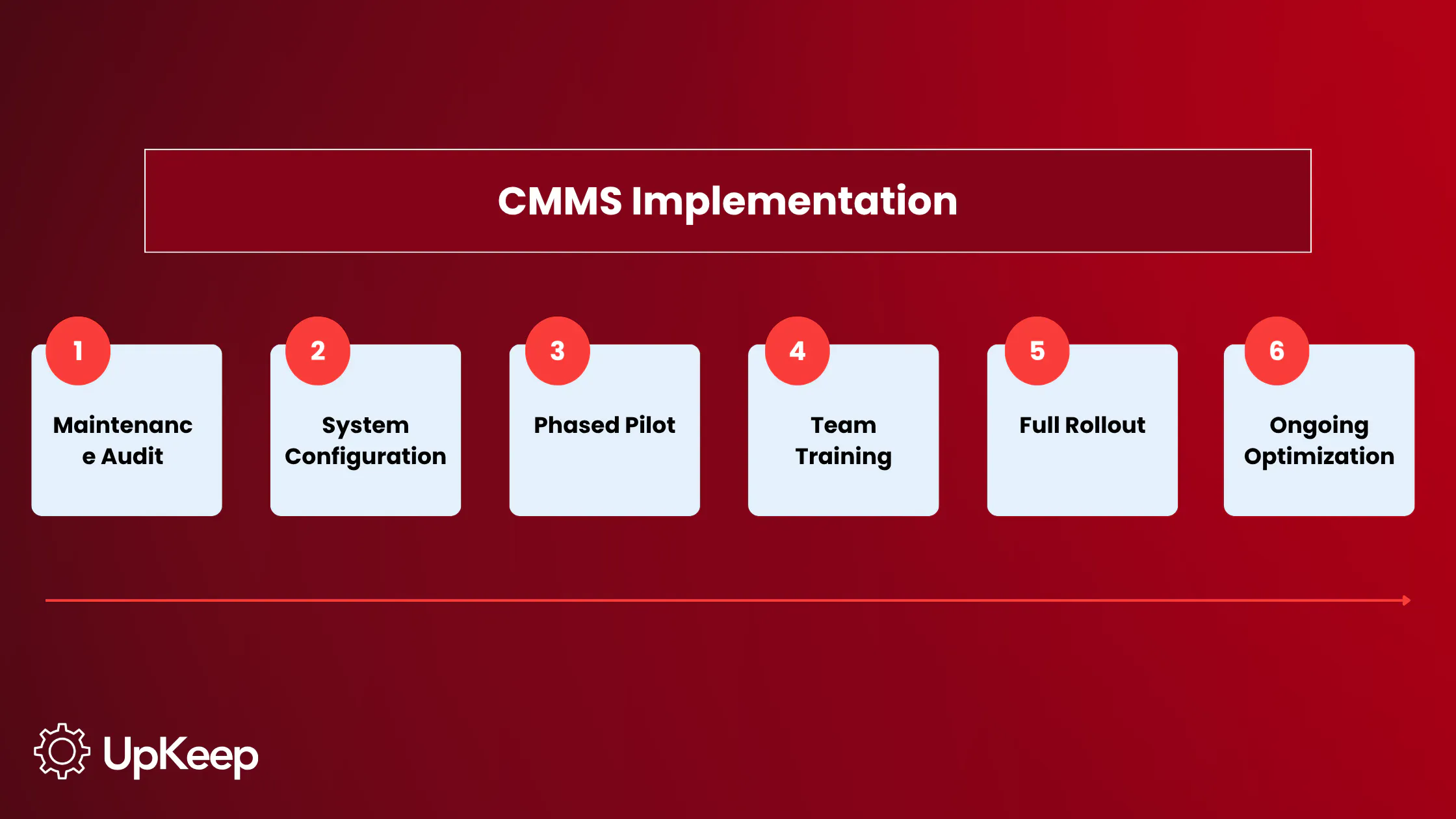
Successful CMMS software deployment typically begins with a maintenance audit that identifies current bottlenecks, critical assets, and gaps in existing maintenance processes. That audit becomes the foundation for everything that follows, including which assets get priority attention, which workflows need to be redesigned, and where integration with ERP, SCADA, or IoT systems will deliver the most immediate value in terms of data accuracy and real-time visibility.
Many automotive manufacturers also choose a phased rollout rather than a facility-wide launch. Piloting the system in one department or location allows teams to refine workflows and identify potential issues before scaling. A gradual implementation reduces the risk of a disruption and gives the organization proof points to build momentum around.

Prepare Your Team for Transition
Change management can make or break CMMS adoption. Maintenance teams need clear processes, consistent workflows, and a shared understanding of how the new system fits into their daily work. Without buy-in from the system’s primary users, even a well-configured platform will go unused.
Effective implementation involves technicians early on, incorporates their input into workflow design, and uses early wins to demonstrate value. Bringing the people who do the work through the entire process helps them see how the platform will make their jobs easier with fewer manual steps, faster access to equipment information, and less paperwork.
It also helps frame CMMS software as a tool designed to support technicians, not replace them. By reducing administrative tasks and improving access to maintenance data, it frees experienced team members to focus on the skilled work that actually requires their expertise.
This framing matters especially now. As skilled labor shortages continue to challenge automotive manufacturing, digital maintenance tools offer a practical path to improving technician efficiency, accelerating onboarding for newer team members, and helping plants do more with the workforce they have.
Maintain Training and Support for Long-term Success
After implementation, ongoing training helps processes continue to improve. Maintenance technicians, supervisors, and reliability engineers all use the platform differently, and each group needs training tailored to how they interact with it on a day-to-day basis.
Vendor onboarding support and long-term resources play a meaningful role after launch when teams are still getting used to new workflows. As organizations layer in predictive maintenance tools, AI-powered analytics, and new system integrations over time, refresher training is essential to ensure those capabilities are actually used rather than ignored.
To track implementation success, manufacturers can monitor metrics like preventive maintenance completion rates and work-order closure rates. These indicators reveal whether the system is being used as intended, or where additional coaching or process refinement is needed to close the gap.
Ready to Transform Maintenance at Your Automotive Facility?
From unplanned failures and spare parts shortages to disconnected data and workforce pressure, the challenges that automotive maintenance teams face don't have to be never-ending headaches. A purpose-built CMMS cuts down on (or outright eliminates) those issues by centralizing workflows, automating preventive schedules, and giving an organization the visibility it needs to act before something breaks. The ROI and operational gains only grow as the system matures.
UpKeep's CMMS platform is built for the demands of automotive manufacturing. It offers mobile-first work order management, predictive maintenance tools, enterprise-grade integrations, and real-time analytics that connect every team, asset, and workflow in one place.
See how UpKeep can work for your operation.
Frequently Asked Questions
What is CMMS software and what does it do for automotive manufacturers?
CMMS software centralizes maintenance operations like work orders, asset histories, preventive maintenance schedules, and spare parts inventory all in a single platform. For automotive manufacturers, it enables teams to shift from reactive to proactive maintenance, reduce unplanned downtime, and make data-driven decisions about critical production equipment.
What are the benefits of predictive maintenance for automotive manufacturers?
Predictive maintenance supported by CMMS technology can reduce unplanned downtime by 30%–50%, lower maintenance costs by up to 25%, and extend the useful life of production assets. By identifying potential failures before they occur, maintenance teams can plan repairs proactively rather than responding to emergencies.
How can mobile maintenance software improve responsiveness on the automotive plant floor?
Mobile CMMS tools give technicians instant access to work orders, equipment manuals, asset histories, and checklists from anywhere on the plant floor. Having information on the go improves the speed and accuracy of maintenance execution.
How much does a CMMS cost?
CMMS pricing varies based on platform features, number of users, and deployment scale, with most modern platforms offering tiered subscription models charged on a per-user, per-month basis.
Basic plans are best suited for smaller operations needing core work order management and preventive scheduling. They can run $21–$279 per month. Mid-tier premium plans with inventory management, analytics, and work order automation range from $63–$440 per month. Large or multi-site enterprises requiring advanced capabilities like IoT integrations, detailed maintenance history, and dedicated support can expect to pay $104–$649 or more per month.
4,000+ COMPANIES RELY ON ASSET OPERATIONS MANAGEMENT
Leading the Way to a Better Future for Maintenance and Reliability
Your asset and equipment data doesn't belong in a silo. UpKeep makes it simple to see where everything stands, all in one place. That means less guesswork and more time to focus on what matters.






![[Review Badge] Gartner Peer Insights (Dark)](https://www.datocms-assets.com/38028/1673900494-gartner-logo-dark.png?auto=compress&fm=webp&w=336)