Entrada en el Blog
Stop the Break/Fix Cycle: How to Build a Proactive Equipment Maintenance Strategy
A complete guide to equipment maintenance strategy, including criticality analysis, KPIs, and best practices to reduce costs and extend asset life.



Key Takeaways
An equipment maintenance strategy is a formal plan that outlines how an organization preserves its assets to ensure reliability and minimize operational disruptions.
An effective strategy uses a solid criticality analysis to categorize assets into High, Medium, and Low priority based on safety, production impact, and repair costs.
Successful equipment maintenance strategies balance the Predictive, Preventive, and Run-to-Failure approaches to optimize costs and reliability.
Equipment maintenance strategy relies on digital systems (CMMS) for real-time visibility into technician productivity, asset history, and spare parts inventory.
What Is Equipment Maintenance Strategy?
An equipment maintenance strategy is a formal plan that outlines how an organization preserves its assets to ensure reliability and minimize operational disruptions. This framework defines the specific methods, schedules, and resources required to keep machinery in optimal working condition throughout its lifecycle.
Core Components Of An Equipment Maintenance Plan
A comprehensive strategy organizes technical tasks into a clear roadmap for the maintenance team. These elements ensure that every technician understands their role in maintaining asset health and reducing unplanned downtime.


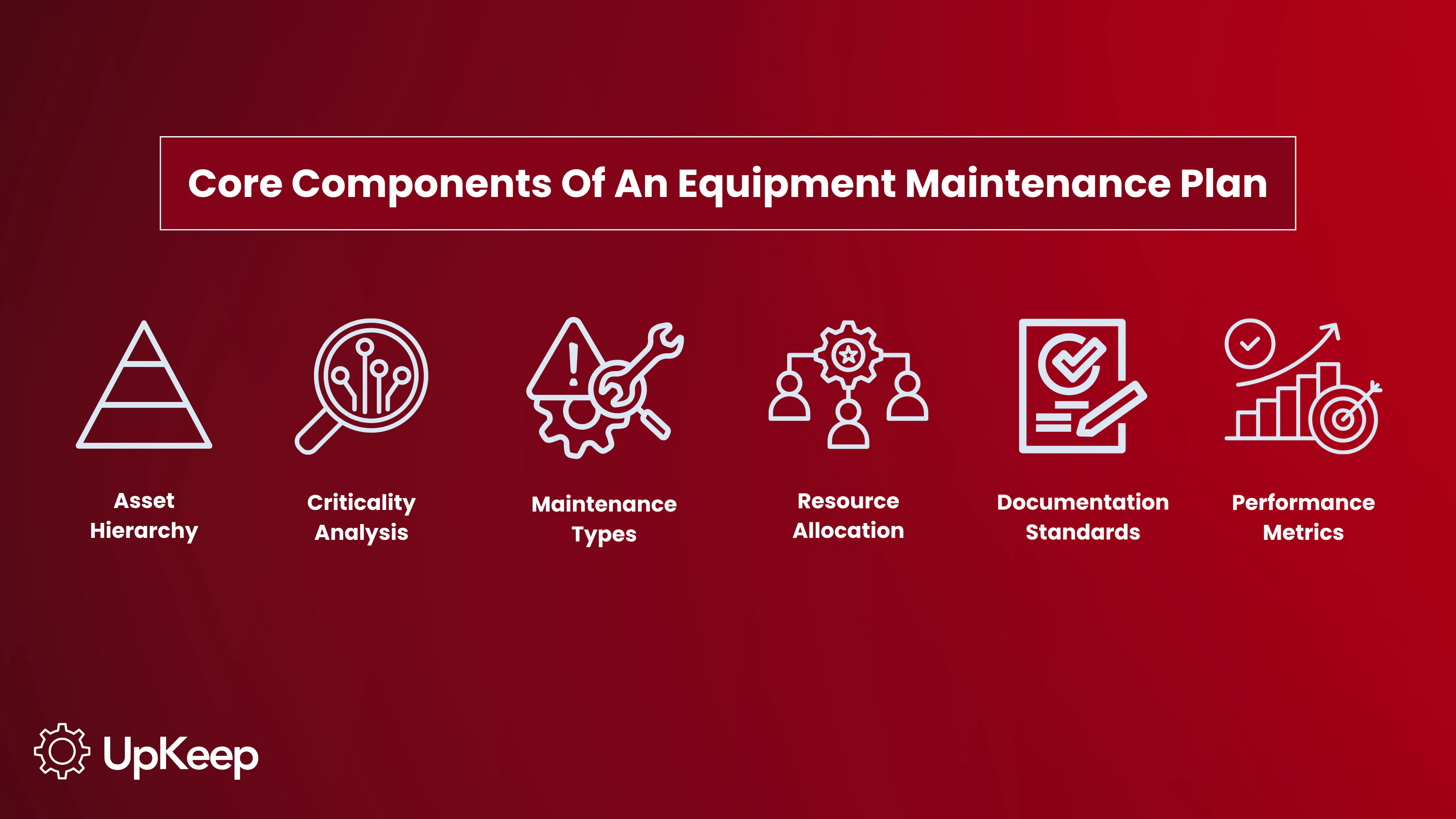
Asset Hierarchy: Organizes equipment by site, area, and type to ensure complete visibility.
Criticality Analysis: Determines which machines are most vital to help teams prioritize work orders.
Maintenance Types: Effective strategies often involve a mix of maintenance types tailored to the facility's specific needs.
Resource Allocation: Identifying the necessary personnel, specialized tools, and spare parts.
Documentation Standards: Establishing protocols for logging work orders and asset histories.
Performance Metrics: Tracking Key Performance Indicators like Mean Time to Repair and preventive maintenance compliance.
Strategic Goals Of An Equipment Maintenance Strategy
These goals ensure that teams work smarter, not harder, while keeping critical assets running at peak performance.
A successful strategy typically focuses on the following key outcomes:
Reduce unplanned downtime: High-impact strategies minimize equipment failures that lead to lost production and emergency repair costs.
Extend asset lifecycle: Consistent care and inspections prevent premature asset degradation, delaying expensive capital replacements.
Increase technician productivity: Providing mobile-first tools and clear work order history boosts wrench time by reducing administrative burdens.
Strengthen safety and compliance: Establishing digital audit trails and conducting regular safety checks helps prevent accidents and OSHA fines.
Optimize inventory management: Strategies help track spare parts usage to prevent stockouts while avoiding the waste of overstocking.
Improve team accountability: Maintenance software uses dashboards to show exactly who is assigned to a task and where the work order stands.
Building an Effective Equipment Maintenance Strategy
Building an effective equipment maintenance strategy is a crucial first step towards the shift from break/fix cycles to a proactive maintenance culture.
To help your organization make this transition, we have broken down every phase of the process.
Phase 1: Preparation & Asset Inventory
Successful maintenance strategies begin with a clear understanding of your current operations and a well-defined set of objectives. This foundation ensures that leadership and technicians are aligned on what needs to be maintained and how success will be measured.
Compile a Master Asset List
A centralized asset register removes information silos from your maintenance strategy.
Log every machine by its site, areas, and type. Ensure you include the age, model, and location for every asset to track its history from installation to the present day.
Pro Tip: Use maintenance software, such as a Computerized Maintenance Management System (CMMS), to log the asset list to support effective maintenance.
Assess Your Maintenance Maturity
Understanding the current state of operations (people, tools, and data) is essential for identifying gaps in maintenance, reliability, and safety.
People: Determine whether the team spends most of its time on repairs instead of scheduled maintenance.
Tools: Audit whether current maintenance processes rely on shelfware, manual tools like paper and spreadsheets, or legacy systems that technicians struggle with.
Data: Check if leadership has real-time visibility into work orders, or whether communication is ‘all over the place’.
Define Metrics for Success
Define what success looks like through specific goals and metrics.
Examples of these goals can be:
“To reduce unplanned downtime by 15% in a single quarter.”
“To increase technician productivity to 95% in three months.”
You can use metrics such as Mean Time to Repair (MTTR) and Mean Time Between Failures (MTBF) to demonstrate your team’s value to senior leadership.
Phase 2: Asset Criticality Analysis
The second phase of building an equipment maintenance strategy is identifying which machines are most vital to the organization through a criticality analysis.
This analysis helps organizations ensure that high-value and high-risk assets receive intensive monitoring while lower-priority items are managed more cost-effectively.
Factors for Determining Criticality
When assessing an asset for criticality, several key factors determine its place in the hierarchy.
Safety: Evaluate if an equipment failure risks human life, leads to regulatory fines, or causes environmental hazards.
Production Impact: Determine if the machine is a bottleneck that could stop the entire production line and kill output.
Repair Cost: Calculate the total financial burden of a failure, including emergency part orders, technician overtime, and lost revenue.
Create a Criticality Matrix
A criticality matrix helps maintenance leaders objectively rank machines into priority tiers
Priority | Impact of Asset Failure |
High Priority Assets | High safety risks, high repair costs, or high production impact. |
Medium Priority Assets | Redundant with manageable repair windows. |
Low Priority Assets | Low to No Impact on Operations |
Phase 3: Selecting Maintenance Types
Selecting the proper maintenance mode ensures that your team allocates labor and budget where they provide the most value. A balanced maintenance portfolio prevents the high costs of over-maintaining non-critical equipment while protecting your most vital production lines from unexpected failure.
To optimize your operations, you must assign a specific strategy to each asset class based on its criticality:
For High-Criticality Assets: Apply predictive maintenance using sensors and AI-powered insights to monitor equipment health in real time.
For Mid-Criticality Assets: Use preventive maintenance with automated, recurring schedules to catch wear and tear before it leads to a breakdown.
For Low-Criticality Assets: Utilize reactive maintenance, also known as run-to-failure, for inexpensive or non-essential parts where a breakdown has minimal impact on operations.
Pro Tip: Consult Manufacturer Guidelines
Original equipment manufacturer (OEM) manuals serve as the primary baseline for establishing initial maintenance schedules and intervals.
Teams can integrate these requirements into the asset history to ensure the organization meets warranty conditions and safety standards.
Phase 4: Strategy Implementation
Your implementation plan can make or break the entire equipment maintenance strategy. A structured rollout should prioritize your team capacity and standardized work. Successful execution depends on balancing the maintenance backlog with new preventive tasks to ensure the workforce can realistically meet compliance targets without burnout.
This stage focuses on resource management and technician enablement to ensure the long-term success of the equipment maintenance strategy.
Build a Maintenance Schedule
Proper scheduling prevents the maintenance team from falling into a cycle of constant firefighting.
As a maintenance leader, ensure you balance the team's workload to prevent burnout and ensure high preventive maintenance compliance. This approach keeps the work order backlog manageable and prevents the team from becoming overwhelmed during peak production cycles.
Did You Know?
UpKeep CMMS has a smart AI scheduler that helps assign tasks based on technician availability, skills, and job priority.
Develop Standard Operating Procedures (SOPs)
Standardizing work execution ensures that every technician performs repairs and inspections to the same high standard.
Organizations can create digital checklists and Standard Operating Procedures to provide clear instructions for every work order. These SOPs reduce errors, improve the safety culture, and guarantee that critical steps remain visible during complex procedures.
Upskill Your Workforce Through Training
Moving to a proactive strategy requires training the workforce on modern diagnostic tools and sensor technology.
Training must focus on practical skills that increase wrench time and help technicians feel confident using digital platforms in the field. High technician adoption rates occur when tools are easy to use and reflect the hands-on nature of maintenance work.
Phase 5: Continuous Improvement
The final phase of building a successful maintenance strategy is creating a cycle of continuous optimization.
Root Cause Analysis (RCA)
When a machine fails despite regular maintenance, teams can use AI-native incident management systems and root cause analysis to identify the underlying problem. This process helps managers understand why breakdown occurr and prevents it from recurring.
A central database of these findings also helps the team to build a knowledge repository for future troubleshooting.
Review KPIs
You should conduct periodic reviews of core metrics to evaluate the effectiveness of the equipment maintenance plan.
Some KPIs to monitor are:
Mean Time Between Failures (MTBF) measures the average time between equipment breakdowns and indicates overall asset reliability.
Mean Time to Repair (MTTR) tracks how long a team takes to fix an asset, helping to identify bottlenecks in the repair process.
Preventive Maintenance compliance rates indicate whether the team is completing planned tasks or reverting to reactive habits.
Work order throughput data helps prove the team's value to senior leadership with measurable productivity gains.
Learn more: Best KPIs for Maintenance Teams
Adjust Intervals
Organizations should use operational analytics to uncover trends and guide smarter decisions about PM schedules. If a machine consistently passes maintenance inspections without issues, extending the time between checks can reduce labor costs and increase wrench time for more critical tasks. This data-driven approach ensures the team performs only work that delivers measurable improvement for the organization.
The Role of Technology in Equipment Maintenance Strategies
Modern maintenance technology transforms equipment maintenance by connecting people, data, and workflows on a single platform. By leveraging automation and intelligent insights, maintenance leaders can uncover trends that guide smarter investment decisions and improve business performance.
Maintenance Management Software For Streamlined Processes
Cloud-based software enables maintenance teams to centralize their operations and eliminate the inefficiencies of paper-based systems. A Computerized Maintenance Management System (CMMS) ensures that technicians have immediate access to repair histories, parts manuals, and checklists to finish jobs correctly the first time.
Modern CMMS streamlines daily workflows through the following core capabilities:
Automated work order management allows supervisors to create, assign, and track tasks in real time.
Preventive maintenance scheduling reduces equipment failures by automatically triggering routine inspections.
Centralized asset registers organize equipment by site, area, and type to build a clear asset hierarchy.
Inventory management tools track spare parts usage and automatically set reorder thresholds to prevent stockouts.
Reporting dashboards provide customizable insights into key metrics like Mean Time to Repair (MTTR) and Mean Time Between Failures (MTBF).
Actions | Pen & Paper | Excel | CMMS |
Assign maintenance tasks | ✅ | ✅ | ✅ |
Track technicians on duty | ❌ | ❌ | ✅ |
Store asset maintenance information | ✅ | ❌ | ✅ |
Get inventory alerts | ❌ | ❌ | ✅ |
Get reminders for scheduled preventive maintenance | ❌ | ❌ | ✅ |
Maintain Centralized Asset Register | ✅ | ✅ | ✅ |
IoT And Predictive Analytics In Modern Maintenance
The integration of Internet of Things (IoT) sensors allows for a shift toward intelligent, condition-based monitoring. AI-powered platforms use real-time sensor data to identify equipment failure risks before a breakdown occurs. These technologies turn maintenance data into a strategic advantage by predicting failures instead of merely reacting to them.
Mobile Solutions For On-The-Go Maintenance Management
Mobile-first maintenance platforms address the needs of frontline users who require field-ready tools to complete work faster. Field-ready apps provide offline access to asset manuals, repair histories, and safety checklists. These solutions achieve high technician adoption rates by offering an intuitive user interface.
Frequently Asked Questions about Equipment Maintenance Strategy
What are the types of maintenance?
Maintenance strategies are generally divided into three main categories based on when and why the work is performed. Choosing the right mix depends on the equipment's criticality and the desired balance between cost and reliability.
Reactive Maintenance is also known as "break/fix" or "run-to-failure." This work occurs only after an asset has already broken down.
Preventive Maintenance (PM) involves scheduled, routine tasks intended to prevent breakdowns and extend equipment life.
Predictive Maintenance (PdM) is an advanced strategy that uses sensors and AI to monitor asset health in real time, predicting failures before they happen.
What is the real difference between preventive and predictive maintenance?
While both aim to prevent failures, the primary difference lies in the trigger for the maintenance work. Preventive maintenance relies on time-based intervals or usage, whereas predictive maintenance relies on the machine's actual condition.
Is predictive maintenance worth the high upfront cost?
Predictive maintenance is a significant investment, but it provides high ROI for critical production assets where downtime is expensive. By identifying risks before a breakdown occurs, companies avoid the massive costs associated with emergency parts, overtime, and lost production revenue. For low-criticality assets, however, simple preventive schedules or run-to-failure strategies are often more cost-effective.
What is the difference between criticality and root cause analysis?
Criticality analysis is a proactive planning tool, while root cause analysis (RCA) is a reactive improvement tool used after an event has occurred.
Criticality analysis: This evaluates which machines are most vital to safety and production to prioritize maintenance schedules.
Root cause analysis: This investigates why a specific failure happened to ensure it does not occur again.
MÁS DE 4000 EMPRESAS CONFÍAN EN LA GESTIÓN DE OPERACIONES DE ACTIVOS
Liderando el camino hacia un futuro mejor para el mantenimiento y la confiabilidad
Los datos de sus activos y equipos no pertenecen a un silo. UpKeep simplifica ver dónde se encuentra todo, todo en un solo lugar. Eso significa menos conjeturas y más tiempo para concentrarse en lo que importa.






![[Review Badge] Gartner Peer Insights (Dark)](https://www.datocms-assets.com/38028/1673900494-gartner-logo-dark.png?auto=compress&fm=webp&w=336)