Blog Post
The Manufacturer’s Guide to Equipment Maintenance
Unplanned downtime can cost manufacturers up to $2M per hour. Learn equipment maintenance strategies that reduce downtime and improve OEE.


Key Takeaways
Manufacturing equipment maintenance includes all the processes and activities used to keep machinery, tools, and industrial systems in peak operating condition.
Unplanned downtime in manufacturing now costs twice as much per hour as it did in 2019, with losses reaching $2 million per hour in high-stakes sectors such as the automotive industry.
Effective equipment maintenance is the primary driver for improving Overall Equipment Effectiveness and lowering the rising costs of unplanned downtime.
Transitioning to strategic maintenance requires adopting a Computerized Maintenance Management System (CMMS) to centralize data, standardize inspections, and enable Root Cause Analysis.
Manufacturing equipment maintenance includes all the processes and activities used to keep machinery, tools, and industrial systems in peak operating condition. This discipline focuses on preventing unexpected failures, ensuring employee safety, and extending the functional life of machines.
New-age manufacturing equipment maintenance is becoming more proactive. The goal is to transform maintenance from a cost center into a competitive advantage.
Why Manufacturing Equipment Maintenance is Important
Organizations benefit in numerous ways from implementing manufacturing equipment maintenance. These advantages include:
Reduced Downtime
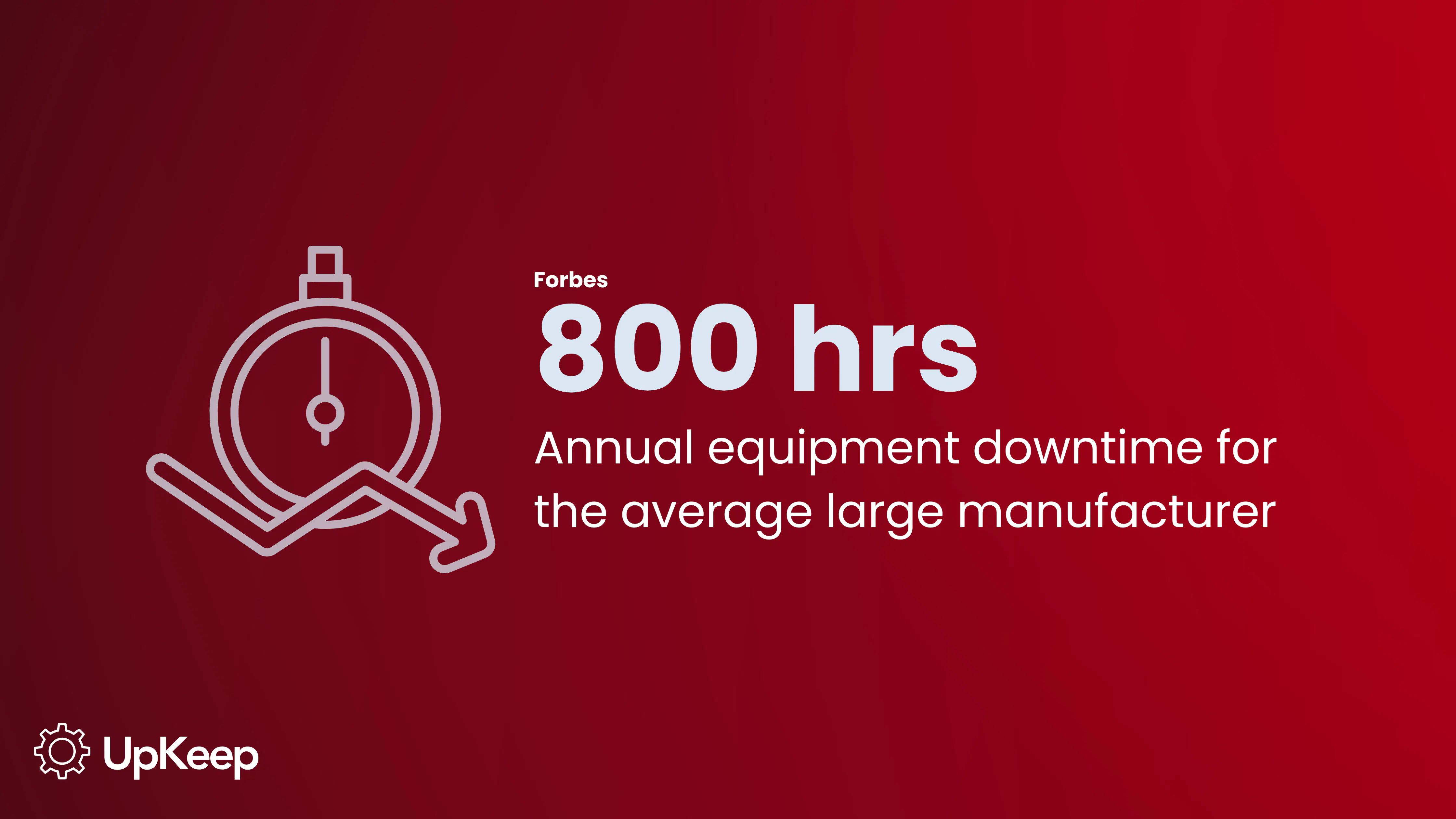
The average large manufacturer experiences over 800 hours of equipment downtime annually, more than 15 hours of lost production every week.


A solid equipment maintenance plan keeps machines in good condition and reduces the risk of unplanned downtime, allowing teams to remain productive.
Improved Overall Equipment Effectiveness
Overall Equipment Effectiveness (OEE) is the gold standard for measuring manufacturing productivity by tracking availability, performance, and quality.
Effective maintenance ensures that machines operate with minimal defects, increased throughput, and produce Top Quartile manufacturing performance.
Lower Operating Costs
Investing in proactive maintenance reduces the cost of ownership for industrial machinery by avoiding the high price of emergency repairs.
These statistics demonstrate how equipment maintenance lowers operating costs for manufacturers.
Cost Savings: The cost of a lost hour of production can range from $39,000 for consumer goods to more than $2 million for automotive manufacturers. (Source)
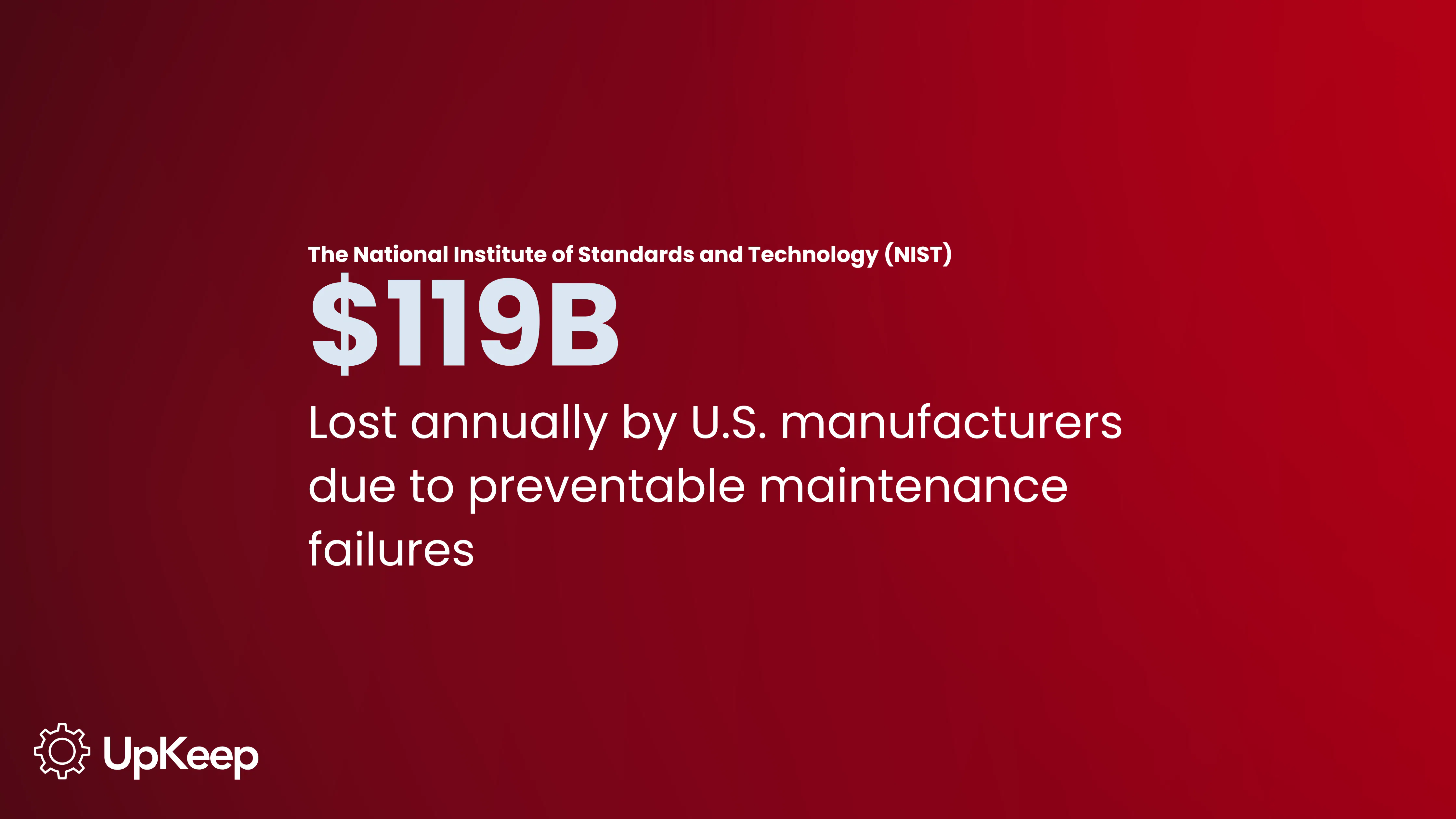
Reduced Preventable Losses: The National Institute of Standards and Technology (NIST) estimates that U.S. manufacturers lose $119.1 billion annually due to preventable maintenance issues.

Increasing Costs of Downtime: The financial impact of downtime has increased rapidly over the years. Each hour of unplanned downtime now costs roughly 50% more today than it did in 2019. (Source)
Types Of Manufacturing Equipment Maintenance
Manufacturing facilities can use various maintenance strategies to balance operational costs with equipment reliability. Choosing the appropriate maintenance type depends on the asset's criticality, the cost of downtime, and the availability of real-time data.
Let’s take a look at the maintenance strategies used in manufacturing industries.
Reactive Maintenance
Reactive maintenance, also known as run-to-failure, involves performing repairs only after a machine has broken down. This approach requires minimal planning, but it often leads to high unplanned downtime and expensive emergency repair costs. This strategy is typically reserved for non-critical assets where the cost of a preventive program exceeds the cost of replacement.
Strategy: Equipment may operate until it fails.
Risk: This approach creates reactive chaos, as 70% to 90% of the team's time is spent firefighting rather than working.
Impact: According to the National Institute of Safety and Technology, reliance on reactive maintenance results in 3.3 times more downtime than top-performing quartile facilities.
Preventive Maintenance
Preventive maintenance (PM) consists of regularly scheduled inspections, cleaning, and parts replacements designed to prevent failures before they occur.
Manufacturing managers use CMMS platforms to automate maintenance schedules, ensuring critical inspections, compliance checks, and safety tasks never slip through the cracks.
Strategy: Tasks are performed based on set time intervals, such as weekly, monthly, or annually, regardless of the asset's current state.
Risk: Over-maintenance is a real risk. Companies may spend money on servicing procedures that an asset does not need.
Impact: Facilities using preventive maintenance can reduce downtime by 30% and improve scheduled maintenance compliance rates by 40% to 60% within three months.
Usage-Based Maintenance
Usage-based maintenance triggers service activities based on actual equipment utilization instead of time. This method ensures that maintenance is performed only when needed, preventing the waste of resources associated with over-maintenance of idle machines.
Strategy: Maintenance is prompted by specific utilization metrics such as machine hours, production cycles, or miles traveled.
Risk: If meters are not tracked accurately or sensors fail, critical maintenance windows can be missed entirely.
Impact: This approach optimizes wrench time by focusing technician labor on equipment that has reached a high-wear state.
Condition-Based Maintenance
Condition-Based Maintenance (CBM) monitors the actual health and performance of an asset to determine when maintenance is required. Instead of following a calendar, technicians intervene only when sensors indicate a deviation from normal operating parameters, such as excessive vibration or temperature spikes. This strategy relies on an integrated platform, such as UpKeep CMMS, that connects field technicians to real-time equipment data.
Strategy: Sensors track specific real-time conditions, such as heat, pressure, or fluid quality, to identify risks before breakdowns occur.
Risk: High initial investment in sensor technology and the need for a tech-savvy team to interpret data can be significant barriers.
Impact: CBM allows teams to catch potential failures early, reducing the MTTR (Mean Time to Repair) by providing context for the repair before the technician arrives.
Predictive Maintenance
Predictive maintenance (PdM) uses artificial intelligence (AI) and operational analytics to predict exactly when an asset will fail so maintenance can be scheduled at the optimal time.
Strategy: AI-driven models analyze historical and real-time data to identify patterns and predict failure windows.
Risk: Data silos or dirty data from legacy systems can lead to inaccurate predictions if the information is not standardized.
Impact: Research has found that manufacturers that use predictive maintenance see a 52.7% reduction in unplanned downtime compared to those relying on reactive strategies.
Learn More: Predictive and Condition-based Maintenance Compared
Manufacturing Industries that Benefit From Equipment Maintenance
Manufacturing equipment maintenance is the backbone of any industry that relies on physical assets to produce, move, or process goods. Below is a comprehensive list of industries that benefit from manufacturing and industrial maintenance, categorized by sector.
1. Heavy Industry & Raw Materials
These industries rely on massive, high-torque machinery that operates in harsh environments. Maintenance here is focused on preventing catastrophic mechanical failure.
Mining & Quarrying: Crushers, conveyor systems, massive excavators, and drilling rigs.
Steel & Metal Smelting: Blast furnaces, rolling mills, and overhead cranes.
Oil & Gas: Refineries, offshore drilling platforms, pumping stations, and pipelines.
Chemical Manufacturing: High-pressure reactors, mixing tanks, and specialized piping.
Cement & Glass Production: Kilns, grinders, and high-temperature cooling systems.
Pulp & Paper Mills: Large-scale rollers, wood chippers, and chemical processing vats.
2. Transportation & Aerospace
Reliability in these sectors is often a matter of life and safety, making rigorous maintenance schedules legally mandatory.
Automotive: Robotic assembly lines, stamping presses, and paint booths.
Aerospace & Defense: CNC precision machining, composite curing ovens, and jet engine testing cells.
Shipbuilding: Welding robots, heavy-duty hoists, and dry-dock pumping systems.
Rail & Locomotive: Locomotive assembly and specialized track-laying machinery.
3. Food, Beverage & Agriculture
Maintenance here is driven by hygiene standards and the perishability of the product.
Food Processing: Industrial ovens, freezers, meat-cutting saws, and mixers.
Beverage & Bottling: High-speed filling machines, capping lines, and carbonation systems.
Agricultural Processing: Grain elevators, combines, and automated sorting/packaging systems.
Dairy: Pasteurization units, homogenizers, and automated milking systems.
4. Life Sciences & Healthcare
Precision and sterility are the primary drivers for equipment maintenance in the healthcare sectors.
Pharmaceuticals: Tablet presses, blister packaging machines, and cleanroom HVAC systems.
Medical Device Manufacturing: Injection molding for surgical tools and precision laser-cutting.
Biotechnology: Bioreactors, centrifuges, and cryo-storage maintenance.
5. High-Tech & Consumer Goods
These industries benefit from maintenance that ensures extreme precision and high-volume output.
Semiconductors: Wafer fabrication tools, lithography machines, and vacuum pumps.
Consumer Electronics: Surface Mount Technology (SMT) lines for circuit boards and robotic assembly.
Textiles & Apparel: Automated looms, industrial sewing machines, and dyeing equipment.
Furniture Manufacturing: CNC wood routers, sanding machines, and upholstery staplers.
Plastics & Packaging: Injection molding, blow molding, and high-speed labeling machines.
6. Energy & Utilities
Maintenance in the energy and utility sector is critical for infrastructure stability and public service continuity.
Power Generation: Turbines (steam, gas, hydro), generators, and cooling towers.
Renewable Energy: Wind turbine gearboxes, solar tracking motors, and battery storage cooling.
Water Treatment: Industrial pumps, filtration systems, and chemical dosing units.
Waste & Recycling: Shredders, balers, and optical sorting machines.
7. Logistics & Infrastructure
While often overlooked in manufacturing, these sectors use identical equipment to move and store goods.
Warehousing & Logistics: Automated Storage and Retrieval Systems (ASRS), conveyors, and forklifts.
Data Centers: Critical cooling systems (CRAC units) and backup power generators.
Commercial Real Estate: Large-scale HVAC, elevators, and building management systems.
Manufacturing Equipment Maintenance Best Practices
Manufacturing equipment maintenance best practices involve a combination of digital tools, technical discipline, and cultural alignment. Implementing these standard practices transforms manufacturing equipment maintenance into a repeatable and reliable process.
Adopt A Computerized Maintenance Management System (CMMS)
A CMMS acts as the central intelligence hub for all facility maintenance operations. This digital platform replaces inefficient paper logs and spreadsheets, providing a clear view of asset health and team productivity.
Did you know? According to recent industry data, 65% of companies use a CMMS to optimize costs, and those who do report better visibility into task completion and a significant reduction in unplanned downtime.
Conduct Regular Inspections
Consistent maintenance inspections allow teams to detect wear and tear before it results in a catastrophic failure. Having a CMMS helps standardize inspection checklists, ensuring that every technician follows the same safety and quality protocols.
Invest In Workforce Training
Sophisticated industrial machinery requires a highly skilled workforce to manage complex maintenance tasks. Investing in workforce development helps bridge the skills gap and empowers technicians to use advanced diagnostic tools effectively.
Prioritize Root Cause Analysis (RCA)
Root Cause Analysis involves investigating a failure to identify the primary reason it happened. Prioritizing RCA ensures that teams solve the fundamental problem instead of just addressing the immediate symptoms of a breakdown. This practice is vital for reducing the frequency of recurring issues that drain maintenance budgets and lower OEE scores.
Follow Manufacturer Guidelines
Original equipment manufacturers (OEMs) provide detailed service manuals that outline the optimal maintenance schedule for every asset. Following these guidelines keeps machinery running within design specifications and protects the validity of equipment warranties.
Frequently Asked Questions about Manufacturing Equipment Maintenance
How to manage equipment maintenance?
Managers organize equipment maintenance by centralizing all work orders, asset histories, and inventory data into a digital system. A computerized maintenance management system provides a single source of truth, allowing every technician and manager to access real-time information on their mobile devices. This approach eliminates the data silos created by paper logs and manual spreadsheets.
How to develop a preventive maintenance program?
Reliability experts recommend prioritizing assets based on their criticality to the production line to maximize return on investment. Following a structured rollout helps the team adopt proactive habits without disrupting current production targets.
How can proper training reduce maintenance costs?
Proper training reduces maintenance costs by ensuring technicians use tools correctly and identify issues early. Providing modern tools and the training to use them improves employee retention and operational efficiency.
Training programs lower costs through the following outcomes:
Skilled technicians complete repairs faster and with fewer errors.
Proper training ensures that repairs are performed the first time.
Educated workers identify minor faults before they escalate into expensive failures.
Training reduces the risk of workplace accidents and associated regulatory fines.
What does equipment maintenance include?
Equipment maintenance includes a variety of tasks that protect machinery from premature wear and unexpected failure. A comprehensive plan covers mechanical adjustments, electrical inspections, and safety compliance checks to maintain peak performance. These tasks vary by asset but generally focus on preserving the machine's structural integrity.
4,000+ COMPANIES RELY ON ASSET OPERATIONS MANAGEMENT
Leading the Way to a Better Future for Maintenance and Reliability
Your asset and equipment data doesn't belong in a silo. UpKeep makes it simple to see where everything stands, all in one place. That means less guesswork and more time to focus on what matters.






![[Review Badge] Gartner Peer Insights (Dark)](https://www.datocms-assets.com/38028/1673900494-gartner-logo-dark.png?auto=compress&fm=webp&w=336)