Entrada en el Blog
The Essential Guide to Building Maintenance Plans
Reduce emergency repairs, improve safety, and extend asset lifespan with a strategic building maintenance plan. Get a step-by-step guide and see how CMMS software drives long-term savings.



Key Takeaways:
A building maintenance plan reduces expensive emergency repairs and extends the lifespan of critical assets, directly improving your bottom line.
Effective maintenance plans are tailored to the building's specific context, and facility managers need to factor in building age, regulatory demands, and environmental challenges.
The goal of a strong building maintenance plan is to minimize reliance on reactive, manual work. A Computerized Maintenance Management System (CMMS) is essential for scheduling tasks, managing work orders, tracking asset history, and providing the data needed for informed decision-making.
A building maintenance plan is a structured approach for scheduling maintenance to ensure the reliability, safety, and efficiency of assets within a facility. It includes the tasks, schedules, and resources needed to preserve the function and value of a building over time. Implementing a building maintenance plan moves the organization away from unpredictable and expensive "break/fix" chaos toward planned, proactive processes that reduce costs and minimize unplanned downtime.
Why Do You Need a Building Maintenance Plan?
Having a building maintenance plan has become a strategic necessity that goes far beyond simple repairs and directly impacts a facility's finances, operations, safety, and long-term value. Planned maintenance is crucial for operational teams, especially the resource-constrained maintenance manager.
Financial Benefits
Building maintenance plans dramatically reduce the frequency of unplanned downtimes and catastrophic failures, which are often expensive to fix. Regular, small-scale maintenance is significantly cheaper than major overhauls or replacements. Doing this extends the asset lifespan, lowers the Mean Time to Repair (MTTR), and overall capital expenditure.
Operational Benefits
Having a maintenance plan directly improves the performance, reliability, and productivity of your entire facility. Regular inspections and preventive maintenance reduce downtime, risk of unplanned equipment failures, and maximize Overall Equipment Effectiveness (OEE).
Safety & Compliance and Asset Value Benefits
Regular inspections of critical safety systems, such as fire alarms, electrical components, and structural elements, reduce accident risk and ensure a safe, functional environment for occupants. Maintenance planning ensures compliance with local, national, and industry health and safety standards. Routine checks and digital audit logs help prevent costly OSHA penalties or lost certifications, especially in heavily regulated industries like food and pharma.
Types of Building Maintenance in the Plan
A robust building maintenance plan incorporates various maintenance types and often uses a Computerized Maintenance Management System (CMMS), such as UpKeep, to track and execute work effectively. These types fall into two major categories: Planned and responsive (reactive) maintenance.
Planned maintenance is performed to reduce the likelihood of failure and prevent unplanned downtime. Responsive or reactive maintenance strategies are implemented to restore assets after the team identifies a problem or a piece of equipment has failed. The goal of a strong maintenance plan is to minimize reliance on reactive maintenance tasks.
Maintenance Type | Description | Triggers | |
Planned Maintenance (PM) | Planned Maintenance | Performed to stop equipment failures and reduce reactive work. | Based on time (e.g., every month) or usage (e.g., every 1,000 hours of operation). |
Routine Maintenance | Daily or regular activities to keep the building clean, functional, and aesthetically pleasing. | Daily or regular. | |
Condition-Based Maintenance (CbM) | Schedules maintenance only when necessary, or when equipment shows signs of wear or decreased performance. | When monitoring equipment performance indicates a need for intervention (e.g., vibration, temperature). | |
Predictive Maintenance (PdM) | Uses sensors and real-time monitoring software to estimate an asset's future condition and anticipate failures. | Real-time monitoring software (often IoT) to anticipate failures. | |
Reactive or Responsive Maintenance | Corrective Maintenance | Activities intended to restore the functionality of a building or asset after damage or decay has occurred. | After damage or decay has occurred. |
Emergency Maintenance | Most urgent type of reactive maintenance, performed in response to a sudden, unexpected breakdown. | When failure threatens safety, security, or life, or when vital system performance declines. | |
Deferred Maintenance | Necessary repairs that were deliberately postponed. | Postponed due to budgetary constraints, limited staff, or time restrictions. |
Compare Predictive vs Condition-Based Maintenance
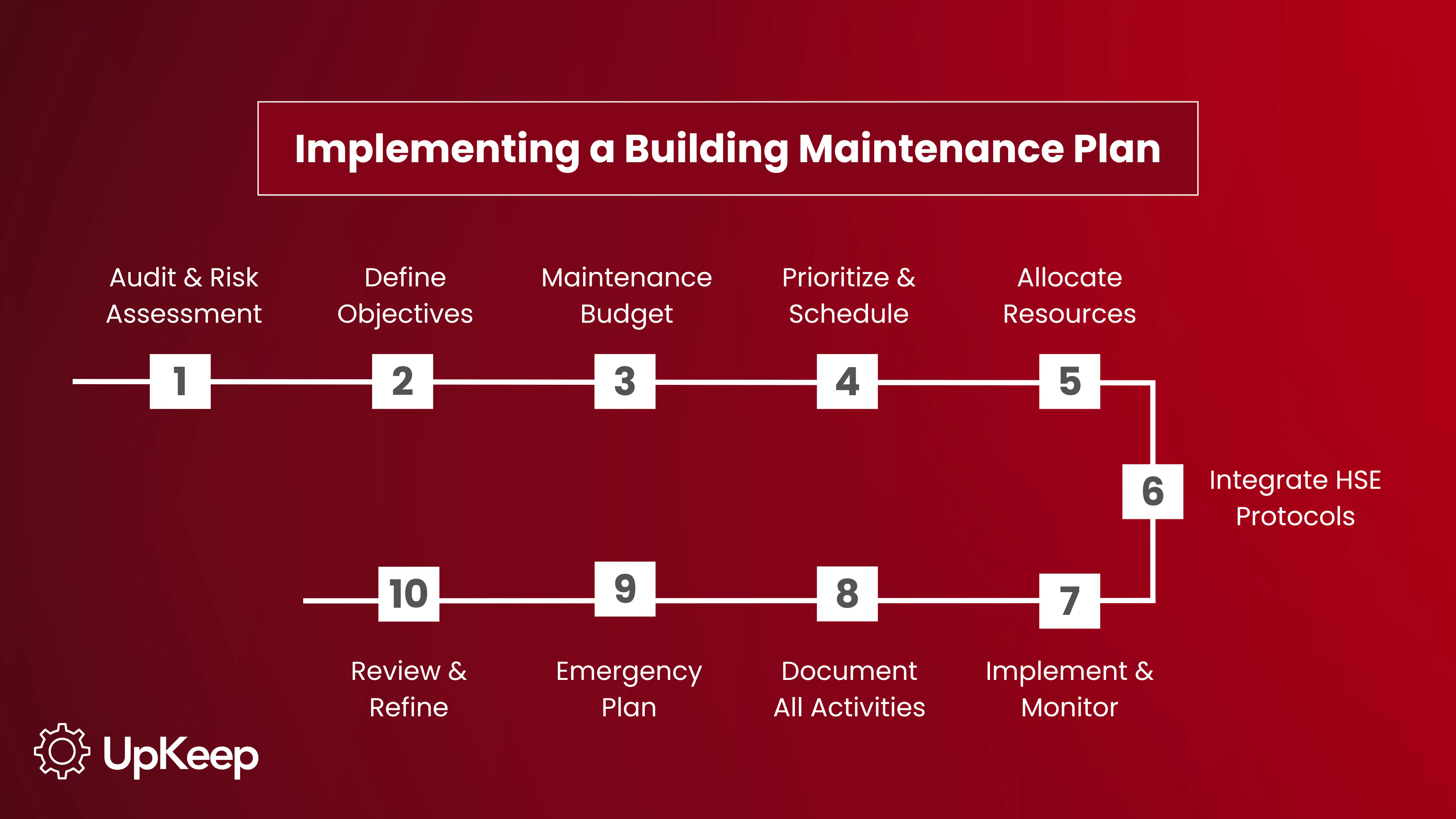
A Step-by-Step Guide to Implementing a Building Maintenance Plan
Following a structured approach to execute the building maintenance plan allows you to account for all assets, use resources efficiently, and ensure the facility remains safe and operational.
Step 1: Conduct a Thorough Audit and Risk Assessment
Start by conducting a detailed audit of all equipment and systems, including HVAC, plumbing, and electrical components. Following the audit, perform a risk assessment to identify which asset failures would pose the greatest threat to safety, operations, or compliance. Using a reliable CMMS allows you to build a clean asset hierarchy and use mobile checklists for inspections.
Step 2: Define Objectives and Build a Work Order System
With a clear picture of your assets and risks, you can set specific, measurable maintenance objectives. These goals include reducing equipment downtime by 20%, lowering annual repair costs, and improving preventive maintenance compliance. To manage the tasks required to meet these objectives, build a robust work order system. This system will serve as the central hub for creating, assigning, tracking, and documenting all maintenance activities, from routine inspections to emergency repairs.
Step 3: Develop a Realistic Maintenance Budget
A successful plan requires adequate financial support. Develop a detailed budget that accounts for all anticipated maintenance costs for the year. Be sure to allocate funds for both preventive maintenance and a contingency fund to cover unexpected breakdowns.
This budget should account for all anticipated costs, including:
Labor: Regular and overtime hours for your technicians.
Parts: The cost of spare parts and required inventory for maintenance, repairs, and operations (MRO).
Tools: The purchase or rental of necessary equipment.
Contractors: Costs for specialized external services.
A CMMS provides the data needed for accurate budgeting by tracking costs associated with maintenance tasks. This data helps justify spending and prove the maintenance team's value to leadership.
Step 4: Prioritize and Schedule Maintenance Tasks
Factors such as safety risks, production impacts, and regulatory requirements determine the criticality of tasks. Create a detailed maintenance schedule that outlines all recurring preventive maintenance tasks and specifies their frequencies (daily, weekly, monthly, or annually). A well-organized schedule ensures proactive work is completed on time and nothing falls through the cracks.
Step 5: Allocate Resources
Effective execution depends on having the right people and tools for the job. Allocate resources by assigning specific tasks to technicians based on their skill sets and expertise. Ensure your team has the necessary tools, personal protective equipment (PPE), and spare parts to perform their duties safely and efficiently.
Step 6: Integrate Health, Safety, and Environmental (HSE) Protocols
Ensure your maintenance plan fully integrates all relevant health, safety, and environmental (HSE) regulations, as well as the International Code Council (ICC) local building codes. Document safety procedures for tasks like lockout/tagout and working in confined spaces. Providing regular training on these protocols is crucial for preventing accidents, protecting your team, and avoiding potential penalties or legal issues. A strong safety protocol is a vital component of a successful building maintenance plan.
Step 7: Implement and Monitor the Plan
Start executing scheduled tasks and managing daily operations through your work order system. Continuously monitor the plan's performance by tracking key performance indicators (KPIs) such as preventive maintenance compliance, scheduled vs. unscheduled work, and overall equipment effectiveness (OEE). This data will reveal whether your strategy is achieving its objectives.
Step 8: Document All Activities and Findings
Keep detailed records for every work order, noting what was done, who performed the work, how long it took, and the parts used. This historical data provides valuable insights for optimizing maintenance schedules, troubleshooting recurring problems, and justifying budget requests. It also creates an indispensable audit trail that demonstrates adherence to regulatory standards.
Step 9: Incorporate an Emergency Preparedness Plan
Augment your maintenance plan with a clear emergency protocol that outlines procedures for critical asset failures, power outages, or other urgent situations. This plan should include emergency contact lists, step-by-step response actions, and backup procedures to minimize operational disruption.
Step 10: Regularly Review and Refine the Plan
A building maintenance plan should be a living document that evolves with your facility. Schedule periodic reviews, either quarterly or annually, to evaluate its effectiveness. Analyze your KPIs, get feedback from your maintenance team, and assess whether you are meeting your original objectives. Use these insights to improve productivity, adjust schedules, and refine your overall strategy to meet better the changing needs of the building and your organization.


Key Stakeholders in a Building Maintenance Plan
A successful building maintenance plan involves a collaborative effort from a team of internal and external personnel, each with distinct responsibilities.
Role | Responsibilities |
Facility Manager | Holds primary responsibility for overall maintenance strategy, creating schedules, overseeing budget, and ensuring long-term operational health. |
Maintenance Supervisors | Manage day-to-day implementation, lead technical teams, assign tasks, and ensure work is on schedule and meets standards. |
Technicians | Perform actual hands-on maintenance and repair tasks. |
Internal Support Roles | |
Engineering and Operations Team | Manage system integrations, ensure data accuracy, and handle reporting. |
The Procurement Team | Manages MRO supplies inventory, tracks spare parts, handles purchase orders, and manages vendor costs. |
Housekeeping and Janitorial Staff | Spot and report issues like leaks or broken fixtures, creating work requests. |
External Partners | |
Vendors | Supply spare parts, tools, and other MRO inventory. |
Contractors | Perform highly specialized work, such as elevator maintenance or complex HVAC repairs. |
What Is a Building Maintenance Checklist?
A building maintenance checklist is a detailed, task-oriented document that technicians use to guide them through the specific steps of a maintenance job. It ensures that every action required for an inspection, repair, or preventive maintenance task is completed consistently and safely. Modern CMMS platforms can utilize AI to generate checklists based on the asset type and task at hand.
Try UpKeep CMMS Maintenance Checklist Generator for Free!
Building Maintenance Plan vs. Building Maintenance Checklist
Feature | Building Maintenance Plan | Building Maintenance Checklist |
Scope | Covers the entire maintenance program. | Focuses on a single, discrete task. |
Purpose | Outlines long-term goals, budget, and priorities. | Provides step-by-step instructions for execution. |
Content | Includes schedules, resource allocation, KPIs, and objectives. | Contains a sequence of actions, required tools, and sign-offs. |
Relationship | The overarching document contains many checklists. | A component of the plan used to complete a specific job. |
Components of a Building Maintenance Checklist
A comprehensive building maintenance checklist is organized into specific categories to ensure all aspects of the facility are regularly inspected and maintained. A well-structured checklist helps standardize procedures to ensure regulatory compliance.
Exterior Maintenance
The UK Department of Environment, Food and Rural Affairs recommends the following steps for exterior maintenance:
Inspect the roof for any damaged, loose, or missing shingles, as well as signs of leaks or debris.
Examine walls for peeling or blistering paint, mildew, or damage to siding materials.
Ensure gutters and downspouts are clear of debris and functioning correctly to prevent water from damaging the foundation.
Verify that drainage areas around the building slope away from the foundation.
Check for and repair any potholes, cracks, or uneven surfaces that could pose a trip-and-fall hazard.
Ensure parking lines, traffic signs, and pedestrian walkways are clearly marked and visible.
Trim trees and shrubs, especially those close to the building, power lines, or obstructing walkways.
Check irrigation systems for leaks or malfunctions and maintain lawns to keep the property looking professional.
Inspect window and door seals for drafts or signs of decay.
Check all exterior wood trim, including window sills and door frames, for signs of rot or insect damage.
Interior Maintenance
HVAC Systems
Inspect and service heating, ventilation, and air conditioning (HVAC) units quarterly or semi-annually.
Clean evaporator and condenser coils.
Check and clean or replace air filters to maintain air quality and efficiency.
Verify that the thermostats are operating correctly.
Inspect ductwork for any leaks or damage.
Clear drain lines and pans to prevent water overflow.
Check refrigerant levels.
Plumbing
Check for leaks in pipes, faucets, toilets, and other fixtures.
Look for signs of water damage on ceilings and walls, especially below bathrooms and kitchens.
Test the water pressure to ensure it is within the normal range.
Ensure all drains in sinks and floors are clear of clogs.
Inspect water heaters for leaks or signs of corrosion.
Electrical Systems
Test all light fixtures and replace bulbs as needed.
Check outlets and circuit breakers to ensure they are functioning safely.
Test all Ground Fault Circuit Interrupter (GFCI) outlets to ensure they trip correctly.
Inspect electrical panels for signs of overheating or wear.
Ensure all electrical cords and connections are in good condition and not frayed.
Floors, Walls, and Ceilings
Inspect for any signs of damage, such as cracks, stains, or peeling paint.
Schedule repairs for any identified damage to walls, floors, or ceilings.
Ensure flooring is secure and does not create a trip hazard.
Pest Control
Regularly inspect for signs of pests or rodents, such as droppings or nests.
Address any infestations promptly with professional assistance if necessary.
Seal any cracks or holes in the building's exterior to prevent pest entry.
Common Areas and Facilities
Lobbies, Hallways, and Entrances
Ensure floors are kept clean and dry. Clean all entrance glass and windows.
Check that all lighting is operational to ensure hallways and lobbies are well-lit.
Inspect and test all doors, including automatic doors, to ensure they are functioning correctly.
Restrooms
Check that all toilets and sinks are in good working order.
Ensure restrooms are well-stocked with necessary supplies.
Maintain a high standard of cleanliness and sanitation.
Elevators and Escalators
Test the elevator call buttons and ensure the interior is clean and well-lit.
Verify that the elevator's emergency phone or alarm is working correctly.
A qualified elevator service company should perform regular maintenance and inspections as per safety regulations.
Safety and Emergency Systems
The following tasks are in line with the US Department of Labor’s Occupational Safety and Health Adminstration (OSHA) requirements.
Fire Safety
Ensure portable fire extinguishers are available in their designated places.
Check that fire extinguishers are fully charged and accessible, with no obstructions.
Verify that aisles, doorways, and fire equipment are not blocked by storage or other items.
Keep areas around sprinkler heads clear of any stored material.
Emergency Exits
Confirm that all exit doors are unlocked and unobstructed on both sides.
Check that exit signs are in place, clearly visible, and illuminated.
Ensure that aisles and passageways are kept clear at all times and are wide enough for exit.
First Aid and General Workplace Safety
Verify that first-aid supplies are available and restocked.
Inspect extension cords to ensure they are free from damage and not used as permanent wiring.
Check that materials are stacked stably and securely to prevent them from falling.
Seasonal Maintenance
Spring
Inspect the roof, gutters, and exterior for any damage caused by winter storms.
Service air conditioning units before the summer heat arrives.
Clean windows, screens, and siding.
Turn on and test exterior water systems and sprinklers.
Summer
Monitor HVAC systems to ensure they are running efficiently during peak use.
Inspect decks, patios, and outdoor furniture for necessary repairs.
Implement pest control measures, as insects are more active in warmer months.
Fall
Clean leaves and other debris from gutters and downspouts to prevent clogs and ice dams.
Inspect and service heating systems to prepare for winter.
Check windows and doors for drafts and repair seals or add weatherstripping.
Shut off and drain exterior water lines to prevent pipes from freezing and bursting.
Winter
Ensure heating systems are operating reliably and efficiently.
Check insulation in attics and crawl spaces to prevent heat loss.
Prepare for snow and ice removal by stocking up on salt or ice melt and servicing equipment like snow blowers.
Special Considerations for Creating an Effective Building Maintenance Plan
A building's maintenance needs are not one-size-fits-all; they are heavily influenced by its age, purpose, location, and construction. Tailoring your maintenance plan to these specific factors is essential for safety, efficiency, and cost-effectiveness.
Age of the Building
Historic Buildings: The goal in maintaining historic buildings is to preserve the historic building's original character, which often requires specialized artisans and period-appropriate materials. These buildings may also contain hazardous materials like lead paint or asbestos that require careful handling during repairs.
Older Buildings (25 years and above): For non-historic older buildings, the focus shifts to addressing wear and tear and system obsolescence. Core systems like plumbing, electrical, and HVAC may be outdated, inefficient, and may not meet modern codes. Maintenance plans for these buildings often include phased upgrades and retrofits alongside frequent inspections.
New Buildings: Maintenance for many new buildings involves sophisticated software, sensors, and technology. The priority here is preventive maintenance based on manufacturers' specifications to ensure these complex systems operate efficiently without stress.
Industry and Use
A building’s function dictates the intensity and focus of its maintenance plan.
Healthcare Facilities: There is zero tolerance for downtime in hospitals and clinics. Maintenance must adhere to strict regulations for infection control and patient safety. Air filtration, water quality, and emergency power systems are critical. Work is often scheduled during off-hours to minimize disruption to patient care.
Educational Facilities: Schools and universities require a focus on durability and safety. Major projects are often completed during summer or winter breaks. High-traffic areas like hallways and restrooms see significant wear and require robust materials and frequent upkeep.
Manufacturing Plants: The goal in an industrial setting is to minimize equipment downtime. Industrial maintenance is heavily focused on production machinery, often utilizing predictive technologies to anticipate failures. The plan must also account for harsh operating conditions, such as dust or chemical exposure, that can accelerate wear on the building itself.
Residential Buildings: Key areas in residential property maintenance include HVAC, plumbing, and appliances within units, as well as the upkeep of common areas like lobbies, pools, and fitness centers. Responsiveness to tenant repair requests is a crucial part of the plan.
Office Buildings: This involves upkeep of HVAC systems to ensure optimal air quality for a productive work environment and maintain IT and electrical infrastructure to prevent technological downtime. Maintaining the aesthetics of common areas like lobbies and restrooms is essential for employee morale and corporate image, while facility managers regularly inspect fire alarms and emergency exits to meet OSHA standards.
Geographic Location
A building's location presents unique environmental challenges that must be addressed in the maintenance plan.
Urban areas: Buildings in urban centers face challenges from air pollution, which can soil exteriors and clog HVAC filters. Access for large equipment and cranes can be difficult and expensive, and maintenance work must often comply with strict noise regulations..
Beachside or Seaside: The biggest challenge for coastal properties is the corrosive effect of salt air on metal, concrete, and painted surfaces. Maintenance plans must include frequent washing of the building exterior and the use of corrosion-resistant materials and coatings. High humidity also increases the risk of mold and mildew.
Suburban: Suburban buildings often have more extensive landscaping and grounds to maintain, including lawns, trees, and irrigation systems. They may also face more significant challenges with pests compared to dense urban cores.
Building Type
High-rise buildings have complex, centralized systems for HVAC, plumbing, and fire suppression that require specialized knowledge and maintenance. Elevators and escalators are critical components with their own demanding service schedules. Exterior work, like window washing, is also far more complex and costly than for a low-rise structure.
Construction Materials
The materials used dictate the type and frequency of maintenance.
Brick and Masonry require periodic inspection of mortar joints to repair cracking and deterioration (tuckpointing).
Concrete must be inspected for cracks and spalling. Applying sealants can prevent water intrusion, which can damage the concrete and corrode steel reinforcement.
Glass and Metal Panels, standard in modern buildings, require regular cleaning and inspection of gaskets and seals to prevent leaks.
Wood must be painted or stained to protect it from rot, insects, and water damage.
Sample Building Maintenance Checklist Template
Benefits of Using CMMS Software for Maintenance Tracking and Documentation
CMMS (Computerized Maintenance Management System) software centralizes and automates maintenance operations, replacing outdated paper-based systems with an efficient digital solution. Using CMMS for your building maintenance has numerous benefits, as follows.
Effective Work Order Management
When a problem is reported, a digital work order is created, containing all necessary details, such as the asset's location, the issue, and required parts.
The system then assigns the task to the appropriate technician, who receives an instant notification. Managers can track the status of every work order in real time, from creation to completion, ensuring nothing is overlooked.
Consistent Preventive Maintenance
A CMMS allows teams to be proactive, rather than reacting to breakdowns. You can schedule recurring preventive maintenance (PM) tasks for critical equipment based on time intervals (e.g., every month) or usage triggers (e.g., every 1,000 hours of operation). The software automatically generates a work order when a PM task is due, helping to prevent unexpected failures and reduce costly downtime.
Asset Lifecycle Tracking
From the moment an asset is installed to the day it's decommissioned, a CMMS tracks its entire history. This includes purchase date, installation details, total maintenance costs, and a complete record of every repair and PM task performed. This comprehensive data provides valuable insights, helping managers make informed decisions about whether to continue repairing an aging asset or replace it.
Mobility
Technicians can use a smartphone to access the system directly from the field. They can receive work orders, view asset histories and manuals, document their work with photos, and close out jobs on the spot. This eliminates the need for paper forms and manual data entry, improving accuracy and ensuring that managers have up-to-the-minute information on all maintenance activities.
Take Control of Your Building Maintenance Today
Implementing a building maintenance plan is a shift from a firefighting approach to a proactive, strategic operation. While it requires an initial investment of time and resources, a well-executed plan pays for itself by preventing costly emergency repairs, ensuring occupant safety, and extending the life of your most critical assets.
However, managing all of these moving parts with spreadsheets and paper forms is inefficient and prone to error. Hence, a Computerized Maintenance Management System (CMMS) becomes essential. UpKeep centralizes your entire operation, from automating preventive maintenance schedules and managing work orders to tracking asset history and providing real-time data for better decision-making.
Ready to stop fighting fires and start planning for success? Learn how UpKeep's AI-powered Asset Operations Platform can help you streamline your maintenance and reduce downtime by requesting a demo today.
Frequently Asked Questions about Building Maintenance Plans
How does facility maintenance software help the planning process?
Facility maintenance software, or a CMMS, helps the planning process by automating the scheduling of recurring tasks, centralizing all work orders and documentation, and providing data-driven reports. This replaces manual paperwork and allows for more efficient tracking and better-informed decision-making.
How frequently should you create or update your building maintenance plan?
The facility or building manager should review the building maintenance plan regularly and update it as needed. An annual review is considered good practice to ensure the plan remains relevant and practical.
How can you make a maintenance schedule?
To create a maintenance schedule, you follow these general steps:
Prepare an inventory of all building components and assets (e.g., roof, HVAC, windows).
Assess the condition of each item to understand its current state.
Identify the specific maintenance tasks required for each item.
Determine the frequency for each task (e.g., daily, weekly, monthly, annually).
Prioritize the tasks and plot them into a calendar, logbook, or planning document.
Asset management vs. facility management: what’s the difference?
Facility management is a broad field focused on ensuring the functionality, comfort, and safety of an entire building or site for the people within it. Asset management is a more focused discipline within facility management that deals specifically with tracking the lifecycle and optimizing the maintenance of individual physical assets (like an HVAC unit or elevator) to maximize their value and performance.
What is the cheapest type of maintenance?
Preventive maintenance is the cheapest type of maintenance in the long run. Performing small, regular maintenance tasks is significantly more cost-effective than allowing a problem to escalate into a major failure that requires expensive, reactive repairs.
MÁS DE 4000 EMPRESAS CONFÍAN EN LA GESTIÓN DE OPERACIONES DE ACTIVOS
Liderando el camino hacia un futuro mejor para el mantenimiento y la confiabilidad
Los datos de sus activos y equipos no pertenecen a un silo. UpKeep simplifica ver dónde se encuentra todo, todo en un solo lugar. Eso significa menos conjeturas y más tiempo para concentrarse en lo que importa.






![[Review Badge] Gartner Peer Insights (Dark)](https://www.datocms-assets.com/38028/1673900494-gartner-logo-dark.png?auto=compress&fm=webp&w=336)