Blog Post
10 Common Maintenance Issues and How Your Team Can Overcome Them
Learn the most common issues faced by maintenance teams and some practical tips you can follow to help you avoid them.


10 Common Maintenance Issues and How To Overcome Them
Maintenance teams everywhere face tough challenges every day. They come to work not knowing what they will face when they arrive because of equipment reliability issues and more.
By executing a few new ideas, maintenance teams can make a major difference in the reliability and uptime of their equipment. We’ll examine some of the most common issues maintenance teams face and address what you can do to overcome them efficiently.
What Are the Biggest Challenges in Maintenance?
Some of the biggest challenges today’s maintenance teams face include:
Misguided operational focus
Lack of schedule and structure
Lack of cohesiveness
Too much reliance on past experience
Inadequate task instructions
And more
Let’s take a closer look at common maintenance issues and the challenges they may pose for your organization.
The 10 Most Common Maintenance Issues
Let us begin by looking at some of the known problems that maintenance and reliability managers encounter on a daily basis.
#1: Misguided Operational Focus
Operations may be worried about taking equipment out of service so it can receive maintenance, so they often delay or cancel scheduled preventive maintenance. They may justify this by saying that the needed repair activity will be the same whether maintenance is reactive or planned.
But we know that without preventive maintenance, there is a risk of longer downtime and even more expensive repairs when something fails.
#2: Lack of Schedule and Structure
At times, routine tasks may merely be entries on a to-do list with nothing intended to drive compliance. Vague instructions to “check” something with no guidance of an acceptable limit don’t have real value.
The result of this may be a “tick and flick” style of maintenance that doesn’t actually identify warning conditions or impending failures.
#3: Reactive Routines
If an organization has experienced trouble in the past due to preventable failures, managers may overcompensate by overscheduling maintenance tasks. But this could lead to the maintenance team doing unnecessary work — or worse, it could lead to future problems caused by unnecessary intrusive maintenance.
#4: Lack of Cohesiveness
When maintenance teams view each piece of equipment as a standalone object with its own unique strategy, this could lead to time and resources being eaten up by having too many maintenance strategies to manage.
This may also lead to similar assets having differently worded and recorded failure mechanisms and routine tasks that are structured and grouped differently within the CMMS.
#5: Too Much Reliance on Past Experience
Don’t get us wrong, there’s no substitute for strong experience and expertise. But when maintenance tasks and their frequencies are just based on someone’s opinions or what has always been done instead of sound assumptions, teams can run into trouble.
Without strong documentation, assumptions may lead to under- or over-maintaining. Doing what you’ve always done may not work, and it can make future reviews tricky.
#6: Inadequate Task Instructions
There’s a lot of time and effort that goes into developing maintenance guidelines and best practices, but things won’t work properly if the team doesn’t create clear, detailed instructions.
Many groups fall back on the knowledge existing maintenance people already have, but this can be lost when those people leave the team. Over time, incomplete, inadequate instructions lead to poorly executed tasks that will only get worse.
#7: Neglecting To Address Certain Types of Failures
The most common failure modes occur from routine tasks. But there are also failures that occur less frequently that can have a great impact on the business. Although day-to-day preventive maintenance is important, these high-consequence failures can’t be forgotten about.
#8: Making Assumptions About New Equipment
Just because something is new doesn’t mean it will operate without failure for a long time. It also doesn’t mean you can’t anticipate what the new equipment’s failures will be. Maintenance teams should use data from similar pieces of old equipment to anticipate the needs of the newer pieces and make a PM schedule.
#9: Doing What We Can Rather Than What We Should
Maintenance teams are often guilty of deciding which tasks to perform based on their skill sets rather than what the equipment requires. This can be addressed with training programs and new hires as necessary to ensure the teams can provide what the equipment needs.
#10: Missing Opportunities To Improve
The maintenance process will never get better unless completed tasks are reviewed regularly to gather feedback on:
Tools and spare parts needed
Frequency
Instructions
And more
Without reviewing opportunities to improve, the effectiveness and/or quality of tasks will degrade over time, as will the equipment.
4 Steps To Overcoming Common Maintenance Issues
By executing a few new ideas, maintenance teams can make a major difference at their site. There are a few steps that can make all the difference between success and failure, which is not as drastic a difference as you may think. The difference between these two outcomes is exactly as shown below:



Figure 1: The distance between success and failure
By developing a few key questions to ask yourself, you can overcome maintenance problems, causing the reliability and maintainability of assets to rise. This will make things run much smoother for maintenance teams.
Here are the four steps that, if followed, will make a large impact on the maintainability and reliability of your equipment.
Step #1: Upgrade the Reliability and Maintainability of Your Assets
A maintenance technician should focus on making equipment maintainable, and thus reliable, to meet the intent of the end-user ― production. Listed below is the process you can follow to achieve this goal:
Identify with production management ― you want production to be a partner in this effort ― what the most critical equipment in the worst condition is. Remember that it does not matter what we consider to be critical, but rather, what production management thinks is critical and can deliver immediate results if it were reliable.
Develop a plan with your crew and production to upgrade this equipment to a maintainable and reliable level.
Identify all the problems with this equipment using all techniques and technologies available at the time, including production data on the equipment.
Implement or ensure maintenance has a fully functional maintenance planning and scheduling role.
Execute your plan with production and your crew, ensuring that all repairs are made using effective, repeatable procedures with specifications and standards. Perform a quality assurance/quality control check to validate that the work was completed to specifications. At this time, all egos must be checked at the door.
Once all of the work is complete, commission the equipment using as many predictive maintenance technologies as possible, along with production process data. Since a person cannot predict failure, condition-based monitoring is a much more accurate representation of what is truly being performed.
Post a sign on the equipment that states: “WARNING: Maintained equipment in this area” (see Figure 2). Establish an agreement between your crew and production to maintain this equipment to “like new” conditions no matter what. The results may shock you, so record production output increases once the equipment is up and running.


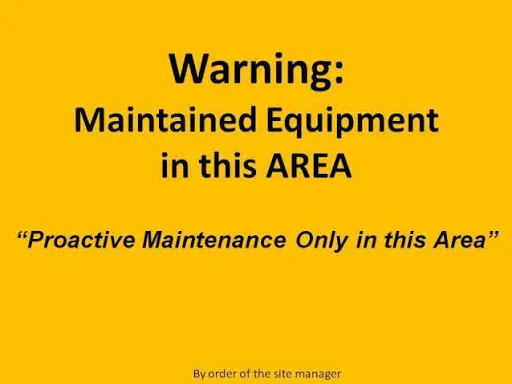
Figure 2: Warning sign example
Since people’s memories are very short, post the results that you achieve with the equipment, and make sure that they are updated daily by your production partner. One of the best items to display is the mean time between failure (MTBF) of specific “best actor” assets. Put this by the equipment every week, as shown in Figure 3. It’s advisable to add a directional arrow ― people might not understand that we want MTBF to increase, for example ― and a goal. Generally, it’s recommended to not use a world-class goal but instead one that’s realistic given where the team is right now.


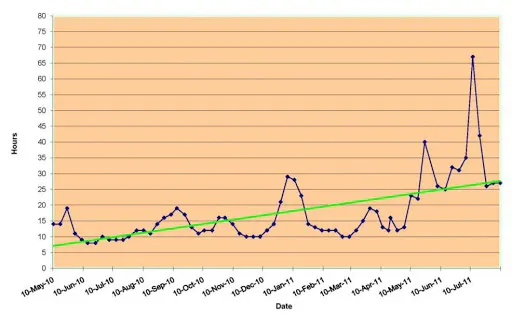
Figure 3: Mean time between failure (MTBF) example – 900 electric motors (compliments of Kim Hunt – Domtar)
Develop an effective Failure Modes Driven Strategy for the equipment (identifying failure modes, causes of failures, etc.) to build a solid maintenance plan using preventive maintenance, predictive, and condition-based monitoring.
Move to the next piece of equipment based on production management’s input, and complete the steps the same way you did for the last one.
If you always follow this process, you will be successful in improving your assets’ reliability and maintainability while meeting the requirements of production.
Step #2: Identify Where You Are and Where You Are Going by Using Simple Metrics That Measure Effectiveness
Having the right effectiveness metrics in place while being focused on continuous improvement is crucial. A great example would be if preventive maintenance (PM) compliance is above 98%, but the equipment continues to fail. It does not make sense, right?
Well, have you ever thought about using a line graph that shows the correlation between PM labor hours and emergency labor hours in order to measure PM effectiveness? You must know where you are before you can begin a journey.
See Figure 4, and if the results are not acceptable, you may want to review Step #1 again. PM compliance is a metric that only measures if PMs are completed on time.


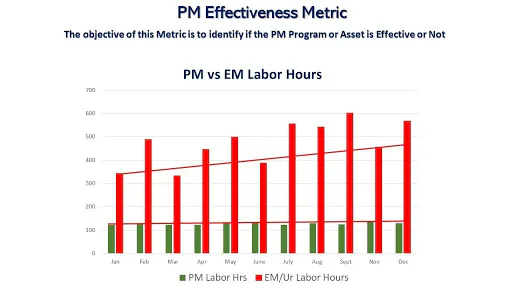
Figure 4: PM vs. emergency labor hours graph
With this one metric, you will know where you are with your current PM program. Once you know where you are, you can begin to develop a plan to head in the right direction.
Step #3: Use Maintenance Dashboards to Manage an Area or Function
The next step is to develop a maintenance dashboard with a live comparison of specific KPIs that validate each other. This is like driving down the road in your car and looking at all the gauges; if one is flashing red, you may need to stop and solve the problem.
The KPI dashboard concept is the same. This specific one can be fed by an Excel program, which is populated by your CMMS/EAM or other data source.

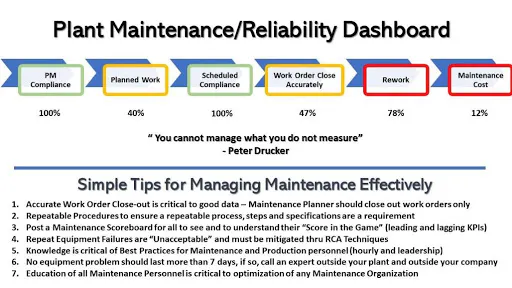
Figure 5: Maintenance dashboard example
To build the dashboard, begin by identifying three questions that you would like to know the answer to on a weekly or monthly basis, which would confirm or deny whether all KPIs are accurate.
Are work orders closed out accurately? (Planner closes the work order.)
Is the data accurate? (Review data accuracy monthly.)
Are my metrics improving because our actions are effective?
Step #4: Create and Manage the Plant with a “Plant Scoreboard”
Post the plant scoreboard on video monitors or charts in the plant, in all production areas, and in the maintenance shop.
Examples of information posted on the scoreboard may include:
PM Compliance
Overall Equipment Effectiveness (OEE)
Budget Compliance
And more


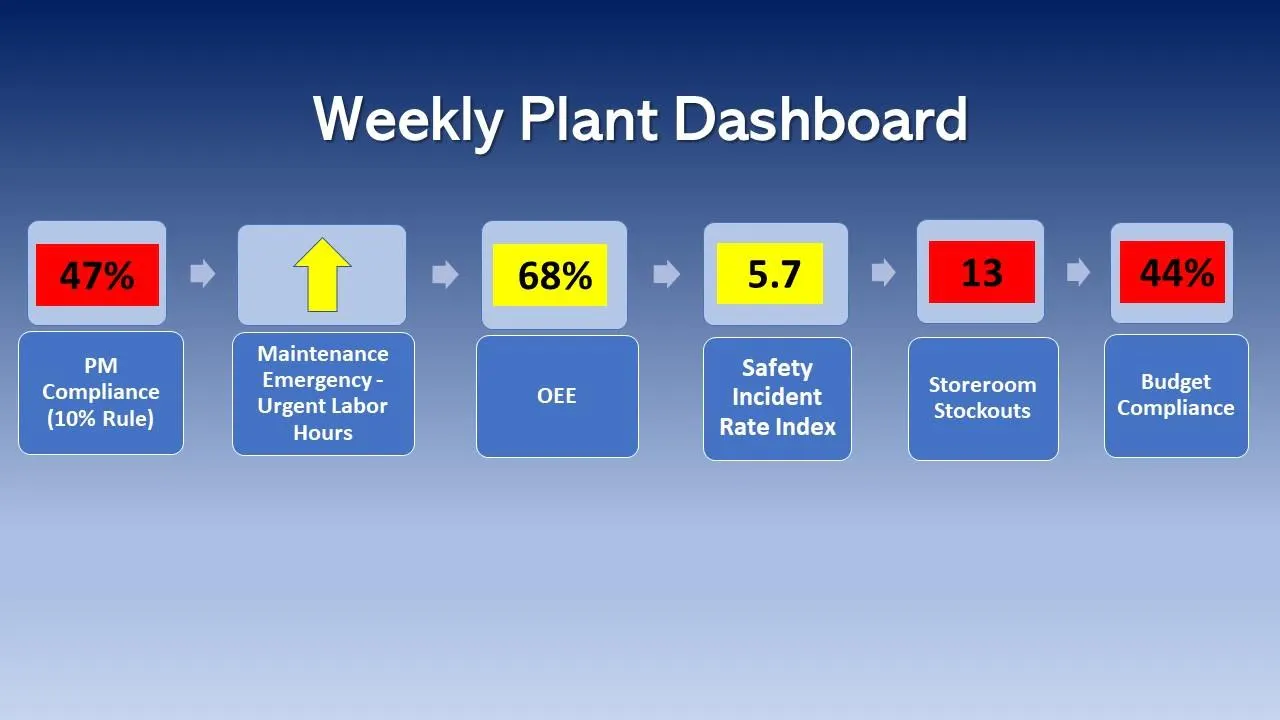
Figure 6: Plant scoreboard example
Manage Maintenance Issues With Ease Using CMMS Software From UpKeep
If you want to succeed, take things one step at a time and stay focused. These ideas allow a maintenance crew to be successful with a definite plan.
Another crucial tool to the success of your maintenance team is UpKeep’s CMMS software. This mobile-first, easy-to-use platform helps you take control of your maintenance assets and reliability. It helps users easily track, access, and manage all their maintenance activities, regardless of where they are.
Contact UpKeep to start a free trial today, or request a free tour so you can see how everything works first. Then sign up and watch your maintenance issues melt away.
Want to keep reading?



Article
How To Build an Efficient Preventive Maintenance Checklist


Article
How to Implement a Preventive Maintenance Program


Article
Why Is Preventive Maintenance Cost Effective?
4,000+ COMPANIES RELY ON ASSET OPERATIONS MANAGEMENT
Leading the Way to a Better Future for Maintenance and Reliability
Your asset and equipment data doesn't belong in a silo. UpKeep makes it simple to see where everything stands, all in one place. That means less guesswork and more time to focus on what matters.






![[Review Badge] Gartner Peer Insights (Dark)](https://www.datocms-assets.com/38028/1673900494-gartner-logo-dark.png?auto=compress&fm=webp&w=336)