Blog Post
The Business Case for a Preventive Maintenance Checklist to Make Your Assets Last
How modern CMMS and AI technologies can transform a simple task list into a cost-saving, continuously improving preventive maintenance program.



Key Takeaways:
A preventive maintenance checklist is a structured list of tasks to help teams catch equipment failures before they happen.
Organizations that adopt consistent PM programs can save 12%–18% in maintenance costs, according to the U.S. Department of Energy.
Digital preventive maintenance checklists powered by CMMS and AI tools transform task lists into strategic, automated maintenance programs that improve with every completed cycle.
According to the U.S. Department of Energy, companies save an average of 12%–18% in costs by transitioning from reactive to preventive maintenance. A preventive maintenance checklist can streamline the process for everyone by extending asset life, saving costs, and standardizing your strategy for all involved. The advantage is clear, but how do you get started?
Here’s what you need to know about preventive maintenance checklists to drive efficiency.
Understanding Preventive Maintenance Checklists
Preventive Maintenance Defined
Before building a checklist, it helps to understand where preventive maintenance fits in the broader asset landscape and why it's worth the investment:
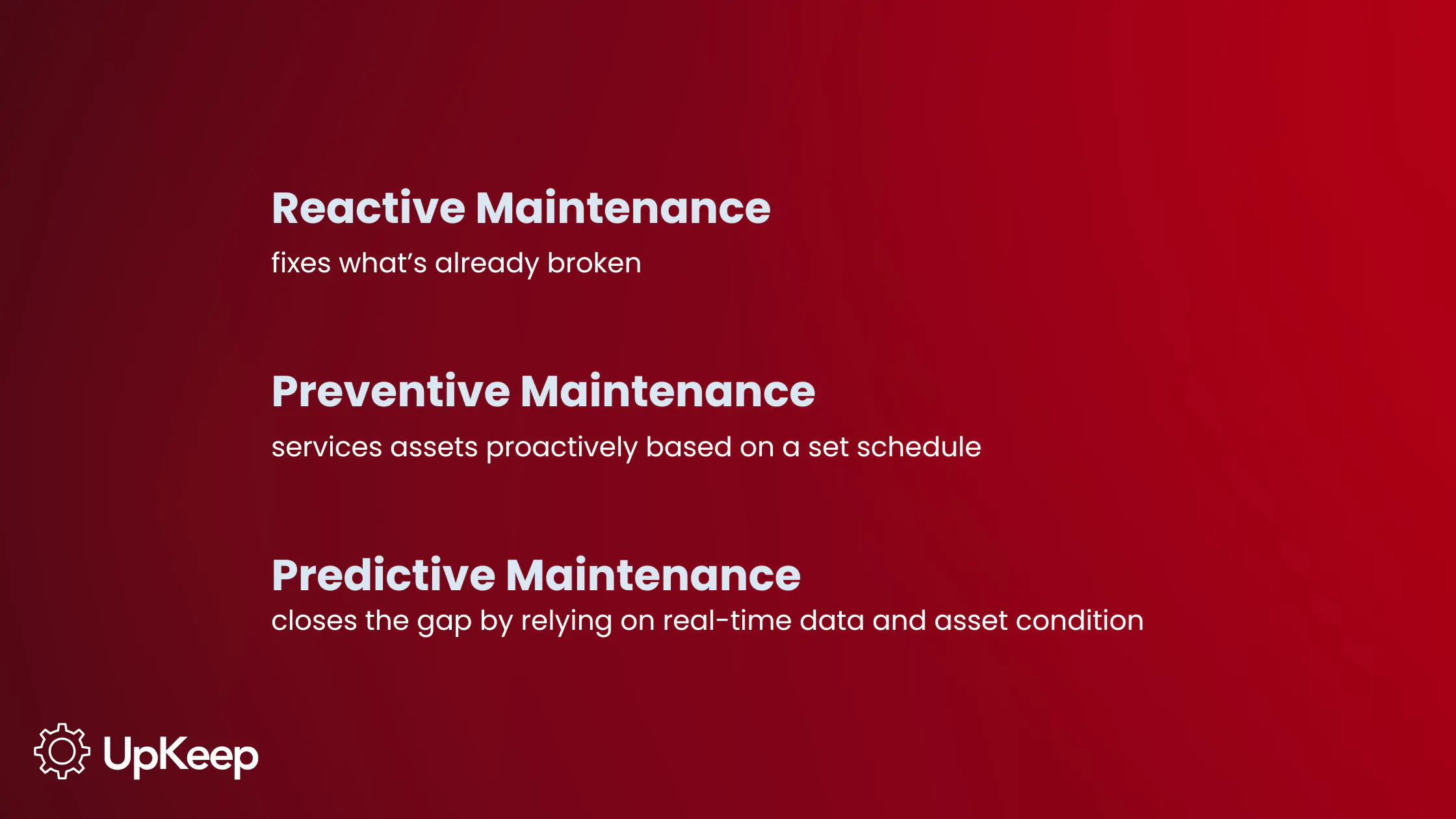
Reactive maintenance addresses failures after they happen. It's fast to implement but costly in downtime and emergency repair bills.
Preventive maintenance (PM) is a more proactive approach that schedules service at regular intervals before failure occurs. It gets ahead of breakdowns, reduces unplanned downtime, and extends asset life. The tradeoff is the estimated time-based schedules aren’t always perfectly accurate with an asset's actual wear and usage, which can lead to under- or over-servicing.
Predictive maintenance (PdM) takes it a step further by using real-time condition data to trigger service only when an asset shows signs of wear. However, it requires more sophisticated technology and investment.


Preventive Maintenance Checklist Defined
For most organizations, preventive maintenance represents the right balance of practicality and performance. Plant Engineering’s 2018 maintenance survey found that 80% of maintenance personnel prefer the preventive approach, and a PM checklist makes it function.
A PM checklist is a structured, standardized list of tasks performed at scheduled intervals to prevent equipment failure before it can happen. Its core components include:
The asset being serviced
Required tools and PPE
Detailed, step-by-step tasks
Frequency and expected labor for each task
Beyond day-to-day operations, PM checklists serve two major goals simultaneously: operational reliability and compliance and audit readiness. They’re not a one-time document though; they should evolve as you gather more asset data over time and learn from previous maintenance cycles.
3 Key Benefits of Implementing a Preventive Maintenance Checklist


1. Enhance equipment lifespan and performance
Every piece of equipment has a manufacturer-estimated service life, but that assumes the proper regular maintenance. A PM checklist ensures no critical inspection step is missed during routine service, systematically extending the life of your assets.
As time goes on, detailed checklist histories give maintenance teams a more comprehensive view of each asset's health, making it easier to spot points of wear and failure before they become a liability. What starts as a simple task list becomes a living record of how your equipment actually behaves, offering valuable information for long-term planning.
2. Reduce unexpected downtime and costs
Unplanned downtime is one of the most disruptive and costly events a maintenance team can face. Research has found it’s grown to cost as much as $9,000 per minute.
PM checklists cut that cost by shifting teams from reactive firefighting to proactive action, reducing both the frequency and severity of emergency repairs. When a technician catches a worn brake pad or fluid leak during a routine inspection, the fix is scheduled, budgeted, and completed in a timely manner, rather than in a scramble during peak production hours.
If teams then supplement checklists with AI-powered tools, they can close the loop on failed inspection items by automatically triggering follow-up work orders, quickly preventing small issues from escalating.
3. Standardize maintenance procedures across teams
With a standard preventive maintenance checklist, every technician follows the same steps, regardless of experience level, shift, or location. That consistency improves work quality and supports regulatory compliance and auditability.
Uniformity also reduces dependence on legacy knowledge, which is an increasing concern as skilled labor shortages intensify across industries. When procedures live in a technician's head rather than a documented checklist, turnover becomes an operational risk. Documented workflows also ease onboarding for new hires and ensure vital information survives personnel changes.
A standardized checklist makes cross-location benchmarking possible as well. You can identify which facilities are meeting PM targets and which need additional support.
Types of Preventive Maintenance Checklists
The format you choose for your PM checklist should match the complexity of your assets and needs of your team.
Visual Checklists: A User-Friendly Approach
Visual checklists use images, diagrams, and color-coded indicators to guide technicians through maintenance tasks. They're most valuable for complex machinery with many components or for multi-lingual teams where language barriers could introduce errors. By reducing cognitive load and giving technicians visual confirmation of what they're looking for, these checklists minimize the chance of skipping a step under time pressure.
Task-Based Checklists: Step-by-Step Procedures
Task-based checklists take a more procedural approach, breaking maintenance down into sequential, action-oriented steps that any qualified technician can execute reliably. The best task-based checklists also include space to log meter readings, temperatures, or vibration data, doubling the checklist’s function as a data collection tool. Tying each task to a pass/fail threshold or numerical range keeps results objective and comparable over time.
Digital Checklists: Leveraging Technology for Efficiency
Digital checklists are increasingly the standard, and for good reason. Paper checklists can be error-prone, difficult to aggregate, and easy to lose. Digital checklists eliminate illegible notes and manual data entry, enable real-time reporting, and support closed-loop work order management where task completion automatically generates a record. When checklists live in a centralized system, it enables filtering by technician, location, due date, status, and priority.
Preventive Maintenance Checklist Examples by Type
|
List Type |
Visual |
Task-based |
Digital |
|
Includes |
Diagrams, photos, color-coding, component maps |
Sequential steps, pass/fail thresholds, fields for measurements and readings |
All task and visual elements, plus auto-generated records and reporting dashboards |
|
Data capture |
Limited; primarily visual confirmation |
Moderate; manual loggings of readings and observations |
Real-time; automatic upon task completion, searchable and auditable |
|
Scalability |
Low; best for specific assets |
Moderate; consistent across varying experience levels but hard to aggregate |
High; centralized templates can deploy across all sites at once |
|
Best use case |
Complex machinery, numerous components, new technicians |
Procedures where sequence and precision are critical, regulated industries |
Multi-site operations that require centralized records and reporting, remote teams |
Critical Steps for Creating Your Own Preventive Maintenance Checklist
Identify Critical Assets for Maintenance
Preventive maintenance isn’t appropriate for every asset, and attempting to apply it universally dilutes your team's focus and budget. Start with an asset criticality assessment that evaluates each asset based on factors like production impact, replacement cost, safety implications, and failure frequency. The assets that score highest are where a thorough PM checklist delivers the most value.
Manager’s Pro Tip
Explore checklist templates for common asset classes like air compressors, cooling towers, building controls, motors, and pumps.
Build your asset inventory first, then layer checklists on top based on criticality. Keep organization front of mind as well: Checklists should be clearly labeled for the specific asset they address so technicians never have to wonder if they're working from the right document.
Gather Necessary Data and Resources
A PM checklist is only as good as the information behind it. Pull from OEM manuals, historical failure records, and frontline technician expertise to determine which tasks belong on each checklist and at what intervals.
Use an asset operations management system to schedule PM tasks based on usage, time triggers, or sensor alerts, and modify schedules as the system collects data from ongoing maintenance and repairs. Ensure each checklist clearly specifies the tools, spare parts, lubricants, and PPE technicians will need before they head into the field. Incomplete prep is often why maintenance tasks run long or are deferred. Pay attention to warranty terms as well since some manufacturers require documented PM records for coverage to remain valid.
Customize Your Checklist for Specific Needs
A fleet vehicle checklist looks nothing like an HVAC checklist or a steam boiler checklist. The same logic applies across your operation; air compressors, chillers and cooling towers, fans, motors, fire alarms and smoke detectors, and building controls all carry distinct failure modes and service requirements. Attempting to use a one-size-fits-all template across asset types is a fast path to missed steps and technician frustration. Strong checklists reflect the specific maintenance needs, failure modes, and operating conditions of each asset class.
Build in regular review cycles from the start to evaluate PM performance, with intervals adjusted based on failure data and operational changes. Frontline technician involvement is another critical component, as they consistently spot steps that planners overlook, and their buy-in meaningfully improves completion rates. Also account for seasonal variability; some assets require more intensive PM during peak usage periods, and your checklists should reflect that.
Adopting Technology in Preventive Maintenance Checklists
Benefits of CMMS in Streamlining Maintenance Processes
A computerized maintenance management system (CMMS) is the operational backbone that makes a PM checklist program scalable. It automates scheduling, tracks completion, and stores every checklist response as searchable historical data, centralizing information and eliminating systemic silos.
CMMS analytics uncover insights that aren’t obvious at the individual level, such as which assets consume the most labor, which PM tasks correlate with fewer failures, and where schedule compliance is consistently slipping. Automated triggers from failed inspections turn a completed checklist directly into an actionable follow-up work order, no supervisor review required.
Modern maintenance platforms like UpKeep deliver measurable results. Organizations that implement consistent preventive maintenance schedules with UpKeep can reduce equipment and asset downtime by as much as 26% and extend asset and equipment lifetime by up to 11%. That’s the difference between a simple checklist and a quantifiable competitive advantage.
The Role of AI and Data Analytics for More Effective Maintenance Strategies
Every completed checklist generates data, like the frequency of flagged items, parts consumption rates, and technician time per task. Using this data strategically creates a maintenance program where each completed checklist makes the next cycle a little smarter, faster, and more reliable.
AI-driven insights move maintenance teams from calendar-based routines to evidence-based programs that respond to how each asset behaves in the field, rather than vague recommendations.
Operational analytics can reveal patterns that would otherwise go unnoticed, such as seasonal failure spikes, technician efficiency gaps, and parts that consistently fail ahead of schedule. Platforms like UpKeep, with Nova AI built in, surface these recommendations automatically to help teams optimize PM intervals, reduce waste, and catch emerging risks early.
A well-built preventive maintenance checklist transforms reactive habits into a smarter, more resilient maintenance strategy. It standardizes execution and captures data for continuous improvement. Start with your most critical assets, let the data guide your intervals, refine from there, and reap the benefits of reduced costs, smooth operations, and extended asset life.
FAQs: Your Preventive Maintenance Checklist Questions Answered
What should be included in a comprehensive PM checklist?
At minimum, preventive maintenance checklists include asset identification, required tools and PPE, sequential step-by-step tasks, completion thresholds or measurements for each task, and estimated labor hours. The more specific each task, the more useful the resulting data.
How often should maintenance tasks be scheduled and reviewed?
Frequency depends on OEM guidelines, asset criticality, and actual usage patterns. Time-based, meter-based, or hybrid triggers are all valid depending on the asset type. The key is to treat your schedule as a living document. Revisit it after failures, seasonal shifts, or significant changes in production volume, and adjust based on what your data tells you rather than defaulting to the original setup.
Can preventive maintenance checklists be customized for specific equipment?
PM checklists can and should be customized for specific equipment. Generic checklists applied across dissimilar asset types lead to missed maintenance and false confidence. When tasks are standardized, specific to each asset, and automated through a CMMS, the risk of human error drops significantly, and quality improves. Custom fields, asset-specific task sequences, and location-based variations make checklists more accurate and actionable.
Learn how to build the ultimate preventive maintenance checklist with UpKeep. Experience the power of our thorough maintenance management tool with your free trial today.
4,000+ COMPANIES RELY ON ASSET OPERATIONS MANAGEMENT
Leading the Way to a Better Future for Maintenance and Reliability
Your asset and equipment data doesn't belong in a silo. UpKeep makes it simple to see where everything stands, all in one place. That means less guesswork and more time to focus on what matters.






![[Review Badge] Gartner Peer Insights (Dark)](https://www.datocms-assets.com/38028/1673900494-gartner-logo-dark.png?auto=compress&fm=webp&w=336)