Blog Post
Medical Imaging Equipment Maintenance: A Guide to Safety, Compliance & CMMS
Learn how healthcare facilities use preventive maintenance and CMMS software to keep medical imaging equipment compliant and reliable.



Key Takeaways
Preventive maintenance is essential for preventing costly, unplanned downtime, ensuring diagnostic accuracy, enhancing patient safety, and extending the lifespan of medical imaging equipment.
A CMMS is a key tool for compliance. It helps automate preventive maintenance (PM) schedules and creates the centralized, auditable logs necessary to prove compliance with regulatory bodies and medical professional bodies.
Original Equipment Manufacturer (OEM) guidelines are the primary authority for medical imaging equipment maintenance. General checklists are only a guide and do not replace the manufacturer's protocols.
Regular maintenance is directly linked to meeting mandatory regulatory and professional standards. This ensures that equipment functions safely, minimizes risks like excessive radiation (ALARA principle), and protects both patients and staff from mechanical or electrical faults.
What is Medical Imaging Equipment?
Medical professionals use medical imaging equipment to visualize structures and processes inside the human body. Each imaging modality operates on a distinct principle and is optimized for specific diagnostic tasks. Below is a summary of the most common medical imaging technologies, their functions, and primary uses.
X-ray (Radiography)
How It Works: X-ray uses a small, controlled dose of ionizing radiation to create two-dimensional images based on tissue density.
Uses: Detecting bone fractures, identifying dental cavities, and evaluating the chest for conditions such as pneumonia.
Computed Tomography (CT)
How It Works: CT employs a rotating X-ray scanner and a computer to create detailed, cross-sectional images of the body.
Uses: Identifying tumors, diagnosing internal bleeding, spotting kidney stones, and examining complex bone injuries.
Magnetic Resonance Imaging (MRI)
How It Works: MRI uses powerful magnets, radio waves, and computer processing to generate highly detailed images of soft tissues.
Uses: Examining the brain and spinal cord, diagnosing joint and ligament injuries, and evaluating tumors in soft tissues.
Ultrasound (Sonography)
How It Works: Ultrasounds transmit high-frequency sound waves into the body and record the echoes as they bounce back, creating real-time images of the internal structures.
Uses: Monitoring fetal development during pregnancy, examining organs (like the gallbladder, liver, and kidneys), and visualizing blood flow.
Nuclear Medicine
How It Works: This involves administering a small amount of a radioactive tracer (radiopharmaceutical) that collects in specific areas, allowing a camera to track organ function.
Uses: Detecting cancer, evaluating heart blood flow, and assessing brain disorders like Alzheimer's.
Fluoroscopy
How It Works: Fluoroscopy uses a continuous X-ray beam to produce a live video feed, often enhanced with a contrast agent.
Uses: Guiding procedures (like placing catheters or joint injections) and observing movement (like a barium swallow for the digestive tract).
Why Medical Imaging Equipment Maintenance is Important
Regular maintenance is crucial for medical imaging equipment because it directly impacts operational efficiency, financial stability, and patient care. It is a proactive strategy to ensure these complex, high-investment assets function reliably, safely, and accurately.
Maintenance Prevents Costly Breakdowns
Unexpected equipment failure leads to significant financial losses and operational chaos. For instance, the Canadian Medical Imaging Inventory Report found that Computed Tomography (CT) imaging units operate an average of 14 hours per day; 80% of sites reported operating on weekends, and 40% reported operating 24 hours a day. Given the medical imaging equipment demanding use, improper maintenance will inevitably result in costly breakdowns. Preventive maintenance identifies and addresses potential issues before they escalate into major failures. This minimizes unplanned downtime, which disrupts patient schedules and delays diagnoses.
Extends the Operational Life of Equipment
Medical imaging devices are a significant capital investment for any healthcare facility. Routine maintenance extends the equipment's functional and operational life. Medical facilities can also delay the high cost of purchasing new machines by addressing wear and tear and preventing major component failures.
Ensures Diagnostic Accuracy
The primary purpose of imaging equipment is to provide accurate diagnostic and treatment information. Poorly maintained equipment can suffer from calibration drift, leading to distorted, blurry, or inaccurate images. This can result in misdiagnoses and improper patient treatment. Regular calibration and performance checks are essential to ensure that the images produced accurately reflect the patient's condition.
Improves Patient Safety
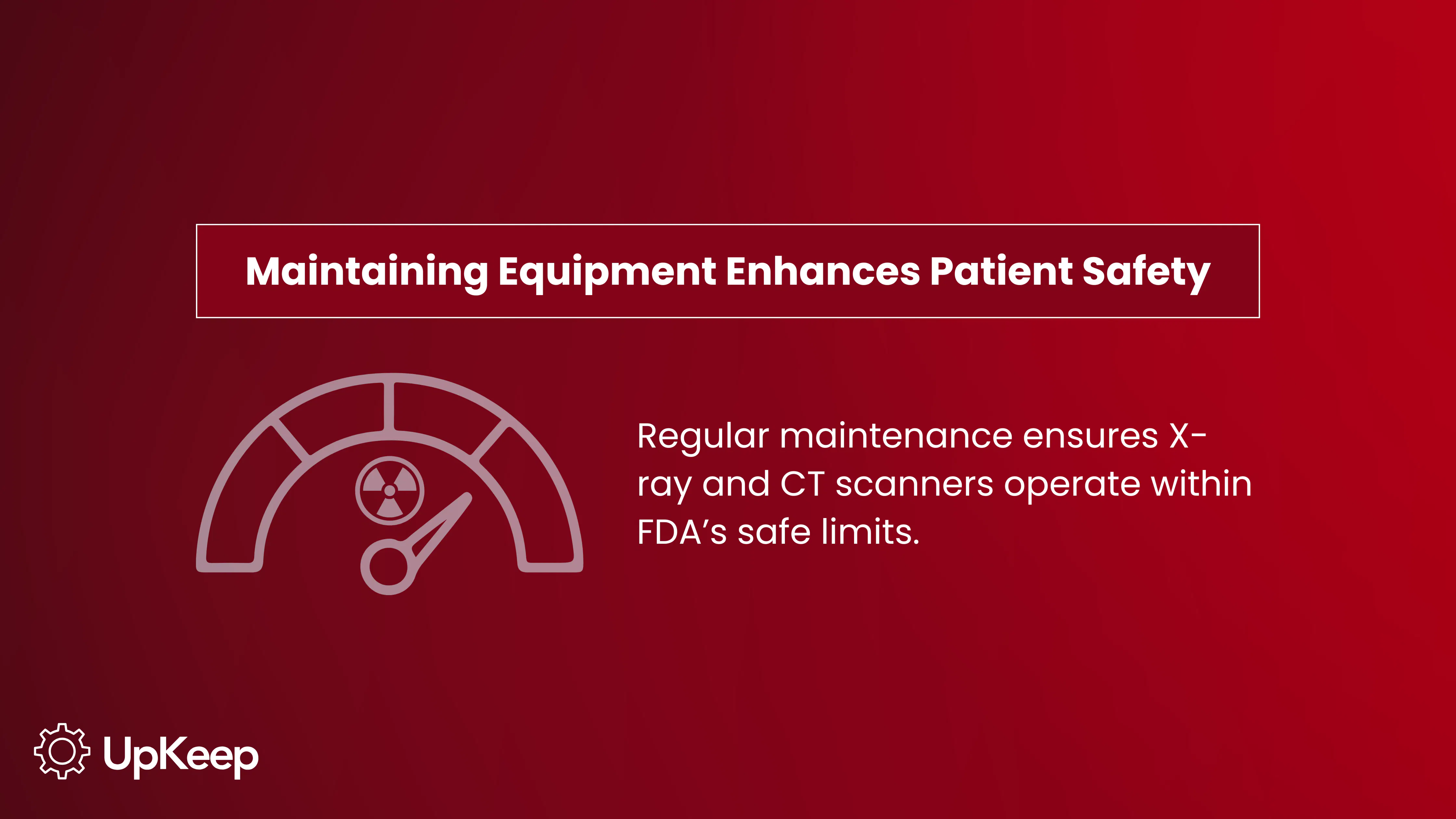
Breakdown of medical imaging equipment can lead to uncontrolled radiation and mechanical failures that may directly harm patients. Therefore, patient safety is a top priority that maintenance directly supports. For equipment such as X-ray and CT scanners, regular maintenance ensures the machines operate within safe parameters, keeping radiation as Low as Reasonably Achievable (ALARA), as recommended by the United States Food and Drug Administration. Preventive maintenance checks and corrects potential mechanical malfunctions that could physically harm a patient during a procedure.


Preventive Maintenance and Regulatory Compliance
Compliance with health and safety regulations is mandatory for all medical imaging facilities. Regulatory bodies and professional standards organizations establish strict rules to safeguard both patients and staff from hazards such as excessive radiation exposure, electrical faults, or mechanical failures. The risks associated with imaging, particularly ionizing radiation, require that equipment be maintained meticulously to minimize patient exposure while ensuring diagnostic quality.
Regulatory bodies, such as the Occupational Safety and Health Administration (OSHA), require employers to provide a safe environment, which in radiology encompasses everything from hazard communication to ensuring that equipment functions safely and reliably. Professional organizations such as the American Society of Radiologic Technologists (ASRT) also establish practice standards that define the expected level of performance and safety for imaging procedures, which rely on properly functioning equipment.
A preventive maintenance strategy is crucial for ensuring and documenting this compliance. A proactive PM plan schedules the regular inspections, calibrations, and component tests required by manufacturers and other standards groups.
Medical Imaging Equipment Maintenance Checklist
Here is a general checklist to guide the routine maintenance of medical imaging equipment. It covers essential general, system, and imaging/software checks to help ensure assets remain safe, functional, and reliable.
Disclaimer: This checklist is a general guide and does not replace or supersede the specific maintenance protocols, schedules, and service manuals provided by the original equipment manufacturer (OEM). Always prioritize OEM documentation for all maintenance activities.
General Checks
Visually inspect all power cords, data cables, and connectors for fraying, cracking, or other damage. Ensure all connections are secure.
Check the external housing for any cracks, loose panels, or physical damage.
Verify that all emergency stop buttons and safety interlocks are functional and unobstructed.
Ensure that all safety, warning, and instructional labels are present, legible, and securely attached.
Wipe down all equipment surfaces, controls, and displays using approved hospital-grade disinfectants.
Check all air intake vents and cooling fans to ensure they are operating properly. Ensure they are clean, dust-free, and unobstructed to prevent overheating.
Verify that the room's temperature and humidity are within the manufacturer's optimal operating range.
System Checks
Turn the system on and observe the boot-up process. Ensure it completes successfully without any unusual delays or error messages.
Test all control buttons, knobs, touch screens, and monitors. Verify they are responsive and functioning correctly.
Verify that all status and warning indicator lights function as intended.
Test the table's full range of motion (up/down, in/out). Listen for unusual noises and check for smooth, precise movement.
For CT, MRI, or X-ray C-arms, test the rotation and tilt functions. Ensure movement is smooth and all locking mechanisms engage properly.
Review the system's digital error logs for any recurring warnings, fault codes, or anomalies. Document and investigate any new or persistent errors.
Imaging and Software Checks
Load a test patient profile. Select and run standard scan protocols to ensure they load correctly.
Test key software tools (e.g., measurement, annotation).
Perform a test scan using the standard quality assurance (QA) phantom for that specific device (e.g., CT phantom, MRI ACR phantom). Evaluate the resulting image for artifacts, blurring, distortion, and correct signal/density. Compare the image quality metrics to the machine's established baseline.
Verify that test images are successfully saved to the local system.
Confirm that test images can be successfully sent to and retrieved from the PACS (Picture Archiving and Communication System).
Check the system status for any pending, manufacturer-approved software updates or security patches.
Confirm that any scheduled backups of system settings or local databases are running successfully.
Specific Maintenance Strategies for Different Equipment Types
X-ray Machine Maintenance Protocols
Maintenance for X-ray machines focuses heavily on safety, operational integrity, and regulatory compliance. Protocols involve regular, documented inspections of the equipment's physical, mechanical, and electrical systems to ensure they function safely and correctly. A comprehensive X-ray maintenance plan, often managed within a CMMS, includes several key inspection areas based on safety checklists:
Warning System Verification: This is a top priority. Maintenance must confirm that all visual "X-RAY ON" and "READY" lights are functional. Any audible signals that indicate an exposure is in progress must also be tested.
Physical and Electrical Integrity: Technicians inspect the tube housing, collimator, and all high-voltage cables for any visible damage, wear, or potential fluid (oil) leaks. The control panel's condition, including all switches, buttons, and displays, is also checked for legibility and proper function.
Mechanical Stability: This involves testing the full range of motion. The tube head must be stable, and all its locks, angulation controls, and movements must be smooth and secure. The patient table or chair is also inspected for stability and safe operation.
Core Safety Features: Technicians must verify critical safety components to ensure the system's integrity and reliability. This includes ensuring the collimator light works, the emergency stop button functions correctly, and all required radiation warning labels are present, legible, and accurate.
Documentation and Logs: A key part of compliance is verifying that the equipment's logbook is present, up to date, and accurately reflects its service history.
MRI Equipment Maintenance Protocols
MRI systems require a specialized preventive maintenance approach that focuses on their unique components, including cryogenics, magnets, and radiofrequency coils. A consistent service plan is essential to ensure operational stability, diagnostic accuracy, and the longevity of the machine. UpKeep helps reduce the risk of component fatigue and costly, unexpected downtime.
Key maintenance protocols for an MRI include:
Cryogen and Magnet System: Regularly analyze helium levels and purity. This is critical to maintaining the correct supercooled temperature and preventing costly failures in which the magnets rapidly heat up and lose conductivity.
Cold Head Service: Monitor the cold head, which re-liquefies helium gas. This component requires routine oil tests and absorber replacements to prevent contamination and maintain its cooling efficiency.
Coil Integrity: Regularly inspect both gradient coils and radio frequency (RF) coils. This includes proper cleaning, checking RF power output, and ensuring correct handling to prevent damage from fatigue or forced connections.
Electronic and Software Support: Ensure the system is protected by an uninterrupted power supply (UPS) and that all control software is kept up to date to maintain processing accuracy and prevent image artifacts.
General Cleaning: Perform periodic cleaning and disinfection of all patient contact surfaces, interfaces, and system electronics in accordance with manufacturer specifications.
Ultrasound Machine Maintenance Guidelines
Ultrasound maintenance is unique because it relies heavily on consistent, daily care by the operators, in addition to periodic professional service. Proper daily cleaning and handling are the most effective ways to prevent common failures and extend the machine's lifespan.
Key maintenance guidelines for ultrasound systems include:
Clean Transducers (Probes): This is the most critical daily task. Clean and disinfect transducers after every patient, according to the manufacturer's guidelines. Use only approved cleaning solutions and wipes, as incorrect chemicals can damage the probe's lens.
Inspect Transducers: While cleaning, visually inspect the probe's housing, lens, and cable for any cracks, splits, or damage that could compromise safety or image quality.
Wipe Down Console and Peripherals: Clean the keyboard, trackball, monitor, and console surfaces to remove dust, fingerprints, and residual ultrasound gel.
Check Air Filters: Visually inspect the system's air filters for dust buildup. Clogged filters are a primary cause of overheating and component failure. Clean or replace them as needed, following the manufacturer's instructions.
Proper Cable and Probe Handling: Handle transducers and their cables with care. Avoid dropping or knocking the probes. Do not roll equipment over the cables, and avoid kinking or tightly coiling them, as this can damage the sensitive internal wires.
Correct Shutdown Procedure: Always shut the system down using the proper power-down sequence. Improperly shutting down the machine (such as using the main power switch) can cause software corruption.
Manage Peripherals: Keep peripherals like printers and external monitors clean and stocked with supplies.
CT Scanner Maintenance Essentials
CT (Computed Tomography) scanners are among the most complex and heavily used pieces of medical imaging equipment. Maintaining them in optimal condition requires a consistent maintenance strategy to ensure patient safety, diagnostic accuracy, and equipment longevity.
Climate Control: The room must be kept within the manufacturer's specified temperature and humidity ranges. Overheating is a primary cause of damage to the scanner's sensitive electronic components.
Cleanliness: A dust-free environment is essential. Dust can clog air filters, leading to overheating and system failure.
Daily Calibration: The most critical daily task is running calibration checks, often using a "phantom". This ensures the scanner is producing accurate, high-quality images and that radiation dosage is correct.
Cleaning: Regularly clean the scanner, patient table, and control console according to the manufacturer's guidelines to maintain hygiene and ensure proper function.
Visual Inspection: Check all cables and connections for visible wear, fraying, or damage. Inspect the gantry and patient table for any obstructions or issues.
Error Logs: Monitor the system's console for any error messages or warnings and report them immediately.
The Role of a CMMS in Medical Imaging Equipment Safety and Compliance
A Computerized Maintenance Management System (CMMS) is a vital tool for managing the complex compliance and safety requirements of medical imaging equipment. These systems provide a centralized platform for managing medical equipment, scheduling preventive maintenance, and creating the digital documentation needed to pass compliance audits. Using a CMMS shifts a facility's compliance strategy from a reactive, paper-based approach to a proactive, automated, and auditable digital process.
Asset Management and History
A CMMS enables healthcare facilities to track all imaging equipment as individual assets with ease. This includes centralized information on the asset's location, detailed work order history, and maintenance logs. This digital record-keeping is essential for proving that equipment, such as X-ray, CT, and MRI machines, is being adequately maintained in accordance with safety standards.
Work Order and PM Scheduling
The system automates the scheduling of crucial preventive maintenance tasks. This ensures that vital safety checks and calibrations are not missed. Technicians can manage these work orders in real-time, documenting the work completed and the parts used. This creates a verifiable log showing that safety procedures are consistently followed.
Compliance and Safety Monitoring
A CMMS is the central hub for all compliance documentation. It allows facilities to keep detailed records specifically for passing audits. This includes managing safety inspections, tracking employee training records, and storing Safety Data Sheets (SDS) related to cleaning or maintenance chemicals. By generating reports from this data, managers can easily demonstrate adherence to standards set by organizations such as the Food and Drug Administration, the U.S Environmental Protection Agency, and OSHA.
Bottom Line
Effective medical imaging equipment maintenance is a critical operational function that directly impacts patient safety, diagnostic accuracy, regulatory compliance, and a facility's financial health. Adhering to specific preventive and predictive maintenance strategies for each medical imaging equipment is non-negotiable.
Using technological tools like a CMMS moves this entire process from reactive paper checklists to a streamlined, auditable, and proactive system. UpKeep, a mobile-first CMMS, centralizes asset histories, automates preventive maintenance work orders, and creates digital, audit-proof logs necessary for compliance with regulatory requirements.
Frequently Asked Questions
How often should I perform preventative maintenance on my X-ray equipment?
The exact frequency for preventive maintenance depends on the manufacturer's recommendations, the equipment's age, and its level of usage. It is essential to follow the specific service schedule outlined in your equipment's documentation and to comply with all local regulatory requirements.
Who can perform MRI preventive maintenance?
Given the complexity of MRI systems, including their magnets, cryogenics, and radio-frequency coils, preventive maintenance should be performed only by trained and certified personnel. This typically includes the original equipment manufacturer's (OEM) technicians or a qualified third-party service engineer specializing in that specific model.
What does MRI preventive maintenance entail?
MRI preventive maintenance is a specialized process. It includes tasks such as analyzing helium levels and purity to protect the magnet, servicing the cold head to ensure cooling efficiency, inspecting the integrity and cleanliness of RF and gradient coils, and verifying all electronic and software support systems.
How often should medical imaging equipment undergo preventive maintenance?
There is no single answer, as the required frequency varies by equipment type. An ultrasound may have daily operator checks and an annual PM, while a CT scanner might require daily, quarterly, and annual service intervals. Always follow the manufacturer's specific guidelines for each asset and comply with all relevant safety regulations. Using a CMMS helps track and automate these different schedules.
4,000+ COMPANIES RELY ON ASSET OPERATIONS MANAGEMENT
Leading the Way to a Better Future for Maintenance and Reliability
Your asset and equipment data doesn't belong in a silo. UpKeep makes it simple to see where everything stands, all in one place. That means less guesswork and more time to focus on what matters.






![[Review Badge] Gartner Peer Insights (Dark)](https://www.datocms-assets.com/38028/1673900494-gartner-logo-dark.png?auto=compress&fm=webp&w=336)