Entrada en el Blog
La función de la tecnología de sensores en la revolución de la mantención preventiva.
Mientras que las tareas de mantenimiento preventivo siempre tendrán su lugar en un programa de gestión de activos integral, las tecnologías de sensores de mantenimiento predictivo de hoy prometen revolucionar la forma en que se maneja el mantenimiento preventivo y elevar aún más el nivel de rendimient


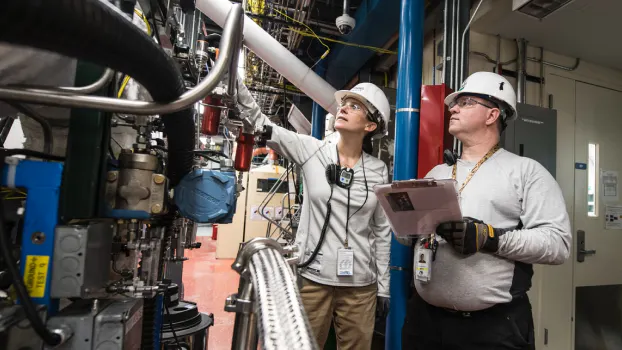
KPIs in Action: Real-World Examples in Maintenance and Manufacturing
Selecting the right key performance indicators (KPIs) is critical to helping manufacturers streamline their maintenance activities, prioritize repairs on critical assets, and tie their tasks to business objectives. Companies that select metrics that ultimately reduce downtime can successfully enhance the productivity of their operations, improve profitability, and enhance customer satisfaction.
These goals can be achieved regardless of industry. To help illustrate this fact, here are some real-world examples of some of the best KPIs in action.
How Overall Equipment Effectiveness (OEE) Identifies Improvement Areas
OEE is one of the best KPIs to use in maintenance and manufacturing, which is based on availability, performance, and quality. Let’s consider an automotive parts manufacturer that runs one shift per day.
The OEE calculation begins with evaluating availability. Planned production time, which is the maximum amount of time equipment should be running, takes into account shift set-up, breaks and lunch. Our manufacturer has a planned production time of 400 minutes per day. Actual run time then takes both planned and unplanned downtime into consideration. Let’s say in this example, this manufacturer has 50 minutes of downtime per day, resulting in a run time of 350 minutes. Availability equals runtime divided by planned production time, which in our example is 87.5 percent.
The second factor in OEE is performance, and this looks at how the asset is actually performing compared to its optimal capability. For example, if the asset has an ideal cycle time of one second and can produce 20,000 parts per day, you’d multiply those numbers and divide them by run time calculated in seconds, resulting in a performance factor of about 95 percent.
Finally, OEE looks at quality. In order to measure quality, this manufacturer must know how many parts are rejected per day. If 2,000 of the 20,000 parts are rejected, that would be a quality measure of 90 percent.
OEE is then calculated by multiplying availability, performance and quality. In this case, the automotive parts manufacturer has an OEE of about 75 percent. To improve OEE, this automotive parts manufacturer may want to analyze why 2,000 parts are being rejected each day to improve its quality or implement maintenance practices to reduce its planned and unplanned downtime, both of which would boost its OEE.
Mean Time Between Failures (MTBF) Helps Improve Reliability
MTBF helps companies measure the likelihood that an asset or a component in an asset will fail within a set period of time. A high MTBF often means higher reliability while a lower one can indicate potential expenses for more failures. Once a manufacturer calculates this measure, it can consider process improvements, data standardization, and root cause analysis to improve MTBF.
For example, a food packaging company has a machine that operates 8 hours per day, and it breaks down three times within 20 work days over the course of a month. For ease of calculation, let’s say the breakdowns each happen after a full work week and each take two hours to repair. The MTBF equals (40 hours + 38 hours + 38 hours + 38 hours) divided by three breakdowns, which is an MTBF of about 51.3 hours.
To increase the MTBF, this packaging company may want to consider condition-based monitoring using sensors that could indicate an impending failure or implement preventive maintenance inspections on a weekly basis to potentially reduce the number of breakdowns. It could also perform a root-cause analysis to determine exactly why the asset breaks down on nearly a weekly basis.
Analyzing Mean Time to Repair (MTTR) May Increase Uptime
Although MTTR can be a useful KPI, it’s critical to evaluate this metric based on the specific circumstances of a particular manufacturer or even piece of equipment. First, it’s important that the data is based on trained technicians who follow standard procedures for evaluating and repairing assets. Second, it’s helpful to keep in mind that every instance of failure can vary widely in how long it takes to repair, ranging from minutes to days or even weeks. Since MTTR takes the average of all these instances, it may not be as helpful in a broad scope. Instead, looking at an individual production line or critical asset can help better identify areas for improvement.
Let’s say an oil and gas manufacturer operates a pump that fails four times in the course of a 40-hour work week, and it takes 45, 30, 25, and 60 minutes to repair it, respectively. The MMTR is calculated by adding together the minutes of unplanned maintenance, which is 160 minutes, and dividing it by the total number of repairs, which is four. Therefore, the MMTR in this example is 40 minutes.
In order to decrease this MMTR, the business may want to look at the training provided to technicians, tools and information available at the point of repair, and other factors that can be improved to boost efficiency. Over time, the organization may be able to reduce its MMTR, improving productivity and decreasing total unplanned downtime.
Conclusion
Selecting the right KPIs in maintenance for manufacturing companies can help companies in a wide variety of industries improve efficiency, reduce downtime, and contribute to a business’ bottom line and profitability. These are just a few real-life examples of how companies may do just that.
The first step after setting strong KPIs and maintenance metrics is to understand how to collect high quality data for analysis. Having the right data will help organizations make smarter business decisions about selecting the highest priority areas for improvement as well as measure progress against those improvements in the future.
¿Quieres seguir leyendo?
Artículo
La función de la tecnología de sensores en la revolución de la mantención preventiva.



Artículo
¿Cuáles son los KPI principales de un administrador de instalaciones?



Artículo
Tiempo medio entre falla y tiempo medio de reparación: definiciones, cómo calcularlas
MÁS DE 4000 EMPRESAS CONFÍAN EN LA GESTIÓN DE OPERACIONES DE ACTIVOS
Liderando el camino hacia un futuro mejor para el mantenimiento y la confiabilidad
Los datos de sus activos y equipos no pertenecen a un silo. UpKeep simplifica ver dónde se encuentra todo, todo en un solo lugar. Eso significa menos conjeturas y más tiempo para concentrarse en lo que importa.






![[Review Badge] Gartner Peer Insights (Dark)](https://www.datocms-assets.com/38028/1673900494-gartner-logo-dark.png?auto=compress&fm=webp&w=336)