Entrada en el Blog
Aplicación de los principios de operaciones de activos en la fabricación
La sociedad moderna seguirá consumiendo y, como resultado, la industria manufacturera se enfrenta a una demanda casi infinita de productos. Dicho esto, la competencia en esta industria puede ser feroz ya que las empresas ven la oportunidad de generar ingresos al satisfacer los deseos y necesidades de los consumidores.


Modern society will continue to consume and, as a result, the manufacturing industry faces a near-endless demand for products. That said, competition in this industry can be fierce as businesses see the revenue opportunity in meeting consumer wants and needs.
For decades, small and large businesses alike have been able to survive and, in some cases, even thrive, using less-than-perfect processes, technologies, and systems. Despite tremendous waste, inefficiencies, and economic downturns, companies have earned enough to keep their doors open and their machines running.
However, global competition, skilled labor shortages, and ongoing disruptions to the supply chain are beginning to push manufacturers to their limits. Being satisfied with the status quo will no longer be enough. Those manufacturing organizations that will grow and succeed in the future will be the ones who are willing to embrace significant change. They will be the ones to harness the power of data and digital technologies to fuel actionable, value-based decisions at every level of the organization.
Asset operations management (AOM) is a mobile-first framework that pulls together data from across teams and devices into a single solution. Its deliverable is real-time data that reflects the day-to-day maintenance life cycle, asset utilization, and performance measurement that serves as the foundation to support informed decisions from technician to executive. AOM optimizes a manufacturer’s maintenance strategies, improves asset performance, and increases availability and reliability in unprecedented ways. The result is a never-before-seen level of efficiency, transparency, and empowerment of a manufacturing team, boosting those organizations who embrace AOM to new levels in an ever-evolving industry.
What Are Common Manufacturing Tasks?



In a nutshell, manufacturing is all about creating new products either directly from raw materials or by using multiple parts or subassemblies. Production occurs through physical, chemical or mechanical means and can be completed on both a small or large scale.
Businesses may produce items to fulfill specific customer orders, to create an available stock, or as an intermediate step in a larger assembly. The manufacturing process itself can be set up in different ways, depending on the items made, the quantities needed, and the complexity of products. For example, repetitive manufacturing is frequently used for high-quantity, homogeneous items such as components of consumer products, durable goods, automotive and electronics. Discrete manufacturing tasks often follow repetitive ones, focusing on the production of end-user items such as cars, airplanes, and appliances.
Custom manufacturing is often completed at job shops, who take on smaller batches of production or unique items ordered by a specific customer. Process manufacturing is frequently divided into continuous and batch. The first represents an ongoing, uninterrupted process that’s frequently used in things like oil or metal refining and some food production; the latter is used in the majority of food and beverage production as well as areas such as pharmaceutical and personal care items. 3D printing is a relatively new branch of manufacturing, using computer-aided design technology and material to create three-dimensional objects.
Current Challenges Manufacturing Teams Face
As the world continues to recover from the repercussions of the 2020-21 global pandemic, its effects have been long-lasting and persistent within the manufacturing industry. Producers from around the world are entering the market, seeking ways to create better, less expensive items to capture market share. At the same time, demand for products, the ways they are delivered, and the speed and availability expected continues to rise.
Supply chain disruptions that were acutely experienced during the pandemic will continue, and manufacturers are seeing an unending fight for a limited and shrinking number of skilled employees. Let’s take a closer look at each of these existing challenges.
Increased Global Manufacturing Competitiveness
According to Safeguard Global, a global payroll solution provider, more than 28 percent of global manufacturing output is coming from China with the United States producing nearly 17 percent. Competition from Japan, India and South Korea as well as European countries is growing as well.
While there has been some resurgence of manufacturing in the United States, fueled by overseas supply chain difficulties, many of these other countries have access to inexpensive labor. This drives their costs down, making it a greater challenge to compete with foreign producers.
Growing with Increasing Demand
Digital technologies, particularly within the consumer market, have driven customer expectations to new heights. Today, the modern customer is used to being able to order just about anything online and have it delivered within shorter and shorter time spans. This has shifted shopping behavior from brick and mortar stores to online ecommerce sites and put additional pressure on manufacturers to meet this demand in extraordinary ways.
Company executives are finding themselves trying to manage rapid growth to meet this demand while at the same time handling the changes required internally in both work processes and technology implementation to sustain it.
Inventory and Supply Chain Management



Just about everyone heard about the supply chain difficulties during the global pandemic, particularly with high-profile consumer products such as toilet paper and hand sanitizer. The issues, however, have persisted post-pandemic, leaving many manufacturers shutting down production lines and failing to be able to meet order deadlines due to ongoing inventory problems and supply chain delays.
Depending on the size of a manufacturing firm, it could be working with a handful of suppliers or thousands of them. Today, more than ever, real-time visibility throughout the supply chain is required. In addition, companies must have an inventory control system that provides accurate and timely information as well as proactively notifies purchasing professionals when items must be replenished.
Upskilling Existing Lower-Skilled Employees
Many industries including manufacturing have been facing high turnover and difficulties in recruiting qualified employees. The combination of a skilled labor shortage with the rapid development of technology within manufacturing is reaching dangerous levels. According to the Robot Report, the skills shortage may put $454 billion of manufacturing GDP at risk by 2028.
Manufacturers are reinvesting in their current employees, offering training and development opportunities to help upskill young team members. Professional organizations are stepping up to provide certification and education through online, work-at-your-own pace venues.
That said, part of the problem is the massive loss of tribal knowledge as older employees retire. Companies have no way to effectively transfer that knowledge to the next generation of professionals and technicians.
Benefits of Asset Operations Management for Manufacturing
As AOM serves as an overall framework for manufacturers, pulling together maintenance, operations, and reliability that rallies around critical assets, it generates a wealth of benefits for the organization, its employees, and, most importantly, its bottom line.
Most of the benefits revolve around having complete, accurate data that can be delivered to the right individuals at the right time to fuel value-added business decisions.
Furthers Digital Transformation of Preventive Maintenance
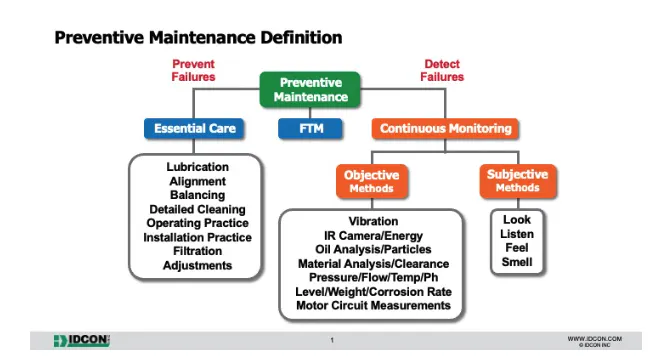
For the past decade, many small and medium-sized manufacturers have worked hard to convert more of their reactive maintenance tasks to preventive ones. Reactive maintenance is often expensive, stressful and unpredictable for manufacturers, resulting in high costs and unhappy employees and customers.
Implementing preventive maintenance programs is often the first step to reducing reactive maintenance. A move toward predictive maintenance, or the ability to better know when a problem will occur before it actually does, is frequently the step that follows.
Although this trajectory makes perfect sense for manufacturers in theory, it requires a great deal of data, cooperation from employees, and technology in practice. AOM delivers those necessities to further the digital transformation for manufacturers when it comes to managing the health and performance of critical assets.
AOM unlocks the true potential of predictive maintenance by unifying passive and active data collection. It breaks down silos that often exist between departments today that will provide manufacturers with better and higher quality data. This data, in turn, provides everyone from technicians to executives with what they need to add overall bottom-line value within their daily work.
Clears the Way to Revenue-Generating, Highest-Value Work



This digital transformation then leads to the second benefit of AOM, which is clearing the decks for the highest value work. Every manufacturing employee can fill their days with tasks; the challenge for the organization is to provide the guidance to help team members select the highest priority, revenue-generating ones to focus on. This not only has the potential to increase profits and reduce costs but empowers employees to be a valuable part of the organization, which positively affects culture, improves employee experience, and reduces turnover.
AOM focuses on collecting the right data, displaying the best insights, and providing actual feedback for maintenance teams to deliver on. Passive data, or data collected automatically without human involvement, frees technicians to focus on these more complex problems and collect even more compelling data actively. Passive data collection is one of the only ways to truly record unplanned downtime events. All of this data then feeds an automation pipeline, where predictive models built from years of historical findings will help define what work needs to be done and when.
Over time, this cycle continues and refines the data repository, fueling ongoing improvements to not only machinery, but also to profit margins.
Expands Operations Capacity Without Increasing Their Head Count
In the early days of automation, the concern of lost human jobs was frequently in the headlines. Interestingly enough, increased product demand, decreased labor availability, and improved technology such as AOM-based solutions have coincided today.
Study after study warns manufacturers of what they know: good people are hard to find and keep. The demand for maintenance workers is projected to increase and grow by up to 13 percent over the next 10 years because of the continuing adoption of new technologies and robotics. Yet, as many as 2.1 million manufacturing jobs in the United States will remain unfilled through 2030. Employers are saying that it's 36 percent harder to find talent than it was in 2018. At the same time, attrition rates are as high as 25 percent, which translates to turning over an entire workforce every four years.
Far from stealing human jobs, AOM allows manufacturers to expand their operations to meet increasing demand in an environment where labor is in short supply. Existing technicians and team members can, at the same time, move to higher skill, higher paying roles through the implementation of this technology.
Reduces Financial Losses From Downtime and Uninformed Decisions
Finally, AOM benefits manufacturers by helping them decrease their financial losses from unplanned downtime and uninformed decisions.
AOM essentially creates a single source of truth for all of a manufacturer’s assets and parts as well as the metadata that goes with them. This allows the organization to track, automate, and collaborate, which not only leads to resolving every work order faster but pushes all employees’ performance to the next level.
Accurate, complete and real-time data are now used to drive efficiency in manufacturing operations–not just preventive maintenance schedules. With AOM-driven end-to-end machine learning, all team members can quickly and decisively make the right decisions to ensure that the company is getting the most out of its machines and dollars.
Both passive and active data fuels this advanced AOM technology, allowing manufacturers to predict when machines will break, when to order parts, when to administer work, and almost more importantly, when not to push work orders into the future to ostensibly save time and money.
AOM delivers immediate visibility and real-time updates to allow all members of an organization to move in lockstep. An automated workflow engine helps employees to standardize workflows, eliminate unnecessary repeatable tasks and deliver value quickly. AOM-based analytics gives manufacturers visibility across their entire organization through business intelligence and customization, helping team members ask the right questions and get timely answers.
Custom reporting and state-of-the-art visualizations are now available, allowing manufacturers to access the performance of all work orders, asset failures, work delays and more. AOM helps shift maintenance from being a cost center to a revenue driver, allowing the entire organization to see the true ROI that a well-oiled maintenance team has on the bottom line.
KPIs and Metrics for Manufacturing Maintenance and Reliability Teams
About half of all maintenance teams note that their top key performance indicator (KPI) is completed planned maintenance. Although this is a good place to start, it’s important to remember that completed planned maintenance does not always easily translate to reaching overarching business goals.
Setting KPIs must focus on helping every employee not only understand why metrics matter for them individually but the role they play in the entire organization. For example, individual technicians are no longer focused on simply completing disconnected tasks. Instead, they can see the history behind every asset repair, have the information and data to perform at their best, and contribute to that body of knowledge for future decisions regarding that particular machine.
Managers and supervisors shift their focus from simply tracking activity like production quotas or schedule adherence to looking at the value their teams add to the overall operation of the company. AOM not only makes their day-to-day jobs easier but also gives them access to the single-source of truth on which to base their decisions.
Finally, all this information rolls up to the c-suite, connecting the work of technicians and managers to top-line business metrics around revenue, cash conservation, and profit margins.
Conclusion
There’s no question that the manufacturing industry will continue to face difficult challenges in supply chain management, upskilling employees, and growing consumer demand. The focus now must be on how to efficiently face those challenges to not only survive but thrive in the future market. Embracing a solution such as AOM can help create an end-to-end, transparent system that fosters employee empowerment and decision-making with a single, accurate data repository designed to fuel actionable, critical business decisions on a daily basis.
¿Quieres seguir leyendo?


Artículo
¿Qué tan bueno es su programa de mantenimiento preventivo?



Artículo
Las 9 principales tendencias de fabricación para 2023



Artículo
La gestión de operaciones de activos continúa destacándose en los informes G2 de invierno de 2023
MÁS DE 4000 EMPRESAS CONFÍAN EN LA GESTIÓN DE OPERACIONES DE ACTIVOS
Liderando el camino hacia un futuro mejor para el mantenimiento y la confiabilidad
Los datos de sus activos y equipos no pertenecen a un silo. UpKeep simplifica ver dónde se encuentra todo, todo en un solo lugar. Eso significa menos conjeturas y más tiempo para concentrarse en lo que importa.






![[Review Badge] Gartner Peer Insights (Dark)](https://www.datocms-assets.com/38028/1673900494-gartner-logo-dark.png?auto=compress&fm=webp&w=336)