Entrada en el Blog
Who is an Asset Life Cycle Manager? Responsibilities, Skills, Tools & Salary
Discover what an Asset Life Cycle Manager does, from procurement to disposal. Learn about required skills, tools, and average salary in our complete guide.



Key Takeaways
An asset life cycle manager is a professional responsible for overseeing the complete journey of an organization's assets, from procurement and deployment through operation, maintenance, and eventual disposal or replacement.
The role requires a hybrid skill set encompassing financial acumen, technical literacy, data analysis, and project management.
The profession is typically divided into IT or physical/industrial types, with both relying heavily on specialized software like CMMS, EAM, or ITAM platforms to automate data, track asset health, and enable strategic forecasting.
Asset life cycle managers provide significant operational cost savings by preventing unplanned downtime, ensuring compliance, and optimizing capital expenditures.
Purchasing assets isn’t the end of an organization’s responsibilities. How well they’re managed is what separates cost-efficient companies from those that overspend and underperform, and that's where an asset life cycle manager comes into play.
This guide covers everything you need to know about the role of an asset life cycle manager. You’ll learn what it is, the tools and skills required, compensation expectations, and why your organization may need to hire one sooner than you think.
What Is an Asset Life Cycle Manager?
An asset life cycle manager is a professional responsible for overseeing the complete journey of an organization's assets, from procurement and deployment through operation, maintenance, and eventual disposal or replacement.
Beyond simply tracking what a company owns, an asset life cycle manager optimizes how assets are used and when they should be renewed, repaired, or retired to maximize return on investment (ROI) and minimize risk.
The scope of their role spans strategic planning, financial analysis, vendor management, compliance, and cross-departmental coordination. Asset life cycle managers sit at the intersection of operations, finance, and technology, making the role a demanding and impactful management position in any modern organization.
Learn more: What Is Asset Life Cycle Management?
Asset Life Cycle Manager vs. Inventory Manager: What's the Difference?
These two roles are frequently confused, but they serve fundamentally different purposes.
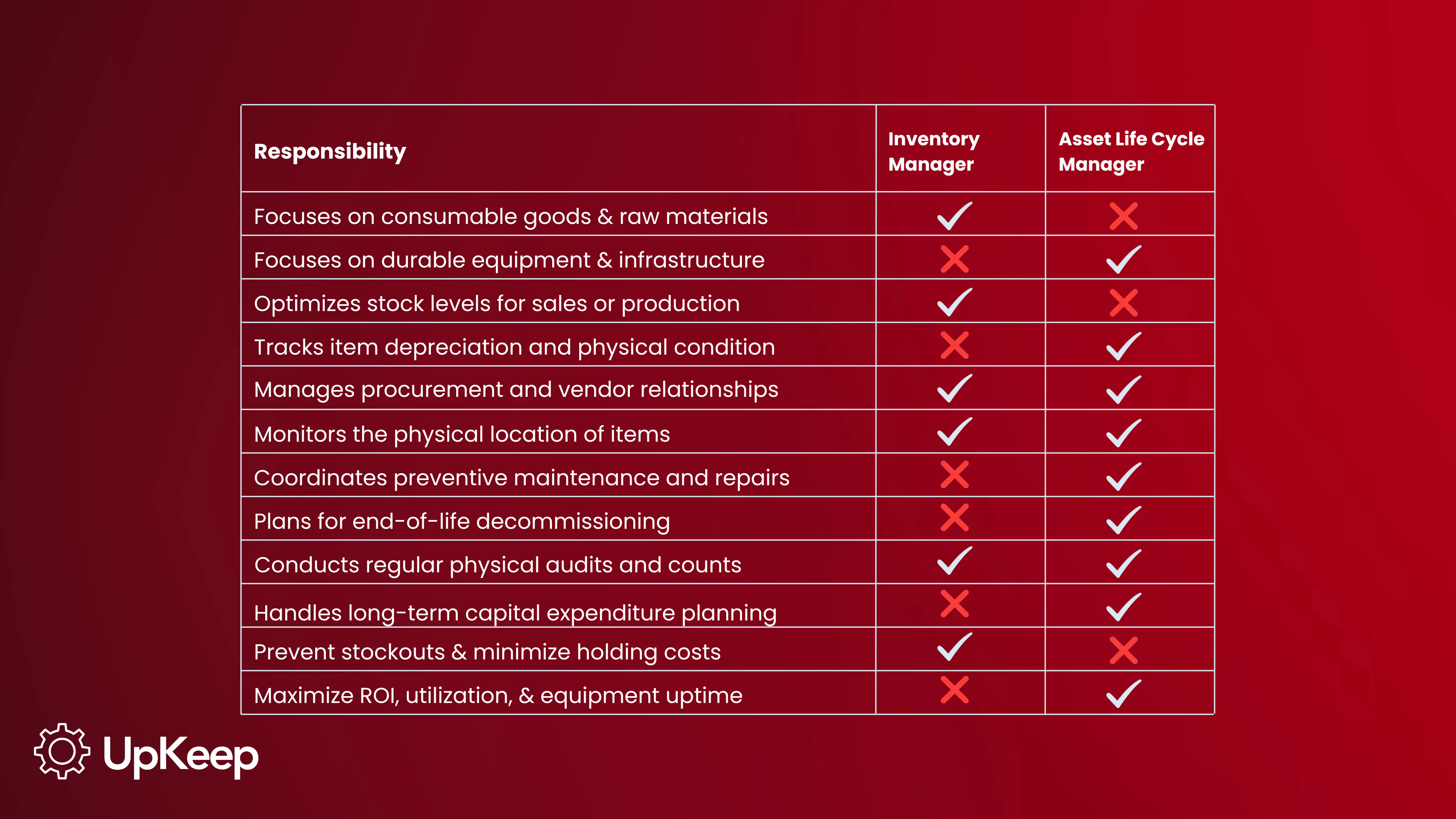
An inventory manager tracks what an organization has at any given point in time. Their job is accuracy and stock control, so they’re responsible for knowing quantities, locations, and conditions of assets in the current moment.
On the other hand, an asset life cycle manager takes a more analytical view. They know what the organization has, but focus on strategic questions like, "What should we acquire? How should we use it? When should we replace it, and what will it cost us over its entire useful life?"
In smaller organizations, these roles may overlap, but as operations grow, the distinction becomes critical, as does the need for dedicated life cycle management.
This table summarizes the differences between the two roles.


Roles and Responsibilities of an Asset Life Cycle Manager
The day-to-day work of an asset life cycle manager covers various activities, all oriented toward making sure assets deliver value efficiently throughout their lifespan.
Key Stakeholders
An asset life cycle manager collaborates regularly with a broad range of internal stakeholders: On the finance side, they work with CFOs, financial controllers, and budget owners to align capital expenditure plans with asset replacement forecasts and depreciation schedules. They also partner closely with operations and facilities managers to understand how assets are used on the ground and where performance gaps exist.
In technology-driven organizations, they collaborate with IT directors and infrastructure teams to manage hardware refresh cycles and software license compliance. Procurement teams are a constant partner for vendor negotiations and acquisition planning, while legal and compliance officers are engaged whenever regulatory obligations or data disposal requirements are involved. Senior leadership, including the COO and department heads, is the primary audience for executive reporting and capital investment proposals.
Core Responsibilities of an Asset Life Cycle Manager
An asset life cycle manager is responsible for the following tasks on a daily basis:
Develop and enforce asset management policies. They establish organization-wide standards for how assets are acquired, tracked, maintained, and disposed of, driving consistency across departments and locations.
Oversee asset procurement and onboarding. They coordinate with procurement and finance teams to evaluate vendors, approve purchases, and ensure new assets are properly registered, configured, and deployed from day one.
Maintain the asset register and keep a complete, accurate inventory of all assets.
Track asset performance and utilization. This involves monitoring how assets are used relative to their capacity, identifying underutilized or redundant assets, and making recommendations to consolidate or redeploy them.
Coordinate maintenance schedules and work with maintenance teams and vendors to plan and execute preventive maintenance programs.
Plan for asset replacement and disposal by modeling end-of-life timelines, building multi-year capital replacement plans, and ensuring retired assets are disposed of in compliance with environmental and data privacy regulations.
Manage vendor and contract relationships by overseeing service agreements, warranties, and supplier performance to verify the organization receives full value from its contracts and renewals are handled proactively.
Ensure regulatory and compliance obligations are met by auditing asset records, verifying documentation, and working with legal and compliance teams to meet industry-specific standards and reporting requirements.
Lead asset audits by serving as the central point of coordination for internal and external audits and verifying that physical inventories match documentation and that a clear chain of custody exists for every asset.
Report asset health and cost metrics to leadership by building dashboards and executive reports that translate asset data into business impact and support informed decisions on capital allocation and operational strategy.
Types of Asset Life Cycle Managers
The role takes different forms depending on the industry and the nature of the assets being managed. The two most common specializations are IT asset life cycle management and physical/industrial asset life cycle management.
IT Asset Life Cycle Manager (Software & Technology)
In technology-driven organizations, the IT asset life cycle manager oversees the full spectrum of hardware and software resources, which includes laptops, servers, cloud infrastructure, SaaS subscriptions, software licenses, and networking equipment. Their mandate is to verify that every technology asset is properly licensed, actively utilized, securely managed, and retired or renewed at the right time.
A significant part of this role involves software license compliance. Organizations that under-license software face steep penalties, and those that over-license waste budget.
IT asset life cycle managers work closely with IT, finance, procurement, and security teams and are often involved in cloud migration planning, hardware refresh cycles, and the development of IT asset management (ITAM) policies. Preferred credentials for this track include ITIL certification, experience with ITAM platforms, and a strong grasp of cloud asset management.
Physical Asset Life Cycle Manager (Industrial & Infrastructure)
In manufacturing, utilities, transportation, facilities management, and other asset-intensive industries, the physical asset life cycle manager is responsible for machinery, vehicles, infrastructure, and equipment. Their work is closely tied to maintenance strategy, and they determine whether to repair or replace aging equipment. They also optimize preventive maintenance schedules and ensure critical assets don't fail unexpectedly.
This specialization requires strong engineering literacy, so a physical asset life cycle manager needs to understand failure modes, asset criticality, and depreciation curves. They also often work with operations and engineering teams and report to directors of facilities, operations, or capital planning.
Crucial Tools for an Asset Life Cycle Manager
The effectiveness of an asset life cycle manager is directly tied to the quality and integration of the tools they use. Managing dozens or even thousands of assets without robust software is impossible at scale. The right platforms give an asset life cycle manager the visibility, automation, and analytical power to make decisions with confidence and keep the organization running efficiently.
For Industrial and Physical Assets
Computerized Maintenance Management System (CMMS)
A CMMS is the backbone of physical asset management. It centralizes all maintenance activity in one place, allowing teams to schedule preventive maintenance, log and track work orders, manage spare parts inventory, and analyze equipment downtime trends.
Without a CMMS, maintenance inevitably becomes reactive; problems are addressed only after they cause disruptions, and the true cost of running each asset remains invisible.
An asset life cycle manager relies on the CMMS as the record system for asset health, using it to determine when an asset is approaching the threshold where repair costs outweigh the value of continued use.
UpKeep is a strong example of a modern, mobile-first CMMS platform designed to make maintenance management accessible to both office-based managers and technicians who work directly on the floor.
Enterprise Asset Management (EAM) Tools
EAM platforms extend oversight across the entire asset life cycle, from acquisition to disposal. Where a CMMS focuses on keeping assets operational, an EAM connects asset data to financial systems, procurement workflows, and capital planning processes. This integration allows an asset life cycle manager to calculate the true total cost of ownership, model depreciation, and build credible replacement forecasts.
Learn more: The difference between CMMS and EAM
Asset Life Cycle Management (ALM) Software
This tool enables an asset life cycle manager to move from operational oversight to strategic planning. The tool answers specific questions like which assets should be prioritized for replacement, where capital investment generates the most value, and what the organization's asset risk profile looks like over time. Without it, these decisions tend to be made on intuition rather than data and so often lead to costly missteps in capital allocation.
For IT Assets
IT Asset Management (ITAM) Platforms
These are purpose-built for managing the unique demands of technological assets, where the inventory changes constantly, license agreements are complex, and the cost of non-compliance can be severe.
An ITAM platform automates the discovery and tracking of hardware and software across the organization, monitors license utilization in real time, and flags assets that are underused, expired, or out of compliance.
How Much Does an Asset Life Cycle Manager Earn?

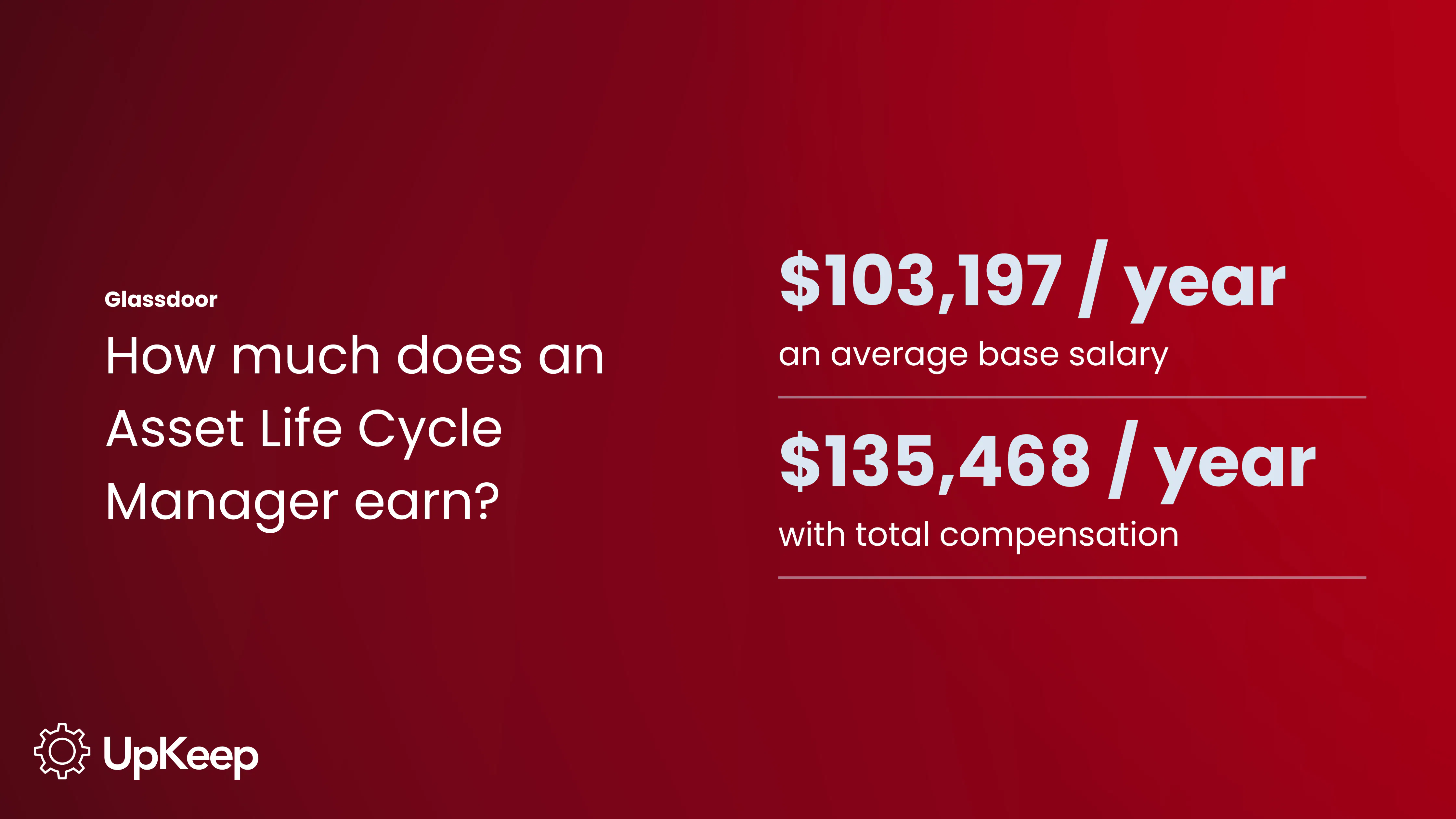
Asset life cycle management is a well-compensated career path, reflecting the high value these professionals bring to organizations. According to Glassdoor, asset managers in the United States earn an average base salary of $103,197 per year, with total compensation, including bonuses and profit sharing, reaching $135,468 per year. Salaries vary based on industry, experience, and location, with top earners in sectors like energy, IT, and financial services commanding well above the national average.
Why Your Organization Needs an Asset Life Cycle Manager
Without a dedicated professional overseeing assets from acquisition to disposal, organizations routinely overspend on maintenance, miss compliance windows, and lose track of critical equipment. An asset life cycle manager brings structure and strategy to this chaos.
They reduce operational costs by scheduling preventive maintenance before failures occur, extend the useful life of assets, and ensure your organization obtains the maximum return on every capital investment. They also create the data-driven documentation that leadership needs to make smart purchasing and replacement decisions, turning reactive firefighting into proactive planning.
Frequently Asked Questions About Asset Life Cycle Managers
What does an Asset Life Cycle Manager do?
An asset life cycle manager oversees every stage of an asset's life within an organization, from initial planning and procurement, through operation and maintenance, to final disposal or replacement. Day-to-day, this includes tracking asset performance, coordinating with vendors, managing maintenance schedules, updating asset databases, and producing reports that inform budget and investment decisions.
What is asset life cycle management?
Asset life cycle management (ALM) is the systematic process of managing an organization's physical or digital assets across their entire lifespan. Rather than treating assets as isolated purchases, ALM treats them as long-term investments that require ongoing strategy. It encompasses acquisition planning, deployment, utilization monitoring, maintenance, and end-of-life management, all with the goal of maximizing value and minimizing cost.
Why is asset life cycle management important?
Poor asset management leads to unplanned downtime, inflated maintenance costs, regulatory non-compliance, and inaccurate financial reporting. Effective ALM solves all of these problems at once. It gives organizations real-time visibility into the condition and location of their assets, supports accurate depreciation tracking, and enables smarter capital expenditure planning. In short, it protects your bottom line and reduces operational risk.
Do I need to hire an Asset Life Cycle Manager?
If your organization manages a significant number of physical assets, including equipment, vehicles, technology infrastructure, or facilities, the answer is almost certainly yes. The cost of a single unplanned equipment failure, a missed compliance audit, or a premature asset replacement can far exceed the annual salary of a dedicated manager. As organizations scale, the complexity of asset management grows exponentially, making a skilled professional not only valuable but essential.
MÁS DE 4000 EMPRESAS CONFÍAN EN LA GESTIÓN DE OPERACIONES DE ACTIVOS
Liderando el camino hacia un futuro mejor para el mantenimiento y la confiabilidad
Los datos de sus activos y equipos no pertenecen a un silo. UpKeep simplifica ver dónde se encuentra todo, todo en un solo lugar. Eso significa menos conjeturas y más tiempo para concentrarse en lo que importa.






![[Review Badge] Gartner Peer Insights (Dark)](https://www.datocms-assets.com/38028/1673900494-gartner-logo-dark.png?auto=compress&fm=webp&w=336)