Blog Post
What is Asset Performance Management Software? Reduce Downtime with APM
Adopt asset performance management software to reduce asset downtime, improve ROI and budgeting, extend asset lifespan, and increase worker safety.


Key Takeaways
Asset performance management software uses real-time data, predictive analytics, and reliability strategies to optimize equipment uptime, safety, and life cycle value.
Unlike asset life cycle management, which focuses on long-term financial planning and asset ownership, APM concentrates on day-to-day operational performance and failure prevention.
APM software integrates IoT, SCADA, CMMS, and enterprise systems to deliver centralized visibility into asset health and maintenance execution.
Key APM capabilities include condition monitoring, RCM-based strategy optimization, predictive analytics, and risk-based inspection that support proactive, data-driven maintenance decisions.
APM delivers measurable business value only when paired with a modern CMMS that enables work execution, data integrity, technician adoption, and ROI tracking.
What Is Asset Performance Management?
Asset performance management (APM) is a systematic approach that combines data analytics, monitoring technologies, and maintenance strategies to maximize the performance, reliability, and lifespan of physical assets.
Unlike traditional maintenance approaches that rely on fixed schedules or reactive repairs, APM uses condition-based monitoring and predictive analytics to make informed decisions about when and how to maintain equipment.
The core principles of asset performance management are understanding how assets perform in real time, predicting potential issues before they escalate, and making smarter maintenance decisions.
Difference Between Asset Life Cycle Management and Asset Performance Management
These terms sound similar but focus on different stages and goals of asset ownership.
Asset life cycle management (ALM) tracks the entire journey of an asset, from initial procurement to final disposal, while APM specifically deals with maximizing the efficiency and uptime of that asset during its operational years.
ALM is often concerned with financial depreciation and long-term capital planning, whereas APM is a tactical, data-driven approach to daily reliability.
Feature/Capability | Asset Life Cycle Management | Asset Performance Management |
Asset Acquisition & Capital Planning | ✔ | ✘ |
Life Cycle Cost Analysis (TCO & Depreciation) | ✔ | ✘ |
Capital Replacement Planning | ✔ | ✘ |
Real-Time Condition Monitoring | ✘ | ✔ |
Predictive Maintenance Analytics | ✘ | ✔ |
Asset Health Scoring | ✘ | ✔ |
Reliability-Centered Maintenance (RCM) Support | ✘ | ✔ |
Risk-Based Inspection (RBI) | ✘ | ✔ |
CMMS Integration for Work Execution | ✔ (Indirect) | ✔ (Direct) |
Asset Performance Management Software Explained
APM software is a centralized digital platform that connects every asset, workflow, and stakeholder to improve operational efficiency.
Modern examples integrate multiple data sources, including:
IoT sensors and industrial equipment: Temperature, vibration, pressure, flow rate, and other condition indicators.
SCADA and control systems: Operational data from programmable logic controllers (PLCs) and distributed control systems (DCS).
Maintenance management systems: Work order history, maintenance records, and asset hierarchies from computerized maintenance management systems (CMMS) platforms.
Enterprise systems: Financial data, inventory information, and operational metrics from ERP systems.
Benefits of Asset Performance Management Software
Organizations that implement APM software consistently report measurable improvements across multiple operational dimensions.
Minimized Downtime
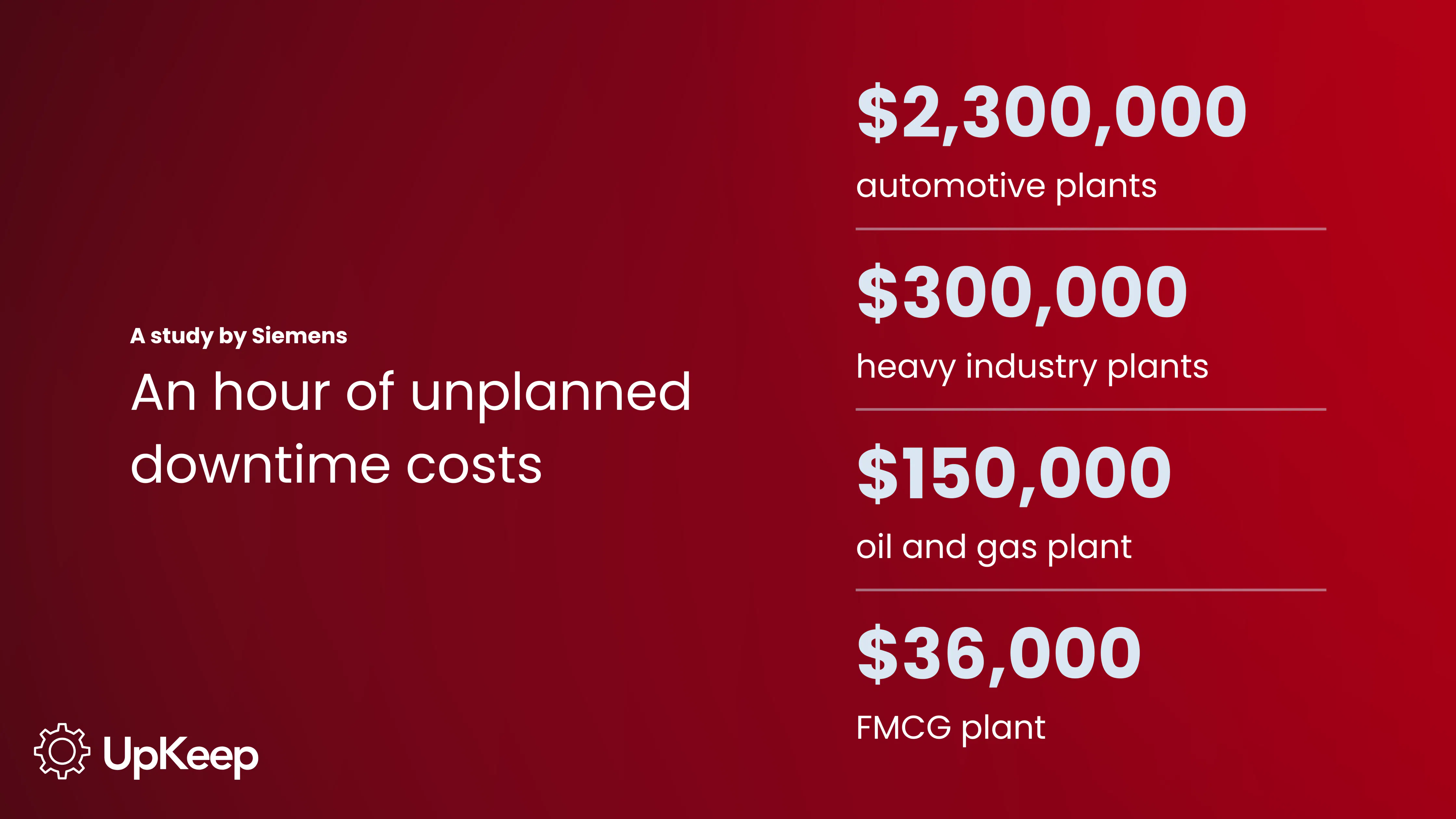
Asset performance software monitors condition indicators like vibration signatures and temperature patterns for maintenance teams to schedule repairs during planned outages instead of responding to emergency breakdowns. For heavy manufacturing plants with high downtime costs, this translates to substantial savings.
According to a study by Siemens, an hour of unplanned downtime costs nearly $2.3 million in automotive plants, $300,000 in heavy industry plants, $150,000 in an oil and gas plant, and about $36,000 in an FMCG plant.


Longer Asset Lifespan and Better Asset ROI
Equipment that receives optimized maintenance will consistently outperform assets maintained on the run-to-failure approach. APM software achieves this through a condition-based approach that prevents both excessive attention, which wastes resources, and insufficient support, which leads to premature failure.
Improved Safety
Equipment failures cost money and can endanger workers and the surrounding community. According to the Workplace Safety Index, 3 of the top 10 workplace injuries are caused by equipment. Asset performance software strengthens safety by identifying high-risk conditions before they lead to catastrophic failures. This is particularly critical for assets like pressure vessels, rotating equipment, and systems containing hazardous materials.
Clearer Budgeting
Traditional approaches to maintenance budgeting rely heavily on historical averages and guesswork. APM software provides data-driven forecasts of upcoming maintenance requirements, spare parts needs, and equipment replacement timing.
This visibility drives more accurate budget planning, better inventory management, and informed capital planning decisions about equipment replacement. Finance teams can allocate resources more effectively when they have reliable predictions rather than unexpected failures.
Key Features of Asset Performance Management Software
Modern APM solutions integrate advanced data science into traditional maintenance practices to provide a comprehensive view of equipment reliability.
Asset Health Monitoring
Asset health monitoring provides the foundation for APM by delivering real-time visibility into how equipment performs on the floor or in the field. This feature eliminates the blind spots often found in manual or paper-based systems.
APM software monitors asset health through:
Real-Time Data Collection: Capture constant updates from IoT sensors and meters to monitor temperature, vibration, or pressure.
Trend Reporting: Visualize performance data over time to identify subtle patterns of degradation before they reach critical thresholds.
Condition-Based Alerts: Automatically notify supervisors when an asset’s health score drops below a predefined baseline.
Asset Strategy Optimization
The software uses reliability-centered maintenance (RCM) principles to ensure maintenance efforts focus on the most critical assets. Asset strategy optimization first analyzes each asset to determine its function, failure modes, and the best proactive tasks to prevent those failures. Then, it identifies which assets require high-frequency preventive maintenance and which need servicing less often to save costs. Finally, the tool creates consistent checklists and procedures based on the optimized strategy to reduce human error.
Predictive Analytics
Predictive analytics in APM software employs machine learning to estimate the remaining useful life of a component. A central concept in this feature is the P-F interval or curve, which represents the time between the point where a potential failure is first detectable (P) and the point of functional failure (F).
APM software identifies the earliest possible warning signs of failure to lengthen the P-F interval, which gives the team more time to respond. It then schedules repairs during the P-F interval to avoid the chaos and high costs of a total breakdown. Finally, it analyzes data patterns after a failure to refine future predictive models and improve asset reliability.
Risk-Based Inspection
Risk-based inspection (RBI) prioritizes maintenance and inspection tasks based on the calculated risk of an asset failing. This calculation considers both the probability of failure and the severity of its consequences.
Some of the key risks assessed are:
Safety Consequences: Prioritizing assets that could lead to worker injury or OSHA violations upon failure.
Environmental Impact: Monitoring systems where a breakdown could result in leaks, spills, or regulatory fines.
Financial Risk: Accounting for the cost of lost production, emergency parts, and overtime labor associated with a specific breakdown.
Connectivity and Integration
Effective APM requires a seamless flow of data between the hardware on the plant floor and the management software used in the office.
It connects directly to PLCs and supervisory control and data acquisition (SCADA) systems to ingest raw machine data. Those APM insights then feed into a CMMS like UpKeep to trigger work orders, assign technicians, and track parts usage automatically.
Why Your APM Software Fails Without a Modern CMMS
APM software provides the high-level strategy and analytical brain, while a CMMS serves to execute the work on the ground. Without a modern CMMS to act as the central hub for technician activity and asset history, even the most advanced analytical insights will fail to produce measurable results.
For an APM software to be successful, it requires the structural support of a CMMS for several critical reasons:
Close the Feedback Loop: APM software identifies a potential failure via the P-F interval, but the CMMS has to trigger the work order, assign a technician, and document the resolution.
Historical Data Integrity: Predictive models in APM software require clean, historical data regarding repair costs and failure codes, which are captured during the daily use of a CMMS.
Technician Adoption: Reliability strategies fail if the field crew refuses to use the tools. A mobile-first CMMS provides the intuitive interface technicians need to log the data that fuels APM analytics.
Inventory Alignment: APM might suggest a critical repair, but without the CMMS managing spare parts and reorder thresholds, the team could face stockouts that stall work.
Proof of Value: While APM predicts improvements, the CMMS provides the key metrics needed to prove the ROI of the reliability strategy to leadership.
Frequently Asked Questions About Asset Performance Management Software
What is the difference between CMMS, EAM, and APM?
A CMMS focuses on the tactical execution of work orders and field operations. Enterprise asset management (EAM) expands this to encompass the entire asset life cycle across an organization and often includes financial and procurement data. APM acts as the analytical layer, using data and AI to optimize reliability and predict failures before they happen.
Is APM software worth the ROI for smaller fleets or plants?
Yes, because smaller operations often have less room for error and fewer backup assets. For SMBs and mid-market clients, implementing structured maintenance tools can lead to significant improvements in preventive maintenance compliance and task visibility. Even for smaller teams, reducing unplanned downtime by identifying risks early can save on emergency parts and lost production.
Can I use a CMMS without an APM software?
You can use a CMMS independently to manage work orders, asset history, and inventory. Many teams start with a mobile-first CMMS to transition away from paper-based processes and establish a baseline of operational efficiency. However, the analytical layer of APM is critical to receive the predictive insights and AI-driven optimizations that move maintenance from a reactive cost center to a strategic advantage.
What are the key KPIs to measure in asset performance management software?
By monitoring the key performance indicators below, organizations can prove the value of their maintenance team and justify future capital investments.
The following list identifies the primary metrics used to assess asset health and reliability:
Mean Time To Repair (MTTR): The average time required to troubleshoot and fix a failed asset; lower MTTR indicates higher efficiency.
Mean Time Between Failures (MTBF): The average time an asset operates between breakdowns; increasing this number is a core goal of reliability excellence.
PM Compliance Rate: The percentage of scheduled preventive maintenance tasks completed on time, which is critical to avoid regulatory fines and safety gaps.
Asset Uptime/Availability: The total percentage of time an asset is operational and ready for production versus its scheduled downtime.
Wrench Time: The amount of time technicians spend performing actual maintenance tasks versus administrative work or searching for parts.
Planned Maintenance Percentage (PMP): The ratio of planned maintenance work compared to reactive break/fix work orders.
OEE (Overall Equipment Effectiveness): A comprehensive score that measures the availability, performance, and quality produced by an asset.
4,000+ COMPANIES RELY ON ASSET OPERATIONS MANAGEMENT
Leading the Way to a Better Future for Maintenance and Reliability
Your asset and equipment data doesn't belong in a silo. UpKeep makes it simple to see where everything stands, all in one place. That means less guesswork and more time to focus on what matters.






![[Review Badge] Gartner Peer Insights (Dark)](https://www.datocms-assets.com/38028/1673900494-gartner-logo-dark.png?auto=compress&fm=webp&w=336)