Blog Post
The Final Level of the Maintenance Maturity Model: World-Class Maintenance
By the time you've reached Level 5 of the Maintenance Maturity Model, you're truly ready to achieve world-class maintenance. At this stage, your entire maintenance system will be centered on maximizing both efficiency and asset uptime. In Level 5, we will integrate world-class metrics provided by the Society of Maintenance & Reliability Professionals (SMRP) to achieve this goal.


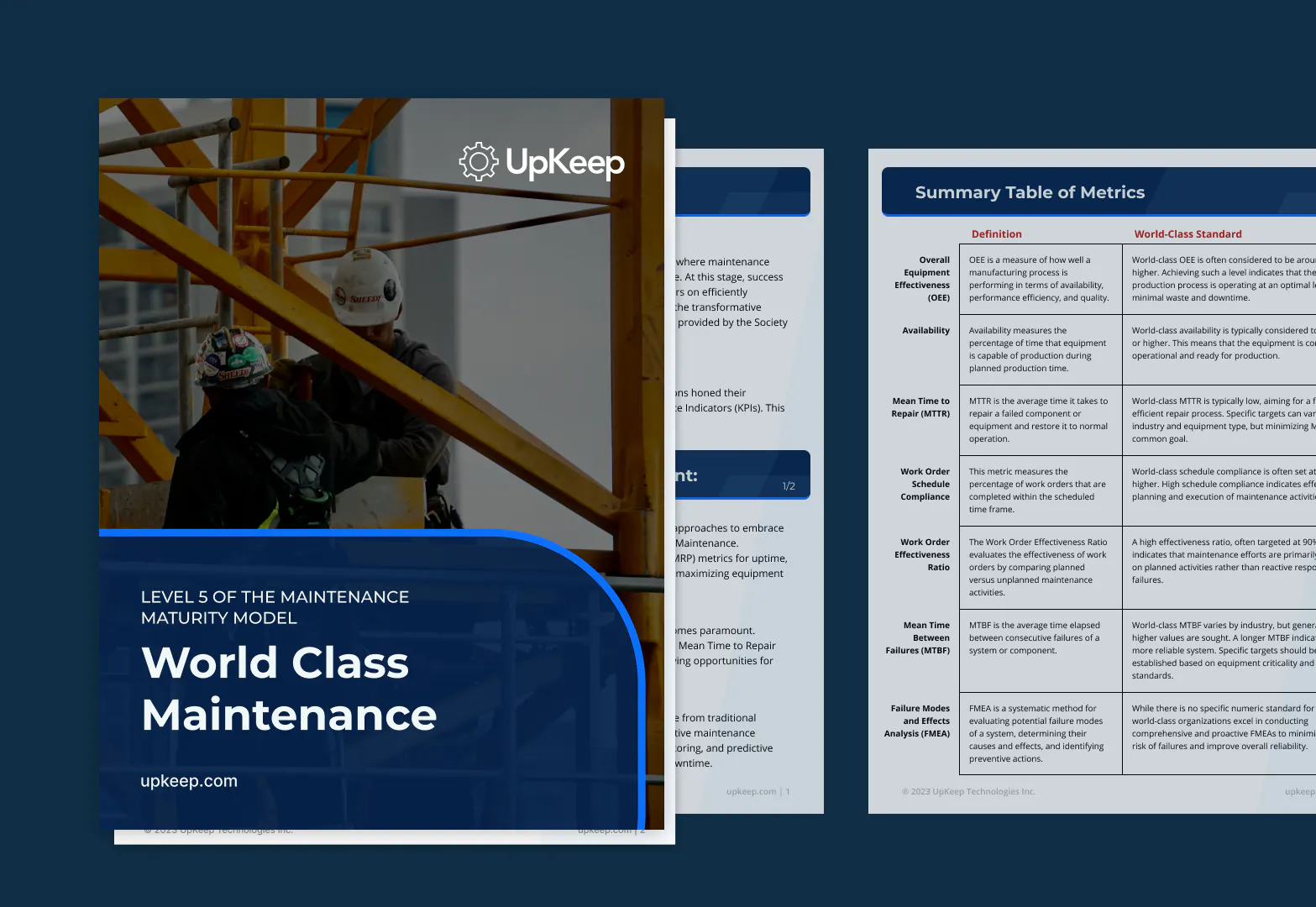
Reaching the Final Level of the Maintenance Maturity Model: World-Class Maintenance
Congratulations! By the time you've reached Level 5 of the Maintenance Maturity Model, you're truly ready to achieve world-class maintenance. At this stage, your entire maintenance system will be centered on maximizing both efficiency and asset uptime. In Level 5, we will integrate world-class metrics provided by the Society of Maintenance & Reliability Professionals (SMRP) to achieve this goal.
Step One: Elevating uptime management
The first step of Level 5 is to focus on minimizing downtime and maximizing equipment availability. Related SMRP metrics include overall equipment effectiveness (OEE), availability, and meantime to repair (MTR).
At this point, your organization has likely abandoned nearly all reactive maintenance tasks in favor of both preventive and predictive maintenance strategies. You may have started using advanced data analytics, condition monitoring, and predictive tools such as sensors, which will begin giving your company the ability to predict potential asset failures before they result in unplanned downtime.
Real-time monitoring is the key to predictive maintenance. Technology can essentially “watch your equipment around the clock,” allowing you to plan maintenance interventions as soon as they are needed.
Tasks in this step may include:
Implement predictive maintenance strategies that leverage technology such as sensors, machine learning, and IoT devices
Use real-time monitoring systems to provide continuous insight into equipment health, which will result in proactive, smarter decisions
Encourage a culture where insights from high quality data will accurately inform maintenance strategies and interventions
Step Two: Strategic work order prioritization
In this step, we align work orders with organizational goals. Work orders should go beyond routine tasks and instead support overarching company business strategies and objectives. Examining things like criticality of equipment, associated risks, and potential impact on uptime will strategically align maintenance resources with overall operations. Related SMRP metrics include measuring work order schedule compliance and work order effectiveness ratio.
Tasks in this step may include:
Implement a risk-based prioritization equipment system so that high-risk areas are addressed first
Prioritize work orders that are or will contribute most significantly to uptime management
Use metrics to determine the efficiency and impact of maintenance activities and continually improve workflows
Step 3: Reliability-centered maintenance
Reliability-centered maintenance (RCM) focuses on identifying failure modes, using proactive maintenance strategies, and creating a culture of continuous improvement. By doing these things, you will create a systematic approach to improving equipment reliability and optimizing performance.
Related SMRP metrics include mean time between failures (MTBF), meantime to repair (MTR), and failure modes and effects analysis (FMEA).
Tasks in this step may include:
Analyze potential failure modes for critical assets as well as consequences of each failure on overall operations
Implement proactive maintenance strategies based on these failure modes including predictive, preventive, and condition-based monitoring so that issues are flagged and addressed before downtime occurs
Create a culture of continuous Improvement that includes feedback loops, lessons learned, and regular reviews of maintenance strategies
Step 4: Asset performance excellence
As an organization, you’ll want to truly focus on asset performance excellence to ensure maximum efficiency and optimization throughout the asset life cycle. SMRP metrics for this level will focus on gauging the effectiveness and reliability of assets and may include overall equipment effectiveness (OEE) and meantime between failures (MTBF).
Tasks in this step may include:
Focus on minimizing downtime, boosting speed and efficiency of equipment, and adhering to high quality standards
Address root causes of failures to implement predictive maintenance
Continuously monitor asset health to prevent potential problems
This step will also include life cycle management that addresses the acquisition, operation, maintenance, and disposal of equipment. This stage will help you determine the best times for upgrades or replacement based on performance data and organizational goals.
Step 5: Continuous improvement culture
This final step looks at world-class maintenance and reliability from a people perspective. SMRP metrics include maintenance turnover, workforce development, and training hours per maintenance employee.
The goal in this last stage is to reduce turnover and create an environment of stability and consistency in your maintenance team. Be sure to measure the effectiveness of any workforce development initiatives in order to enhance the skills and knowledge of your team.
Examine the number of hours it takes to train each maintenance technician and use this data to enhance ongoing professional development. As an organization, it's important to create regular and targeted training programs that instill the knowledge of evolving technologies, industry best practices, and needed skill sets for your maintenance team. Be sure these all align with your company's goals as well as the changing landscape of maintenance practices.
By putting into place knowledge sharing platforms that can help your maintenance team understand and implement best practices, you will go a long way in refining and enhancing the skills that your team needs to use existing technologies to their fullest. This may also include mentorship programs and creating career development paths within your maintenance team, which may include progression tracking, certifications, and opportunities for advancement.
Conclusion
Level 5 is the pinnacle of the Maintenance Maturity Model, integrating SRP metrics and looking at maintenance in a holistic manner. Focusing on uptime management, strategic work order prioritization, reliability-centered maintenance, asset performance excellence, and continuous improvement will help your organization not only achieve but also sustain world-class maintenance. For a more detailed blueprint, download UpKeep’s World-Class Maintenance: Level Five of the Maintenance Maturity Model.
Want to keep reading?


Article
Ready for Level Two of the Maintenance Maturity Model: CMMS Implementation

Article
Embracing Level Four of the Maintenance Maturity Model: Reliable Data and Defined KPIs

Article
Moving to Level Three of the Maintenance Maturity Model: Successful CMMS Adoption
4,000+ COMPANIES RELY ON ASSET OPERATIONS MANAGEMENT
Leading the Way to a Better Future for Maintenance and Reliability
Your asset and equipment data doesn't belong in a silo. UpKeep makes it simple to see where everything stands, all in one place. That means less guesswork and more time to focus on what matters.






![[Review Badge] Gartner Peer Insights (Dark)](https://www.datocms-assets.com/38028/1673900494-gartner-logo-dark.png?auto=compress&fm=webp&w=336)