Blog Post
Embracing Level Four of the Maintenance Maturity Model: Reliable Data and Defined KPIs
y the time you’ve reached level four of the Maintenance Maturity Model, your organization has already made tremendous progress in streamlining operations and workflows and gaining efficiency. You’ve abandoned inefficient manual systems, successfully implemented a computerized maintenance management system (CMMS), extracted valuable insights, and trained your team to fully embrace the solution across your organization.


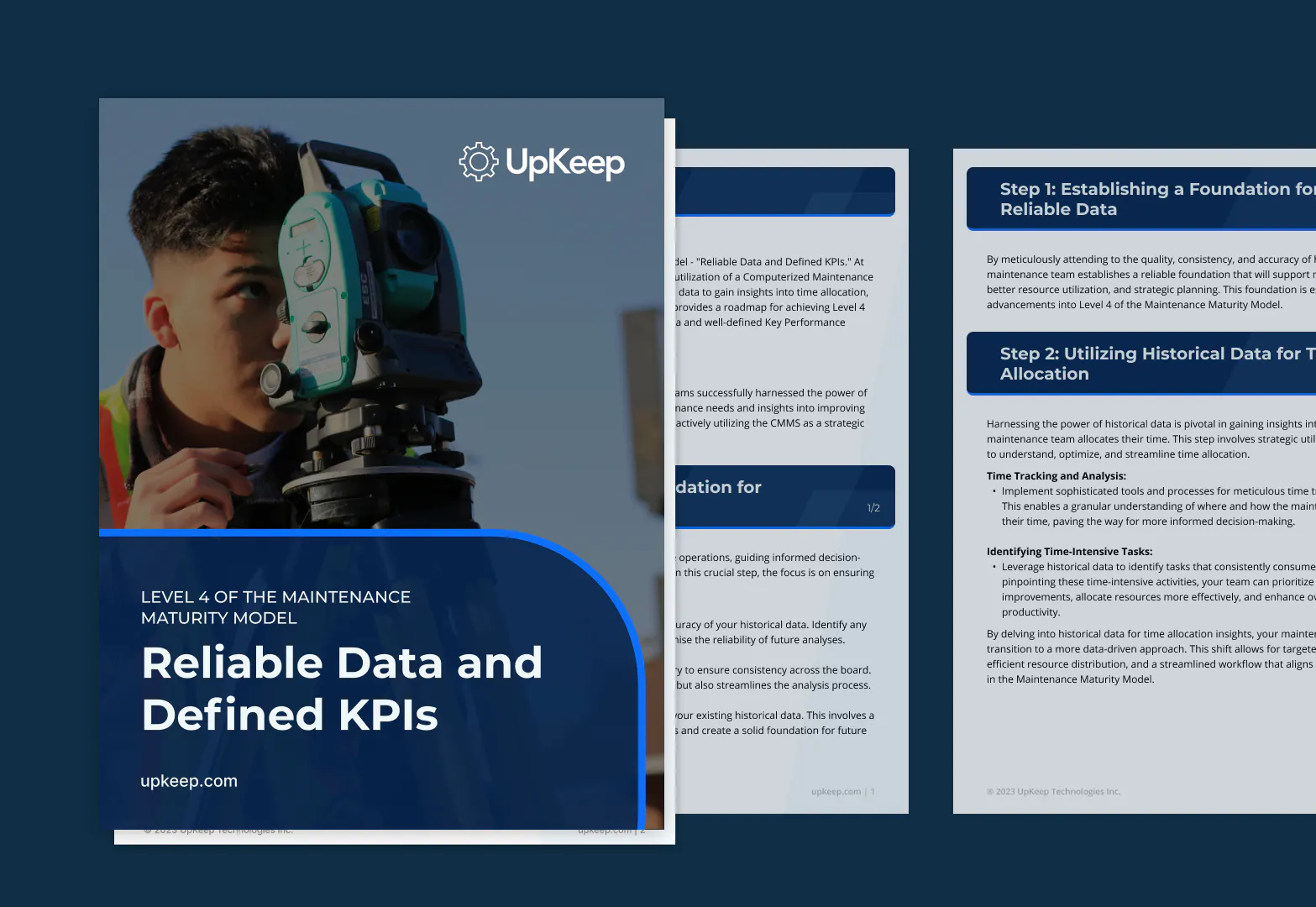
Embracing Level Four of the Maintenance Maturity Model: Reliable Data and Defined KPIs
By the time you’ve reached level four of the Maintenance Maturity Model, your organization has already made tremendous progress in streamlining operations and workflows and gaining efficiency. You’ve abandoned inefficient manual systems, successfully implemented a computerized maintenance management system (CMMS), extracted valuable insights, and trained your team to fully embrace the solution across your organization.
Now, you’re ready to fine-tune the quality of your data and define key performance indicators (KPIs) for the long-term. Here are the six steps to complete Level Four successfully.
Step One: Establish a foundation for reliable data
Everyone has heard the term garbage in, garbage out. With accurate data being the foundation of modern-day computing, it’s critical to establish a way to both clean up existing historic data as well as ensure accurate, complete data entry moving forward.
Begin by assessing your current database and identify any areas where data integrity might be compromised. Create a strategic, step-by-step method to find discrepancies or inaccuracies that will throw off future data analysis and then work to restore them. The success of this fourth level of the Maintenance Maturity Model hinges on not only the reliability of this data but your team’s trust that the data is accurate.
It’s also important to establish a standard method of entering future data so that new information that is inputted into the CMMS is complete and accurate. Be sure to train and obtain buy-in from those responsible for entering future data; their cooperation will be critical.
Step Two: Use historic data for time allocation
The first analysis that should be completed once historic data is cleaned up is to meticulously analyze how time is being spent by your maintenance team.
Not only can you evaluate the performance of technicians in relation to their peers or against personal development goals, but you should be able to identify those tasks and processes that are consuming the majority of your maintenance team’s resources.
Typically, those are the areas to examine for inefficiencies and the best place to start when it comes to implementing improvements.
Step Three: Use historic data to assess asset allocation
Similar to the previous step, accurate historic data can also be used to evaluate the performance of critical assets.
Begin by establishing metrics and KPIs that are tied to asset performance such as overall equipment effectiveness (OEE), unplanned downtime, and failure rates. Evaluate benchmarks and consider industry best practices to establish reasonable goals.
Having accurate data then allows you to analyze past performance of each critical asset, identifying potential timeframes or asset behaviors that may signal impending failures. This allows your maintenance team to shift from a reactive mindset to a proactive or even predictive one, addressing issues before they cause major problems.
Step Four: Understand financial impact
Once you’ve successfully used historic data to analyze both time and asset allocation, the next logical step is to determine how all of this impacts the company’s bottom line.
Begin with a detailed cost analysis to identify the most expensive areas of your maintenance program. This information will fuel future improvements as well as help you prioritize the areas that need immediate attention.
Once the past is understood, it’s easier for your organization to make smarter budget decisions for the future. This data then serves as the foundation to help allocate budgets moving forward, balancing both performance and affordability.
Step Five: Define KPIs
Understanding how to select the best KPIs for your business will be an important step in continuous improvement. After all, you can’t improve what you don’t measure.
Begin by choosing metrics that are closely tied to your company’s business goals. They may include things like reducing unplanned downtime or improving equipment reliability. Then, you’ll want to consider both your historic performance alongside industry best practices to create reachable goals for the short- and long-term.
This sets the stage for a cyclical continuous improvement cycle, allowing your team to return to these established KPIs at regular intervals to check progress and adjust goals accordingly.
Step Six: Implement data-driven decision making
Finally, it’s important to instill a change in mindset across your maintenance team to make day-to-day decisions based on trusted data. Use technology and tools to integrate both your historic and fresh data alongside your established KPIs so that every member of your maintenance team can easily see how the performance of a particular asset or existing workflows are either supporting or detracting from KPI goals.
By empowering your team to make data-driven decisions, you will foster a culture of accountability, teamwork, and ownership.
Conclusion
By completing the fourth level of the Maintenance Maturity Level, your organization will successfully create a foundation of trusted, accurate and complete data that can be effectively used to improve time, asset, and budget allocation and ultimately drive data-based strategic decision-making. For a more detailed blueprint, download UpKeep’s Reliable Data and Defined KPIs: Level Four of the Maintenance Maturity Level.
Want to keep reading?



Article
Embracing Level One of the Maintenance Maturity Model: From Pen and Paper to CMMS


Article
Ready for Level Two of the Maintenance Maturity Model: CMMS Implementation

Article
Moving to Level Three of the Maintenance Maturity Model: Successful CMMS Adoption
4,000+ COMPANIES RELY ON ASSET OPERATIONS MANAGEMENT
Leading the Way to a Better Future for Maintenance and Reliability
Your asset and equipment data doesn't belong in a silo. UpKeep makes it simple to see where everything stands, all in one place. That means less guesswork and more time to focus on what matters.






![[Review Badge] Gartner Peer Insights (Dark)](https://www.datocms-assets.com/38028/1673900494-gartner-logo-dark.png?auto=compress&fm=webp&w=336)