Blog Post
Predictive Maintenance Software for Manufacturing: From Sensor Alert to Work Order
Learn how predictive maintenance software uses IoT sensors and condition data to prevent equipment failures, reduce unplanned downtime, and cut maintenance costs in manufacturing.



Key Takeaways
Predictive maintenance software for manufacturing connects real-time asset condition data to maintenance workflows before equipment fails. When a sensor alert opens a work order, assigns a technician, and confirms parts availability without a human relay step, the prediction becomes a repair faster.
Shifting from calendar-based PM to condition-based maintenance eliminates two failure modes at once: servicing equipment that doesn’t need it and missing equipment that deteriorates between scheduled intervals. Both failure modes carry cost, one in unnecessary labor and shutdowns, the other in unplanned production losses.
A CMMS is the execution layer that makes predictive insights actionable. Without it, sensor alerts land with no work order, no parts check, and no assigned technician. The alert sits in a dashboard until a failure makes it irrelevant.
A functional predictive maintenance program doesn’t require a full sensor network on day one. Starting with the highest-criticality assets is the practical entry point for most manufacturing operations.
Research from McKinsey and Deloitte reports 18%–25% reductions in maintenance costs and an up to 50% reduction in unplanned downtime for manufacturers that move to condition-driven maintenance. The return closes quickly against a baseline where unplanned downtime costs manufacturers an average of $260,000 per hour.
Manufacturing facilities lose an average of 326 hours of unplanned downtime per year, according to Siemens Senseye’s True Cost of Downtime 2024 report. Unplanned downtime costs manufacturers an estimated $260,000 per hour in lost production, a figure that varies widely by production environment, with high-throughput facilities reporting significantly more.
Preventive maintenance programs are standard in manufacturing facilities. The problem is that calendar-based PM schedules can’t respond to actual asset conditions: they service equipment that doesn’t need it and miss equipment that’s deteriorating between scheduled intervals. Predictive maintenance software addresses that gap directly.
What Is Predictive Maintenance Software for Manufacturing?
Predictive maintenance (PdM) software uses real-time condition data from sensors or operational inputs to detect early signs of equipment deterioration and generate maintenance actions before failure occurs. This distinguishes it from both preventive maintenance, which runs on fixed-calendar or meter-based intervals, and reactive maintenance, which runs equipment to failure. In predictive programs, condition data, rather than assumptions about wear, drives the trigger.
The distinction between predictive software and standalone sensor or IoT platforms matters in practice. Sensor platforms generate data. Predictive maintenance software translates that data into actionable maintenance decisions.
Many manufacturing facilities have sensors in place but no workflow connecting the alert to a repair. The data reaches an inbox, a dashboard, or a spreadsheet … and then sits. No technician is dispatched. No work order is opened. The prediction goes unused until the equipment fails anyway.
Two delivery models are common:
Dedicated PdM platforms bundle proprietary sensors with enterprise AI analytics into a single purchase and typically have a longer implementation with higher up-front costs.
CMMS platforms with condition-based triggers and IoT integration reach the same predictive outcomes by connecting to existing or third-party sensors, with faster deployment and lower entry cost. Most mid-sized manufacturers (and many large ones) start here.
How Predictive Maintenance Software Works
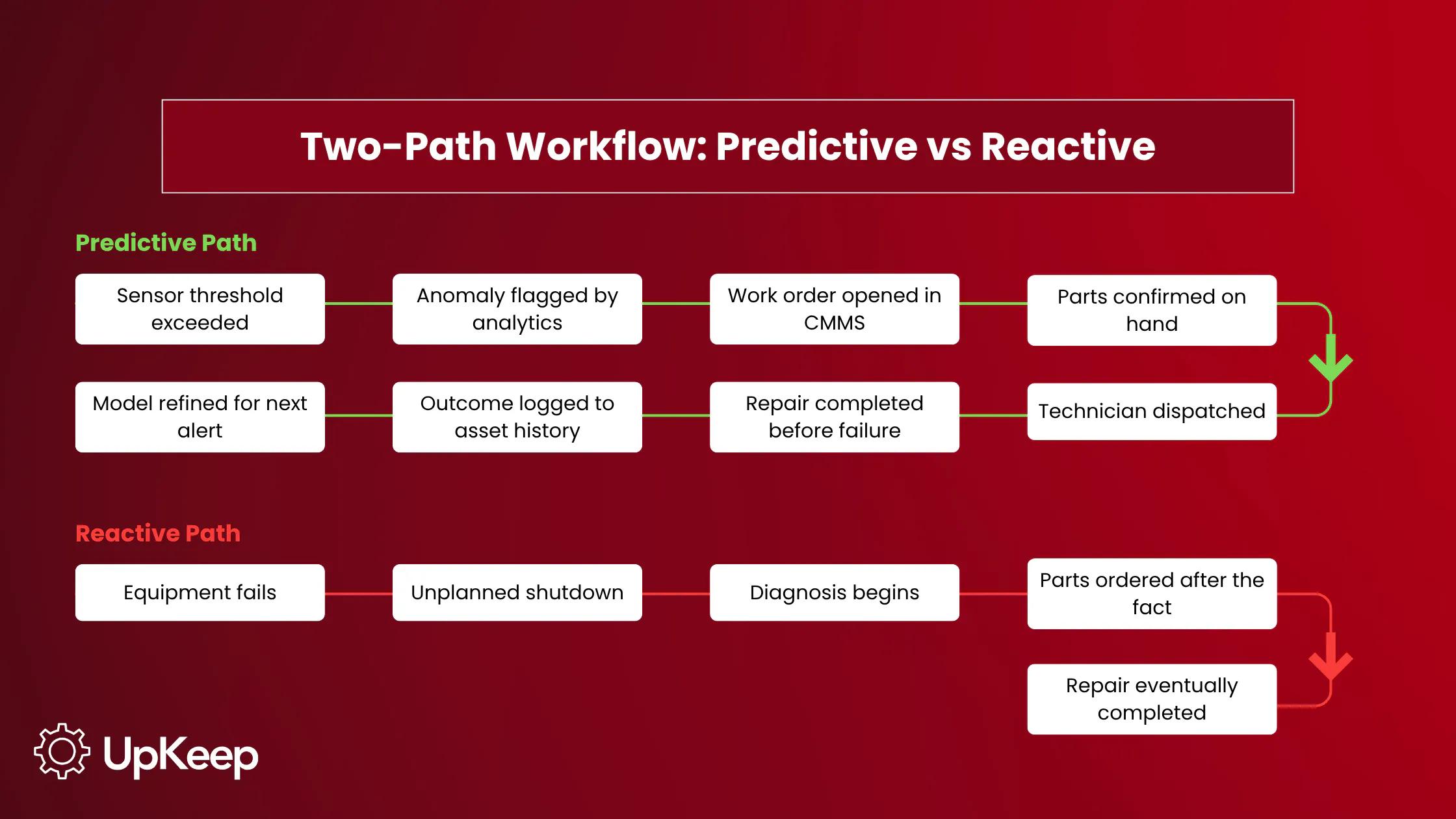
The system operates in four connected layers: data collection, analysis, execution, and feedback, a model consistent with IBM's predictive maintenance framework. Each layer depends on the one before it. A failure at any point in the chain turns the predictive program into an expensive alert system:
Data collection: IoT sensors measure vibration, temperature, pressure, acoustic signatures, and electrical load in real time.
The sensor type determines the failure modes it can detect: Vibration sensors catch bearing wear and shaft misalignment; thermal sensors surface overheating from lubrication failure or electrical faults; acoustic sensors detect cavitation in pumps and cracks propagating in rotating components.
Analysis: Machine learning algorithms establish baseline performance signatures per asset, what normal looks like at rated load, under varying duty cycles, and across seasonal operating conditions.
Deviations from baseline trigger diagnostic flags. The output tells the technician what’s failing and where. For instance, early-stage bearing wear detected via changes in vibration signature, thermal anomaly on the drive-end bearing, or pressure drop indicating seal deterioration.
Execution: The diagnostic triggers a work order in the CMMS. The CMMS then checks parts availability, assigns a technician, and logs the intervention against the asset record.
This is where the prediction becomes a repair. Without the CMMS as the execution layer, the prediction remains an alert with no owner, timeline, or accountability.
Feedback: Completed work orders feed back into the predictive model. Actual failure data, what the sensor flagged, what the technician found, and what the actual failure mode was all refine the algorithm’s forecasting accuracy over time. Programs that build fault libraries by asset class improve with every completed repair.


What Predictive Maintenance Software Addresses in Manufacturing
Unplanned Downtime
Failures caught at the bearing wear stage require a single parts replacement. Those that run to completion require bearing, shaft, and surrounding component repair and, in some cases, gearbox and motor replacement. The cost difference is hours versus days of downtime, one part versus a full drivetrain, a planned intervention versus an emergency mobilization.
Over-Maintenance
Calendar PM services equipment on a fixed schedule regardless of operating condition. A motor running well at 500 hours doesn’t need the same intervention as one showing thermal deviation at 400 hours. According to Deloitte’s predictive maintenance research, poor maintenance strategies, including both reactive programs and over-maintenance from rigid PM schedules, decrease productivity potential by 5%–20%.
Parts Inventory
Predictive programs generate procurement signals weeks ahead of the repair, based on actual deterioration rates. Advance notice allows procurement to source specific parts for specific assets within a known window, reducing both carrying costs and the stockout risk that extends repair time when a failure does occur.
Technician Allocation
Reactive maintenance concentrates labor demand unpredictably. A bearing failure at 2 a.m. pulls whoever’s on call into diagnostic work, at overtime rates, with an unknown scope. Predictive programs shift that demand to scheduled windows with a known scope, which improves labor utilization and eliminates the unplanned overtime that skews maintenance cost per production hour.
|
Reactive |
Preventive |
Predictive |
|
|---|---|---|---|
|
What triggers action |
Equipment fails |
Calendar date or meter reading |
Sensor detects deterioration above threshold |
|
Advance notice |
None |
Fixed interval, regardless of actual condition |
Days to weeks before failure |
|
Labor scheduling |
Emergency response, unplanned overtime |
Scheduled windows, but may service healthy equipment |
Planned window, known scope and parts |
|
Parts procurement |
Emergency sourcing after failure |
Safety stock based on PM schedule assumptions |
Signal-driven procurement ahead of repair window |
|
Downtime type |
Unplanned, unknown duration |
Planned, but may be unnecessary |
Minimized: intervention before failure |
|
Typical cost profile |
High: emergency labor, expedited parts, extended downtime |
Moderate: some unnecessary service events |
Lowest over time: early intervention, planned execution |
Key Capabilities to Look for in Predictive Maintenance Software
Sensor and IoT Integration
The platform must connect to existing or planned sensors. For brownfield manufacturing facilities with mixed equipment ages and varied sensor manufacturers, sensor-agnostic platforms that support OPC-UA, common wireless protocols, and direct PLC integration are preferable. A platform that requires proprietary sensors adds a hardware procurement step to every asset the program expands to cover.
Condition-Based Work Order Triggers
Alerts that don’t automatically generate work orders introduce a manual relay step: Someone reads the alert, decides whether to act, opens a work order, assigns it, and checks parts availability. Each step is a delay and a potential drop-off. The trigger-to-work-order path should require no human intervention.
CMMS Integration or Native Work Order Management
A standalone analytics platform that doesn’t connect to the maintenance execution system is half a solution. The questions to ask any vendor are, “Where does the work order live? Who closes it? And how does the completion data return to the predictive model?”
Asset History and Diagnostic Libraries
Predictive accuracy improves with data. Platforms that build and retain diagnostic libraries by asset class, storing what the sensor detected, what the technician found, and what the actual cause was, produce better forecasts over time than those treating each alert in isolation.
Mobile Execution
Technicians need to receive diagnostic guidance and complete work orders in the field. A predictive alert that requires a technician to return to a desktop to view the work order or log completion isn’t a functional workflow for a manufacturing floor.
Reporting and KPI Visibility
MTBF, MTTR, unplanned downtime rate, and PM completion rate must be visible at the asset and program level. This is how operations leaders demonstrate ROI and identify where the program is producing results and where it isn’t.
KPIs for Predictive Maintenance in Manufacturing
Tracking the right metrics is how teams know whether the program is working or merely generating alerts. The following six KPIs cover detection quality, execution quality, and financial impact, which are the three dimensions that determine whether a predictive maintenance program delivers measurable results.
|
KPI |
What It Measures |
What a Mature Program Moves It Toward |
|---|---|---|
|
Mean Time Between Failures (MTBF) |
Average operating time between unplanned failures per asset |
Upward trend as early detection prevents failures from running to completion |
|
Mean Time to Repair (MTTR) |
Average time from failure detection to asset return to service |
Downward trend as repairs are planned with known scope and parts on hand |
|
Unplanned Downtime Rate |
Hours of unplanned downtime as a percentage of total production hours |
Reduction over baseline: the primary program-level effectiveness signal |
|
PM Completion Rate |
Proportion of condition-triggered PM tasks completed on schedule |
Tracks execution quality; high detection with low completion signals a workflow gap |
|
Maintenance Cost per Production Hour |
Total maintenance spend: labor, parts, downtime as a ratio to output |
Downward trend; the number that anchors budget conversations |
|
False Positive Rate |
Alerts generating work orders on equipment operating normally |
Tracked and reduced over time; high rates erode technician trust in the system |
How to Implement Predictive Maintenance Software in Manufacturing
Identify and prioritize assets by criticality: High-criticality assets whose failure stops a production line or creates safety hazards are the starting point. A full-facility sensor deployment isn’t required on day one, and attempting one extends deployment timelines without proportional early return. The first assets monitored should be the ones where a failure would be the most expensive.
Establish baseline condition data: Baseline periods vary by asset type and duty cycle. Run sensors long enough to grasp normal operating signatures before flagging deviations. Flagging deviations before the baseline is established produces false positives that undermine technician trust before the program has demonstrated value.
Configure alert thresholds and work order triggers: Define what constitutes an actionable deviation per asset class. Overly conservative thresholds generate false positives and alert fatigue, while too tolerant misses developing faults until the failure is close at hand. Review initial thresholds after the first 60–90 days against actual failure events and false-positive rates.
Connect to your CMMS: The alert must trigger a work order automatically, with the asset record, relevant parts list, and technician assignment attached. A predictive program that relies on someone manually translating an alert into a work order has introduced a failure point at the most critical step.
Train technicians on predictive work orders: Predictive maintenance changes what information technicians receive before approaching equipment. A work order generated from a vibration alert should arrive with the sensor reading, baseline comparison, and probable fault type, not just an asset number and a task description.
Track outcomes and refine thresholds: Log failure data against predictions. What the sensor flagged, what the technician found, and whether the diagnosis was accurate all feed the model’s improvement. Adjust thresholds based on false-positive and false-negative rates over the first 90–180 days.
UpKeep connects IoT sensor alerts to automated work order creation, mobile technician dispatch, parts inventory visibility and full asset history in one platform.
For manufacturing teams implementing predictive maintenance, it closes the loop between condition alert and completed repair. Manufacturing teams using UpKeep report a 90% reduction in technician time spent on work order filing and asset location, and a 315% return on investment.
If you want to estimate your own return, you can run the numbers using UpKeep's ROI calculator before committing to a deployment.
Predictive Maintenance as an Operational System
A manufacturing facility running on reactive maintenance has no advance signal. Equipment fails without warning, repair scope is unknown until the machine is opened, and the production line stays down while parts are sourced. Each failure absorbs emergency labor, expedited procurement costs, and lost production time that a planned intervention would have eliminated.
A controlled predictive program runs differently from the first sensor reading. Condition data produces a diagnostic before failure. A work order opens with the fault type, asset history, and parts requirement already attached. The technician arrives knowing what to replace, confirms the parts are on hand, and the asset returns to service without a production stoppage. The completed repair feeds back into the model that generates the next alert.
UpKeep structures that control operationally: Sensor integrations feed condition data into the platform, threshold breaches open work orders automatically, and technicians close out on mobile at the point of work. The asset history builds with every completed repair.
When the next alert fires, the platform already knows the asset’s service history, open parts, and last calibration. Every failure caught before it occurs is a production stoppage that didn’t happen and a maintenance cost that came in below the break-fix alternative.
Interested in learning how UpKeep can optimize your manufacturing setup? Reach out and we’ll show you!
FAQ
What is predictive maintenance software for manufacturing?
Software that uses real-time condition data from sensors to detect early signs of equipment deterioration and trigger maintenance actions before failure occurs. It sits above both preventive maintenance, which runs on fixed intervals, and reactive maintenance, which runs to failure. Condition data determines when servicing is necessary, not calendar assumptions.
How is predictive maintenance different from preventive maintenance?
Preventive maintenance runs on fixed-calendar or meter-based intervals regardless of equipment’s current state. Predictive maintenance triggers when sensor data indicates deterioration is occurring. Preventive schedules may service equipment that doesn’t need it and miss equipment deteriorating between intervals. Predictive programs address both failure modes simultaneously.
What sensors are used in predictive maintenance?
The most common types are vibration sensors for detecting bearing wear, shaft misalignment, and imbalance; thermal sensors for identifying overheating from lubrication failure or electrical faults; acoustic sensors for detecting cavitation and propagating cracks; and pressure sensors for identifying seal degradation and flow restrictions. Electrical load monitoring is also used on motors and compressors to detect early mechanical resistance increases before they produce thermal signatures.
How does a CMMS support predictive maintenance?
The CMMS is the execution layer. Sensor analytics detect the anomaly, then the CMMS translates the alert into a work order with the asset record, parts list, and technician assignment attached. The system also stores completed repair data that feeds back into the predictive model, improving forecasting accuracy over time.
What ROI can manufacturing teams expect from predictive maintenance?
McKinsey and Deloitte report 18%–25% reductions in overall maintenance costs and an up to 50% reduction in unplanned downtime for manufacturers that implement condition-driven programs. Against a baseline where unplanned downtime costs an average of $260,000 per hour, the return on instrumentation and software investment typically manifests within 12–18 months for high-criticality asset deployments. Results vary by facility complexity, asset age, and baseline maintenance maturity though.
4,000+ COMPANIES RELY ON ASSET OPERATIONS MANAGEMENT
Leading the Way to a Better Future for Maintenance and Reliability
Your asset and equipment data doesn't belong in a silo. UpKeep makes it simple to see where everything stands, all in one place. That means less guesswork and more time to focus on what matters.






![[Review Badge] Gartner Peer Insights (Dark)](https://www.datocms-assets.com/38028/1673900494-gartner-logo-dark.png?auto=compress&fm=webp&w=336)