Blog Post
How to Excel at Predictive Maintenance: Steps for a Smooth Implementation
Learn how to make the shift to predictive maintenance step-by-step, the do’s and don’ts that drive a smooth transition, and the benefits it offers.



Unplanned downtime is one of the greatest expenses a facility can face, but it’s also highly preventable. Predictive maintenance (PdM) gives organizations the tools to move from reactive firefighting to intelligent, data-driven operations. By monitoring real-time asset conditions and acting on what the data shows, teams can prevent costly failures, extend asset lifespan, and build a maintenance program that doubles as a strategic advantage.
This article walks through what predictive maintenance is, how it compares to preventive maintenance, the business value it delivers, and, most importantly, how to implement it the right way.


Predictive Maintenance, Explained
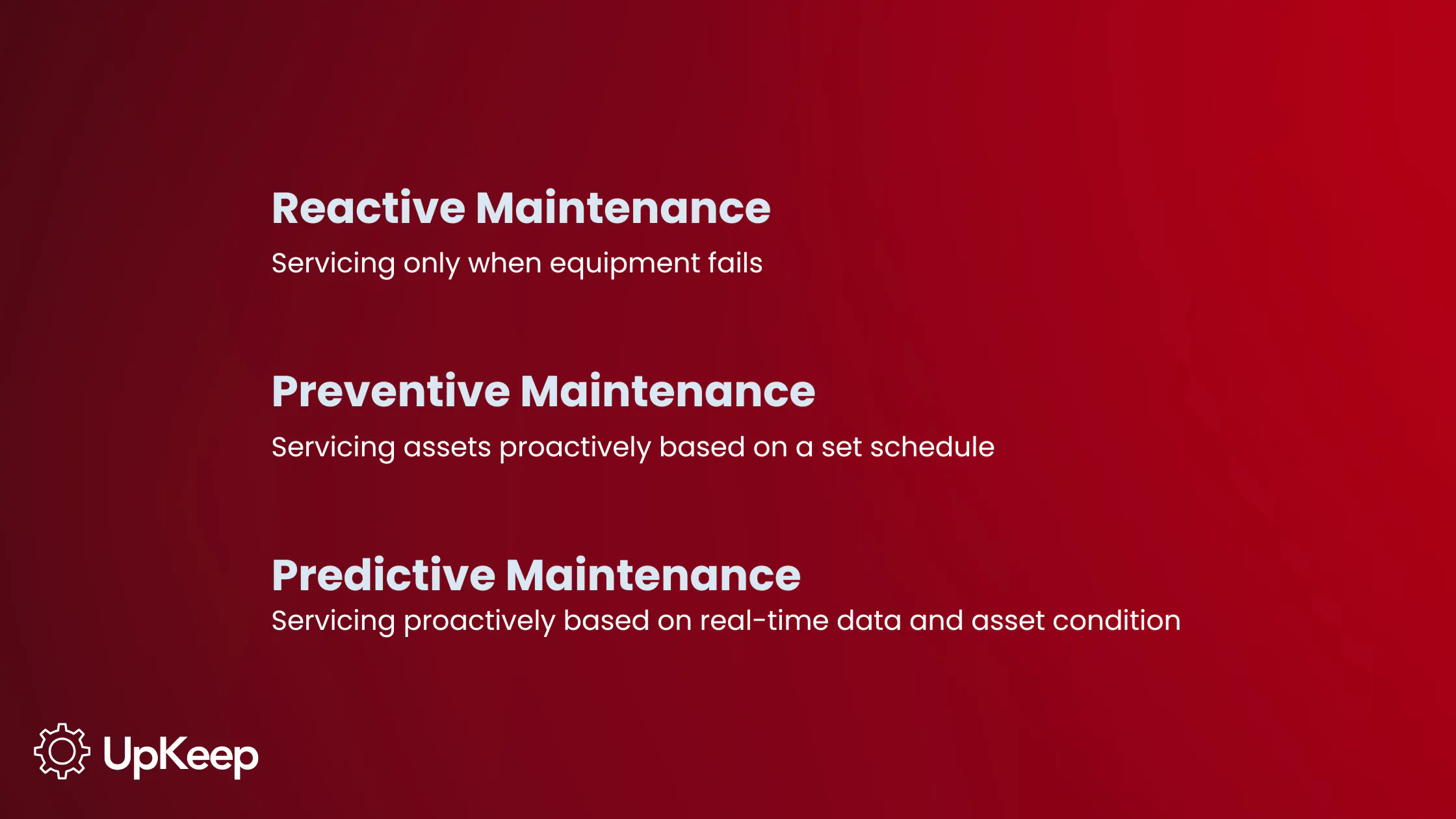
Predictive maintenance is a proactive strategy that uses real-time data and condition monitoring to anticipate equipment failures before they occur. Rather than waiting for a breakdown or servicing equipment on a fixed calendar schedule, PdM allows teams to schedule repairs at the most opportune time based on where an asset is in its life cycle.
The core technology stack behind PdM typically includes Internet of Things (IoT) sensors, SCADA systems, and a computerized maintenance management system (CMMS) that aggregates and surfaces asset health data in one connected platform. When these tools work together, team members across departments gain a single source of truth for asset life cycle data.
PdM adoption shifts your organization from a reactive culture to an intelligent one, allowing teams to base every maintenance decision on hard data rather than guesswork, fixed schedules, or crisis response.
What is the Difference Between Predictive Maintenance and Preventive Maintenance?
Both preventive and predictive maintenance are designed to lengthen asset lifespan and reduce the disruptions that unplanned failures cause. The key distinction is in how and when they act.
Preventive maintenance runs on a schedule, meaning you service the asset on a regular cadence regardless of its actual condition. It’s a meaningful improvement over purely reactive maintenance, but it can result in unnecessary service for assets that don't yet need it and potentially missing assets that are degrading faster than the schedule anticipates.
Predictive maintenance uses condition data to determine when service is needed. This gives teams a clearer picture of where an asset is headed, resulting in maintenance that’s timely, targeted, and grounded in operational reality.
How Predictive Maintenance Benefits Your Organization
The benefits of a mature PdM program extend beyond preventing the occasional breakdown. When implemented effectively, predictive maintenance transforms how an organization manages assets, controls costs, and makes decisions.
Reduced unplanned downtime. By identifying failure patterns early, PdM gives teams time to intervene during scheduled maintenance windows rather than scrambling during unexpected outages. Research shows predictive maintenance can increase equipment uptime by up to 20%.
Lower maintenance costs. Maintenance only happens when data indicates it’s necessary, so PdM eliminates unnecessary preventive work orders, in turn reducing labor costs, parts spend, and technician time spent on assets that don't yet need attention.
Extended asset lifespan. Assets that are serviced based on condition rather than arbitrary schedules last longer, which pushes back replacement timelines and cuts spend across the asset’s life cycle by 10%–20%.
Audit-ready compliance documentation. Predictive maintenance generates a continuous record of asset health, work history, and maintenance triggers to create the documentation that compliance-heavy industries require.
Smarter strategic planning. Over time, PdM data gives operations and maintenance leaders the operational analytics to uncover trends, optimize PM schedules, and make smarter investment decisions across the asset portfolio.
How to Implement Predictive Maintenance the Right Way
The organizations that realize the most value from predictive maintenance are the ones that approach it with discipline, cross-functional alignment, and a clear plan. Here’s how to do it right.

1. Start With an Asset Criticality Assessment
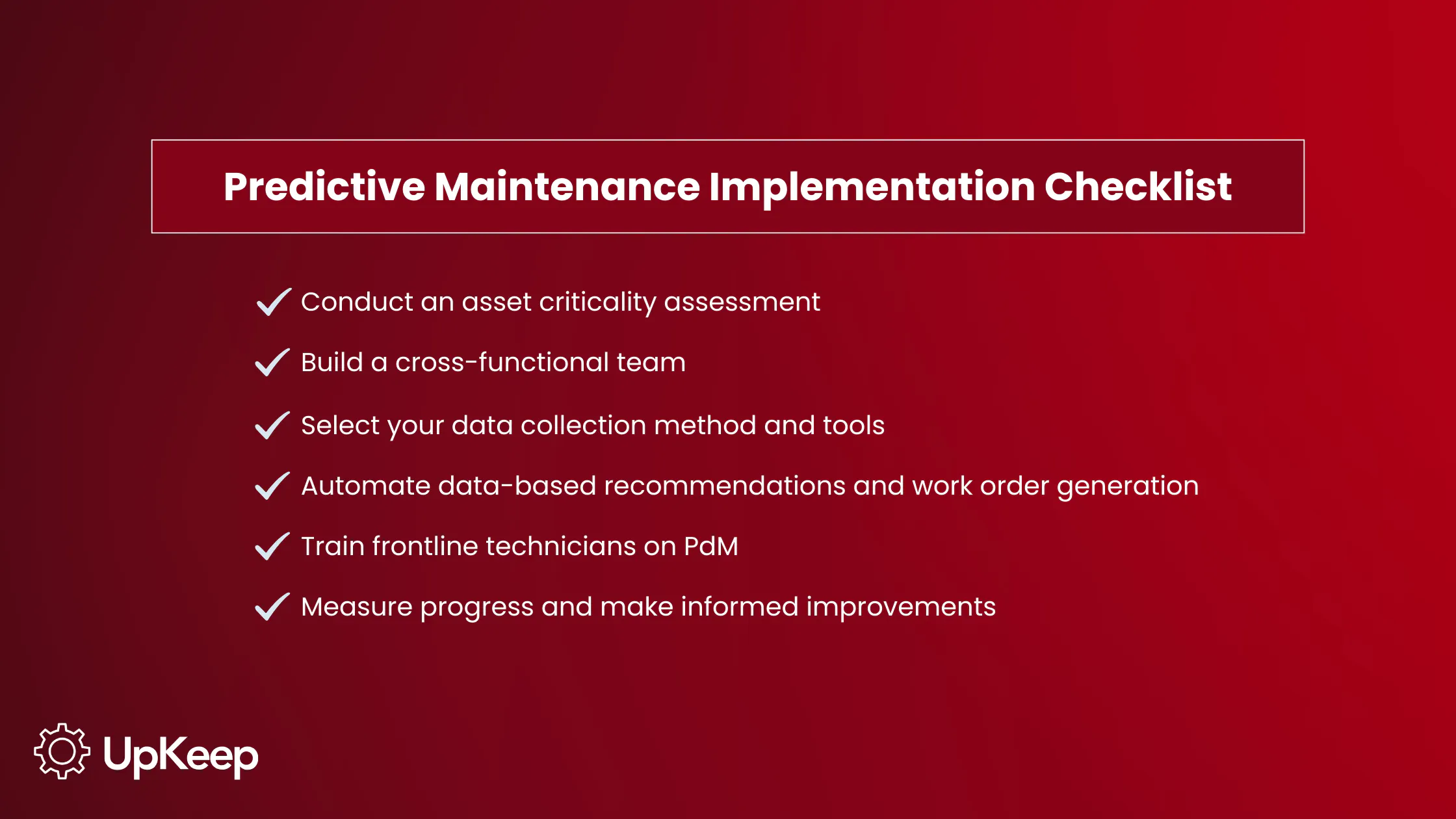
Predictive maintenance program implementation starts with an asset criticality assessment. Use your CMMS to identify which assets carry the highest operational, financial, or safety risk if they fail. Prioritize these first rather than attempting a facility-wide rollout at once. This assessment shapes everything that follows, including how you allocate budget, which assets are monitored first, and which PdM technologies make the most sense to adopt.
Trying to implement PdM across all assets simultaneously is a common mistake. Too broad of a start dilutes focus, strains resources, and makes it harder to demonstrate early wins that build organizational buy-in.
2. Build the Right Team
PdM works best when it isn’t siloed in the maintenance department. Pull in representatives from production, operations, and any other team that feels the impact when equipment goes down. When people across the organization understand the goals of the program, they become advocates rather than obstacles.
Designate a champion for the effort, ideally someone who understands both the technical side of asset maintenance and how different departments interact. Cross-functional ownership is what transforms PdM from a maintenance initiative into an organizational capability.
3. Choose Which Tools and Data to Use
Different PdM technologies and data collection methods are better suited to different failure modes: Vibration analysis excels at identifying issues in rotating equipment; ultrasonic analysis is particularly effective for locating the source of sound-based failure signals; and infrared analysis is effective for electrical concerns. In some cases, using two technologies on a single asset gives a more complete picture than either one alone.
Integrate all PdM data directly into your CMMS so work orders, asset history, maintenance schedules, and condition alerts all live in one connected platform. Disconnected systems create the data silos that predictive maintenance is designed to eliminate.
4. Automate Anomaly Detection and Work Order Generation
Collecting data without a plan to act on it creates alert fatigue. If thresholds aren’t well defined or teams aren’t empowered to respond quickly, condition monitoring data becomes noise rather than intelligence.
Use AI-powered tools to automate the analysis of condition data and return actionable recommendations. They can flag anomalies, generate work orders automatically, and help teams prioritize responses without requiring manual review of every data point, thus freeing technicians to focus on execution.
5. Train Your Frontline Technicians
Neglecting frontline technician training undermines even the most sophisticated monitoring infrastructure. If technicians don’t understand how to interpret sensor data or trust the system's alerts, the technological investment delivers little value.
Technicians need to be equipped to act confidently before a visible problem appears. This means training on not only the technology but also the underlying logic of condition-based maintenance so they can understand what the data means and why it matters.
6. Commit to Measurement and Continuous Improvement
The value of predictive maintenance compounds over time by comparing current readings against historical baselines. Set reading frequencies, hold the team to them, and build PdM KPIs into your standard reporting cadence. Key metrics to track include:
Mean time between failures (MTBF)
Mean time to repair (MTTR)
Planned maintenance percentage
Cost per asset
These metrics help gauge whether the strategy is delivering results and identify which assets need additional attention. Treat missed catches as learning opportunities and celebrate wins that demonstrate ROI, as both are essential for building organizational momentum.
Predictive Maintenance Dos and Don’ts
Implementation Area | Do | Don’t |
Rollout | Start with your highest-risk, highest-impact assets and build from there. | Try to implement PdM across all assets at once. |
Data management | Integrate PdM data directly into your CMMS for one interconnected source of truth for orders, asset history, and asset conditions. | Let data pile up without a clear plan for acting on it. Undefined thresholds turn condition monitoring into noise. |
Technology | Use AI-powered tools like UpKeep's Nova AI to automate anomaly detection, generate work orders, and help teams prioritize responses. | Treat PdM as purely a technology project. Without operational alignment across maintenance, operations, and leadership, adoption will fall short. |
People | Train frontline technicians to interpret sensor data and trust the system's alerts so they can act confidently before a visible problem appears. | Assume the tools will carry the program. If technicians don't understand or trust the data, the investment delivers little value. |
Data foundation | Build and maintain a clean, centralized asset register in your CMMS before layering on condition monitoring. | Underestimate how much PdM depends on accurate historical and real-time data. A weak foundation limits what monitoring can tell you. |
Measurement | Track MTBF, MTTR, planned maintenance percentage, and cost per asset to measure results and identify which assets need more attention. | Skip the KPIs. Without benchmarks, you can't demonstrate ROI or know where the strategy needs adjustment. |
Documentation | Log every PdM intervention in your CMMS, including what triggered the alert, what was found, and what action was taken. | Leave interventions undocumented. That history is what sharpens future predictions and satisfies compliance requirements. |
Thresholds | Revisit and refine alert thresholds regularly as your baseline data matures and your asset health picture becomes clearer. | Set and forget thresholds. Outdated thresholds create false positives that erode team trust in the system. |
What Does Predictive Maintenance Look Like? Practical Applications
PdM can adapt to the needs of each industry and asset type. Here’s how it looks across a range of environments:
Manufacturing: Vibration and thermal sensors on rotating equipment like motors, pumps, and conveyor systems detect early signs of bearing wear or misalignment. A CMMS receives the alert and generates a work order before the issue causes a production stoppage.
Facilities management: HVAC systems monitored for airflow, temperature variance, and energy consumption anomalies allow property teams to schedule filter changes, refrigerant checks, or component replacements during low-occupancy windows rather than after a system failure disrupts building operations.
Healthcare: Predictive maintenance on imaging equipment like MRI and CT machines helps hospital systems avoid the patient care disruptions and regulatory complications that come with unexpected diagnostic equipment downtime.
Fleet management: Telematics data from vehicles feeds into a CMMS to flag engine performance anomalies, brake wear patterns, and battery health deviations before they result in roadside failures or costly emergency repairs.
Utilities and energy: Predictive maintenance on grid infrastructure, transformers, and generation equipment helps operators prevent failures that carry both high financial cost and serious safety implications for technicians and the public.
From Reactive to Intelligent: The Path Forward
Predictive maintenance offers a fundamental shift in how your organization approaches assets, maintenance, and operational risk. The teams that gain the most from PdM treat it as a connected, data-driven strategy that unifies people, workflows, and systems on a single platform and uses every data point as an opportunity to make smarter decisions.
When maintenance data flows seamlessly from IoT sensors into a CMMS and from a CMMS into AI-powered analytics and automated work orders, the result is an operation with full visibility into asset health, the intelligence to act before failures happen, and the efficiency to do more with less.
Frequently Asked Questions
What is the difference between predictive and preventive maintenance?
Preventive maintenance runs on a fixed schedule where you service assets at regular intervals, regardless of their condition. Predictive maintenance uses real-time sensor data and condition monitoring to determine when service is needed. The result is more targeted maintenance that better catches defects before they become critical failures.
What types of assets benefit most from predictive maintenance?
PdM is best suited for high-criticality assets. These include equipment whose failure would stop production, create a safety hazard, or cause a compliance violation, namely, any assets where the cost of unexpected failure significantly outweighs the investment in monitoring. Lower-criticality assets can typically remain on a preventive schedule.
How much does it cost to implement a predictive maintenance program?
Spend varies depending on the number of assets and the technology stack required. At minimum, a PdM program needs sensors, IoT devices, and a CMMS, in addition to a dedicated team member for management. Organizations that already track maintenance KPIs and run a CMMS have a significant head start thanks to the solid foundation they’ve laid.
How long does it take to see results from predictive maintenance?
Most organizations begin to see measurable results within the first few months of deploying PdM. The most noticeable improvements are reduced unplanned downtime and fewer emergency work orders. Longer-term benefits like extended asset lifespan compound over time as the program aggregates more condition data and improves. Measuring from day one is the surest way to demonstrate ROI.
4,000+ COMPANIES RELY ON ASSET OPERATIONS MANAGEMENT
Leading the Way to a Better Future for Maintenance and Reliability
Your asset and equipment data doesn't belong in a silo. UpKeep makes it simple to see where everything stands, all in one place. That means less guesswork and more time to focus on what matters.






![[Review Badge] Gartner Peer Insights (Dark)](https://www.datocms-assets.com/38028/1673900494-gartner-logo-dark.png?auto=compress&fm=webp&w=336)