Blog Post
How Sensor Technology is Redefining Reliability
When it comes to asset operations management, the reliability of your most critical equipment plays a major role in minimizing downtime and maximizing production. The concept of reliability centered maintenance (RCM) has been around for years, evolving as technology has allowed industries to more effectively measure and control key metrics.


How Sensor Technology is Redefining Reliability
When it comes to asset operations management, the reliability of your most critical equipment plays a major role in minimizing downtime and maximizing production. The concept of reliability centered maintenance (RCM) has been around for years, evolving as technology has allowed industries to more effectively measure and control key metrics. Predictive maintenance sensor technology is now pushing reliability to the next level, allowing real-time monitoring of critical assets and more timely maintenance responses.
RCM’s Place Within Maintenance
It’s important to understand that RCM should be selectively used as part of an overall maintenance strategy. While some low-risk, low-cost assets are best maintained by allowing them to run-to-failure and other equipment may benefit from time- or usage-based preventive maintenance, RCM is ideal for your most critical assets.
By focusing on improving the reliability of those assets that are most important to keeping your production lines running, you will minimize unplanned equipment failures and unexpected downtime.
Sensor Technology Complements Reliability
Predictive maintenance sensors that can provide around-the-clock, real-time monitoring of things like temperature, vibration, water levels, and humidity go a long way in helping businesses improve reliability.
Critical equipment often shows signs of wear-and-tear or impending problems through performance anomalies. In the past, companies depended on periodic inspections of equipment to improve performance. Unfortunately, human error or poor timing often resulted in missed opportunities, leading to costly downtime and repairs.
The Impact of Sensor Technology on Reliability Metrics
Manufacturers in various industries use standard metrics to measure their performance when it comes to reliability. As sensor technology becomes more commonplace, it will raise the bar on these metrics, making it possible to reach higher levels than ever before.
Mean Time Between Failures (MTBF)
This is the average time interval between failures of a system or component; the higher the MTBF, the greater the reliability of an asset. Since sensor technology can monitor key performance attributes such as temperature or vibration, it can often trigger an alert when something falls out of a normal range. When this data is integrated into your overall maintenance system, it can alert your team to further explore these anomalies before an actual failure occurs. As a result, the MTBF will increase as well as overall asset reliability.
Mean Time to Repair (MTTR)
MTTR is the average time required to repair a failed system or component and restore it to normal operation. It measures the efficiency of maintenance activities and reflects how quickly failures can be addressed. Sensors can help direct your maintenance team to specific systems or components that may be showing signs of problems, minimizing or even eliminating the time it takes to locate the root cause. This, in turn, should shorten your MTTR, reduce downtime, and increase maintenance efficiency.
Availability
Availability is the percentage of time that a system or equipment is operational and available for use. It considers both scheduled and unscheduled downtime. Because sensors can often pinpoint areas that are not working as they should as soon as parameters fall out of a predetermined normal range, maintenance teams can minimize the time it takes to identify issues. This increases availability, which indicates a more reliable system that is consistently accessible to production line operators.
Failure Rate
The failure rate represents the rate at which failures occur within a given time period. By measuring this metric, you can better understand the reliability of individual components or systems as well as their failure patterns. Sensors can help you gather similar data without actual failure of critical assets. If anomalies are tracked in an asset operations management system, you can identify patterns before failure occurs. This will not only lower your failure rate but also increase reliability overall.
RCM Metrics
Other RCM metrics can be used to assess the effectiveness of maintenance strategies in optimizing reliability. For example, these metrics may include looking at the percentage of proactive maintenance tasks, adherence to maintenance schedules, or the ratio of preventive to corrective maintenance activities. Sensor technology supports proactive maintenance activities, helping teams to schedule the highest priority tasks first. It will improve the ratio of preventive to corrective tasks as potential problems can be identified before emergency action is required.
Overall Equipment Effectiveness (OEE)
OEE is a comprehensive metric that evaluates the overall performance, availability, and quality of equipment. It considers factors such as equipment uptime, production efficiency, and product quality. As sensors that measure temperature, vibration, water levels or humidity trigger alerts when unacceptable readings are recorded, they can increase OEE over time. Not only are eminent failures potentially avoided, but the lifecycle of critical assets can be extended with this more holistic perspective of equipment reliability and efficiency.
Failure Modes and Effects Analysis (FMEA)
FMEA is a systematic approach that identifies and prioritizes potential failure modes and their potential effects on system performance. It helps in understanding the criticality of failure modes and guides reliability improvement efforts. Sensors can support FMEA as they help direct your maintenance team to root causes of failure. This, in turn, can help quickly identify failure modes and allow you to take immediate remediation action.
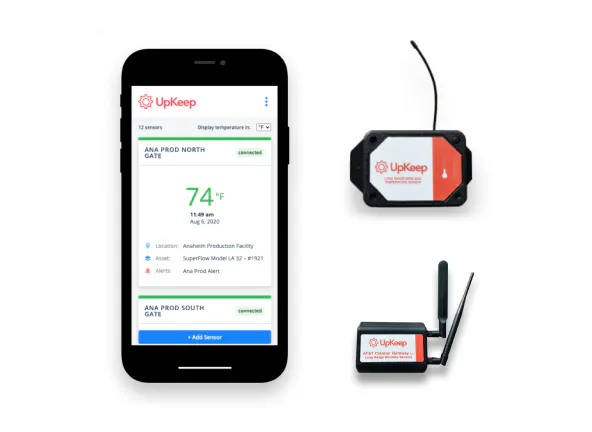
It’s easy to see that a paradigm shift is underway as predictive maintenance sensors emerge in a wide variety of industries. Their ability to constantly watch key indicators on critical assets promises to revolutionize reliability standards and overall performance of these assets. To learn more about UpKeep Edge, our solution to monitoring your assets in real-time, reach out today.
Want to keep reading?


Article
Q&A: Learn More About UpKeep Edge


Article
Preventive Maintenance and RCM Explained


Article
S2:E26 Maintenance and Reliability Optimization with Nathan Kelley
4,000+ COMPANIES RELY ON ASSET OPERATIONS MANAGEMENT
Leading the Way to a Better Future for Maintenance and Reliability
Your asset and equipment data doesn't belong in a silo. UpKeep makes it simple to see where everything stands, all in one place. That means less guesswork and more time to focus on what matters.






![[Review Badge] Gartner Peer Insights (Dark)](https://www.datocms-assets.com/38028/1673900494-gartner-logo-dark.png?auto=compress&fm=webp&w=336)