Blog Post
Q&A: Learn More About UpKeep Edge
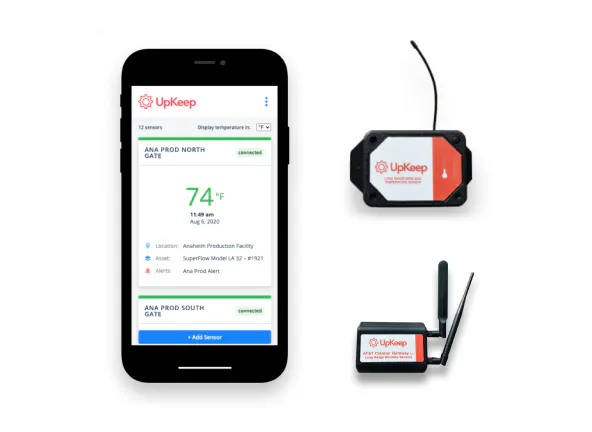
Many UpKeep customers have experienced the power of UpKeep Edge, a system that leverages secure wireless internet of things (IoT) sensors and cellular gateways to deliver real-time data about assets and operating environments. As our team has talked with customers about this technology, many questions have come up in these conversations. We’ve summarized some of the most common inquiries, tapping our product team to share answers with you.


Q&A: Learn More About UpKeep Edge
For the past several years, many UpKeep customers have experienced the power of UpKeep Edge, a system that leverages secure wireless internet of things (IoT) sensors and cellular gateways to deliver real-time data about assets and operating environments. As our team has talked with customers about this technology, many questions have come up in these conversations. We’ve summarized some of the most common inquiries, tapping our product team to share answers with you.
Q: What is UpKeep Edge?
A: UpKeep Edge is a system of action that combines continuous, real-time data acquisition from assets with data visualization, analytics and condition-based alerts to help maintenance, operations and reliability teams advance and optimize asset operations.
Q: How does Edge work?
A: Edge leverages secure wireless IoT sensors and cellular gateways to deliver real-time data about assets and their operating environments to help teams scale their ability to monitor the operating performance of critical equipment and/or facilities.
Q: What are the components of Edge?
A: Edge comes with a 4G LTE cellular gateway that transmits WiFi sensor readings to UpKeep. Four sensors are available and can monitor temperature, humidity, water, and single phase current. Finally, you will have access to the Edge dashboard, allowing you access to all data in one location.
Q: What is involved in setting up Edge?
A: It’s very easy. The wireless sensors are ready to use out of the box and simply require batteries. The sensor sends data through a gateway, which we provide, that can be connected to your cellular network. Encrypted data is then sent to the UpKeep cloud.
Q: Do you need to be a current UpKeep customer to use Edge?
A: Yes, you need to have UpKeep before using Edge sensors.
Q: What are the limits of UpKeep Edge sensors?
A: Each sensor needs to be within 300 feet of the gateway, and each gateway can run 100 sensors.
Q: Does anything interfere with sensor data transmission?
A: As long as radio frequencies can be transmitted, Edge sensors should function properly. In some cases, walls made of thick metal or cinder blocks may block transmission, but this can often be overcome by elevating the gateway.
Q: How do you manage secure data transmission?
A: Data is encrypted end-to-end, from gateway transmission to the cloud, adhering to leading industry encryption standards.
Q: What can I do with Edge?
A: With Edge, you can remotely monitor vital facilities and assets in real time from anywhere, automatically record readings for maintenance and inspection purposes, visualize asset and facility data in user-friendly dashboards, and get alerts when conditions for assets or facilities vary from acceptable baselines.
Q: What value does Edge provide to me?
A: As an affordable and user-friendly solution built into the UpKeep platform, Edge helps you scale your team without adding headcount, centralize asset data and maintenance management in a single system and capture and analyze data to create or optimize condition-based maintenance programs. It also provides early-warning detection to reduce costly failures or breakdowns and helps you affordably build the foundation for preventive and predictive maintenance.
Q: What are the benefits of using Edge?
A: Edge helps you reduce human error by reducing reliance on human techs to capture data as well as response times when anomalies or failures are detected. It can also support condition-based monitoring to decrease costly breakdowns and failures, detect failures much earlier, and provide the data to fuel preventive and predictive maintenance.
Q: What use cases are Edge best suited for?
A: Edge is best suited for monitoring and measuring vital assets and equipment to make sure they are operating effectively as well as for ensuring that facilities and their contents are protected.
Q: What kind of analytics are available?
A: The Edge dashboard allows you to visualize asset and facility data to spot trends, extract insights and drive actionable improvements to maintenance and asset management practices.
Q: How can data be used?
A: UpKeep tracks data through Edge, allowing easy reporting and analytics that can be used to meet various regulatory and compliance requirements.
Q: How do temperature sensors work?
A: We offer three types of temperature sensors: regular, high temperature, and low temperature. Sensors measure ambient temperature, the temperature of a substance, or harsher environments using optional probes. Readings are taken often as every 10 minutes and can be set to provide real-time alerts if temperatures fall out of a specified range.
Q: What applications are best for temperature sensors?
A: Some applications for temperature sensors include monitoring freezer and refrigerator temperatures, tracking ambient temperature in controlled environments like greenhouses or server rooms, or ensuring that manufacturing equipment remain at recommended operating temperatures. Some industries that may benefit from temperature sensors include restaurants, residential facilities, server or data centers, food manufacturers, and pharmaceutical facilities.
Q: How do electric current sensors work?
A: UpKeep Edge electric current sensor measures current between zero and 150 amps and operates by clipping a clamp around a single wire of an AC system. These sensors can transmit readings as often as every 10 minutes and report amp hours as well as maximum, minimum and average RMS current. Alerts can be sent as needed. By monitoring power consumption of critical assets in real time, you can effectively gather insight on machine health or system performance, verify if an asset is running, and manage power consumption to reduce operating expenses.
Q: What applications are best for electric current sensors?
A: Applications may include protecting critical infrastructure or technology from power surges, monitoring power draw of critical equipment, tracking power consumption within facilities to manage costs, or watching the power draw of manufacturing equipment to detect potential failures. Electric current sensors are useful in restaurants, pharmaceutical, commercial buildings, and manufacturing industries.
Q: How do water sensors work?
A: When it comes to water leaks, quick response is critical. Every second could lead to expensive and irrevocable damage to facilities, assets and even inventory. Real-time, remote water detection helps detect the presence of water immediately to ensure a timely resolution to an otherwise costly outcome. When the sensor's lead comes into contact with water, an internal circuit is completed, triggering an alert that is immediately transmitted to UpKeep.
Q: What applications are best for water sensors?
A: Water sensors can be extremely valuable in data or server rooms, storage facilities, freezers or refrigerators, and near expensive equipment that uses electricity. Consider using water sensors around plumbing systems or equipment related to water storage, treatment or heating as well. Some industries that can benefit most from water sensors include warehouses, medical and pharmaceutical facilities, laboratories, and museums and libraries.
Q: How do humidity sensors work?
A: Maintaining relative humidity properly can mean the difference between preservation of facilities, assets or inventory and irreversible loss. Wireless humidity sensors help you remotely monitor the conditions around mission-critical systems, sensitive inventory and assets so you can act quickly if conditions change. Sensors measure RH, temperature, dew point, moisture weight and heat index, transmitting readings as often as every 10 minutes. Alerts can be set as needed.
Q: What applications are best for humidity sensors?
A: UpKeep Edge humidity sensors can protect critical infrastructure, monitor humidity for things like concrete setting in construction, prevent mold growth within healthcare facilities, and help ensure quality in food manufacturing. Some industries that can benefit from humidity sensors include agriculture, data center and server rooms, healthcare facilities, and art galleries.
Q: How do I learn more?
A: Reach out to UpKeep today to schedule a demo of Edge. Our team would love to learn more about your business and help you discover ways to use this real-time data acquisition tool to help you better visualize your data, analyze equipment performance, and set up condition-based alerts to help you optimize your asset operations.
Want to keep reading?



Article
UpKeep Edge | Accelerate Maturity, Improve Decision Making


Article
UpKeep Edge is powered by Microsoft Azure



Article
Sensors for Cold Storage Management in Manufacturing
4,000+ COMPANIES RELY ON ASSET OPERATIONS MANAGEMENT
Leading the Way to a Better Future for Maintenance and Reliability
Your asset and equipment data doesn't belong in a silo. UpKeep makes it simple to see where everything stands, all in one place. That means less guesswork and more time to focus on what matters.






![[Review Badge] Gartner Peer Insights (Dark)](https://www.datocms-assets.com/38028/1673900494-gartner-logo-dark.png?auto=compress&fm=webp&w=336)