Blog Post
A Complete Breakdown of a Fleet Preventive Maintenance Program
Implement a fleet preventive maintenance (PM) program to reduce unplanned downtime, control maintenance costs, and extend vehicle lifespan using scheduled service and CMMS technology.



Key Takeaways
Adopting a preventive maintenance approach to service vehicles on a set schedule based on usage, time, or condition allows fleet teams to detect issues early and prevent costly failures.
Consistent inspection checklists, work orders, and maintenance records create a reliable system for tracking asset health and performance over time for a successful maintenance program.
Technology like a CMMS centralizes asset data, automates maintenance scheduling, and provides the insights needed to improve reliability and make smarter operational decisions.
A fleet preventive maintenance (PM) program is one of the most effective ways to reduce downtime, control maintenance costs, and extend the lifespan of critical vehicles. Instead of reacting to breakdowns after they disrupt operations, organizations use set maintenance schedules to proactively service assets before failures occur.
With the right processes, data, and tools in place, fleet managers can shift maintenance from emergency response into a forward-thinking system that improves reliability, safety, and operational efficiency across the entire fleet.
What Is a Preventive Maintenance Program?
A preventive maintenance program is a structured approach to servicing vehicles and equipment on a scheduled basis before failures occur. Rather than waiting for something to break, PM programs establish service intervals for each asset in advance based on manufacturer recommendations, operational demands, and how critical it is to daily operations.
The goals of a PM program are to extend asset life, reduce unplanned downtime, control maintenance costs, and keep vehicles compliant with safety and compliance standards.
PM programs sit between two other maintenance approaches: Reactive maintenance addresses failures after they happen, which is the most costly and disruptive approach over time; predictive maintenance, on the other hand, uses real-time condition data to trigger service only when equipment shows signs of impending failure, which requires more sophisticated technology. Preventive maintenance occupies the practical middle ground as a proactive, scheduled, and systematic method that doesn’t need sensor infrastructure across every asset.


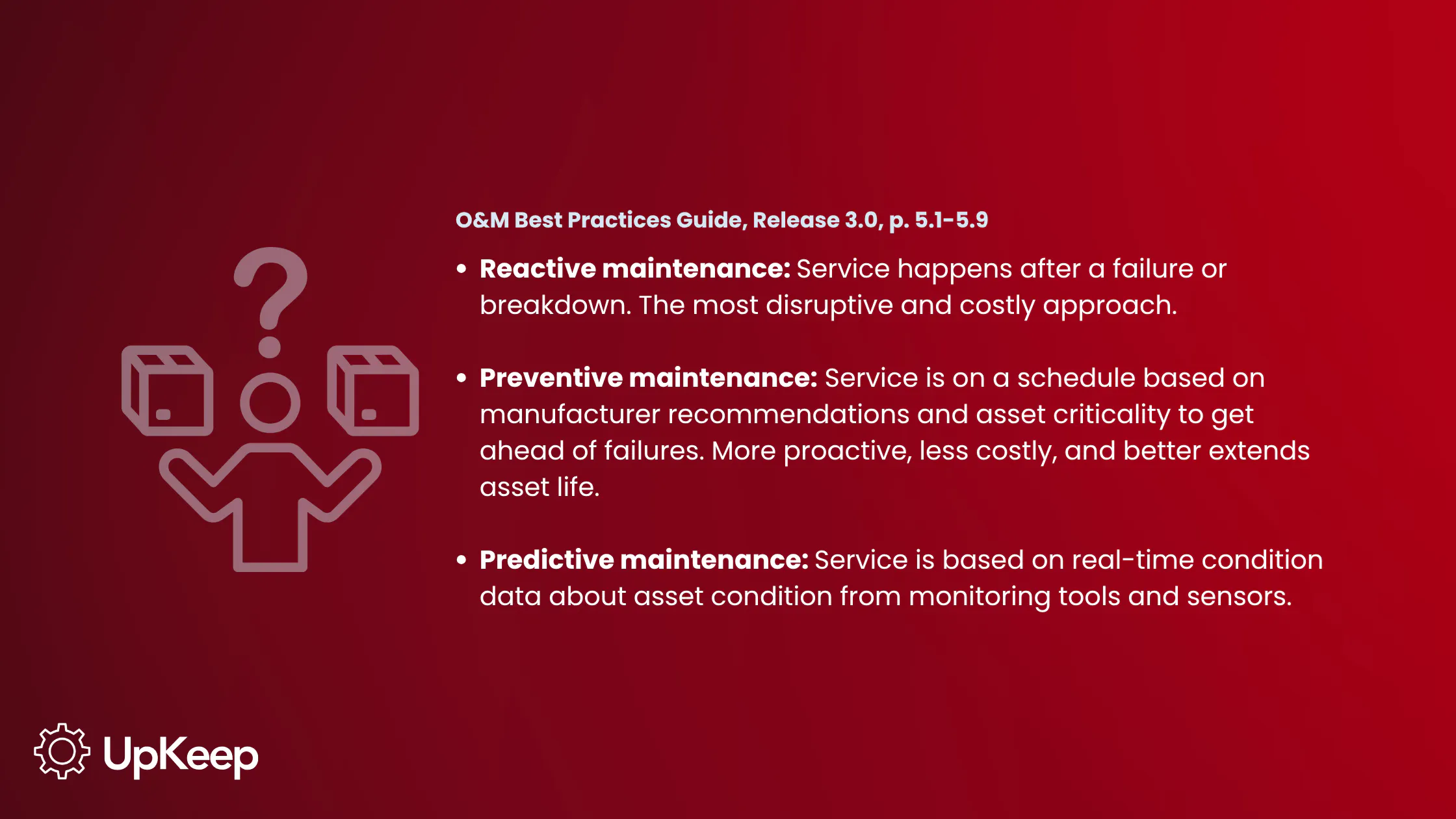
The Range of Maintenance Program Maturity
Reactive maintenance: Service happens after a failure or breakdown. The most disruptive and costly approach.
Preventive maintenance: Service is on a schedule based on manufacturer recommendations and asset criticality to get ahead of failures. More proactive, less costly, and better extends asset life.
Predictive maintenance: Service is based on real-time condition data about asset condition from monitoring tools and sensors.
How PM Impacts Fleet Management
For fleet operations specifically, a PM program covers every vehicle and piece of mobile equipment, assigning each a schedule depending on how it’s used and its criticality to operations.
The benefits of adopting this approach include:
Reduce unplanned downtime: When a vehicle fails unexpectedly, it disrupts routes, delays deliveries, and often triggers costly emergency repairs. A consistent PM schedule catches problems before they become so bad that they force a vehicle out of service at an inopportune time.
Extend vehicle lifespan: Regular fluid changes, brake inspections, tire rotations, and belt replacements prevent the accelerated wear that leads to premature asset retirement.
Improve safety and compliance: Proper maintenance also helps fleets stay compliant with emissions and environmental standards. Fleet vehicles operating under Department of Transportation (DOT) and FMCSA requirements need documented maintenance records to demonstrate regulatory compliance, which a PM program creates systematically.
Control maintenance costs: Scheduled service is consistently less expensive than emergency repairs. Predictable parts consumption also makes inventory planning easier and prevents costly last-minute replacement.
Better data for decision-making: A well-run PM program generates consistent maintenance data that reveals cost-per-mile trends, recurring failure patterns, and which assets are approaching their end of life. These records give fleet managers the full picture to make confident investment and planning decisions.
Components of a Fleet PM Program
A functional fleet PM program is built from several interdependent components. Gaps in any one area create downstream problems in the others:
Asset inventory and vehicle profiles
A complete, accurate record of every vehicle in the fleet sets the foundation for scheduling and cost tracking. This includes:
Make
Model
Year
Mileage
Usage type
Assigned operator
Without reliable asset data, teams can’t build accurate maintenance schedules or measure the program’s performance over time.
Customize maintenance schedules by asset type
Different vehicles have different service requirements and maintenance schedules, from light-duty vehicles to heavy-duty trucks and trailers. A single interval applied across a mixed fleet will underservice some assets and overservice others.
Standardized inspection checklists
Pre-trip and post-trip inspection forms, along with service checklists for each PM interval, ensure technicians stay on top of every task and document consistently. Standardization makes inspection data comparable across technicians, shifts, and locations.
Work order management
Every PM task should generate a work order that captures labor hours, parts used, and technician findings. That work order becomes part of the asset's permanent maintenance history and the primary source for cost reporting. A computerized maintenance management system (CMMS) automates this process, eliminates manual record-keeping, and keeps maintenance history in a single searchable location.
Parts and inventory management
A PM program runs on predictable parts consumption. Maintaining appropriate stock levels for filters, fluids, belts, and brake components prevents service delays and eliminates the cost and disruption of emergency procurement.
Reporting and KPI tracking
Fleet availability rate, cost per mile, PM compliance rate, and mean time between failures (MTBF) can tell you whether the program is working. Tracking metrics consistently turns maintenance data into strategic intelligence.
Fleet Preventive Maintenance Schedules by Type
Not all PM schedules are structured the same way. The right approach depends on the asset, how it’s used, and what failure modes you’re trying to prevent:
Time-based schedules perform service at fixed calendar intervals (monthly, quarterly, or annually), regardless of the vehicle’s usage. This works well for assets that degrade with time even when idle, such as seals, batteries, and fluids, and for vehicles with consistent wear patterns.
Usage-based schedules trigger service when a vehicle reaches a defined threshold, such as miles driven, engine hours, fuel consumed, or number of trips. This is the most common approach for fleet vehicles because it ties service directly to wear rather than somewhat arbitrarily fixed dates.
Condition-based schedules initiate maintenance when a monitoring system detects a parameter outside its normal range using tools like brake wear indicators, tire pressure sensors, and oil temperature thresholds. This approach requires sensor infrastructure but provides the most accurate signal of when service is needed.
Hybrid schedules combine all three, and OEM maintenance guides commonly recommend this approach. For example, an oil change is set based on a threshold of miles driven or after a certain amount of months, whichever comes first, with condition-based alerts layered on top for critical systems. This is how many well-run fleet PM programs work in practice.
Seasonal and compliance-driven schedules address tasks tied to specific times of year or regulatory requirements like annual DOT inspections and brake certifications. These belong in the schedule as fixed events, tracked separately from standard service intervals.
How to Set up a Fleet Preventive Maintenance Program
Building a PM program from scratch can feel like a significant undertaking. Breaking it into sequential steps makes the process manageable and ensures nothing foundational is skipped.
Step 1: Audit your current fleet
Inventory every vehicle and piece of mobile equipment. Document current condition, mileage, last service date, and existing maintenance history. Assets with no maintenance records represent the highest immediate risk and should be inspected first.
Step 2: Define asset criticality
Not every vehicle in a fleet carries equal operational weight. Rank assets by the impact their loss would have on operations. High-criticality vehicles — those whose failure would halt routes, stop production, or create safety risks — receive tighter service intervals and priority scheduling.
Step 3: Build maintenance schedules
OEM-recommended service intervals are the starting point, then you adjust based on actual operating conditions. Heavy-duty use, extreme temperatures, dusty environments, and high-mileage routes all warrant shorter intervals than the manufacturer's baseline.
Step 4: Standardize checklists and work order templates
Develop task-level checklists for each PM type, covering brakes, lights, fluids, tires, mirrors and glass, and safety equipment. Build work order templates that capture the labor, parts, and findings data needed for cost reporting and compliance documentation. Consistency in documentation is what makes reporting reliable and audits straightforward.
Step 5: Assign ownership and implement a CMMS
Designate clear responsibility for scheduling, approving, and closing out PM work orders. Many teams implement a CMMS to automate recurring work orders, track completion rates, manage parts inventory, and centralize maintenance records across the fleet. This removes the manual coordination burden from the team and ensures nothing slips through administrative gaps.
Step 6: Set KPIs and review the program regularly
Define the metrics you’ll use to evaluate program performance, like PM compliance rate, fleet availability, and cost per mile. Then, establish a regular cadence for reviewing them. Regular monitoring allows teams to improve the program over time as the fleet and operating conditions change.
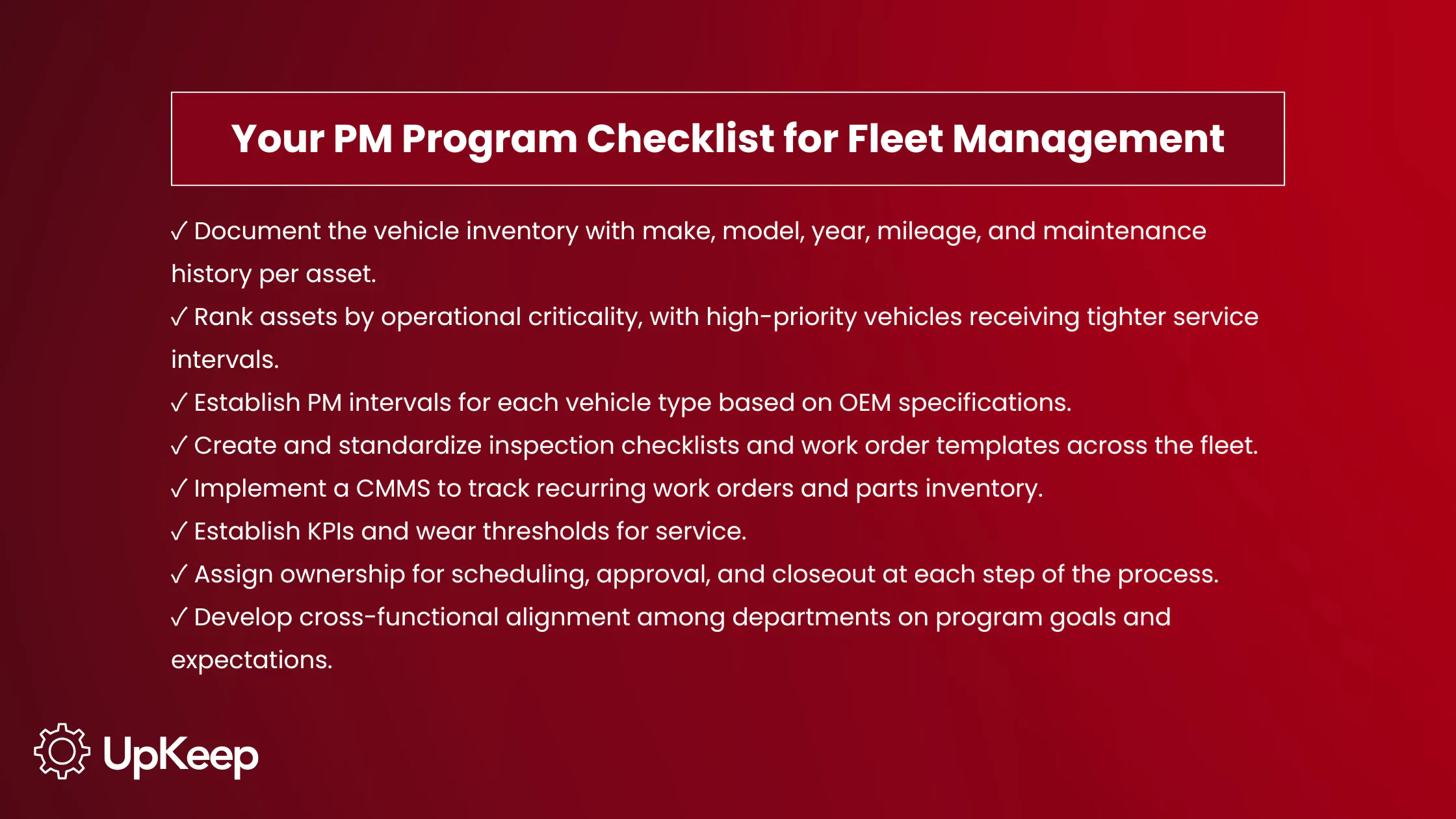
Your PM Program Checklist for Fleet Management

A well-designed fleet preventive maintenance program creates the operational foundation for safer, more efficient asset management. Combining structured maintenance schedules, standardized workflows, and centralized data lets organizations gain the oversight to reduce downtime, improve reliability, and make informed decisions about their fleet.
As fleets grow more complex and data-driven, preventive maintenance programs supported by modern maintenance management platforms enable teams to operate proactively, collaborate more effectively, and keep critical assets performing at their best.
Frequently Asked Questions
How is a fleet PM program different from a reactive maintenance strategy?
Reactive maintenance addresses failures after they occur. A fleet PM program schedules service in advance based on time, usage, or condition thresholds, catching developing problems before they result in unplanned downtime or costly emergency repairs.
What is the difference between preventive and predictive maintenance for fleets?
Preventive maintenance follows predetermined schedules based on time or usage. Predictive maintenance uses real-time sensor data and analytics to trigger service only when condition monitoring detects an impending failure. PM is more accessible and requires less infrastructure; predictive maintenance offers more precision but demands greater technological investment.
How do you build a preventive maintenance schedule for a mixed fleet?
Start with OEM-recommended intervals for each vehicle category, then adjust based on how each asset is used. Group vehicles by type and criticality, assign appropriate schedule types (time-based, usage-based, or hybrid), and build the schedule into a CMMS so it runs automatically rather than relying on manual tracking.
What software do fleet managers use to manage preventive maintenance?
Most fleet managers use a CMMS or dedicated fleet management software. A CMMS automates work order creation, tracks PM completion, manages parts inventory, and centralizes asset history, replacing spreadsheets and paper logs with a single system of record.
What is the best way to track fleet preventive maintenance?
The most reliable approach is a CMMS that generates work orders automatically at scheduled intervals, tracks completion in real time, and captures labor, parts, and technician findings in each asset's maintenance record. Pairing that system with regular KPI reviews gives fleet managers both the operational data and the strategic visibility to keep the program improving.
4,000+ COMPANIES RELY ON ASSET OPERATIONS MANAGEMENT
Leading the Way to a Better Future for Maintenance and Reliability
Your asset and equipment data doesn't belong in a silo. UpKeep makes it simple to see where everything stands, all in one place. That means less guesswork and more time to focus on what matters.






![[Review Badge] Gartner Peer Insights (Dark)](https://www.datocms-assets.com/38028/1673900494-gartner-logo-dark.png?auto=compress&fm=webp&w=336)