Blog Post
Corrective Action Management: Essential Strategies and Insights
Turn problems into prevention with this guide on corrective action plans, root cause analysis, and best practices for operational resilience.



Key Takeaways
Corrective action is a structured, documented process for eliminating the root cause of a confirmed problem.
An effective corrective action plan requires a clear problem statement, a formal root cause analysis, named owners with deadlines, and verified closure. Otherwise, incidents will repeat.
The most resilient organizations integrate both corrective and preventive action, using insights from resolved failures to update maintenance schedules, inspection protocols, and risk assessments to use past problems to prevent future ones.
Every organization encounters problems, from equipment failures to compliance gaps and performance falling short of expectations. What prevents these problems from becoming patterns is a disciplined process for identifying what went wrong, fixing the underlying cause, and confirming the fix actually held.
That process is corrective action. At its core, corrective action management is how organizations convert problems into learning operational strength. When done well, it protects against regulatory risk, reduces the cost of failure, and builds the kind of institutional knowledge that compounds over time. Without it, organizations are exposed to the same incidents, audit findings, and preventable costs year after year.
This guide covers what corrective action is, how to build an effective corrective action plan, and how leading organizations are using technology to make the entire process faster, more accountable, and more effective.
What Is Corrective Action? Definitions and Importance
Corrective action is a structured, documented response to an identified problem, nonconformance, or violation. It’s a formal process designed to eliminate the root cause of an issue so it doesn't happen again.
To understand how this works in practice, consider the difference between changing a blown fuse (a quick fix) versus investigating why electrical overloads keep occurring and redesigning the circuit load (corrective action). The former solves the immediate symptom. The latter solves the problem.
The purpose of corrective action extends well beyond damage control. Regulatory frameworks, quality standards like ISO 9001, and compliance auditors routinely require organizations to maintain a formal corrective action process. In industries like manufacturing, healthcare, and utilities, the inability to demonstrate corrective action history can result in failed audits, fines, or operational shutdowns.
The cost of inaction compounds quickly. A single unresolved equipment failure can turn into a pattern, which then becomes a safety incident. In 2024 alone, the total cost of work injuries in the U.S. was $181.4 billion. And a safety incident is a liability, which can impact the quality of your product. In fact, quality-related costs can take up 15% to 20% of a company’s annual sales revenue. That means organizations that treat corrective action management as a data-driven process consistently gain a strategic advantage.
Key Components of an Effective Corrective Action Plan
An effective corrective action plan (CAP) is a structured document with several non-negotiable components:
A clear problem statement documents what occurred, when, where, and who was involved. It’s important to be specific here, because vague problem statements lead to unclear or incomplete solutions.
Root cause identification is the analytical core of the plan. This requires distinguishing between the proximate causes that revealed the issue and the systemic causes that allowed the problem to occur in the first place. A root cause analysis (RCA) helps get at the underlying issue. In one documented case, a team that conducted root cause failure analysis and implemented a more proactive maintenance strategy cut equipment failures by 45%.
Defined action items with assigned owners, deadlines, and success metrics ensure the plan can be executed. If an action item doesn't have a named owner and a due date, it effectively has no one taking action and no deadline.
A stakeholder communication plan reduces siloes and friction. It aligns everyone, from frontline technicians who execute the fix to managers tracking accountability and leadership monitoring outcomes.
Documentation and an audit trail make the plan traceable and defensible. During regulatory inspections or internal reviews, the ability to show what was done, by whom, and when can be as important as the fix itself. Research shows the average cost of noncompliance is almost three times more than the investment a company spends on compliance programs.
Implementing Corrective Action: A Step-by-Step Process
Step 1: Identify Issues and Determine Necessity
Not every problem warrants a formal CAP. Corrective action guidelines generally distinguish between issues that require informal coaching or a simple fix and those that require a documented, structured response.
Common triggers for formal corrective action include safety incidents, recurring equipment failures, compliance violations, quality escapes, and employee performance concerns that haven’t responded to informal intervention. The threshold is usually whether the issue is isolated or systemic, and whether it carries regulatory, safety, or operational risk.
When a triggering event does occur, document it promptly and objectively before any memory or context is lost. Digital tools that capture and categorize issues at the point of occurrence with timestamps, photos, and incident descriptions significantly improve the quality of the information available for analysis. For example, UpKeep's AI-native safety incident management tool captures and categorizes issues at the point of occurrence.
Step 2: Conduct a Root Cause Analysis for Targeted Solutions
Root cause analysis (RCA) is where corrective action either succeeds or fails. Skipping or rushing through this step is the most common reason corrective actions fail to prevent recurrence.
Three widely used RCA methodologies include:
5 Whys: Iteratively asking "why" until the underlying systemic cause is surfaced. Best for straightforward problems with a clear causal chain.
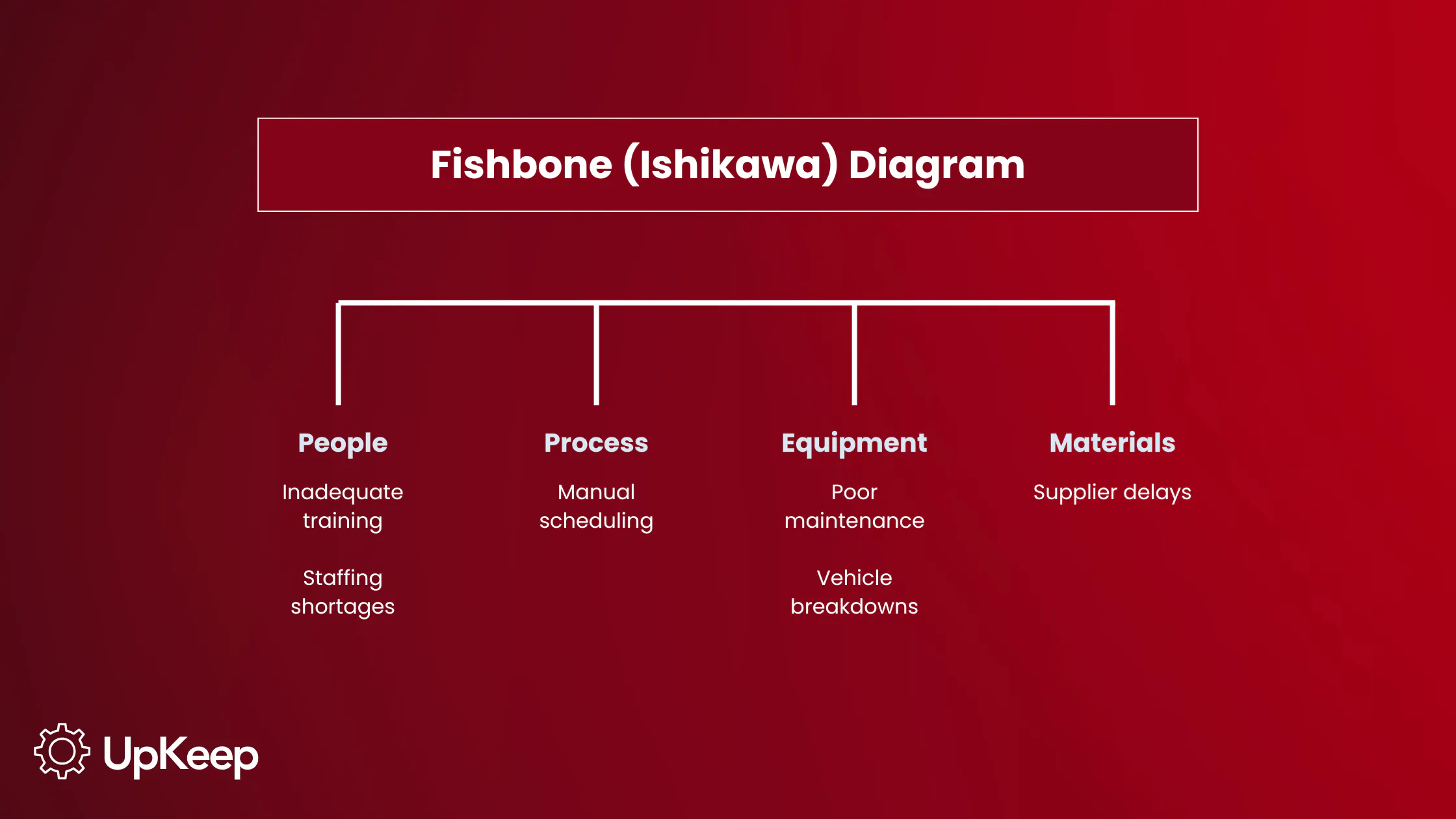
Fishbone (Ishikawa) Diagram: A visual tool that maps potential causes across categories such as people, process, equipment, materials, and environment. Useful for complex problems with multiple contributing factors.
Fault Tree Analysis: A top-down, logic-based approach that maps the relationships between failures and their causes. Common in safety-critical industries.


The goal of each method is the same: Move past what happened and identify why it occurred at a systemic level. AI-driven diagnostic analytics can accelerate this process by uncovering patterns across historical work orders and incidents that would be difficult to identify manually.
Step 3: Develop and Communicate the Corrective Action Plan
As stated earlier, an actionable and auditable CAP includes a problem description, identified root cause, specific corrective actions, responsible parties, implementation timeline, and measurable key performance indicators (KPIs).
Be realistic with your timelines to set your team up for success. Overly aggressive deadlines result in superficial fixes that don't last. Timelines that stretch too long, meanwhile, lose momentum and organizational attention. The right timeline reflects the actual complexity of the required fix.
Tailor your communication of the plan by audience: Frontline technicians need task-level clarity about what exactly they're doing, by when, and with what resources. Managers need accountability checkpoints and visibility into blockers. Leadership needs outcome-level visibility (i.e., “Is this working?” and, “How do we know?”).
A unified platform like a CMMS ensures the plan lives in one accessible location rather than buried in email threads, spreadsheets, and disconnected systems. This is especially important for multi-site operations where the same corrective action may touch teams in different locations.
Step 4: Monitor Progress and Measure Effectiveness
To ensure your plan follows through to completion, build in formal review checkpoints.
KPIs that indicate a corrective action is working include: recurrence rate of the original issue, time to resolution, compliance audit results, and relevant safety metrics. Define these before implementation (see Step 3).
Closing a corrective action plan requires verified resolution. That means confirming that you’ve addressed the root cause, updated relevant documentation and procedures, and formally recorded the closure.
Common Pitfalls in Corrective Action Plans and How to Avoid Them
|
Problem |
Solution |
|
Treating symptoms vs. root causes |
Always conduct a formal RCA before defining corrective actions |
|
Vague ownership |
Assign a named owner with a specific deadline to each action item, reinforcing accountability |
|
Failing to close the loop |
Require verified resolution of the problem and formal closure documentation |
|
Poor documentation |
Use a centralized platform that creates an automatic audit trail, like a CMMS |
|
Siloed execution |
Ensure cross-functional visibility to capture patterns across departments through your unified platform |
Differentiating Between Corrective and Preventive Actions
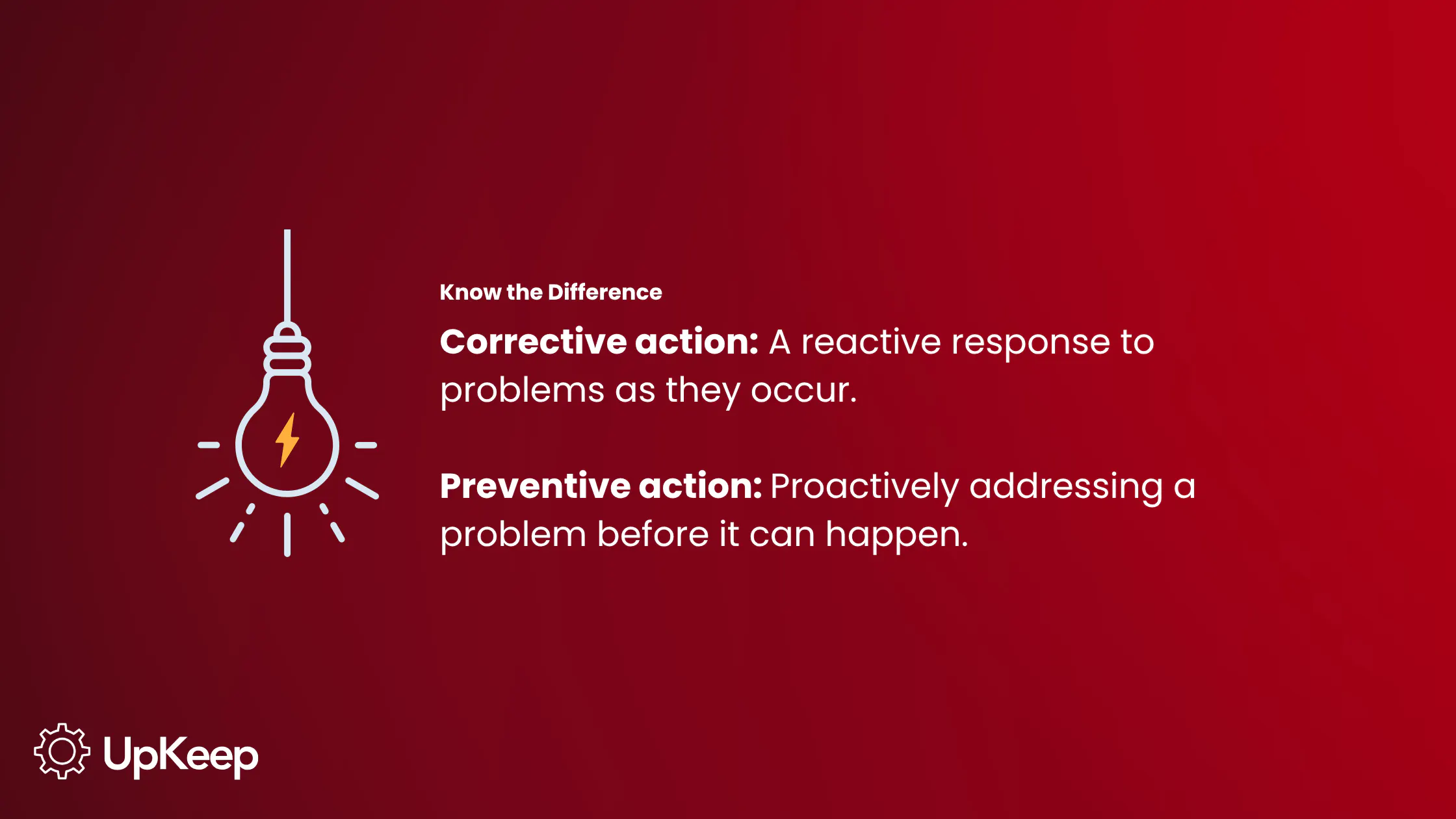
Corrective action is reactive. It responds to a confirmed problem or nonconformance as it happens. Preventive action is proactive, addressing a potential risk before a failure or violation.
Use corrective action when there’s documented evidence of an issue. Use preventive action when data or trends suggest a risk is emerging, even if no incident has occurred. Both approaches require root cause thinking. The difference is whether the triggering event is confirmed or anticipated.

The most resilient organizations integrate both corrective and preventive action. Data from resolved corrective actions should feed directly back into preventive maintenance schedules, inspection checklists, and risk assessments. Predictive analytics tools that recommend PM schedule adjustments based on past failure data are the fulfillment of this integration. These turn lessons from past failures into forward-looking prevention.
Leveraging Technology to Streamline Corrective Action Processes
Manual, paper-based corrective action processes introduce delays, documentation gaps, and accountability failures at every stage. A unified CMMS or EAM platform centralizes issue reporting, RCA documentation, task assignment, and progress tracking in a single system. Having one source of truth with visibility across teams eliminates data silos and duplication.
AI-powered tools further accelerate the process. Natural language interfaces like Nova AI allow technicians to describe an issue conversationally, with the system automatically generating the work order, assigning it to the appropriate owner, and tracking it through to closure. This reduces the administrative burden on field teams by about five hours per week while also improving data quality.
Mobile-first tools are essential for multi-site facilities. Field technicians need to report issues, update statuses, and close out corrective actions from wherever the work is happening. Organizations that rely on desktop-only systems introduce friction that hampers reporting compliance and slows response times.
At the leadership level, operational analytics and customizable dashboards provide real-time visibility into open corrective actions, overdue items, and trends across facilities. This shifts corrective action management from a reactive, department-level function to a strategic, organization-wide capability.
From Reactive Fixes to Operational Resilience
Corrective action is one of the highest-leverage investments an organization can make in its own operational resilience. Every unresolved problem is a future failure waiting to happen, and every properly resolved corrective action is a data point that makes the next failure less likely, preserving safety, quality, and compliance.
The difference between a corrective action process that works and one that doesn't often comes down to visibility and accountability. When the plan lives in a unified system that’s accessible to every stakeholder, tracked to completion, and connected to preventive measures, corrective action becomes a mechanism for continuous improvement.
Ready to put corrective action into practice?
UpKeep gives maintenance and operations teams a single platform to capture issues at the point of occurrence, assign and track corrective actions to verified closure, and turn resolved failures into preventive measures, all in real time and from any device. See how UpKeep can help your team move from reactive fixes to a smarter, more resilient operation.
Frequently Asked Questions About Corrective Action
What are the main objectives of implementing corrective action?
The primary goals are to eliminate the root cause of a confirmed problem, prevent recurrence, and maintain compliance with regulatory and quality standards. Secondary aims include building organizational learning. Each corrective action, when properly documented and closed, becomes a data point that strengthens the organization's ability to prevent future failures.
When is it appropriate to escalate corrective action?
Escalation is warranted when an issue poses an immediate safety risk, when the root cause extends beyond a single department's authority to address, when regulatory reporting obligations are triggered, or when an initial corrective action has been implemented, but the problem has recurred. Clear criteria defined in advance prevent unnecessary escalation of an issue or an ineffective response to a more pressing problem.
How do legal considerations impact corrective action plans?
In regulated industries, corrective action plans are often legally required documentation for audits, litigation, or regulatory investigations. Several ISO standards formalize this documentation obligation and carry their own legal weight:
ISO 9001:2015 (Quality Management), the most widely adopted framework, requires organizations to review and document the effectiveness of corrective actions and update risk levels.
ISO 13485 (Medical Devices) is stricter, requiring effectiveness checks be documented and supported with evidence such as trend analysis, audit logs, or training records.
ISO 14001 (Environmental Management) requires identifying and addressing deviations from environmental policies or objectives.
ISO 45001 (Occupational Health & Safety) requires organizations to investigate incidents, identify root causes, and implement corrective measures. This documentation may serve as evidence in workers' compensation claims, OSHA investigations, or personal injury litigation.
ISO 27001 (Information Security) applies when corrective actions relate to data breaches or security incidents.
Organizations should consult legal counsel when corrective actions involve safety incidents, employee conduct, or potential regulatory violations.
4,000+ COMPANIES RELY ON ASSET OPERATIONS MANAGEMENT
Leading the Way to a Better Future for Maintenance and Reliability
Your asset and equipment data doesn't belong in a silo. UpKeep makes it simple to see where everything stands, all in one place. That means less guesswork and more time to focus on what matters.






![[Review Badge] Gartner Peer Insights (Dark)](https://www.datocms-assets.com/38028/1673900494-gartner-logo-dark.png?auto=compress&fm=webp&w=336)