Blog Post
CMMS Certification: What It Proves and When It's Worth It
CMMS certification proves you can configure and run a maintenance system, not just use one. See which credentials are real and how to earn one.



Key Takeaways
CMMS certification proves you can configure and run a maintenance system. Hiring managers screening for planner and reliability roles see it as evidence of your ability to build asset hierarchies, set PM triggers, and pull audit-ready reports without a long ramp-up.
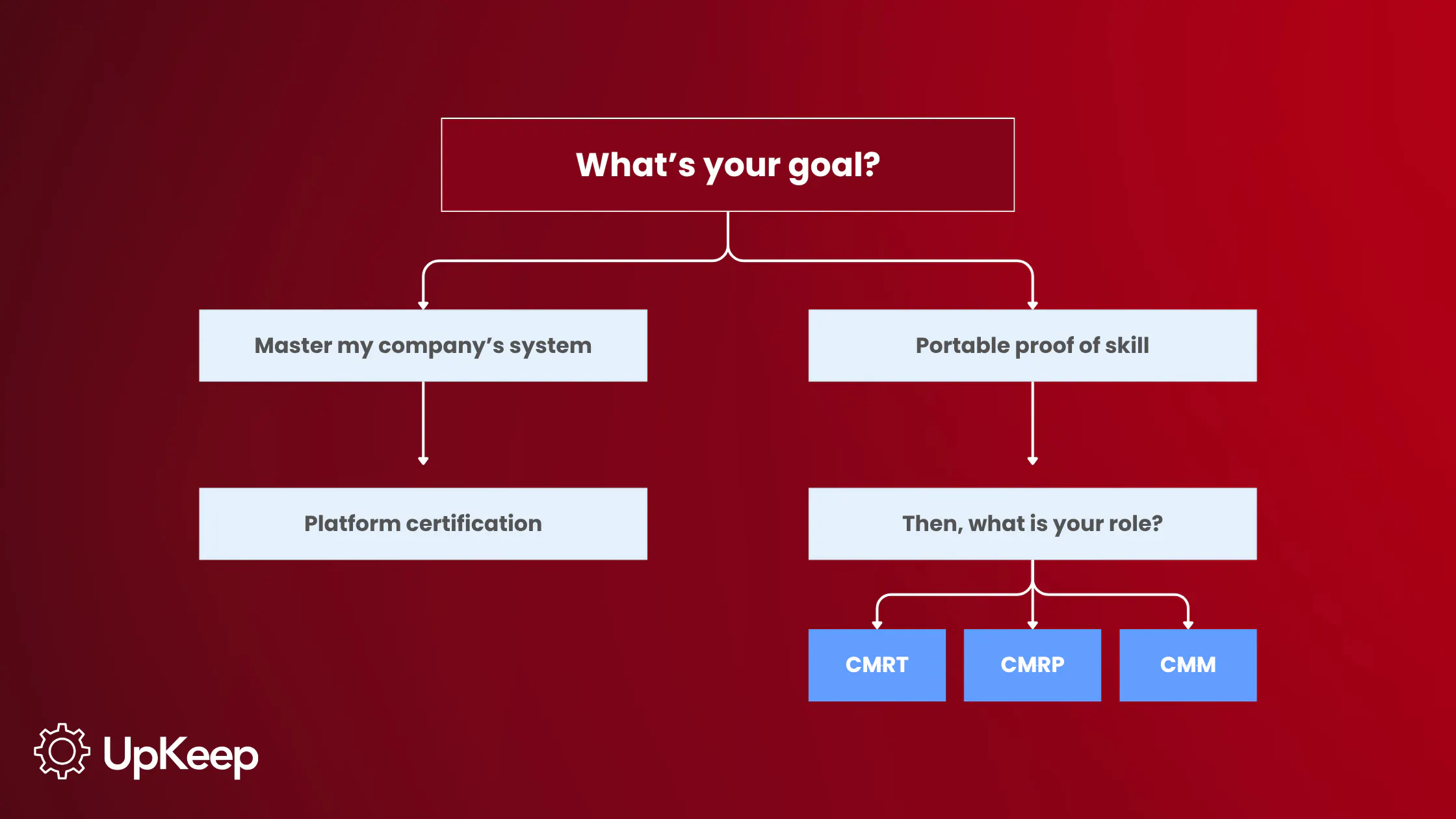
There are multiple CMMS certifications, so the right credential depends on your goal. Platform-specific badges validate one system's configuration, while vendor-neutral credentials like the CMRP cover the reliability and work-management principles applying to any system.
Hands-on practice is more useful than pure reading, because exams test applied scenarios. Candidates who gain real experience clear the assessment faster than those who only review the existing body of knowledge.
Certification pays off at the team level. When a manager tracks credentials and training completion in one place, knowledge transfer stops depending on the few veterans who remember how everything works.
A resume that lists “CMMS experience” explains nothing. It could mean someone closed work orders on a system a manager set up for them, or that they built the entire thing. The difference usually shows up six weeks into the job, when you find out if your new planner can formulate and configure the system or only move around inside one.
That gap is why certification exists, and it’s getting more expensive to ignore. Monster found that 64% of employers struggle to attract talent, and the squeeze tightens every year as experienced technicians who know these systems retire faster than new ones arrive to replace them. An authoritative credential is one of the few reliable ways to tell who can do the work before you hire them.
What Is CMMS Certification?
CMMS certification comprises several credentials intended for different jobs, and picking the wrong one leads to time wasted studying for an exam that won’t advance your career.
Most certifications fall into one of two groups:
A platform certification, which comes from a CMMS vendor and confirms you can configure its software, manage users, and build out its modules. It signifies deep knowledge of one system.
A professional maintenance credential, which comes from an independent body and certifies you understand maintenance and reliability work more broadly, with CMMS administration as one piece of a wider scope.
Then there’s training, which is often mistaken for certification. A course that ends with a certificate of completion just says that you sat through the material, whereas a certification shows you passed an assessment against a published standard, and that’s the delineation a hiring manager cares about.
If you want to become fluent in a specific system, you need training, so start by upskilling your team to become CMMS superusers. The credentials cover the rest.
Why CMMS Certification Matters
If you set PM triggers on the calendar when the assets run on meter hours, you generate services that miss the wear. Some equipment gets touched too often, and the rest fails between intervals. Building an asset hierarchy with no logic to it, meanwhile, pushes the mess onto every report that pulls from it. These mistakes quietly inflate a maintenance budget, so certification is designed to test someone on these before they make the same errors on your floor.
Credentials are also leverage for job candidates since they shorten the screening process for a hiring manager who can’t easily verify hands-on skills. They’re the line that separates a technician from the planner or CMMS administrator roles that pay more and carry more weight. Most people don’t move up just by waiting to be noticed. A recognized credential is how they make their case.
But is it worth the money?
Certification costs include fees and study hours, and the payoff is expanded capability that may lead to a significant pay bump. But avoiding a botched implementation, catching a recurring failure a few months sooner, or qualifying for a role that was previously closed to you justifies the investment several times over. Many employers cover the expenses as well, because a certified team onboards faster and leans less on the one or two people who know everything at the company. Run the numbers against where you want to be in three years to see if it’s worth it.
Vendor vs. Vendor-Neutral Certifications
The credential that’ll move you closer to your goals depends on which system you work in and how far you want the credential to extend beyond it.
Platform certifications come from CMMS vendors themselves. You learn one system deeply, including the modules, configuration, and admin settings, then the vendor confirms you can run it. That’s sufficient for an in-house administrator whose company has committed to a platform because it maps directly to the job. The limit is in the name; it certifies you on that particular platform only, so it carries less weight the day you move to a company that operates on something else.
Vendor-neutral credentials come from professional bodies and certify mastery of maintenance and reliability. They hold their value across employers and tools, which is why a hiring manager recognizes them on sight. The two worth your time are the CMRP and the CMM.
The CMRP (Certified Maintenance & Reliability Professional) from SMRP carries the most weight. It’s the only credential in this space accredited by the ANSI National Accreditation Board under ISO/IEC 17024, which is highly attractive to employers who use accreditation as a baseline.
Its body of knowledge runs across five pillars, but the one that concerns you most here is Work Management, which encompasses planning, scheduling, work orders, and the asset management data the whole program depends on. If you want one portable credential that says you understand maintenance broadly, this is the one to chase.
The CMM (Certified Maintenance Manager) from the Association of Asset Management Professionals is the other major badge of authority. It’s built on a body of knowledge from the Uptime Elements framework and aimed at people running maintenance operations. The certification is well regarded but doesn’t hold the ANAB accreditation that the CMRP does, so take that into consideration if your employer or industry says accreditation is a must.
|
Dimension |
CMRP |
CMM |
|---|---|---|
|
Issuing body |
Society for Maintenance & Reliability Professionals (SMRP) |
Association of Asset Management Professionals (AMP), built on Reliabilityweb's Uptime Elements |
|
Accreditation |
The only ANAB-accredited under ISO/IEC 17024 |
Recognized industry credential but not ANAB-accredited |
|
Focus |
Maintenance, reliability, and physical asset management across five pillars, one of which is Work Management |
Maintenance management across a multi-modular Strategic Maintenance Management body of knowledge |
|
Who it's for |
Planners, reliability engineers, and maintenance managers wanting a portable, accredited standard |
Maintenance managers and leads wanting a structured maintenance management credential |
|
Eligibility |
Open to anyone, with no degree or experience prerequisite |
Demonstrate competencies relevant to the body of knowledge at an intermediate level |
|
How you earn it |
One proctored exam, up to 2.5 hours |
Study the body of knowledge through the Uptime Elements Academy, then demonstrate competency |
|
Recertification |
Every 3 years, 50 credit hours from two or more activities |
Every 3 years, through AMP-approved events and conferences |
|
Cost |
$300 members, $470 nonmembers (USD exam fee) |
$399 (USD exam fee) |
How to Choose: Format, Cost, and Goal
How you earn these certifications and what they cost differ. The CMRP is a single proctored exam that lasts up to two and a half hours and is open to anyone; no degree or minimum years of experience required (although people with a few years of work under their belt tend to find it easier). It runs $300 for SMRP members and $470 for everyone else, and it’s good for three years over 50 hours of continuing education.
For the CMM, you study its body of knowledge through the Uptime Elements Academy and demonstrate mastery, then keep it current through approved events. The exam fee is $399. In comparison, vendors set the training, the test, and the price for platform certifications. They’re usually an online track, but check the specific program.
You can find free and near-free “CMMS certifications” in online searches that are fine for learning a tool, but they only certify attendance. Accredited credentials cost money, but a hiring manager trusts these, so choose carefully.
The Context of the Technician Path
Not everyone wants a manager’s title, and the credentials account for that. The same body behind the CMRP offers the CMRT (Certified Maintenance & Reliability Technician) certification, for instance, which is accredited the same way and built around the work itself, namely, preventive and predictive tasks, troubleshooting, and corrective repairs. If you’re the one with hands on the equipment, that’s your credential.
So, when does it make sense to climb from the CMRT to the CMRP? When the job starts changing around you. The CMRT proves you can execute. The CMRP extends into planning the work, setting reliability strategy, and the budgeting and analysis side of the operation. If you find yourself scheduling other people’s work, owning the PM program, or eyeing a planner or supervisor seat, start looking into the CMRP. Until then, the CMRT is enough to fit the work you’re doing, and there’s no prize for holding a credential ahead of the role.
Two other credentials are worth considering as well:
The CPMM (Certified Professional Maintenance Manager) from the Association for Facilities Engineering is a management credential gated behind experience and references, aimed at plant and facilities managers.
If your work is more facility management with maintenance as one slice of it, the CFM (Certified Facility Manager) should be your go-to.
Other CMMS certifications exist, but most are either narrower than these or not worth the effort. The ones above hold up when someone who knows the field reads your resume.


How to Prepare for CMMS Certification
Once you’ve picked one, the prep has the same general shape, whether it’s the CMRP, the CMRT, or a vendor exam:
Determine your knowledge gaps. Pull the issuing body’s outline and honestly grade yourself in each domain. The weak spots are where to devote your study time.
Study using official materials. Use the governing body’s own guides and practice exams. Third-party prep quality ranges from solid to useless, and only the official outline is guaranteed to match the test.
Get hands-on practice. These exams test applied judgment over recall, so reading will only take you so far. Build asset hierarchies, set PM triggers, and pull reports in a working CMMS until it’s muscle memory.
Join a study group. Local chapters and online communities trade question banks and study plans. Explaining a concept to someone else is the fastest way to find the gaps you didn’t know you had.
Book the exam even if you don’t feel 100% ready. An open-ended plan gives you an excuse to push back taking the test. A date on the calendar forces you to make the last few weeks count.
For a manager, prep is a tracking problem. They have to pinpoint who’s working toward what certification, who’s making time for it, who already holds which credential, etc. UpKeep Learn keeps all that information in one place. It also lets you assign the training that fits each role, monitor completion, and view every technician’s certification status next to the work they’re doing. With UpKeep Learn, you can see the team’s capability on one screen instead of reconstructing it from memory when someone hands in their two weeks’ notice.
Turning Certification Into Team Capability
A maintenance operation that neglects certification runs into the same problems every time: The knowledge sits with two or three veterans and lives nowhere else. New hires take months to become useful, the CMMS is used three different ways by three different people, and the same asset fails the same way every quarter because nobody reads the history. That reactive state is where more teams are headed as their most experienced people retire.
Certification is one of the levers that reverses direction. It puts a documented standard under your team’s skills, shrinks onboarding, and keeps competence from leaving with a single resignation. The credential proves a person cleared the bar. Tracking it across the team in UpKeep Learn alongside the work orders and PM history tells you who’s cleared it, who’s close, and where the next gap opens before it costs you.
If you’d rather view your team’s capability than guess at it, start a free UpKeep trial or book a demo.
Frequently Asked Questions
What is CMMS certification?
Several different credentials sit under that umbrella. Some are tied to a specific CMMS platform and prove you can run that software; others are vendor-neutral maintenance credentials like the CMRP that treat CMMS work as part of a broader skill set. None is literally named “CMMS certification,” which is why search results for it look like a cluster of unrelated programs.
How do you get CMMS certified?
Match the credential to your goal first, then prepare using its published body of knowledge. For something like the CMRP, you apply through the issuing body, study the domains, get hands-on experience, and take a proctored exam. For a platform certification, you run the vendor’s training track and pass their test.
How much does CMMS certification cost?
It depends on the test. The CMRP exam is $300 for members and $470 for nonmembers, while the CMM exam fee is $399. Platform and other credentials range widely, so check the issuing body directly and budget for study materials and any membership that drops the exam fee while you’re at it.
Can you get CMMS certified online or for free?
You can usually study and test online, but the no-cost “certifications” you see advertised are training certificates that confirm you finished a course. They’re useful for skill development but aren’t the same as a proctored credential measured against a standard. The accredited ones charge a fee, but they’re more trustworthy to an employer.
What’s the difference between CMMS training and certification?
A training course hands you a completion certificate for working through the material, meaning it confirms you just finished the content. A certification puts your knowledge through a graded exam tied to an industry standard, which is what a hiring manager values. Most people end up doing both, starting with training to master a tool and then getting certified once they want to validate that knowledge.
Is CMMS certification worth it?
For anyone planning to stay in maintenance, usually yes. The return is greater capability over a raise though. You gain faster onboarding, fewer expensive mistakes, and access to planner and reliability roles that ask for it. While it costs money and hours, plenty of employers reimburse it, and the math works out if you’re weighing it against a whole career.
4,000+ COMPANIES RELY ON ASSET OPERATIONS MANAGEMENT
Leading the Way to a Better Future for Maintenance and Reliability
Your asset and equipment data doesn't belong in a silo. UpKeep makes it simple to see where everything stands, all in one place. That means less guesswork and more time to focus on what matters.






![[Review Badge] Gartner Peer Insights (Dark)](https://www.datocms-assets.com/38028/1673900494-gartner-logo-dark.png?auto=compress&fm=webp&w=336)