On Demand
An Industry Perspective: How Food and Bev Leaders Can Modernize Maintenance Operations
Duration: 1 hour
Published on: July 16, 2026


In this live fireside discussion, UpKeep CEO Ryan Chan and Solutions Engineer Jon James sit down to talk through the strategies and approaches defining the shift. James spent years leading Maintenance and Production Operations at Keurig Dr. Pepper and Anheuser-Busch before moving to the platform side, bringing a practitioner's lens to a conversation most industry discussions keep at the surface level. Together, they cover what the most effective food and beverage operations programs are doing differently, what's driving the change, and what leaders should be prioritizing to make the shift.
WHAT YOU'LL LEARN:
- The key changes reshaping maintenance operations in food and beverage manufacturing today and what's accelerating them
- What the highest-performing operations programs across multi-plant manufacturers have in common
- How leading teams are achieving operational excellence that holds consistently across every plant, not just the flagship site
- What it looks like when compliance readiness is part of daily operations rather than assembled before an inspection
- Where technology is genuinely changing how maintenance teams work on the floor, and where the real adoption barriers are
- What operations and maintenance leaders should be focusing on right now to stay ahead of the shift
Transcript:
Olli: Good morning, good afternoon, and maybe even good evening to everyone dialing in. If you don't mind, put in the chat where you're joining from. You can probably tell by my accent that I'm over in England, so it's evening for me, but I'm sure we have plenty of folks from the US and across Europe as well.
What do we have for you today? A discussion about food and beverage, an industry we hold very dear here at Upkeep. I'll spare you the details since I want to get out of the way and bring the talent onto the screen, but first, a few quick logistics.
We're aiming for about thirty minutes of discussion today, and at the end we'll have an open Q&A, so start thinking about your questions now. There's a Q&A box at the bottom of your Zoom window. You can also use the chat, but it sometimes gets busy and questions are hard to track, so the Q&A box is your best bet. We'll get through as many as we can.
This is a pretty relaxed conversation, light on slides, so sit back and listen, and share any thoughts in the chat as we go.
One last thing before I pass over to my more talented hosts: the question I always get is about the recording. It will arrive tomorrow morning by email. If you don't see it, ask anyone on the Upkeep team and we'll send you the link. Occasionally it lands in spam, so check there too.
Without any more ado, let me introduce who's handling the conversation today. Ryan, welcome. How are you?
Ryan: Doing great. It's a beautiful day here in Los Angeles.
Olli: Very good. I wish I had the same weather as you. And Jon, how are you doing?
Jon: Hey, how's it going? I'm also in LA, so definitely enjoying the vibes and plenty of sun out here.
Olli: Can I get a quick one or two sentence bio from you both? Ryan first.
Ryan: Sure. My name is Ryan, and I'm the CEO and founder of Upkeep. I went to Cal Berkeley as a chemical engineer and worked as a process engineer in a manufacturing plant that was spun out of DuPont Chemicals. Every single day I was thinking about how to streamline our manufacturing process: make it run better, smoother, faster, and more productively. I was part of the team responsible for picking, choosing, and implementing maintenance software, and the whole premise was to better understand downtime and the root cause of failures so we could reduce downtime and increase production throughput.
I did that for a bit and then pivoted into building a tech company to solve the gaps in the industry around technology, understanding downtime, and improving the maintenance process. It's been an 11-year journey running Upkeep. We're a team of 150 people, it's been so much fun, and the entire industry is changing so quickly.
I'm really excited to be here interviewing one of our own: Jon, who used to be part of Anheuser-Busch and a few other companies, running their maintenance teams, operations teams, and production plants. Jon, I'll pass the baton to you to introduce yourself more formally.
Jon: Thanks, Ryan. My name is Jon James, and I'm a solutions engineer with Upkeep. I've been with this team for about two years, but as Ryan said, I spent the majority of my career working in manufacturing, food and beverage specifically. Some names that might come to mind: L'Oréal, Anheuser-Busch, and Keurig Dr Pepper, where I spent most of my years in different roles, from operations to ultimately becoming a maintenance manager.
So, many years in the trenches: high-speed packaging lines, extreme temperature zones, and managing very strict compliance audits. My main goal was to keep the lines running, and for most of my career I was using legacy systems like SAP and Oracle. I've lived with the exact challenges we're going to be talking about today, not only from an admin and leadership standpoint but also through my team members. Ease of use wasn't a strong point back then, especially on mobile, so I'm really looking forward to digging into some of that today.
Olli: Thank you both. Jon, if you still have any connections back at Dr Pepper, it's my favorite drink. I usually have one for a webinar, but I forgot today, so if you've got any hookups over there, let me know. Ryan, over to you. The show is yours.
Ryan: Thank you, Olli, and I appreciate you setting all this up. The goal today is to have a discussion around food and bev: what's happening in the industry, what the current trends are, and ultimately what those of us in maintenance and operations can do to prepare for what's coming.
Before we get too deep, Jon, I'd love to hear a little more about your history working on the plant floor at Anheuser-Busch. What did a good day look like? What did a bad day look like? Any memorable days that really stuck out?
Jon: Sure. I spent over a decade in food and beverage. A good day was any day the lines were running well: no holds, no safety incidents, and not much downtime to deal with.
A bad day could be a bunch of things. I'd walk in and maybe sanitation had done a cleaning the night before and sprayed down a sensor or an electrical panel, and now we're scratching our heads trying to figure out how to get the lines running. Pair that with extreme temperatures during our busy summer season, where you're trying to make sure nobody gets dehydrated and everyone is stretching and staying safe. There were a lot of competing priorities. But ultimately, you just wanted to make sure everybody was safe, you made a quality product, and you kept the lines running. That was my focus day in and day out.
Ryan: I appreciate you sharing that. It feels like in food and beverage manufacturing, at least here in the US, these bad days continue to happen, and it sounds like they're increasing as the years go on. We have a report showing that food and beverage is actually one of the few industry sectors where both the cost and the amount of unplanned downtime have been rising over the past five to ten years. From your perspective, Jon, what's changed over the last decade? Why is downtime getting harder to control, and why are costs rising?
Jon: You're hitting the nail on the head. Costs are rising across the board: labor, raw materials, all of it is going to keep going up. As a former maintenance manager, you're held to KPIs, right? PM compliance, uptime, throughput, and of course a budget. When you're held to a specific financial threshold, you often have competing factors between keeping the line running and saving a dollar.
I can recount times as a maintenance manager when we pushed back certain PMs because we didn't want to take the financial hit during that quarter or that month. It's a chicken-and-egg trap: you have to justify taking the line down for an overhaul, or justify replacing an asset, by first seeing the loss. That's what a lot of manufacturers are dealing with today. Because maintenance isn't looked at as a profit center but as a cost center, we have to take the hit before we can justify moving in a positive direction on equipment.
This promotes a run-to-failure environment. We're just running and running, trying to keep the lines up, and when we do hit a run-to-failure moment, we take on even more downtime than if we'd just taken the time to address the issues in the first place. And that's not just throughput. We're talking emergency labor, overtime, and waste and scrap on the lines. In food and beverage especially, you often don't have rework opportunities, so that's even more cost. How do we address it? By being more proactive, more preventive, and even predictive with maintenance. That's how we reverse the unplanned downtime trend.
Ryan: One of the beauties of Upkeep is that we serve a lot of different industries, and manufacturing as a whole is a very broad one. We have discrete manufacturers, automotive, and consumer products companies as customers, but food and beverage seems uniquely different. What makes running a maintenance team in food and beverage harder than in other manufacturing industries?
Jon: I think there's definitely the safety component, and not just employee safety but food safety. You're producing a product that's going to be consumed by the public, so it's critical to have very strict guidelines to make sure the process is safe and you're not going to hurt somebody, whether that's internally or your customers out in the world. That, first and foremost, is one of the biggest differentiators from other manufacturers.
Ryan: It's such an important topic, because the products you manufacture go into people's bodies. It's the food we consume, and there's perishability on top of that. Food safety is so important. It's very, very different and definitely one to highlight.
Jon: Another thing that comes to mind: in my experience, food and beverage processes are very fast-paced. At both Keurig Dr Pepper and Anheuser-Busch, we were running thousands of cans or bottles a minute. When you're running at those speeds, any bit of downtime, whether it's a minute or an hour, is a huge financial impact. So you want to be proactive and take the time to replace filters, seals, and so on to make sure you don't have quality issues and can keep the line going at a good pace.
Ryan: And RJ in our chat is pointing out some really good points here: unit margins are much lower than in other manufacturing, so you're chasing volume. When you have these low-margin, extremely high-volume plants running at such high speeds, every single minute of downtime matters.
Jon: Absolutely.
Ryan: You alluded to the labor shortage and how difficult it's been to bring on new folks. We have a stat from another one of our reports projecting a shortage of about 1.9 million manufacturing workers over the next decade just here in the US. We've talked about the labor shortage many times, but I'd love to hear your experience at the plant level. How did the shortage affect you and the decisions of your plant and maintenance team? Where did it hurt the most, and how did you manage the difficulty hiring?
Jon: Sure. And you said something really important: it's not happening just in California, it's happening everywhere. There's a general labor shortage across the board, whether we're talking food and beverage or any other manufacturing vertical.
My experience working in lean manufacturing is that you have to focus on your biggest pain points, your heavy hitters, from a productivity, quality, or safety standpoint. And to do that, you have to rely on the data you have available. You can't just white-knuckle your way through issues in the plant. You have to spend your time on the things that will really drive impact and improvement, and you need good, reliable data to do that.
One of the things I like about Upkeep is that we really promote ease of use at the mobile level, at the floor level. Out in the field, a technician can just speak to their device and document what they're doing in a work order, or reach out to Nova, our AI agent, to help troubleshoot an issue they haven't seen before.
From a labor shortage standpoint, you lean on the 80/20 rule: 20% of the fixes you put in place are going to make the biggest impact on your OEE and throughput. But to find them, you need easily accessible, good-quality data.
I'll give you an example from early in my time as a maintenance manager at Keurig Dr Pepper. We kept seeing a lot of downtime across our can lines, and the hearsay from the floor was that the palletizers were the bottleneck shutting us down and the only reason we weren't hitting our numbers. So I took it upon myself to Gemba, which is a TPM term for going to the actual place, out on the floor, to see what was really going on. I did see stops at the palletizer from time to time, but it wasn't our bottleneck. When you looked at the real issue, it was that operators weren't properly loading cartons at the packers. That's a training or personnel issue, not a maintenance issue at the palletizers. Having good data and being able to act on it is very impactful. It doesn't just help your unplanned downtime KPIs, it means more of those good production days I was talking about earlier.
Ryan: Interesting, Jon. What I hear you saying is: we've got this labor shortage, and we can do everything possible to hire more people and make the role more enticing, but the real answer is the 80/20 rule. In a funny way it's less about trying to fill the gap, because the gap is the gap. Instead, do what you can with what you have. What you have today is the labor force working in your plant, the operators on the shop floor, and you prioritize that top 20% because that's what's really going to move the needle. Did I get that right?
Jon: Spot on, Ryan. You only have twenty-four hours in the day, and you have to play the cards you're dealt. So focus on the biggest drivers.
Ryan: I imagine a lot of companies are burning out their teams right now, saying we've got to complete every PM, every single task and inspection. But what I hear you saying is maybe it's not about that. If you try to do everything, you're always going to be running at a shortage of labor and time. Instead, figure out and prioritize the 20% that's really going to move your business.
Jon: Absolutely.
Ryan: We've been talking about the struggles of food and bev: high volume, low margin, coupled with this labor shortage. People throw out a stat quite often that the cost of downtime is generally around $10,000 an hour. I'd love to hear your perspective, Jon. Was that close to your world, or was it much more than that?
Jon: I'd say that's a little conservative for my world. Again, we were running high-speed can lines and bottle lines. Just to do some quick math: if you go get a case of beer from the store, it's likely upwards of twenty dollars, and we were doing about sixty to eighty cases a minute. So every minute of downtime is thousands of dollars. Depending on the product, the number can be fairly low, but coming from beer and soft drinks, it adds up quickly.
The other issue is the inherent productivity losses. Not only are you losing time on the lines you can't get back, you now have to make it up to meet your delivery. So we're talking overtime, working weekends, time and a half, double time. We're also talking scrap and waste on the lines, because in food and beverage you often don't have the option to rework product. Some of it goes straight to the trash or onto the floor, maybe because it stalled in a hot zone in your pasteurizer or an oven in your processor.
I had a customer who made bread loaves, and any time they had a downstream issue, they had to keep running the conveyors out to a chute that sent the bread directly to the trash. That's not coming back. That's completely wasted raw material and product. So really think about it: $10,000 an hour can sound conservative. It might even be the floor of the potential loss from unforeseen downtime.
Ryan: When you calculated your cost of downtime, did you include the cost of double time? The cost of scrap? The coordination cost when things go off schedule? And do you have any recommendations for our listeners on how to best calculate the true cost of downtime?
Jon: Absolutely. I would factor in all those things I mentioned. It's not just the cost per case per minute or per hour, it's the external factors: your overtime, your scrap, and if you have SLAs with your customers, any penalties you'd have to pay if product isn't on the truck or on the shelf. Factoring in all of that really helps when we go back to those competing priorities and justifying a rebuild or a machine replacement. When you're making your ROI argument, accounting for all those factors strengthens the case.
Ryan: Definitely. We've covered everything from hiring to the cost of downtime. One thing unique to food and bev that I'd love to double-click into is inspections and audits. Again, these are products that will be consumed by customers and consumers like us. With a lot of companies we've spoken to, some do audits very well, and others treat them like a fire drill: shoot, the auditor's coming, we've got to scramble, clean up, and get everything prepped. What do you feel separates a facility that's genuinely ready for an inspector any day of the week, any day of the year, from the ones in scramble mode?
Jon: I feel like most of my career was the latter. It was painstaking when you knew an audit was coming, or when you were expecting a surprise visit, and you're thinking, man, I've got to get all these binders ready. We relied heavily on paper-based documentation and really cumbersome processes.
The difference between firefighter mode and being ready to tackle an audit confidently by default comes down to your day-to-day processes, especially around documentation: inspections, checklists, your maintenance records. If it's all well documented as part of your natural workflow, it becomes much easier to be audit-ready twenty-four seven.
A lot of times that's not the case when you're leaning on a legacy maintenance system, or putting work orders on paper or a whiteboard. You end up losing detailed information, and things fall through the cracks. Instead of being confident you'll pass the audit, you're crossing your fingers and hoping the auditor doesn't ask a specific question or look for a certain thing. Otherwise you might end up with a fine or penalty, or worst case, have to shut down your plant to finally meet expectations.
An old plant manager I worked with used to say: make it easy to do right, hard to do wrong. What that means is building your system so the right thing is easy: documenting what you did, taking pictures of the final product of what you PM'd or worked on. Then it's not an afterthought or an added action, it's inherently built into your natural workflow. Audit-ready teams have built those systems into their day-to-day, so it's not something they have to scramble for. It's just their routine.
Ryan: Easy to do right, hard to do wrong. What I hear you saying is that making it easier for the team to input good data means you're ready for an audit at any point, without the firefighting and scrambling.
One thing we talk about quite a bit, and I know you're well versed in, is sensors and remote condition monitoring. This is an area where we can help customers deploy sensors to support all the audit data and detail that's needed, without anyone ever having to go into a system and type anything or send an operator out to log an inspection. How was remote condition monitoring done at plants you worked at, and what have you seen our best food and beverage customers do with sensors to help with audits and inspections?
Jon: Sure. The example that comes to mind is Anheuser-Busch, where we captured a lot of sensor data points throughout the brewing and fermentation process to make sure the beer would be in spec when it came time to filter and package it. Things like temperature, and CO2 and oxygen levels to prevent oxidation. We tracked those on a regular basis and had alerting set up so we could quickly address an issue if something went out of threshold.
It's a really great tool compared to having someone go out with a meter on a specific cadence, because again, you have competing priorities, especially in a lean manufacturing environment. Those checks might get missed or done late, and if that happens, you could end up dumping all that product, which costs thousands of dollars. Having real-time data you can act on, with alerts via text or email, goes a long way.
That's something I feel is definitely a strength of our Edge product: you can set that up, set up trending, and even get more predictive over time. You start to see, all right, last time we had this failure, the temperature got to this level or the vibration spiked. You can spot leading and lagging indicators before an event happens and act before you accrue that downtime.
Ryan: Definitely. All right, I know we're approaching our thirty-minute mark, so I'm going to ask one last question and then we'll open it up to the Q&A from our audience.
Jon, thank you so much for sharing your experience. It's been awesome to hear this dual perspective: being a maintenance manager at a large food and beverage facility, and the other side of the coin, implementing software and technology on the Upkeep side. If I were to put you in your own shoes ten years ago, as a maintenance manager, knowing what you know now, what would you do differently?
Jon: Great question. Ten years ago, as a maintenance manager, I was very much in firefighter mode, just trying to keep my head above water and keep the lines going, but also chasing my tail quite a bit.
I would tell myself: you don't have to stick to the status quo. You don't have to keep writing your work order routine on a whiteboard or a cork board, or rely on a paper process. Take some time out of your busy day, and I know you're very busy, to look at what technology is out there and available so you can work more efficiently. You went to school as an industrial engineer; efficiency should be important to you.
The fact that your technicians are taking fifteen to thirty minutes at the end of shift, during a pivotal time in shift handover, to capture their notes, and the fact that you're regularly losing information in those work orders, that's a problem. But you're so focused on keeping the lines running that you're not addressing the root causes. You don't have to settle for that. You don't have to live with that pain as an admin, and your technicians on the floor don't have to live with it either. There's technology out there that can make your life and their lives a lot easier.
We talked earlier about what a good day and a bad day look like. When you build a repeatable, smooth process for doing the job, technicians want to come in, do their maintenance, and get home to their families safely. They don't want the pressure of getting lines back up from all this reactive work generated day in and day out. It's a lot easier to come in, have a plan, execute the plan, and go home. When you make their job easier, they're happier, you're happier, and your KPIs reflect it. Everybody's happy. It becomes a flywheel of positive energy that flows up and ultimately impacts your business positively.
Ryan: Some great words of wisdom. Thank you, Jon. To sum up what I heard: just because this is the way things have always been doesn't mean it has to stay true going forward. Really appreciate it. I know we're up on time, but we've got a few questions from our audience. Olli, do you want to help field them?
Olli: Yes, we do. There are a few in the chat, so allow me to go through them. One I saw a moment ago: how did Dr Pepper calculate downtime cost? I think that's for Jon.
Jon: Yeah. Going back to what I was saying earlier, we calculated downtime based on our throughput value. Depending on the product we were running, it had a specific price point, so that factored in. We also accounted for overtime and any waste or loss. For the most part we hit our deliveries, and I don't believe we ever took on penalties, but that would come into play if we were trying to make an ROI argument.
Olli: Very good. Any comments to add, Ryan, or shall I go to the next question?
Next one, and it's a reasonably long one: do you think assigning maintenance personnel to each machine would be a good call? Most of the repairs I saw were due to PLC issues or a very important motor burning out. How can we tackle this in-house? Who wants to go first?
Jon: There are a couple of questions there, so I'll start with assigning a maintenance technician to one machine. It's a good thing, but it's a double-edged sword. When I was at Dr Pepper, we had our bottle line techs and our can line techs. But when you're running lean and somebody calls out sick or goes on vacation, you open yourself up to even more downtime if there's no cross-training across the different assets. So you can do it, as long as there's some cross-training still happening so you're flexible enough to plug somebody else in when a person is out. And going back to what Ryan was saying about labor shortages, it's really important to have flexibility on your maintenance team.
Ryan: I absolutely agree. It's great for clear lines of ownership: when an asset goes down, you know exactly who to call. But as you said, Jon, there has to be redundancy. And it's great skills development for the techs to cross-train on new skills, new assets, new repairs. Definitely recommend it.
Jon: Absolutely.
Olli: Are you ready for one, Ryan? I think this one's for you: what will be next for the Upkeep CMMS in adapting to the challenging world of AI and condition-based monitoring?
Ryan: I love it. What's next for us? What we've seen from our customers is that you all want more than just a maintenance platform. We've heard from a lot of customers that they have all these different silos of data, not just maintenance but operations, reliability, finance, plus remote condition monitoring tools where data lives in separate systems. And what we've heard is frustration: so many different logins, so many integrations to build.
So this is the vision, the future of Upkeep: we want to give you a single place to understand the entire cost of downtime and the entire root cause of failure, what happened, when, where, and why. We combine what we call active data, technicians out in the field, with passive data from the machines, whether that's a PLC or a remote condition monitoring sensor, and join all those data points under one umbrella to tell the full picture of the asset.
That's where we're going, and it's where I'm most excited about how this plays in with AI. AI is really great at understanding very large data sets, but it's only as good as the data you provide it. And it's extremely good when you give it full context: technician data, remote condition monitoring data, PLC data, finance data, reliability, operations. It's so good when you give it all the context. That's where we're headed, and it's what I'm most excited about.
Olli: Very good. Ryan, you teed me up perfectly to show our final slide before our final question. As Ryan just gave such a good synopsis of what's coming with Upkeep, feel free to take a look for yourself via the QR code here or the link, which I'll throw into the chat in a moment.
Our last question, and I think this one's for you again, Ryan. How can we use Upkeep to improve key food safety requirements? For example: sanitization before the startup of any machine, QA approvals for maintenance work, setting up specific cleaning points and processes to work in tandem with maintenance, and recording machinery deep cleans for QA and QC processes. What are some key features Upkeep has that set it apart from others in that area?
Ryan: Such a good question. A few basic things come to mind. When we talk to a lot of our customers, things are still being done on paper and pen. Inspections for audits get done on a clipboard and filed away in a cabinet. Then, like the example we gave, when an auditor comes, you have to dig through that cabinet and pull out every record, date-stamped and signed. The most basic thing so many companies can do is organize it in a digital system. That's step number one.
Step number two: what makes Upkeep different is that we're so much more than maintenance, audits, inspections, and work orders. We're a full platform. You get full visibility, with all your remote condition monitoring sensors joined under one umbrella, and you can integrate your PLC data into Upkeep.
Not only that, we have a product for safety, so you can log all your safety events, because oftentimes work starts from incidents and corrective action plans. That's our Upkeep Safety product. And if you want to loop in training, certifications, and education, so when a piece of equipment breaks you know exactly who is certified, skilled, and trained to repair a motor, fix a pump, or change out a compressor, we have a product for that called Upkeep Learn.
That's what's so different about Upkeep and why I believe it's uniquely different from all the rest: it's all done under one umbrella. Instead of five or six or seven different platforms, when something breaks, when there's a safety incident, when you want to upskill a technician, it's all in one system. So as Olli mentioned, we'd love for you to check it out. There's the QR code, or go directly to our website, upkeep.com, and start a free trial or get a demo from any of our team members.
Olli: What a way to finish. Thank you, sir. Everybody in the chat, if you enjoyed the conversation today, please put in a ten, or give us a high score anyway, a number to tell us you enjoyed it.
While we do that, let me thank our two speakers for a great conversation. Jon, first: thank you, sir. Where can people find and connect with you if they have a question?
Jon: I'm at Upkeep. You can reach me at [email protected] if you want to send me an email. I'm definitely open to any questions and following up. And again, I'm a solutions engineer, so if you're interested in a demo, I'm happy to jump on and do a demonstration of our product for you as well.
Olli: Very good, thank you. And Ryan, appreciate your time and wisdom in running the conversation. How can people find and connect with you?
Ryan: Of course. I'm pretty active on LinkedIn; find me at Ryan Chan. Or shoot me an email at [email protected]. I try to respond to every email I can, so don't be shy.
Olli: I'll take you up on that. All right, thank you everyone. If you made it this far, congratulations. As mentioned, we'll send out the recording via email, most likely tomorrow morning, so keep a lookout for that. If you don't see it, feel free to reach out to any of us by email and we'll get you the recording. With that, that's the end of the show. Hope you enjoyed the conversation, and we'll see you on the next one. Thanks, everyone.
Jon: All right. Thanks, everyone. Bye.
Explore More Events


Event
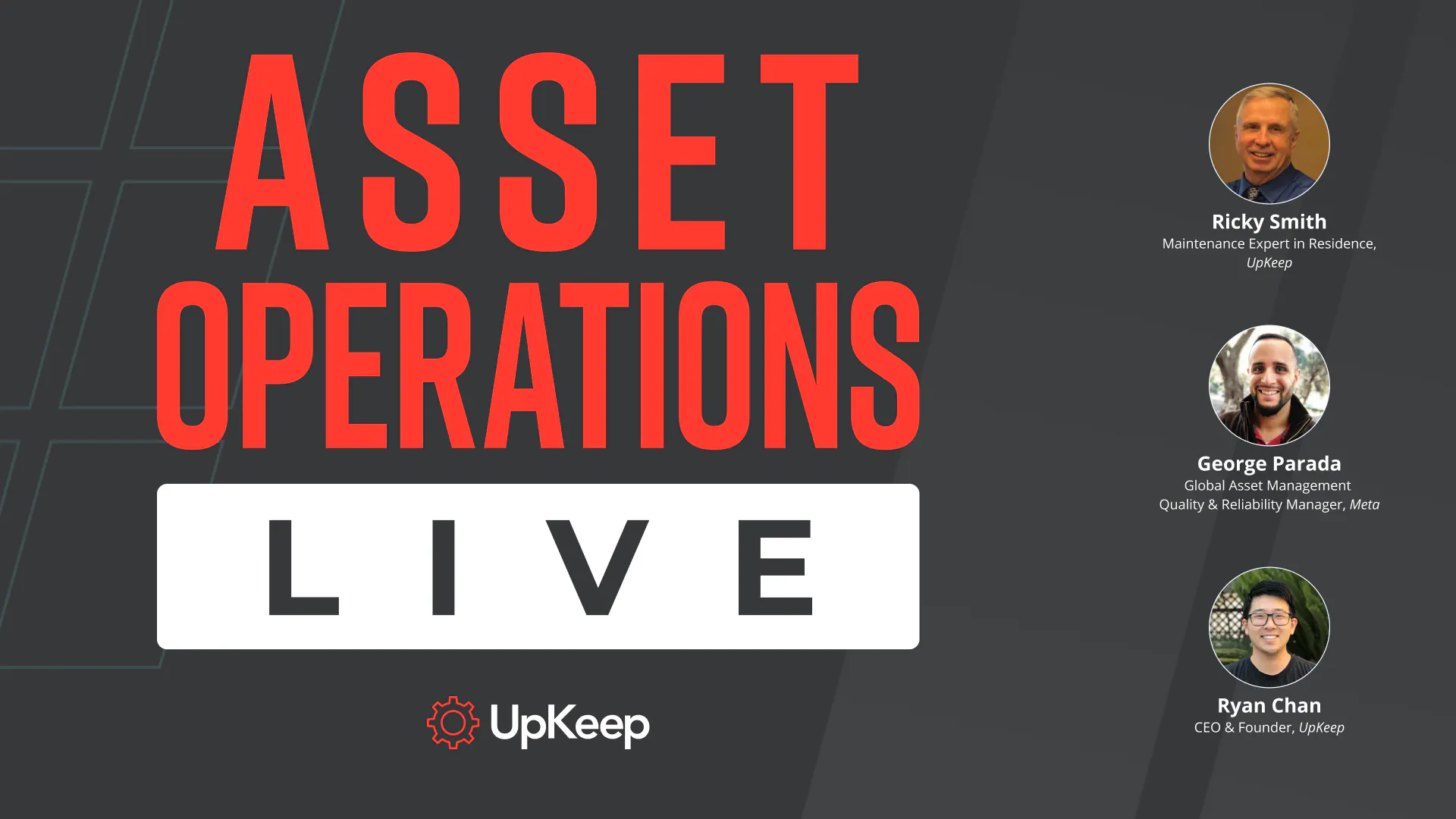
Asset Operations Live: Continuous Improvement From Wherever You Are
Join us for a deep dive into some of Asset Operations Management’s core fundamentals. This webinar covers the themes outlined in the two AOM pillars: Everything Measured Can Be Improved and Data Accessible From Wherever You Are.

Event
Curing Common Maintenance Headaches - Sensor Technology in Food & Beverage Production
Join us for an enlightening webinar designed specifically for maintenance and reliability professionals in the food & beverage industry. Explore how sensor technology can redefine your maintenance process.


Event
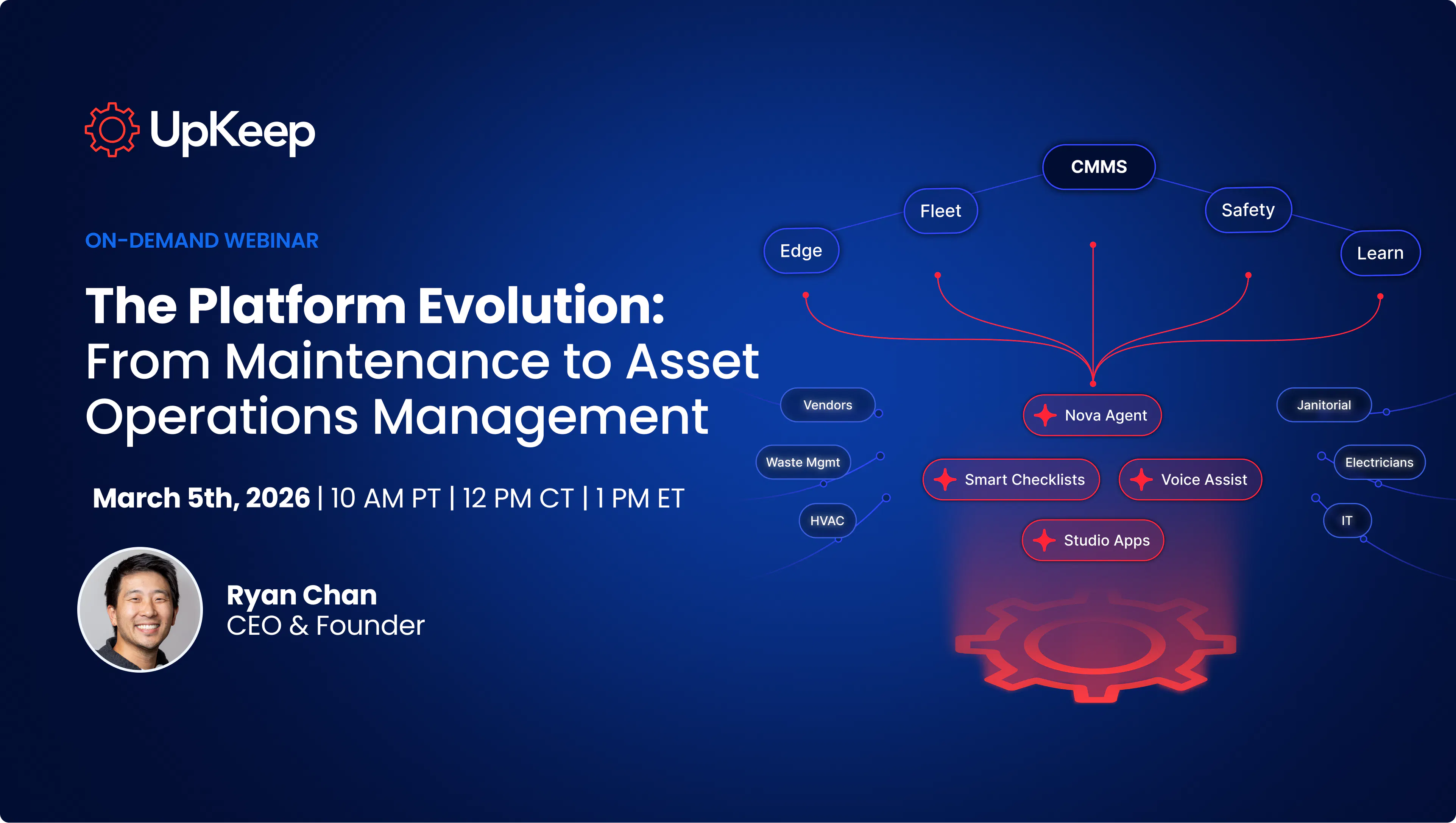
The Platform Evolution: From Maintenance to Asset Operations Management
Join UpKeep CEO Ryan Chan and a panel of operations leaders for a live conversation on Asset Operations Management, a new category of platform built for the way industrial teams actually work.





![[Review Badge] Gartner Peer Insights (Dark)](https://www.datocms-assets.com/38028/1673900494-gartner-logo-dark.png?auto=compress&fm=webp&w=336)