Entrada en el Blog
What Is Safety Incident Reporting and Why Is It Important?
Improve safety, reduce downtime, and strengthen compliance with effective incident reporting. Learn how accurate reports drive reliability and safer operations.



Key Takeaways:
Safety incident reporting connects real events to root causes that shape safer, more reliable operations.
Accurate reports improve working conditions, reduce downtime, and extend equipment life.
Timely documentation supports OSHA compliance and audit readiness.
Consistent reporting builds trust, accountability, and a stronger safety culture.
Integrated digital tools simplify reporting and turn data into actionable insights
At some point in your career, you’ve probably witnessed or experienced a safety incident firsthand. It might have been a minor cut, equipment malfunction, or a near miss that nearly caused harm. The reality is, no worksite is entirely risk-free. What matters most is how teams respond when things go wrong.
Safety incident reporting connects the dots between what happened, why it happened, and how to stop it from happening again. Done right, it strengthens preventive maintenance (PM) schedules, improves uptime, and drives a culture where safety becomes second nature.
What Is Safety Incident Reporting and Why It Matters
Safety incident reporting is an ongoing process that captures workplace safety events. It helps identify hazards, manage risks, and fosters a culture of continuous safety improvement.
When incident reporting is done accurately, it supports compliance and helps organizations respond proactively. Best practices for incident reporting systems emphasize consistent reporting and follow-up to prevent future incidents. Implementing an effective reporting program transforms workplace safety and operational reliability.
What’s the Purpose of Incident Reporting?
The purpose of safety incident reporting is simple — learn from every event. Each logged report allows teams to dig deeper through root cause analysis, trace patterns, and take corrective and preventive actions (CAPA). Whether it’s a minor or serious incident, the data helps pinpoint where a process, training, or component failure occurred.
According to OSHA’s Incident Investigation Overview, effective investigations focus on identifying root causes rather than placing blame. That shift in mindset turns incidents into an opportunity to build safer systems and processes across the operation.
Top 3 Benefits of Safety Incident Reporting
Accurate reporting helps maintenance and operations teams prevent accidents, reduce downtime, and strengthen reliability across systems. Every record supports safer processes and smarter decisions.


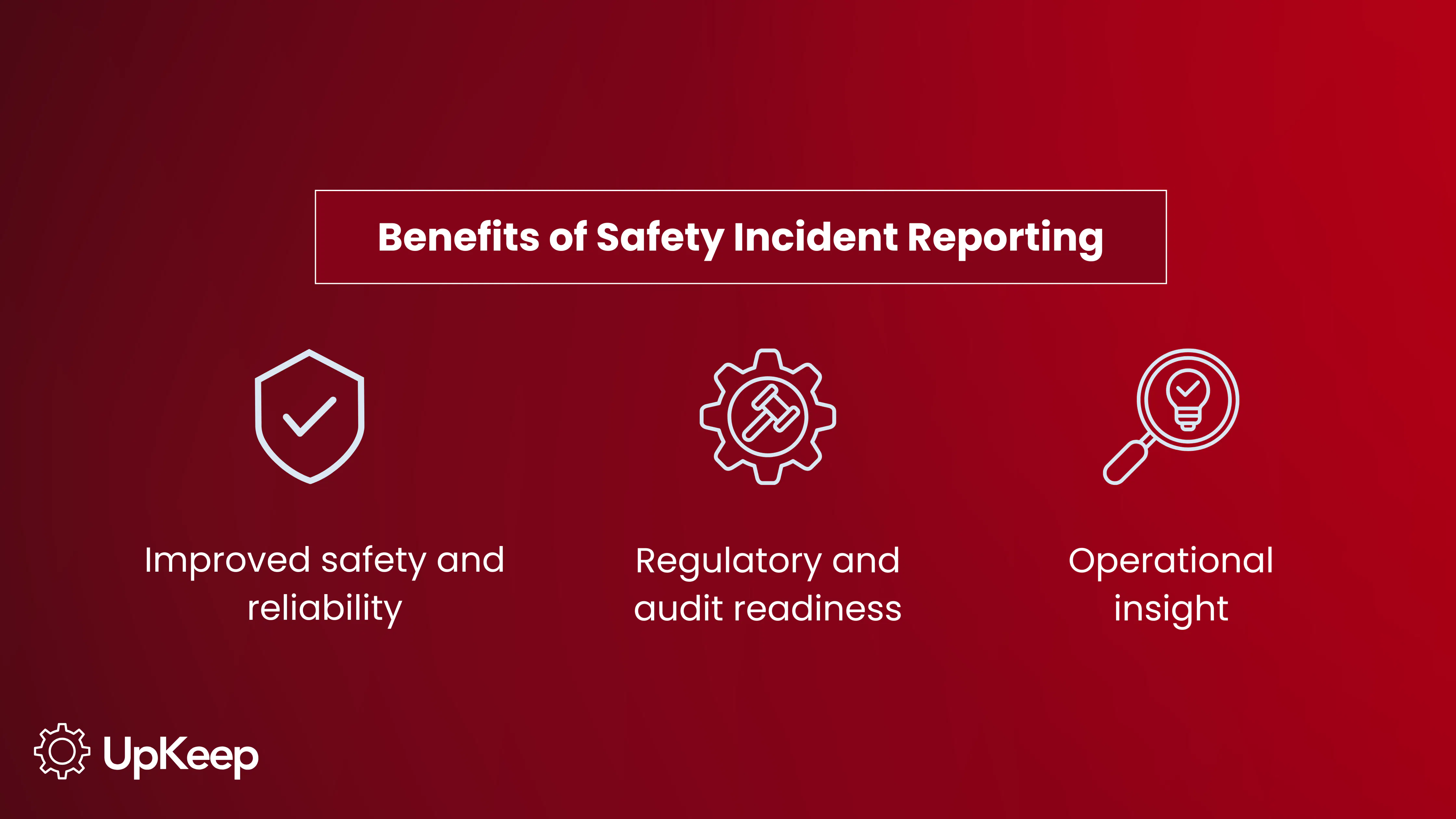
Key benefits of reporting:
Improved Safety and Reliability: Reporting hazards and near misses improves workplace safety and equipment dependability. Issues get fixed before they escalate to downtime or injury.
Regulatory and Audit Readiness: Thorough documentation ensures full OSHA compliance and creates a strong audit trail, reducing fines and protecting organizational credibility.
Operational Insight: Reports generate actionable data that support APM and CAPA processes, allowing maintenance teams to anticipate issues and extend asset lifespan.
OSHA Recordable vs. Reportable Incidents
Different events require different reporting, and each plays a role in improving safety performance and reliability-centered maintenance (RCM) programs. Clear categorization ensures compliance and the right follow-up actions are assigned, tracked, and closed effectively.
Recordable Incidents
These include work-related injuries and illnesses that must be documented and maintained in OSHA logs (e.g., OSHA Form 300). They typically require medical treatment beyond first aid, restricted work, job transfer, or result in days away from work. Recordable incidents help organizations track safety performance and guide preventative maintenance programs.
Recordable incidents include:
Near Miss: An event that could have caused harm but did not—critical for early hazard detection.
Property Damage: Damage impacting tools, assets, or equipment performance and uptime.
Injury: Injuries causing lost work time, medical treatment beyond first aid, or serious harm.
Illness: Work-related illnesses caused or worsened by workplace conditions.
Reportable Incidents
These are severe incidents that must be reported directly to OSHA within strict timelines to enable rapid investigation and intervention. Reporting is a legal mandate separate from recordkeeping.
Reportable incidents include:
Fatalities: Must be reported within 8 hours.
Serious Injury: Inpatient hospitalizations, amputations, or loss of an eye: Must be reported within 24 hours.
Environmental: Significant environmental releases impacting safety may also be reportable under OSHA or other regulatory agencies.
Safety Incident Reporting Instructions
Incident reporting should be easy and prompt. OSHA advises capturing details while they’re current and clear.
Incident reports should include:
Time, date, and location
People involved and evidence
Equipment or process affected
Description of what occurred
Immediate and corrective actions taken
Report severe cases by contacting OSHA directly:
Call the nearest OSHA office
Call the 24-hour OSHA hotline at 1-800-321-6742 (OSHA)
Report online via the OSHA portal
Setting Up an Effective Reporting System
An effective system makes reporting a natural part of daily workflows. The best setups integrate directly with maintenance software and mobile apps, ensuring every incident is captured quickly and data is available in real time for analysis and corrective action. When safety and maintenance ecosystems connect through a CMMS, data becomes actionable safety intelligence that drives efficiency, uptime, and accountability across teams.
A strong reporting structure should include:
Simple digital reporting tools connected to CMMS platforms
Defined reporting procedures and accountability roles
A no-blame safety culture that encourages participation
Ongoing training for consistent documentation
CAPA tracking and follow-up verification
Integration with PM and APM data to identify recurring issues
Record retention through OSHA Form 300 and related logs
Leveraging Data from Safety Incident Reports
Safety incident data reveals where risk, equipment failure, and inefficiency intersect. When analyzed over time, these reports help reveal patterns in maintenance activity. By treating this data as a feedback loop, maintenance teams strengthen both safety management systems (SMS) and reliability-centered maintenance (RCM) strategies.
Integrating data into a CMMS allows teams to:
Identify failure trends and target root causes more efficiently
Refine preventive maintenance (PM) schedules to address high-risk assets
Measure KPIs like Mean Time Between Failures (MTBF) and Mean Time to Repair (MTTR)
Develop smarter corrective and preventive action (CAPA) plans
Improve budget forecasting based on incident and asset performance trends
Overcoming Incident Reporting Challenges
The goal is to make reporting easy, consistent, and trusted. Common challenges include lack of time, fear of blame, or complex reporting procedures. To address these:
Simplify submission forms: Fewer steps encourage timely completion.
Reinforce non-punitive policies: Focus on learning, not fault.
Provide mobile accessibility: Make it easy to log incidents from the field.
Link reports to outcomes: Show technicians how reports create safer, more reliable operations.
Safety Incident Reporting with UpKeep
UpKeep helps organizations close the gap between safety events and corrective action. With features that automate reporting, assign CAPA tasks, and integrate feedback into preventive maintenance plans, UpKeep turns every safety report into actionable data. Managers get transparency, technicians get simplicity, and the organization gains accuracy and compliance. Learn more about UpKeep’s EHS and Compliance Solutions.
Building a Safer Future Through Effective Incident Reporting
Safety incident reporting is a practical safety and preventative maintenance tool that protects people and assets. Every report contributes to stronger systems, fewer injuries, and more reliable operations. By adopting simple, integrated reporting solutions and encouraging open communication, organizations can boost uptime while building a culture where safety and maintenance go hand in hand.
FAQs about Safety Incident Reporting
Who should file a safety incident report?
Anyone who witnesses or is involved in an incident — reporting is everyone’s responsibility.
What safety incidents need to be reported to Osha?
All events that cause or could cause harm, including near misses and property damage.
When should safety incident reports be filed?
Immediately after the incident to ensure accuracy and compliance.
How are reports used?
Data from reports supports PM schedules, CAPA actions, and safety audits, creating long-term reliability and a stronger SMS.
MÁS DE 4000 EMPRESAS CONFÍAN EN LA GESTIÓN DE OPERACIONES DE ACTIVOS
Liderando el camino hacia un futuro mejor para el mantenimiento y la confiabilidad
Los datos de sus activos y equipos no pertenecen a un silo. UpKeep simplifica ver dónde se encuentra todo, todo en un solo lugar. Eso significa menos conjeturas y más tiempo para concentrarse en lo que importa.






![[Review Badge] Gartner Peer Insights (Dark)](https://www.datocms-assets.com/38028/1673900494-gartner-logo-dark.png?auto=compress&fm=webp&w=336)