Entrada en el Blog
From Cost Center to Profit Driver: the ROI of EHS Software Investment
Learn why modern EHS programs pay off through major cost savings, stronger safety performance, and data-driven risk prevention. See how companies boost uptime, cut insurance costs, and achieve ROI as high as 239%.



Key Takeaways:
Investing in EHS software is a strategic move that delivers measurable value, with studies showing a return of up to $6 for every $1 invested in safety programs.
A robust EHS framework directly reduces costs, including those for injuries (averaging $39,000 per nonfatal case), fatalities (averaging $ 1.42 million), and indirect costs that can be up to 4.5 times greater than direct expenses.
EHS software transforms EHS from a cost center into a strategic function, improving operational efficiency (up to 7% improvement in uptime), boosting employee morale, supporting sustainability goals, and providing the data for proactive risk management.
To realize the full return on investment, companies must strategically integrate the EHS system with operational processes (e.g., maintenance) and ensure high user adoption, and shift the focus from lagging metrics to leading indicators (e.g., near-miss reports) to prevent incidents proactively.
Environment, Health, and Safety (EHS) is a framework that businesses use to protect employees, the public, and the environment from harm. It combines regulatory compliance with internal policies to manage a company's operational risks. A strong EHS program prevents accidents, reduces liability, and fosters a responsible corporate culture.
Each component has a distinct focus:
Environment: This element addresses a company's impact on the natural world, including managing waste, controlling pollution, and ensuring sustainable practices.
Health: This part protects employees from short-term and long-term health risks, such as exposure to hazardous materials or ergonomic issues.
Safety involves implementing procedures and training to prevent workplace accidents and injuries. Private industry employers reported 2.8 million nonfatal injuries and illnesses, highlighting the critical need for effective safety protocols.
A comprehensive EHS program creates a proactive culture where teams identify and control potential hazards before they cause harm. Managing these elements effectively requires a centralized system for incident reporting, follow-up tracking, and OSHA compliance. UpKeep's EHS module, for instance, helps teams log safety events and manage corrective actions to maintain a safe and compliant workplace.
Why Invest in EHS?
Investing in Environment, Health, and Safety (EHS) is a strategic business imperative that delivers measurable returns. Companies that treat EHS as a value driver, backed by data, are better positioned for sustainable growth and a stronger bottom line.
Reduce Significant Operational Costs
A primary benefit of a robust EHS program is the direct reduction of costs associated with workplace incidents. According to a study by the National Safety Council, the financial impact of even a single injury can be substantial.
The average cost for a single, medically consulted work-related injury is $39,000.
A workplace fatality can cost a company an average of $1.42 million
However, the actual financial burden is often hidden in indirect costs. OSHA’s Safety Pays cost model estimates that indirect costs for workplace injuries can be up to 4.5 times greater than direct costs, particularly for incidents with lower direct costs. This indicates that the major financial burden for inaction is in indirect costs.
Drive Commercial Value
Mature EHS programs are directly linked to improved organizational efficiency and increased commercial value. A study by Ernst & Young (EY) found that 73% of EHS leaders confirm that a mature EHS function adds significant commercial value to their organization. This value is realized through improved operational discipline and a stronger corporate reputation, which helps attract and retain top talent and appeals to customers who prioritize corporate responsibility.
Enjoying the Benefits of EHS Software
Investing in EHS software delivers direct financial returns and indirect strategic advantages that strengthen an organization's long-term viability. By transforming EHS from a cost center into a strategic function through technological tools, businesses can unlock significant value through cost savings, efficiency gains, and improved brand reputation.


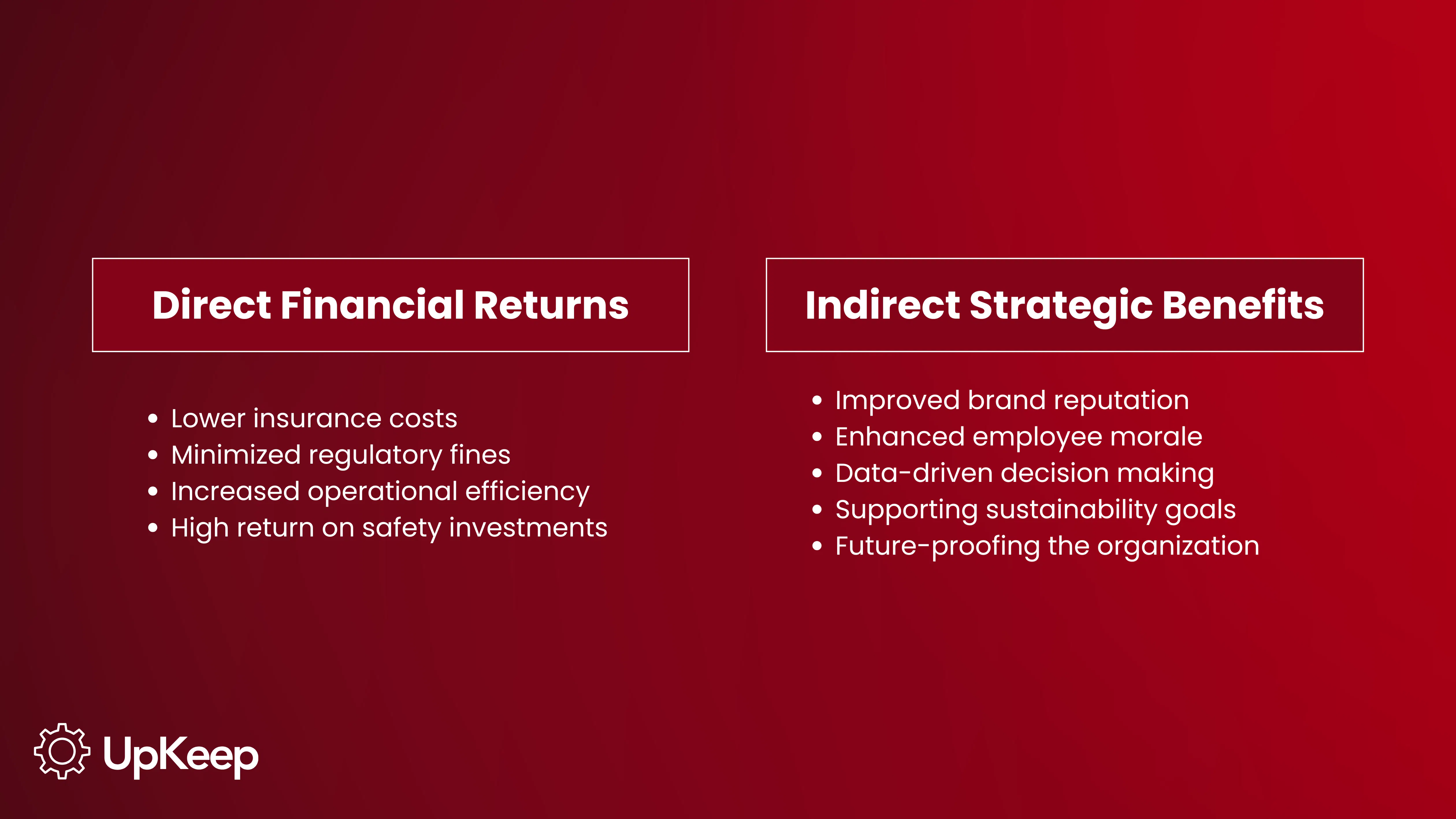
Direct Financial Returns
The most tangible benefits of a mature EHS program appear directly on the balance sheet. These returns are measurable and have a significant impact on profitability.
Key direct benefits include:
High Return on Safety Investments: Studies consistently show strong financial returns from EHS initiatives. Companies can see a return of up to six dollars for every dollar invested in an effective safety program.
Lower Insurance Costs: A primary driver of ROI is the reduction in workers' compensation insurance premiums. Fewer workplace incidents and a proactive safety culture directly lead to lower insurance costs.
Minimized Regulatory Fines: EHS software automates compliance tracking and maintains a clear audit trail, significantly reducing the risk of costly penalties from regulatory bodies such as OSHA.
Increased Operational Efficiency: Automating EHS processes frees up valuable time for safety professionals. By replacing manual paperwork with streamlined digital workflows for incident reporting, inspections, and data analysis, teams can focus on proactive hazard prevention rather than administrative tasks.
Indirect Strategic Benefits
EHS programs create widespread value that enhances an organization's strategic position and resilience. While harder to quantify, these indirect benefits are crucial for sustainable growth.
Strategic advantages include:
Improved Brand Reputation: A strong commitment to employee safety and environmental stewardship enhances a company's public image, building trust with customers, investors, and the community.
Enhanced Employee Morale: A 2025 Report by the World Economic Forum & McKinsey Health Institute states that investments in EHS programs lead to higher employee morale, better engagement, and lower turnover rates.
Data-Driven Decision Making: Modern EHS platforms centralize safety data, offering real-time analytics and dashboards. This empowers leaders to identify risk trends, understand root causes, and make informed decisions to prevent future incidents.
Supporting Sustainability Goals: A robust EHS program provides the verifiable data needed for sustainability reporting, which investors and stakeholders increasingly demand.
Future-Proofing the Organization: By embedding a strong safety culture and leveraging data, organizations can anticipate future risks, adapt to changing regulations, and ensure long-term business continuity.
Departments that benefit from EHS Software
An investment in Environment, Health, and Safety (EHS) software delivers value far beyond the safety department, creating a positive ripple effect across the entire organization. When a company commits to a strong EHS program, every team reaps tangible benefits. Ultimately, a proactive EHS strategy integrates safety and efficiency into the core of every department's operations, driving collective success.
Department | Benefits of EHS Software | Key Impact |
EHS and Safety Teams |
| Up to 40% reduction in time spent on administrative tasks. |
Operations and Production Teams |
| 5-7% improvement in operational uptime for companies with top-tier safety performance. |
Finance and Leadership |
| Businesses earn a $4 to $6 return for every dollar invested in safety. |
All Employees |
| Up to 51% less employee turnover in companies with strong safety cultures. |
Calculate the ROI of your EHS Software in Four Steps
Calculating the return on investment (ROI) for Environment, Health, and Safety (EHS) software is a systematic process that quantifies the hard financial savings and the strategic value it brings to your organization. Following these steps can build a compelling business case for your EHS software investment.
Step 1: Calculate Direct Savings
The first step is to identify and calculate the direct, tangible savings the software will generate. These are often the easiest costs to quantify and include:
Savings from reduced incident costs. Fewer injuries lead to lower compensation claims, medical expenses, and insurance premiums.
Savings from avoided fines. Improved compliance management helps prevent costly fines and penalties from regulatory agencies like OSHA.
Savings on materials such as paper, printing, and physical storage by moving to a digital system.
Estimate time and labor costs saved through administrative tasks, report generation, and automation of data entry.
Step 2: Estimate Indirect Savings
Next, estimate the indirect or "soft" savings. While assigning a precise dollar value to these benefits is harder, they are critical to the overall value proposition.
Savings from increased productivity due to less downtime from incidents and more efficient workflows.
Savings from higher employee morale. A safer work environment reduces employee turnover and the associated costs of hiring and training new staff.
Estimate the value of an enhanced brand reputation: A strong safety record can improve your company's public image, positively impacting sales and customer loyalty.
Step 3: Determine the Total Investment Cost
To calculate an accurate ROI, you must determine the total cost of ownership (TCO) for the EHS software.
Software Fees: Subscription, licensing, and user fees.
Implementation: Costs for setup, data migration, and configuration.
Training: The cost of training your employees to use the new system.
Support: Ongoing maintenance and technical support fees.
Step 4: Calculate the Final ROI
With the identified savings and costs, you can calculate the final ROI using a standard formula.
Calculate Total Savings: Add the Direct Savings and Indirect Savings.
Calculate Net Return: Subtract the Total Investment Cost from your Total Savings.
Use the ROI Formula: ROI (%) = (Net Return / Total Investment Cost) x 100
For example, if your savings are $150,000 and your total investment cost is $50,000, the net return is $100,000. The ROI would be ($100,000 / $50,000) x 100 = 200%.
Pro Tip: Align EHS ROI with Corporate Goals
To make a strong business case and encourage executive buy-in, align the calculated ROI with broader corporate objectives. Frame the benefits in the context of the company's strategic goals, such as improving operational efficiency, achieving sustainability targets, or increasing overall profitability. This demonstrates that the EHS software is a strategic asset for the entire organization.
Maximizing the Return on Investment (ROI) of Your EHS Software
To maximize its return on investment (ROI), companies must adopt a strategic approach focused on integration, user adoption, and continuous improvement. Simply owning the software is not enough; actual value is unlocked when the EHS system becomes indispensable to the company's daily operations and culture. To make the most of this, you should leverage the people, processes, platform, and the company’s strategy.


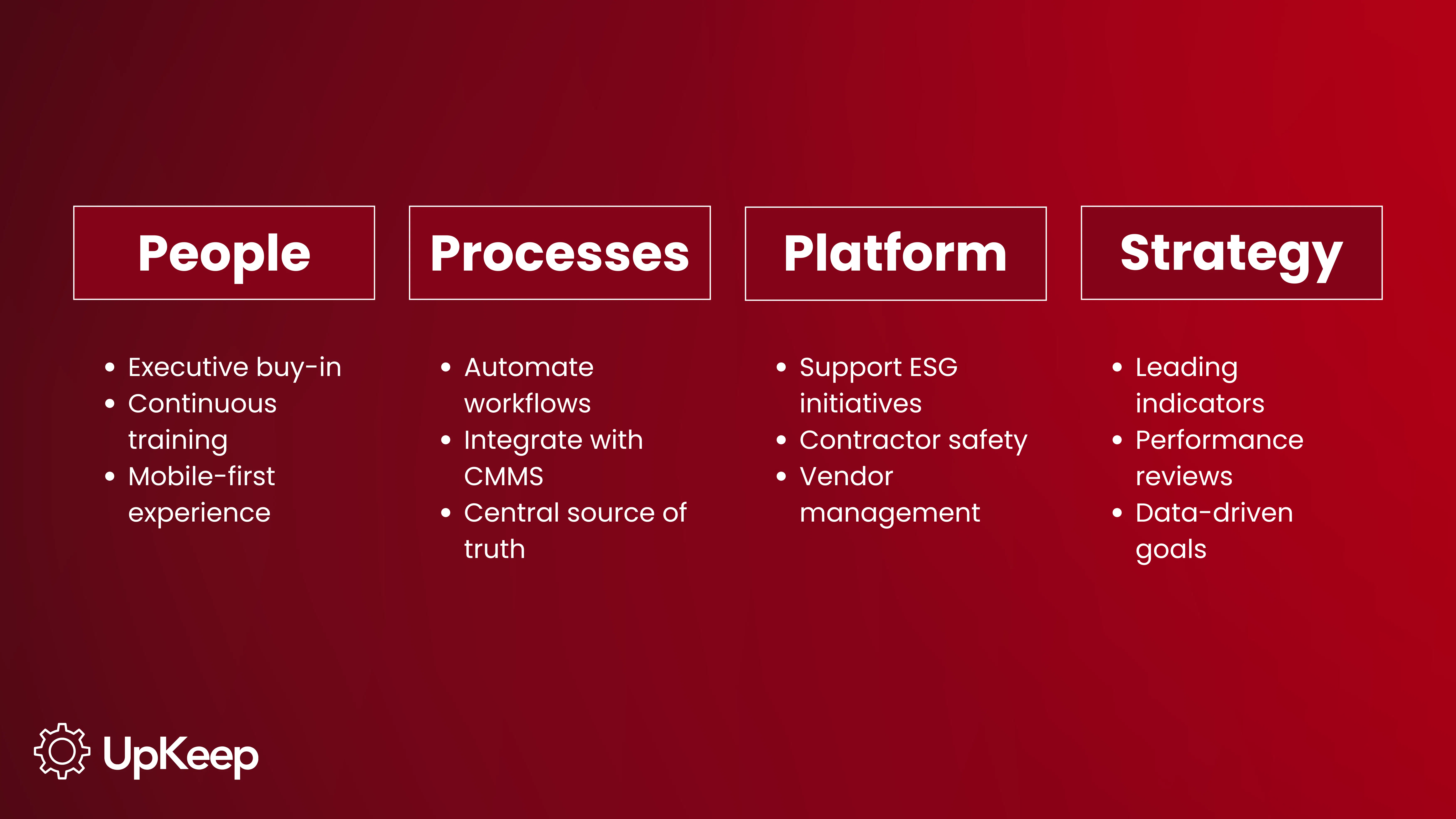
People - Drive Organizational Adoption and Engagement
Secure Executive Buy-In. Leadership must visibly champion the EHS software and use its data in meetings and presentations to signal its importance.
Provide Continuous, Role-Based Training. Ensure every employee knows how the system makes their specific job easier and safer.
Prioritize a Mobile-First, User-Friendly Experience. A simple and accessible mobile interface is critical for frontline worker engagement and data collection.
Processes - Integrate EHS Software into Core Business Processes
Automate and Streamline Key Workflows. Use the system to automate administrative tasks like assigning Corrective and Preventive Actions (CAPAs), sending deadline notifications, and generating compliance reports.
Connect EHS to Existing Operational Systems. Create triggers between platforms, such as requiring a Job Hazard Analysis (JHA) in the EHS system before a high-risk job can be started in your CMMS.
Position the EHS system as the central source of truth for safety, operations, and maintenance teams to coordinate and communicate risk management efforts.
Platform - Expand the Platform's Value Beyond Compliance
Extend the System to Support Sustainability Initiatives. The platform tracks and reports key environmental metrics like energy use, water consumption, and waste generation.
Improve Contractor and Vendor Safety Management. Configure the system to onboard, train, and monitor the safety performance of third-party partners and vendors while on-site.
Strategy - Use Data for Proactive Performance Management
Focus on Leading Indicators Over Lagging Metrics: Track proactive data like near-miss reports, safety observations, and training completions to identify and address risks before they cause harm.
Conduct Regular Performance Reviews: Schedule recurring meetings with stakeholders to analyze EHS dashboards, identify risk trends, and set data-driven goals for continuous improvement.
The Importance of Mobile Access in EHS Software
Mobile EHS apps connect frontline workers to the central safety system. Providing field-friendly software is now a competitive advantage and a fundamental requirement for creating an effective and proactive safety culture.
Enables Real-Time Reporting and Communication
Mobile apps allow employees to instantly report incidents with photos from the field, eliminating dangerous delays in reporting. This gives managers immediate visibility into risks, enabling them to push safety alerts directly to frontline workers.
Improves Efficiency and Data Accuracy
By digitizing workflows for inspections and audits, mobile apps eliminate inefficient and error-prone paper processes. Direct data entry with standardized fields ensures information is accurate and complete, improving the quality of safety insights.
Enhances Safety Culture and Engagement
An easy-to-use EHS app empowers all employees to participate in safety, lowering the barrier to engagement. This shared responsibility builds trust and demonstrates a company-wide commitment to worker well-being.
Strengthens Risk Management and Compliance
Mobile EHS apps create a time-stamped, audit-ready digital record of all safety activities, simplifying compliance. Real-time field data, combined with instant access to safety documents, enables leaders to proactively identify and mitigate risks.
Maximize your EHS ROI with UpKeep
UpKeep EHS is a dedicated safety-incident reporting and management module that drives significant ROI by seamlessly connecting safety to maintenance. This digital approach moves your team from reactive cleanup to proactive hazard elimination, significantly reducing costly downtime and injury claims. A Verdantix study cited by the National Safety Council found that logging Corrective and Preventive Actions (CAPAs) with technologies like UpKeep EHS yielded the most ROI, up to about 239% from administrative savings and accident prevention.
Don't wait for your next costly incident to prove the value of safety. Request a demo to start driving a solid ROI for your team today.
Frequently Asked Questions about ROI for EHS Software
What is the typical ROI for EHS software?
Companies implementing EHS systems for over five years achieved an average ROI of 239%. For every $1 invested in safety, organizations typically save $4 to $6 by avoiding injuries, lost work, and administrative costs. Businesses with effective safety management systems can reduce injury and illness costs by 20%to 40%.
How can industrial companies benefit from AI in EHS?
AI analyzes large datasets to identify patterns that lead to negative outcomes, flagging recurring risk circumstances and recommending preventive actions before incidents occur. AI automates manual work, such as near-miss reporting and video investigation, freeing EHS professionals to focus on coaching and high-value tasks.
How do I convince management to invest in EHS?
First, translate EHS metrics into financial terms by calculating the ROI. Then show how EHS supports broader company objectives, such as operational excellence, brand reputation, and becoming an employer of choice.
MÁS DE 4000 EMPRESAS CONFÍAN EN LA GESTIÓN DE OPERACIONES DE ACTIVOS
Liderando el camino hacia un futuro mejor para el mantenimiento y la confiabilidad
Los datos de sus activos y equipos no pertenecen a un silo. UpKeep simplifica ver dónde se encuentra todo, todo en un solo lugar. Eso significa menos conjeturas y más tiempo para concentrarse en lo que importa.






![[Review Badge] Gartner Peer Insights (Dark)](https://www.datocms-assets.com/38028/1673900494-gartner-logo-dark.png?auto=compress&fm=webp&w=336)