Entrada en el Blog
Work Smarter and Gain Efficiency with Predictive Maintenance Strategy
Stay ahead of equipment failure and lead with data by adopting a predictive maintenance strategy. Learn what this approach entails and how to implement it.



Key Takeaways
Predictive maintenance (PdM) catches early warning signals of asset degradation through continuous sensor monitoring, enabling teams to act before failures occur.
A successful PdM program requires the right foundation, including a clean asset register, a criticality assessment to prioritize high-value equipment, and a CMMS to centralize condition data, work orders, and asset history.
AI and IoT complement PdM by automating work order generation and recommended actions, which reduces manual effort and lets technicians focus on decisions that require human judgment.
Equipment doesn’t fail without warning. Temperatures start to rise, vibrations shift, and performance degrades long before anything visibly breaks. It’s imperative to catch those signals early to gain the upper hand on growing problems.
A predictive maintenance (PdM) strategy makes that possible. By monitoring equipment condition in real time and acting on what the data shows, teams enable maintenance decisions that are data-informed, cost-effective, and risk-reducing.
What is a Predictive Maintenance Strategy?
Predictive maintenance is a data-driven approach that monitors the condition of your equipment in real time to anticipate failures before they happen, which allows teams to optimize equipment servicing and avoid unexpected and costly emergency repairs.
PdM alerts teams to act based on the data, making it more precise and cost-effective for high-value or high-risk assets.
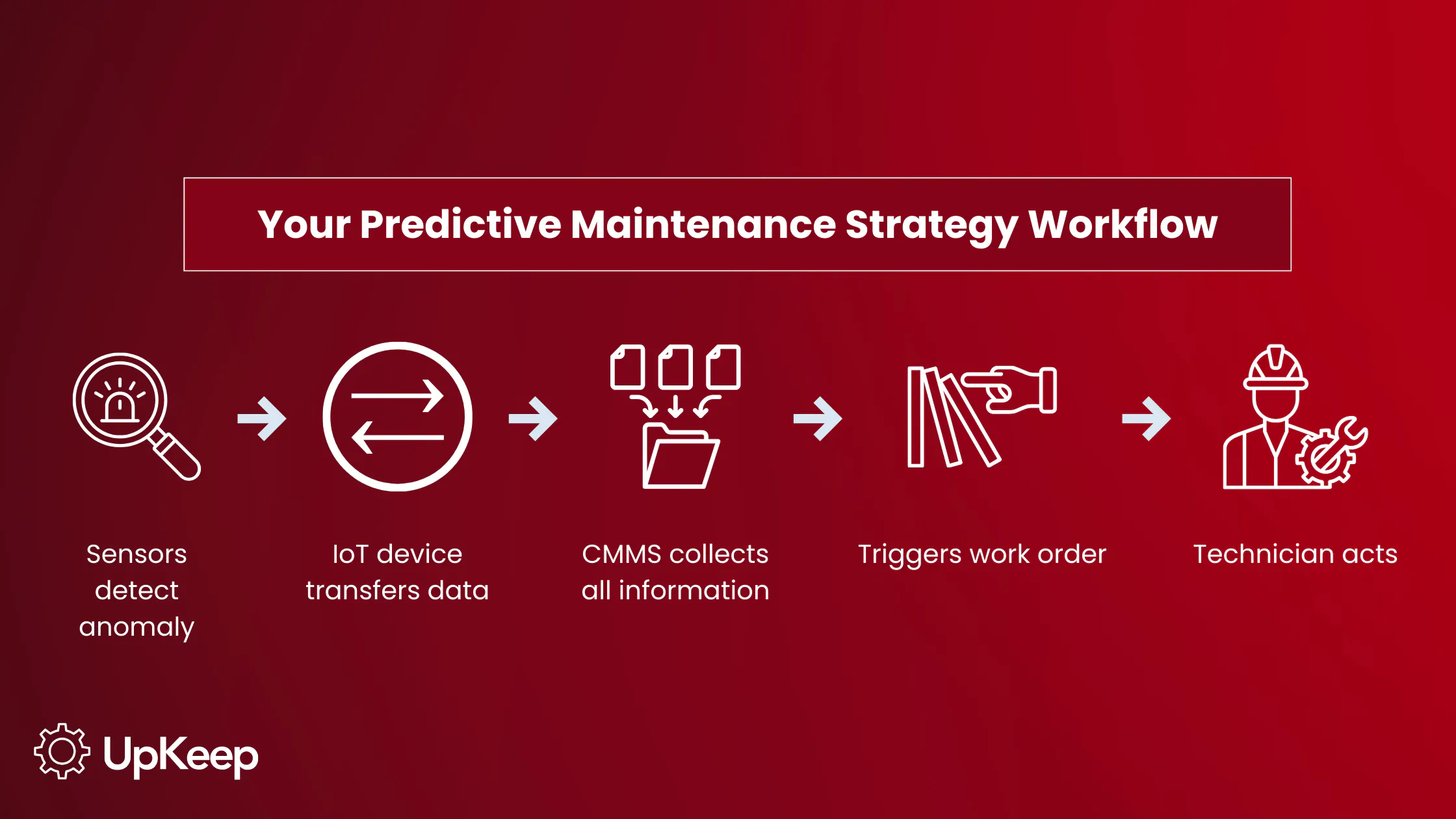
PdM collects continuous performance data through sensors, analyzes that information for anomalies or patterns that signal deterioration, and then prompts a maintenance response before a failure.
When combined with a centralized CMMS, that information connects to work orders, asset history, and maintenance schedules. This, in turn, prevents time-consuming manual cross-referencing and jumping from system to system.
What Does a Predictive Maintenance Strategy Include?
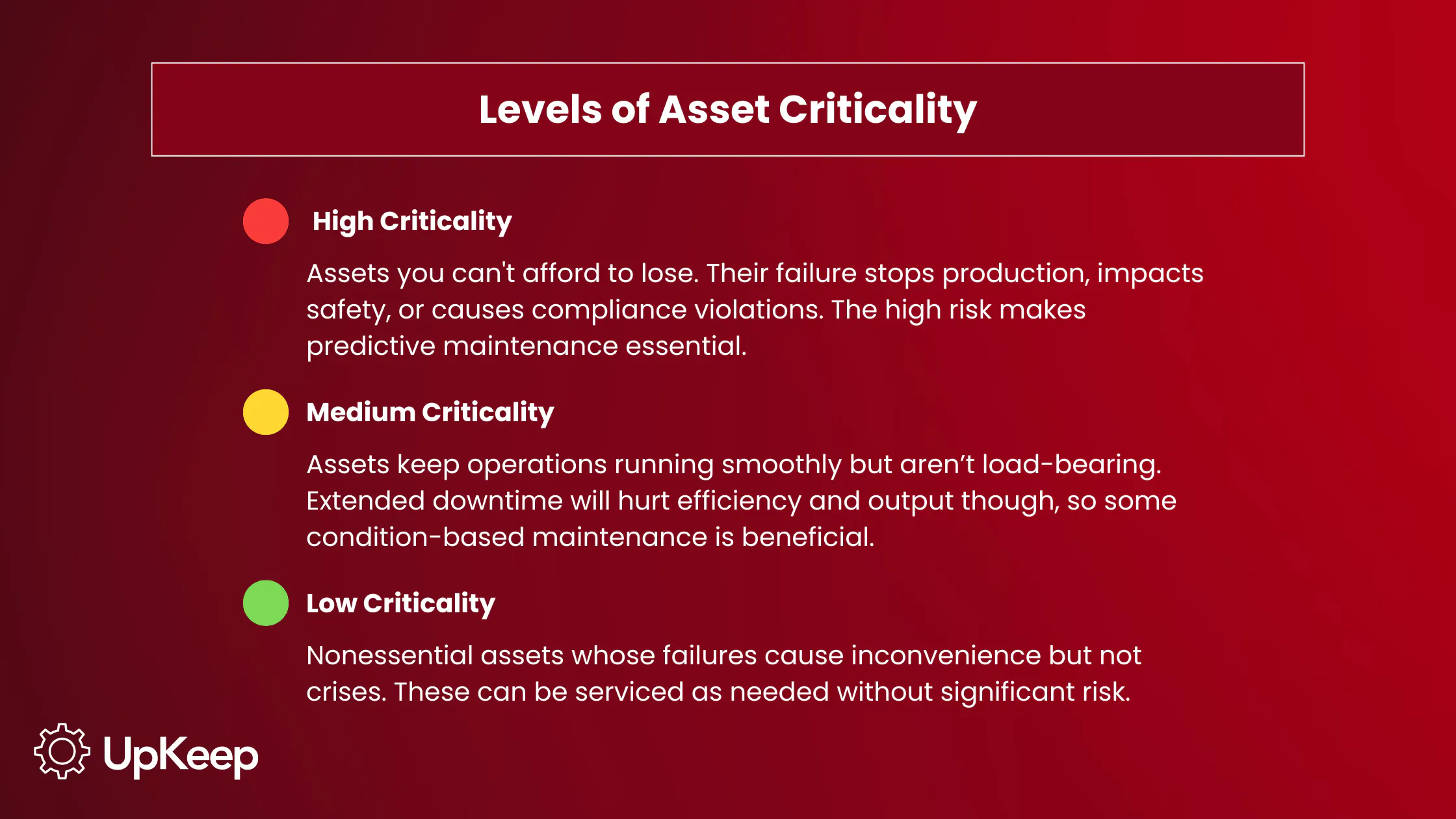
Start with an asset criticality assessment (ACA) to determine where the investment in PdM makes the most sense before committing to a full rollout.
An ACA answers the question, “If this fails, how bad will it be?” To conduct one:
Identify what a system is supposed to accomplish.
Break it down into the functions you need to reach those goals.
Trace those functions back to the components that operate them.


Organizations that rely on reactive maintenance, incomplete asset registers, or disconnected systems may need to strengthen their data foundation before predictive monitoring can deliver meaningful results. PdM is only as good as the data behind it.
Mid-size and enterprise operations with multiple asset classes or facilities tend to see the greatest gains from PdM, since the volume and variety of equipment make manual condition tracking impractical, and the cost of unplanned downtime is proportionally higher.
When it comes to budgeting, PdM collection typically requires a full-time, dedicated employee and investment in a robust tech stack, including IoT sensors, AI and machine learning algorithms, and data analytics.
If you already track KPIs like mean time between failures (MTBF), mean time to repair (MTTR), and planned maintenance percentage, you have a baseline in place to measure PdM's impact from day one. This enables you to build a business case and gain buy-in from leadership and other teams.
Predictive Maintenance Readiness Checklist
Use the following criteria to assess whether your organization is ready to implement and sustain a predictive maintenance program:
A clean, complete asset register: Incomplete or inconsistent asset records will produce unreliable signals, so a well-maintained asset register is crucial.
A criticality assessment identifying key assets: Not every asset warrants predictive monitoring. A criticality assessment focuses resources on the equipment whose failure would most significantly impact safety, production, or cost.
Relevant KPI tracking: Metrics like MTBF, MTTR, and planned maintenance percentage establish the performance baseline needed to measure improvement. These should be in place before implementation begins.
A CMMS in use for work orders and asset history: Predictive maintenance generates recommendations that need to flow into actionable work orders. A CMMS captures that handoff and provides the historical record that makes trend analysis possible.
Budget and dedicated staffing: PdM requires ongoing investment in sensors, software, and the people who interpret and act on the data.
Defined alert thresholds and escalation processes: These ensure the right people act at the right time.
Cross-functional stakeholder alignment: Predictive maintenance touches operations, finance, IT, and leadership. Alignment on goals, roles, and success metrics makes a program sustainable.
Tools to Drive Your Predictive Maintenance Strategy
Sensors are the foundation of any PdM program and can include:
Vibration sensors that detect early signs of bearing wear and misalignment in rotating equipment.
Thermal cameras that identify heat anomalies in electrical systems.
Ultrasonic tools that locate the source of sound-based failure signals.
Oil analysis to track fluid degradation in engines and hydraulic systems.
Internet of Things (IoT) devices offer a practical middle ground between wired systems and portable collectors. They take scheduled or continuous readings and transmit data wirelessly to your CMMS, which reduces manual data collection while maintaining information quality.
A CMMS is the connective tissue of a predictive maintenance program, offering a single source of truth where condition data, maintenance schedules, and operational analytics live together. Sensor data flows directly into the CMMS, which then triggers automated work orders and updates asset history.
Combining multiple PdM technologies gives a clearer picture of operations and helps teams make faster, more confident repair decisions. For example, vibration analysis may identify a failing bearing, while ultrasonic analysis pinpoints its location. As sensor costs continue to fall and wireless connectivity improves, PdM technology is becoming increasingly accessible to organizations that previously thought it out of reach.

How AI Can Power a Predictive Maintenance Strategy
AI transforms predictive maintenance from reactive monitoring into proactive intelligence. Rather than requiring technicians to manually review condition data and make decisions, AI expedites the PdM process by analyzing patterns across large data sets and offering recommendations.
Agentic AI tools like UpKeep's Nova go further by automating the work that follows an alert. Nova can generate work orders, schedule preventive maintenance, and flag anomalies without requiring manual input, freeing technicians to focus on the repairs and decisions that require human judgment.
Natural language interaction removes one of the most common barriers to CMMS adoption among frontline teams. When technicians can update records, pull asset history, or log a finding by describing it in plain language, it streamlines more consistent data entry and strengthens the quality of the entire PdM strategy.
AI-powered reporting and dashboards give operations and maintenance leaders customizable visibility into performance, cost, and reliability trends across their asset portfolio, making it easier to justify investment and demonstrate the program's value.
Take Your Maintenance Strategy From Preventive To Predictive
The transition from a preventive to a predictive maintenance program succeeds when it starts small, proves its value quickly, and scales from there:
Start with a clean asset register. Before adding any condition monitoring, make sure your CMMS holds accurate, complete records of your assets, their locations, and their histories. That foundation makes anomalies detectable in the first place.
Secure cross-functional buy-in early. The transition stalls when PdM stays isolated in the maintenance department. Align production managers, operations leaders, and frontline technicians on what the program aims to accomplish before you scale. When people across the organization understand the goals, they’re more likely to lend their support and become advocates.
Define your alert thresholds and escalation process before going live. Decide up front what sensor reading triggers a work order, who’s notified, and what the expected response time is. An undefined procedure is one of the fastest ways to generate alert fatigue and lose team trust in the system before it has a chance to prove itself.
Use your existing KPIs as your baseline. Be sure to track MTBF, MTTR, and planned maintenance percentage to measure impact clearly. These metrics are how you build a business case, demonstrate ROI, and earn the organizational support to keep the program growing.
Preventive vs. Predictive Maintenance
Preventive Maintenance | Predictive Maintenance | |
Service triggered by | The schedule | The asset’s condition |
Timing based on | A predetermined cadence, whether the asset needs it or not | When data indicates service is required |
Informed by | Manufacturer recommendations, run time, and historical service data | Real-time sensor readings of asset quality, full asset history, performance trends |
Best for | Low- to medium-criticality assets and equipment with predictable wear | High-criticality assets, hard-to-replace equipment, systems that impact safety and compliance |
Get Ahead of Downtime With Predictive Maintenance
Predictive maintenance is a strategic commitment to running your operations on data rather than instinct. Build a solid foundation, align the right people, and connect every layer of the program into a single platform to earn the best results from this approach.
If you want fewer emergency repairs, longer asset life, and a team spending more time on work that matters rather than reacting to unplanned failures, the PdM strategy provides a strong advantage. Simply let the data lead.
Frequently Asked Questions About Predictive Maintenance Strategy
What types of assets benefit most from predictive maintenance?
High-criticality assets whose failure would halt production, create safety risks, or cause compliance violations deliver the greatest ROI from PdM. Low-criticality assets that create inconsequential impact upon failure are generally suited for as-needed maintenance.
What tools are commonly used in a predictive maintenance program?
The most common include vibration sensors for rotating equipment, thermal cameras for electrical systems, ultrasonic tools for sound-based failure detection, and oil analysis for engines and hydraulic systems.
Do I need AI to run a predictive maintenance strategy?
No, but AI significantly accelerates the process. Without it, technicians must manually review condition data and make decisions; AI analyzes patterns across large datasets, automates work order generation, and flags anomalies with minimal human input.
How does a CMMS support predictive maintenance?
A CMMS acts as the central hub where sensor data, asset history, maintenance schedules, and work orders all connect. One accessible source of truth eliminates manual cross-referencing and ensures all teams operate based on complete, accurate information.
What KPIs should I track to measure predictive maintenance success?
Mean time between failures (MTBF), mean time to repair (MTTR), and planned maintenance percentage are the core metrics. Establishing a baseline with these before launching PdM allows you to quantify impact and build a business case for continued investment.
How do I know if my organization is ready to use a predictive maintenance strategy?
Key readiness indicators include having a complete asset register, a complete criticality assessment to identify key assets, a CMMS already in use, relevant KPIs, an allocated budget and dedicated staff, and cross-functional stakeholders aligned on program goals.
MÁS DE 4000 EMPRESAS CONFÍAN EN LA GESTIÓN DE OPERACIONES DE ACTIVOS
Liderando el camino hacia un futuro mejor para el mantenimiento y la confiabilidad
Los datos de sus activos y equipos no pertenecen a un silo. UpKeep simplifica ver dónde se encuentra todo, todo en un solo lugar. Eso significa menos conjeturas y más tiempo para concentrarse en lo que importa.






![[Review Badge] Gartner Peer Insights (Dark)](https://www.datocms-assets.com/38028/1673900494-gartner-logo-dark.png?auto=compress&fm=webp&w=336)