Entrada en el Blog
How Predictive Maintenance is Reshaping Building Operations in 2026
Learn how predictive maintenance transforms building operations in 2026 by reducing costs, extending asset life, improving reliability, and optimizing energy use with smart analytics.



Key Takeaways:
Predictive maintenance is becoming a core strategy for building operations in 2026, driven primarily by aging infrastructure, rising energy costs, and newly mature analytics technology.
The article explains how the technology works by moving teams from a time-based to a condition-based model, detailing the six main benefits, such as lower costs, higher reliability, and longer asset life.
It provides a practical overview of different analytics methods (from simple rules to RUL estimation), their real-world applications in systems like HVAC and elevators, and how to overcome common implementation challenges.
Why Predictive Maintenance Matters in 2026
Building systems are aging. Energy costs are climbing. And maintenance teams are being told to save money while keeping everything running. Predictive maintenance helps solve that problem by using data to spot early signs of wear, so teams can plan repairs before failures happen.
As a result, predictive maintenance has shifted from a "nice-to-have" to a core part of modern building operations. The key drivers behind this shift are clear:
Aging Infrastructure: Older HVAC units, pumps, and chillers need constant attention. Predictive tools detect performance drops early and extend asset life.
Rising Energy Costs: Heating, cooling, and lighting systems waste power when components degrade. Fault detection helps cut energy use and stabilize budgets.
Budget Pressure: Preventive maintenance still wastes time on healthy equipment. Predictive insights direct labor and parts where they’re actually needed.
Sustainability and Compliance: Smarter maintenance reduces waste, supports carbon targets, and improves reporting for sustainability efforts.
The 2026 Tipping Point: Why Now?
The push for predictive maintenance isn't new, but the technology is now mature enough for wide adoption.
Affordable IoT sensors, connected building management systems, and AI-driven analytics make it possible to track every major asset in real time—from HVAC chillers and pumps to lighting circuits and elevators. The global market for predictive maintenance is growing quickly as buildings modernize to cut costs and emissions.
How Predictive Maintenance Works in Buildings
Once you’ve made the case for predictive maintenance, the real question is how it fits into day-to-day building operations. It’s not about adding more data; it’s about making that data useful.


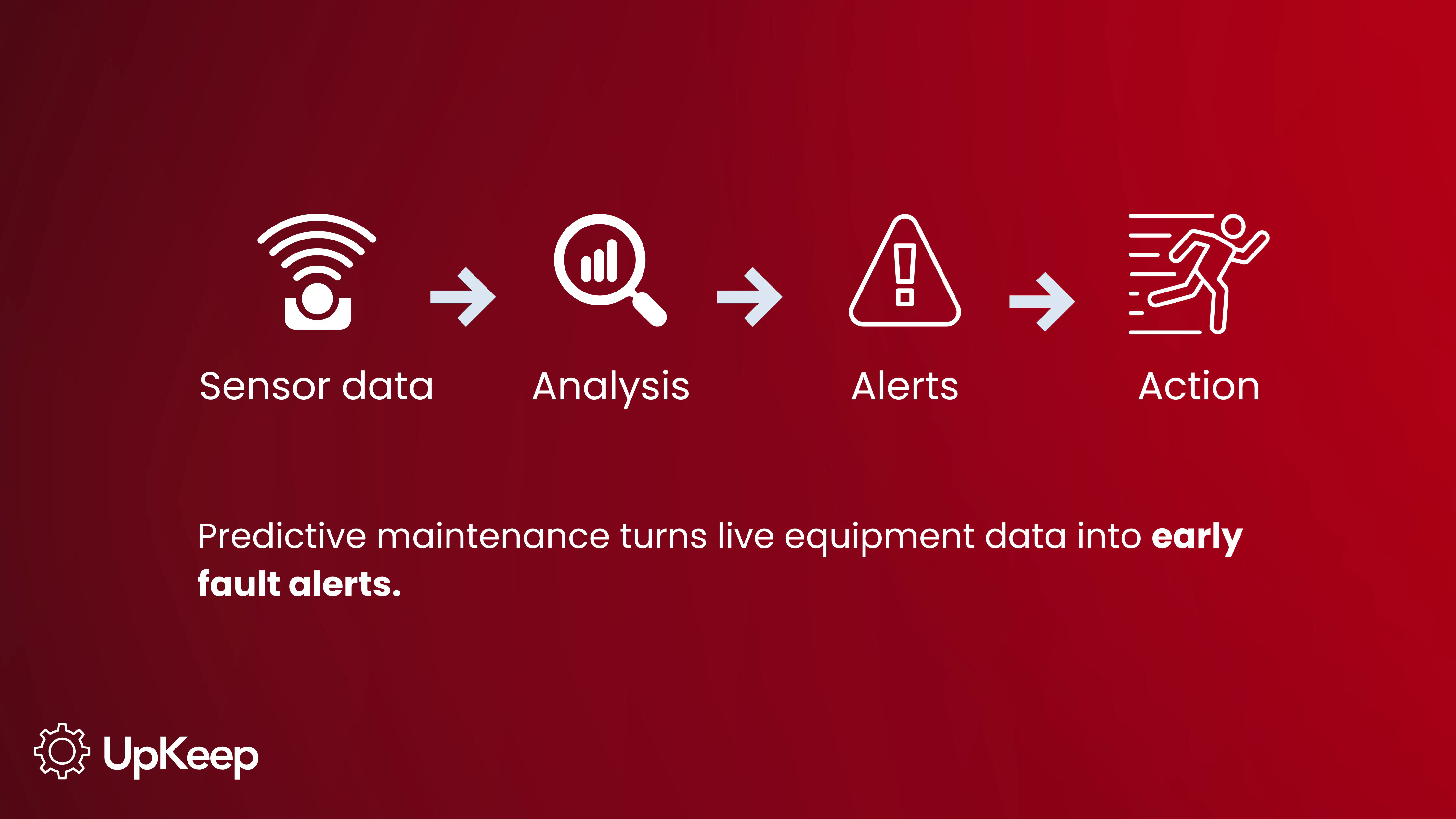
Most systems follow the same basic workflow:
Data collection: Sensors and meters already built into HVAC units, pumps, or switchboards capture readings like vibration, temperature, or current draw.
Condition analysis: Software compares these readings against historical baselines or manufacturer specs to see when performance begins to drift.
Fault prediction: When a reading crosses a warning threshold or a trend indicates likely failure, the system raises an alert or automatically creates a work order.
Action: Technicians inspect or repair the asset before it fails, keeping systems online and preventing secondary damage.
This moves maintenance from being time-based to condition-based:
Approach | What it means | Example |
Reactive maintenance | Fix it after it fails | Replace a fan motor once it stops working |
Preventive maintenance | Fix it on a fixed schedule | Service the motor every three months |
Predictive maintenance | Fix it when data shows a problem | Replace the motor when vibration readings rise beyond normal limits |
The difference is precision. Instead of servicing equipment because it’s “due,” teams service it because the data says it’s starting to fail. That means fewer unnecessary jobs, better resource use, and more stable uptime.
Benefits of Predictive Maintenance for Buildings
Predictive maintenance pays off when it turns information into action. The real value is in the extra uptime, longer asset life, and fewer callouts your team sees once the system’s running smoothly.
1. Lower maintenance costs
When faults are caught early, repairs are smaller, cheaper, and planned. Many facilities report cutting maintenance costs by around a quarter after switching from purely preventive schedules to predictive monitoring.
2. Higher system reliability
Knowing a fan or pump is drifting out of range means you can act before it stops. This keeps heating, cooling, and electrical systems online, avoiding knock-on failures that can shut down entire floors or production areas.
3. Longer asset lifespan
Consistent operation within safe parameters prevents the stress and heat cycles that wear components out. Over time, predictive monitoring can add years to the useful life of HVAC motors, compressors, and other high-value assets.
4. More efficient energy use
Faulty components often draw extra power long before they fail. Fixing issues early keeps efficiency high and helps buildings meet sustainability and carbon-reduction goals.
5. Safer working conditions
Predictive alerts flag overheating motors, pressure drops, or electrical imbalances before they become hazards. That means fewer emergency callouts and safer inspections for technicians on site.
6. Better planning and resource use
When you know which assets are likely to need work next, you can schedule jobs, order parts, and assign technicians in advance thus reducing overtime and wasted trips.
Analytics Methods Used in Predictive Maintenance
Not every building runs the same level of analytics. Predictive maintenance platforms typically use a mix of these methods.
Rule-based monitoring
This is the simplest level. You set thresholds for a parameter and get an alert when it’s exceeded. Example: AHU supply fan current draw rises 15% above normal for 20 minutes → open a work order. Good for: quick wins, retrofits, older plants.
Anomaly detection
The system learns what normal looks like for that asset (its usual temperature curve, vibration signature, or power profile) and flags patterns that don’t match. This works even if you don’t have lots of past failures on record. Good for: variable-load HVAC, pumps that cycle, buildings with mixed legacy equipment.
Performance deviation/indirect fault detection
Here the software looks at input vs output. If a chiller is delivering less cooling for the same power, or a pump is using more power for the same flow, it assumes a fault (fouling, belt slip, valve issue). Good for: energy-led maintenance, buildings chasing carbon targets.
Remaining useful life estimation
This is the most advanced. Using long-run sensor data plus asset history, the system estimates how long a component can run before failure. Instead of “something’s wrong,” you get “this fan bearing has a week left at current load.” Good for: critical assets, hospitals, data centres, sites with limited shutdown windows.
Why this matters for technicians
For technicians, the key is that you don't need the most advanced (RUL) method on day one; you can start with simple rules and anomaly detection. This allows you to match the right method to the right asset—for example, simple rules for lighting panels, anomaly detection for lifts, and RUL for critical chillers. Ultimately, better analytics means fewer nuisance alerts and more "real," actionable work orders.
Real-World Applications Across Building Systems
Once predictive maintenance is up and running, it becomes part of everyday operations. The same principles apply across different systems, but each asset type reveals faults in its own way.
HVAC systems
Heating and cooling equipment are ideal for predictive monitoring because they already generate large volumes of data. Vibration or temperature sensors can detect worn bearings, refrigerant leaks, or clogged filters long before they cause downtime. Analytics can also reveal gradual efficiency loss, such as a compressor drawing more power to deliver the same cooling output.
Electrical and lighting systems
Smart panels and meters can identify voltage drops, phase imbalances, or excessive current draw that indicate loose connections or failing components. Predictive alerts let technicians replace parts during scheduled access times rather than responding to tripped circuits or lighting outages.
Elevators and lifts
Vibration and motor-speed tracking exposes cable stretch, door misalignment, or brake wear early. These insights help teams plan maintenance during low-traffic hours and avoid out-of-service events that disrupt tenants.
Plumbing and water systems
Flow and pressure sensors flag leaks, pump inefficiencies, or valve issues as soon as they develop. Predictive data can even warn of partial blockages or cavitation before a failure floods plant areas.
Building envelope and structure
Strain gauges, displacement sensors, and crack monitors track how façades and structural components respond to weather and load over time. Subtle changes can be logged and compared to baseline readings to detect problems like façade movement or concrete fatigue.
The advantage is scale. Once sensors and software are connected through a central platform, all of these systems can be monitored side by side. That means the same dashboard that spots a chiller fault can also highlight a voltage drop or water leak — giving teams a clear view of where to focus attention first.
Challenges in Implementation and How to Overcome Them
So good so far, right? Well, here’s the but… even when the benefits are clear, getting predictive maintenance up and running isn’t always smooth. Most issues come down to cost, data, or capability. However, all of the following challenges can be managed with a phased, practical approach. See below:
1. Upfront costs
Sensors, analytics platforms, and integration can look expensive at first. The best way around this is to start small: monitor one system, like HVAC, in a single building. Use those results to justify wider rollout and secure further budget.
2. Data gaps and inconsistencies
Predictive models rely on clean, complete data. Many sites still have missing asset records or incomplete maintenance logs. Before adding sensors, update your asset registry and link it to your CMMS. Even simple steps like standardising asset names and logging readings consistently can make a major difference.
3. Integration with existing systems
Older building management systems weren’t built to share data easily. Choose predictive tools that use open APIs and can connect directly to your current BMS or CMMS. That way, alerts feed straight into your existing workflows rather than creating another silo.
4. Skills and confidence
Technicians don’t need to become data scientists, but they do need to trust the system. Run short, practical sessions showing what each alert means and how it links to known issues on-site. Early wins build credibility faster than presentations or theory.
5. Change fatigue
Introducing predictive tools often coincides with other digital upgrades. To keep momentum, focus on quick, visible results — fewer callouts, smoother HVAC performance, reduced downtime. Once the team sees those gains, adoption becomes natural.
The key takeaway here is that predictive maintenance works best when built step by step. Start where the pain is highest, prove the value, and expand from there. Over time, your predictive system becomes part of standard operations, not an add-on project.
Connecting Predictive Data to Your CMMS
The benefits of a connected CMMS Connecting these two systems is what turns a predictive alert into a manageable workflow. Instead of data living in a separate dashboard, alerts can automatically create work orders, prioritize jobs based on asset health, and provide technicians with all the sensor data in one place. This closes the loop, ensuring insights aren't just seen—they're acted on.
Bring predictive maintenance to life with UpKeep As these technologies mature, UpKeep helps you get there now. It connects predictive insights directly to mobile work orders and asset data, giving your team one platform to improve reliability, safety, and energy performance. See how it works with a free trial.
The Future of Predictive Maintenance in Smart Buildings
Predictive maintenance is evolving fast. As we’ve shown, building systems are shifting from simple monitoring to automation, where equipment can diagnose and even correct faults on its own.
Here’s what’s coming in 2026:
Edge AI
More analytics will happen right inside the building instead of in the cloud, as AI models run locally on devices. That means faster alerts, even when connectivity drops.
5G and faster networks
More connected devices mean richer, faster data. High-speed networks allow real-time analysis of vibration, power quality, and other detailed signals.
Autonomous diagnostics
Some systems already make small automatic adjustments — like balancing airflow or tuning pump speeds — before anyone receives an alert.
Sustainability integration
Predictive tools will link asset health directly to energy and carbon metrics, so teams can see the environmental impact of every repair.
Self-optimising buildings
Digital twins and AI models will learn from past faults and continually fine-tune performance without manual intervention.
Bring Predictive Maintenance to Life with UpKeep
As these technologies mature, buildings will take care of more routine tasks themselves. For maintenance teams, that means spending less time reacting and more time improving reliability, safety, and energy performance.
UpKeep helps you get there now. It connects predictive insights directly to mobile work orders and asset data, giving your team everything they need in one platform. See how it works with a free trial.
FAQs
Can predictive maintenance work with older building systems?
Yes. You can retrofit older assets with sensors or smart meters. Even a small amount of live data helps you detect problems early.
How much sensor coverage is enough?
Start small. Focus on high-value or high-risk assets like HVAC chillers, air handlers, or elevators. Once you see results, expand to other systems.
How long before I see results?
Most teams notice fewer emergency work orders and better uptime within 3–6 months. Energy savings and extended asset life follow soon after.
How do I connect predictive data to my CMMS?
In UpKeep, predictive alerts can link to work orders once your sensor data is connected to the platform. The exact setup depends on the sensors you use and how they send data. Most sensors pass their readings through a service or integration that UpKeep can receive. Once that connection is made, any alert from the sensor can create or update a work order inside UpKeep so your team sees it right away.
What’s the biggest mistake teams make when starting?
Collecting too much data but not using it. Start small, focus on one system, and refine your process before scaling up.
MÁS DE 4000 EMPRESAS CONFÍAN EN LA GESTIÓN DE OPERACIONES DE ACTIVOS
Liderando el camino hacia un futuro mejor para el mantenimiento y la confiabilidad
Los datos de sus activos y equipos no pertenecen a un silo. UpKeep simplifica ver dónde se encuentra todo, todo en un solo lugar. Eso significa menos conjeturas y más tiempo para concentrarse en lo que importa.






![[Review Badge] Gartner Peer Insights (Dark)](https://www.datocms-assets.com/38028/1673900494-gartner-logo-dark.png?auto=compress&fm=webp&w=336)