Entrada en el Blog
Resumen del panel del Día Mundial de la Fabricación Digital de IIoT
En "La muerte de MES: una nueva visión para la pila de software de fábrica", los panelistas discutieron los problemas con el enfoque estándar de las operaciones de fabricación.


It’s been quite the couple years for the manufacturing industry. Unpredictable supply chains, shifting consumer demand, turbulent global dynamics—all of it has forced businesses to adapt to a new agility. In order to succeed, manufacturers must be prepared to ramp up production to meet this surge in customer needs, while maintaining productivity amidst workforce shortages.
This new agility should be accompanied by innovation; the ability to create new business processes and optimize existing ones to maintain a competitive advantage. However, a company’s ability to thrive is only as good as the technologies they use to manage their operations. Unfortunately, today most manufacturers dislike their operations management systems for many reasons.
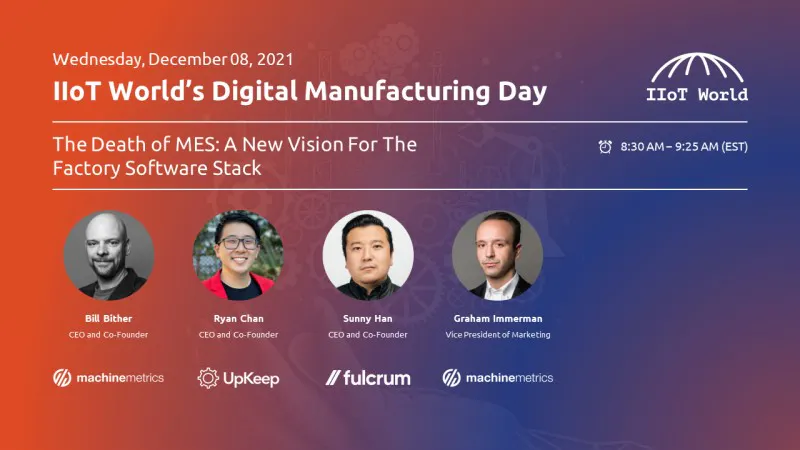
But a new school of thought is emerging. In the panel The Death of MES: A New Vision for the Factory Software Stack, Ryan Chan (CEO and Founder, UpKeep), Bill Bither (CEO and Co-Founder, MachineMetrics), Sunny Han (CEO and Co-Founder, Fulcrum), and Graham Immerman (Vice President of Marketing, MachineMetrics) discussed the problems with the standard approach to building manufacturing operations. Additionally, they painted a vision for the solution landscape based on the following principles:
Machines should drive people and systems, not the other way around.
A world of choice, where manufacturers are free to build a technology stack with the tools they need, not just the ones their enterprise resource planning (ERP) suite has chosen for them.
A world of flexibility, where data can be used across every department to exceed customer expectations, not just in operations, accounting, and planning.
A world of opportunity, where every manufacturer can have the technology and ability to be customer-first.
Why Do Manufacturers Hate Their System So Much, and Why Is It Coming to a Head Today?
According to Bither, ERP systems are generally monolithic and hard to customize, which is a problem since every manufacturer has its own differences. There are more niche solutions out there, but while they attempt to fit specific business needs, their addressable market is so small they don’t have the resources to make really good software.
So manufacturers are left with choosing between massive ERP systems that take years to implement, or niche ones that try to be more company-specific but the software isn’t good. It’s hard because when your business changes, these systems aren’t equipped to be flexible.
What Are the Challenges Manufacturers Face When Implementing These Legacy Systems?
Han began by mentioning Conway’s Law, which basically states that the communication architecture of your company affects the communication architecture of the software and product you build. This applies to ERP implementations as well; companies inherit the business processes and communication architecture the software dictates.
The probability that your business fits the software’s architecture is extremely low. It means people will have to shift everything they do, which causes a significant amount of questions and concerns. Both your business and your software should be adaptable and changeable at the same time, and that’s not the case. The pain most people feel when implementing these systems comes from that.
How Does the Current Manufacturing Skills Gap Affect the Requirements for a Modern Manufacturing Software Solution?
Historically, manufacturing has been a laggard with regards to technology. Chan emphasized that the time, need, and drive for better technology is now. In addition to the skills gap, manufacturers are also dealing with a workforce shortage and COVID-19. Chan believed that shop floor workers are being undervalued, which is why we’re seeing a greater need for digital transformation and better tools and technology.
What Are the Benefits of a Decentralized Approach?
Bither noted that up until recently, the monolithic ERP was basically the only option. And while a decentralized approach is still in its infancy, and there are still gaps, there are also a number of benefits for manufacturers. For example, if you’re manually entering data at the end of a shift and encountering inconsistencies, you can add a machine monitoring solution. If you’re lacking the ability to manage the maintenance on your equipment, pull in a CMMS solution. Quality issue? Find an excellent quality management solution and integrate with it.
You don’t have to rip out your system and bring in something new, according to Bither. That’s one of the great benefits of this decentralized approach, and why we’re seeing a move toward it.
What Actions Should Manufacturers Take to Leverage and Enhance Their Current Software?
In lieu of a rip and replace strategy, Han suggested even implementing just a few systems to cover any gaps. Assuming those systems are future-facing, they’ll connect with other systems going forward. Han said to not be afraid of these new systems and approaches if they’re going to help your business. Many manufacturers are still in a “one solution solves everything” mode, but being courageous, able, and willing to integrate those point solutions is the way to go.
What Is It About an Ecosystem Approach That Provides More Scalability Versus an All-in-One System?
Bither noted an all-in-one system doesn’t change to one’s business needs easily. Whereas if you have a series of best-of-breed, vertically integrated, SaaS applications, you can pull one out and put one in as needed. With a decentralized system, you can focus on what you do best. Plus, it can be difficult to scale an all-in-one system without spending a lot of money.
What Are Vendors Doing to Make This Easier for Manufacturers?
Bither also touched on the idea of strong APIs and open architecture. The most important aspect of being able to connect to other systems is having that data accessible.
What Advice Would You Give to Manufacturers Who Keep finding Themselves in “Pilot Purgatory?”
What Chan said he always tells people is to get to value ASAP. The pilot stage doesn’t add value. Chan elaborated that the real issue is getting people to adopt technology, and the big question is not if you like it or don’t like it, but rather, are you getting value from it? Chan’s biggest advice in addition to getting out of the pilot phase as soon as possible is to take it slow. Don’t do big things, do slow releases and get value along the way.
How Are You Convincing End Users Who Are Getting Promised an All-in-One Silver Bullet to Consider Other Approaches?
Han said there’s a growing understanding that complexity is not the same as something being complicated. It might seem simple to have everything in one box, but these solutions are often burying a significant amount of complication during implementation. Minimizing complexity, even if it becomes a little more complicated is the right approach. Furthermore, in Han’s company, he hasn’t had to do much convincing. Customers intuitively understand the benefits; they just haven’t had the opportunity to work with places like his.
Han believes the biggest difference is that the software ecosystem is a non-zero-sum system. Working together isn’t going to hurt anyone. Everyone’s just trying to make all this software work together. And doing that will make everything better.
Is a Single-Vendor-Meets-All Approach Even Achievable?
Chan mentioned this all stems from companies wanting a single source of record for their data. It makes sense because having cross-functional teams, and having data from said cross-functional teams, is helpful in driving the best decisions across the entire business. When we look at it like this, it’s important to have one solution with all this data.
So it’s possible, but it’s very difficult. What’s going to drive best innovation is best-in-breed vertical solutions with open platforms coupled with BI solutions to enable cross-functional data reports, enabling businesses to drive the best decisions. One thing that’s changed is the birth of new technologies bringing all this data across all teams together.
How Are Challenges Around Data Collection and Storage Different in a More Decentralized Approach?
According to Bither, if you have a decentralized system, each area of the stack is going to have its own way of storing and describing data. You need a way for them to communicate because integration happens when there’s commonality between systems. Luckily, you only really need to have a unique identifier for the primary objects needing to communicate. Whereas if you’re using a monolithic system, you’re going to have to own it all. You don’t have the flexibility to go really deep into an area of expertise.
Chan added that when you use a monolithic system, you’re basically resorting to the least common denominator, which can be good because now everything speaks a common language. The challenge with best-in-class vertical software is you could have different systems speaking different languages. That translation layer is super critical.
Han concluded the panel by saying in today’s day and age, it shouldn’t be the customer’s concern. Software providers should be figuring it out amongst themselves and their engineers. In the past, it’s always been the responsibility of the customer to figure it out. And that’s another difference between monolithic and best-in-class software: an emphasis more on the customer. In a monolithic system, the database is what you’re trying to make happy.
Click this link to watch the recording of the panel!
¿Quieres seguir leyendo?
Artículo
Maintenance in Data Centers Discussion with George Parada



Artículo
Gestión del ciclo de vida de los activos | Reducir el costo total de propiedad



Artículo
Optimización del Mantenimiento Preventivo | Lo que necesitas saber
MÁS DE 4000 EMPRESAS CONFÍAN EN LA GESTIÓN DE OPERACIONES DE ACTIVOS
Liderando el camino hacia un futuro mejor para el mantenimiento y la confiabilidad
Los datos de sus activos y equipos no pertenecen a un silo. UpKeep simplifica ver dónde se encuentra todo, todo en un solo lugar. Eso significa menos conjeturas y más tiempo para concentrarse en lo que importa.






![[Review Badge] Gartner Peer Insights (Dark)](https://www.datocms-assets.com/38028/1673900494-gartner-logo-dark.png?auto=compress&fm=webp&w=336)