Entrada en el Blog
Cómo el mantenimiento revolucionará el mundo (Capítulo 4, Parte 1)
*Over the next few weeks, UpKeep will be releasing chapters from our upcoming publication, How Maintenance Will Revolutionize the World. This is the first installment and includes chapters 1-3. Chapter 3 can be found here.


HOW TO EXECUTE A MAINTENANCE PLAN
“Yesterday's skills will not fuel tomorrow's economy.”
-Elaine Chao
THE ULTIMATE GUIDE FOR CHOOSING A MAINTENANCE STRATEGY
If you don’t have a maintenance plan at your business, it’s time to make one.
This section is for those just starting on their maintenance hero journey. If you do not have an intentional plan in place for maintenance on your equipment, start here.
INSTRUCTIONS
We’ve provided the simplest way to get started picking the right maintenance for your business below. First, break out your existing assets into this 2x2 matrix that plots each equipment by the cost of failure by costs to track. While this isn’t the most thorough way to assess your maintenance needs, it is helpful in guiding you on how to start.
Take all of your assets and rate each on the 1-10 scale below. As a general rule, assets are any pieces of equipment that are over $2000 in value OR are critical to your business. *Note, use your best judgement and this is meant to be a relative exercise!
1= high cost to track condition → 10= easy/low cost to track condition
1= high cost of failure → 10= low cost of failure


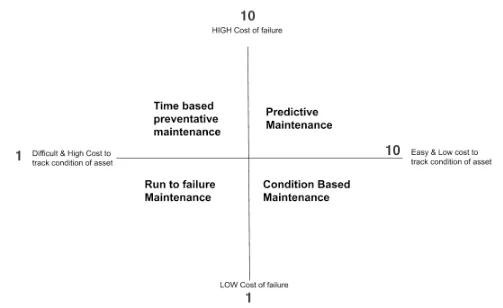
Next, plot each piece of equipment on this diagram.Note that you will have assets under different quadrants on the chart. This is right as each piece of equipment will have its own ideal form of maintenance.
Now that you have an idea of which kinds of maintenance you should invest in moving forward, read on to your specific section for more on this type of maintenance and how to get started.
STEP 1 - COLLECTING DATA - ADD YOUR ASSETS
Document all of your equipment
If you run maintenance on components of equipment, be sure to include that as well.
Put them into a spreadsheet that looks like the sample below. Your key columns should be: asset name, asset category, asset cost, and lifetime
| Asset Name | Asset Category | Asset Cost | Lifetime | ETC -- Additional Custom Data |
| Main Lobby HVAC | HVAC | $10,000 | 10 years | |
| Main Lobby HVAC - Heat exchanger | HVAC | $2000 | 5 years | |
| Main Lobby HVAC - Condensing Unit | HVAC | $1000 | 3 years |
STEP 2 - COLLECTING DATA - SCORE ON COST OF FAILURE
Score all of your equipment in a 1-10 based on the cost of failure of this asset. The cost of failure should include all things including:
Downtime costs
Regulatory cost
What are all of the risks from a hazard, safety, etc perspective
What is the probability of failure?
Replacement costs
STEP 3 - COLLECTING DATA - SCORE ON ABILITY TO TRACK CONDITION
Score all of your equipment from 1-10 based on the ability to measure and track the condition of your equipment. When thinking about the cost to measure performance and track condition, be sure to include:
Technician time to measure performance
Cost of sensors
Cost of time to implement
Do we currently have the resources
| Asset Name | Asset Category | Asset Cost | LIfetime | ETC -- Additional Custom Data | Cost of Failure of asset | Cost to measure performance and track condition |
| Main Lobby HVAC | HVAC | $10,000 | 10 years | **** | ||
| Main Lobby HVAC - Heat exchanger | HVAC | $2000 | 5 years | 6 | 4 | |
| Main Lobby HVAC - Condensing Unit | HVAC | $2000 | 5 years | 3 | 5 |
Step 4 - COLLECTING DATA - PLOT DATA POINTS
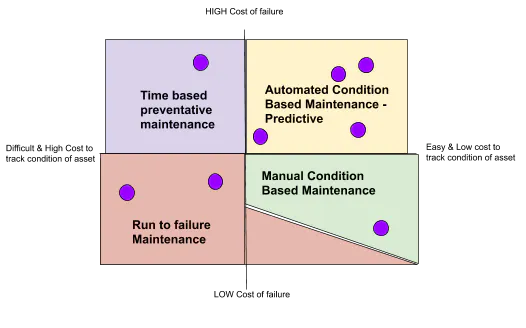
Plot all of your assets on this grid to help you determine the correct maintenance strategy
Your equipment may have many different maintenance strategies which is why it is important to showcase your sub-assets
This is an exercise to help guide you -- this is not the only way to do this.


Step 5 - COLLECTING DATA
Take all of your equipment and start assigning maintenance strategies.
If you have regulatory compliance, you’ll want to use those guidelines, not this guide.
Go through all of your assets in run to failure. Are you sure you want to run these into failure? Did we categorize this correctly?
If you have a component on an asset that is a single point of failure for your equipment, you’ll want to make sure that inherit the cost of the failure to be the main asset. For example, the HVAC could be a 6 cost of failure, and if the heat exchanger goes down then it takes the entire HVAC down, the heat exchanger should also be a 6 for cost of failure.
| Asset Name | Asset Category | Asset Cost | LIfetime | ETC -- Additional Custom Data | Cost of Failure of asset | Cost to measure performance and track condition | Maintenance Strategy |
| Main Lobby HVAC | HVAC | $10,000 | 10 years | **** | Multiple | ||
| Main Lobby HVAC - Heat exchanger | HVAC | $2000 | 5 years | 6 | 4 | Time based Preventive | |
| Main Lobby HVAC - Condensing Unit | HVAC | $2000 | 5 years | 4 | 5 | Condition Based |
Step 6 - SETTING UP REPORTS and ESTABLISH KPIs for the team
Run a few reports
You can now track how many assets have multiple maintenance strategies
Create a dashboard that displays
What % of your assets are in run to failure, preventive, condition based, etc?
And what value of your assets are in maintenance strategy bucket?
As a company is this where you want to be?
For all of your assets in preventive maintenance -- track schedule compliance etc
Here are some KPIs to track based on your maintenance strategy
| Maintenance Strategy | Primary Metric | Secondary Metric | Tertiary Metric |
| Run to failure maintenance | Parts cost Labor cost | Time to resolution. If it breaks, how long until we get it back up and running MEAN TIME TO REPAIR | |
| Time Based Preventive Maintenance | Schedule compliance. TIP: Shoot for 90%+. Jobs done on time | Mean time between failure. Use this metric to see if we are OVER - PM’ing or UNDER PM’ing | |
| Condition Based Maintenance | # hours of downtime | Mean time between failure. Use this metric to see if we are OVER - PM’ing or UNDER PM’ing | Schedule compliance. TIP: Shoot for 90%+. Jobs done on time |
| Predictive Maintenance | OEE - Overall equipment effectiveness and asset utilization. The pace-setter targets are typically above 92 percent in most industry verticals, but take into account your operating context when defining your targets. | Total planned work in the planner’s backlog that was generated by PdM work. Your target should be four to six weeks of backlog, 50 percent of which should be predictive maintenance. (https://www.reliableplant.com/Read/2430/measuring-cbm-program) | Predictive maintenance schedule compliance |
Step 7 - START TAKING ACTION -- TIME BASED PREVENTIVE MAINTENANCE
Go through all of your assets in the time based preventive maintenance bucket
Start creating PM schedules for each. You can use this as a guide for choosing the correct interval
Here is a common checklist for preventive maintenance: http://wordpress-484842-1527293.cloudwaysapps.com/preventive-maintenance-checklist/
Step 8 - START TAKING ACTION - CONDITION BASED MAINTENANCE
Purchase the equipment to log and track
Set up the correct intervals for your team to run condition based maintenance
Step 9 - START TAKING ACTION - PREDICTIVE MAINTENANCE
Start small. Be sure you have strong leadership and a hard-working team in place, and don’t try and take it all on at once.
Identify PdM ready assets. Choose your pilot assets wisely, not at random.
Identify resources required. Prepare the labor, materials, facilities, technology (sensors), and training to start your PdM program.
Implement asset monitoring and begin data collection. Install new technologies and collect baseline data.
Create algorithms to predict failures. Design algorithms to process and analyze data from your new PdM technologies.
Apply to pilot asset. Use PdM technologies and algorithms to monitor and provide insights on your pilot asset.
Establish continuous implementation and improvement process. Synthesize learnings to prove your PdM program’s value and continue to improve before begin taking steps to scale.
Step 10 - Improvement process : GET BETTER DATA
Now this entire process starts from the very beginning and it starts with better, higher quality data
Understand what actions worked
Track your KPIs and understand the actual cost of failure of your equipment to decide whether you want to change your maintenance strategy
Identify bottlenecks in your process
Move condition based maintenance to predictive
Chapter 4 to be continued next week!
¿Quieres seguir leyendo?


Artículo
Cómo crear una lista de verificación de mantenimiento preventivo


Artículo
7 consejos para un mejor programa de mantenimiento preventivo


Artículo
Ejemplos de mantenimiento preventivo que ahorran y desperdician dinero
MÁS DE 4000 EMPRESAS CONFÍAN EN LA GESTIÓN DE OPERACIONES DE ACTIVOS
Liderando el camino hacia un futuro mejor para el mantenimiento y la confiabilidad
Los datos de sus activos y equipos no pertenecen a un silo. UpKeep simplifica ver dónde se encuentra todo, todo en un solo lugar. Eso significa menos conjeturas y más tiempo para concentrarse en lo que importa.






![[Review Badge] Gartner Peer Insights (Dark)](https://www.datocms-assets.com/38028/1673900494-gartner-logo-dark.png?auto=compress&fm=webp&w=336)