Entrada en el Blog
Hospital Equipment Maintenance: How to Keep Critical Devices Safe, Compliant, And Reliable
This guide breaks down common equipment needs, key maintenance challenges, SOP essentials, and how CMMS and predictive tools help hospitals stay compliant.


Key Takeaways:
Hospital equipment maintenance is a critical function that directly impacts patient safety, diagnostic accuracy, and operational reliability.
Managing thousands of diverse, highly regulated assets requires a standardized maintenance program (SOP) to overcome challenges like staff shortages, aging equipment, and complex protocols.
A CMMS is essential for centralizing all maintenance records, providing the traceable documentation required to pass audits from bodies like The Joint Commission and the FDA.
Hospital equipment directly affects patient safety, diagnostic accuracy, and clinical workflow. When critical systems fail, procedures get canceled, and care slows, often at a real financial and reputational cost.
A disciplined maintenance program is the solution. It keeps equipment dependable—ensuring calibrated analyzers return accurate results and defibrillators fire on demand—while also stabilizing operations. This standard work creates full visibility into asset history and provides the critical documentation needed to prove compliance during audits and accreditation.
Common Medical Equipment That Needs Maintenance
That mission of reliability and compliance spans thousands of devices across the facility. Hospitals run thousands of devices around the clock, and each category brings different risks and checks. Here’s how maintenance priorities differ across major hospital systems.
Imaging systems: MRI, CT, and X-ray units require precise calibration and cooling verification. Small alignment drift reduces diagnostic confidence and can misstate dose.
Life-support systems: Ventilators, defibrillators, and anesthesia machines follow tight inspection cycles. Power path, alarm logic, and sensor accuracy are verified to avoid in-use failures.
Laboratory and infusion equipment: Analyzers need reagent checks, sensor calibration, and software updates, while infusion pumps require flow-rate accuracy and alarm response verification.
Sterilization and environmental systems: Autoclaves and OR HVAC are tracked for temperature, pressure, and airflow balance. A failed sterilizer or negative pressure loss can halt schedules.
Monitoring devices: ECG and vital-sign monitors run continuously. Batteries, leads, and probes must be replaced on a preventive cadence to avoid signal loss.
Software-controlled devices: Firmware, cybersecurity patches, and network configuration changes need documented review and validation.
The Unique Challenges of Hospital Maintenance
Keeping this wide range of medical equipment reliable is a complex logistical task. Hospitals face several persistent barriers that make preventive and predictive maintenance harder to sustain.
Aging Assets and Limited Budgets
Replacement cycles lag reality. Technicians are often forced to keep older systems safe with more frequent inspections, calibrations, and creative multi-vendor parts sourcing.
Diverse Manufacturers and Protocols
A single hospital may have hundreds of models from dozens of brands, all with different test steps and service intervals. Without a centralized CMMS, schedules and records inevitably drift.
Shortage of BMETs
Certified biomedical technicians (BMETs) often cover multiple departments or sites, stretching preventive schedules and slowing response times to urgent repairs.
Regulatory Complexity
The Joint Commission, FDA, and ISO require traceable evidence for every inspection, repair, and calibration. Missing data can trigger findings even when the work was done.
Limited Visibility
Paper logs and isolated spreadsheets hide dangerous trends. Teams can’t easily see recurring faults, shifts in MTBF, or high-risk assets in real time.
Operational Pressure
A failed ICU defibrillator will always pre-empt a planned radiology calibration. This constant, necessary reprioritizing creates service backlogs unless work is tightly managed.
A Standard Operating Procedure for Hospital Equipment Maintenance
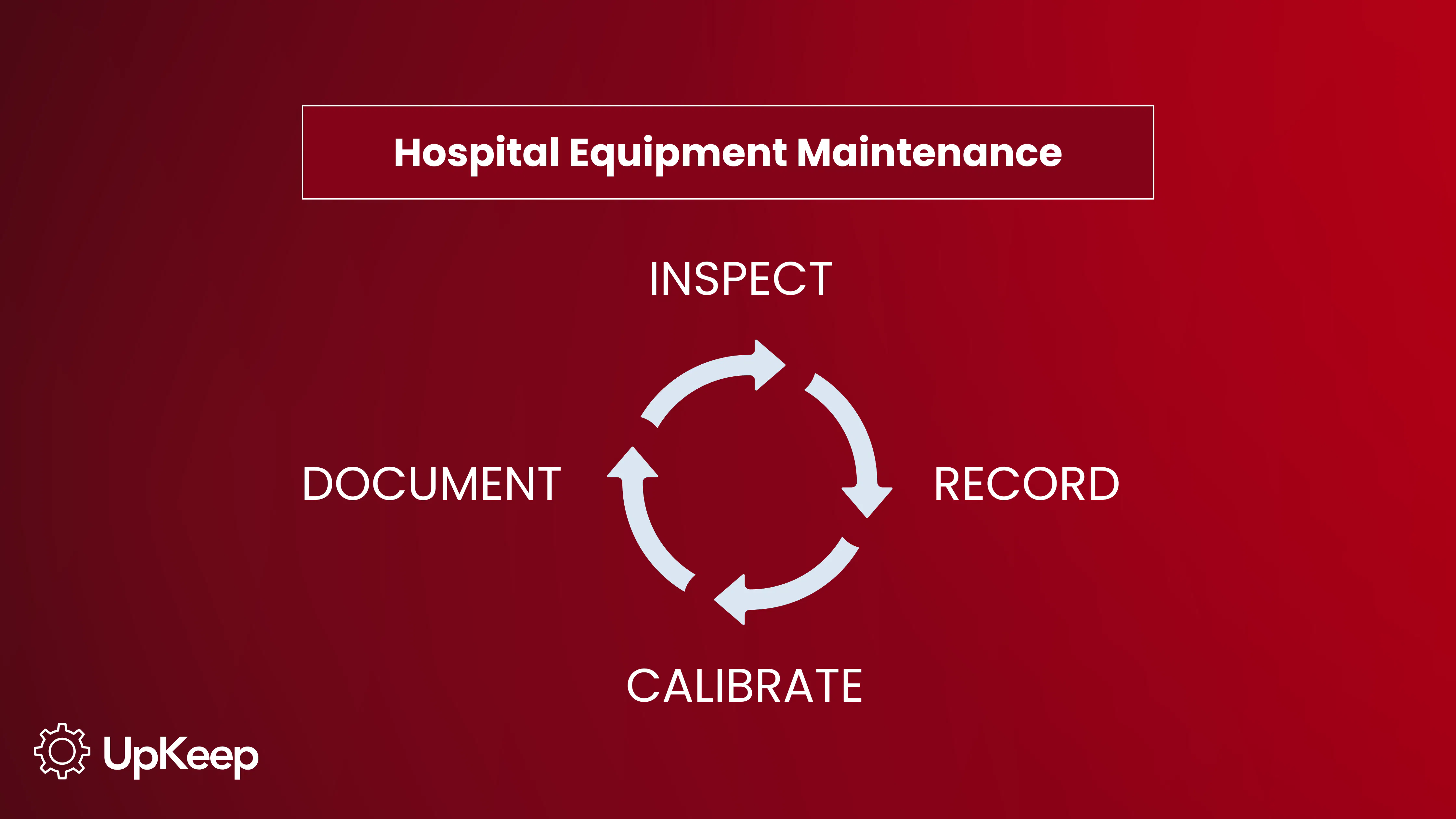
To manage these challenges, hospitals must rely on clear, repeatable processes that keep maintenance consistent. A strong SOP ensures inspections, calibrations, and repairs are held to the same high standard across all shifts and sites.


1. Asset Inventory and Criticality
This is the backbone of your CMMS and the basis for audit-ready reporting. Every asset should be logged with:
Unique ID, location, and department
Make, model, and serial number
Service frequency and maintenance type
Criticality class (e.g., life-support, diagnostic, general)
2. Scheduled Maintenance
Follow manufacturer intervals; shorten cycles for heavy-use or older equipment.
Calibrate, inspect, and clean per documented steps.
Record all findings and corrective actions immediately.
Tag out failed devices until the issue is resolved.
3. Functional and Calibration Checks
Verify that voltage, pressure, temperature, and flow are in range.
Confirm all interlocks, alarms, and backups are functional.
Use traceable, in-date calibration tools for all checks.
4. Training and Accountability
Train maintenance staff and clinical operators on safe handling and emergency procedures.
Refresh training after any device software updates or policy changes.
5. Documentation and Traceability
Capture the date, technician, work order, tasks performed, parts used, and test results.
Attach calibration certificates and close the work order with a digital sign-off.
Optimizing Maintenance with Predictive and Digital Tools
Once those standard procedures are in place, digital tools can take your maintenance program a step further. While fixed schedules keep hospitals compliant, connected devices and live data help technicians act before a fault disrupts patient care.
IoT Sensors and Connected Monitoring
Modern devices can report on their own health. These signals flow to dashboards or your CMMS to flag drift before it becomes a failure.
MRI chillers: Coolant flow and compressor vibration
Autoclaves: Temperature and pressure stability by cycle
Ventilators: Airflow resistance and motor load
AI and Anomaly Detection
Advanced models analyze an asset's historical performance to detect subtle behavior changes—hotter pumps, higher current draw, or longer spin-up times. Research shows organizations using predictive maintenance can cut unplanned downtime by more than 50% compared to reactive approaches.
CMMS Integration
This is where the data becomes actionable. Sensor alerts can automatically open work orders in the CMMS, which can then:
Prioritize the task by asset criticality and patient impact.
Assign it to available technicians with the right certifications.
Track resolution time and recurring failure patterns.
Impact on Technician Workflow
This approach allows you to target inspections to assets showing actual stress. Your team spends less time on "calendar clean" devices and more time on equipment that is trending toward failure.
Meeting Healthcare Maintenance Regulations
Whether you're using a standard SOP or an advanced predictive system, all maintenance activities must be documented to meet strict regulatory standards. In healthcare, maintenance records are just as important as the work itself because they prove that safety rules and manufacturer specifications were followed.
Core Regulatory Frameworks
All frameworks require documented proof that work followed manufacturer specs and safety rules.
Joint Commission – Environment of Care: Sets the inspection, testing, and maintenance (ITM) requirements for accredited hospitals.
ISO 13485: Defines the quality management systems for medical devices and service providers.
IEC 60601: Governs the safety and essential performance for electrical medical equipment.
FDA 21 CFR Part 820: Mandates records for maintenance, calibration, and servicing under the Quality System Regulation.
Audit Readiness
A CMMS is the key to audit readiness. It centralizes records so that inspection data, work orders, and calibration reports are always available. Auditors typically review:
Work orders with date, time, and responsible technician
Calibration certificates with traceable references
Complete service history and parts logs
Preventive and corrective maintenance policies
Liability Protection
Detailed maintenance documentation also reduces legal and insurance exposure. Clear records show that equipment was serviced to standard, protecting the hospital if a device fails or an investigation occurs.
Hospital Maintenance in Action: Case Studies
Seeing how major healthcare systems apply these principles, SOPs, and digital tools can clarify the path forward.
Mayo Clinic
With over 100,000 active devices, Mayo Clinic centralized inspections, calibration, and repair tracking in a CMMS. As a result, overdue inspection backlogs dropped 40%, and audit reports could be generated in minutes.
Apollo Hospitals
Apollo Hospitals introduced AI-based connected monitoring systems that track patient and device performance in real time. This initiative aims to detect anomalies early and enable pre-emptive maintenance, helping reduce scan delays and extend asset life.
NHS Trust (UK)
Cambridge University Hospitals NHS Foundation Trust partnered with Philips to digitize medical device integration and maintenance documentation. The project improved data visibility, reduced manual entry errors, and streamlined audit preparation.
Across all cases, the common thread is clear: disciplined processes, digital documentation, and connected tools let technicians spend less time on paperwork and more time keeping equipment safe.
Keep Your Hospital Equipment Safe, Compliant, and Ready
With the right tools, technicians can manage thousands of assets, meet audit requirements, and act on early signs of wear. UpKeep helps hospital maintenance teams:
Schedule and document all inspections, calibrations, and repairs
Centralize compliance records for surveys and accreditation
Track performance trends and prioritize high-risk assets
Connect technicians, departments, and vendors in one system
Every alert, work order, and service record stays traceable. See how UpKeep supports hospital equipment maintenance and start a free trial.
FAQs
How often should medical imaging systems like MRI or CT scanners be recalibrated?
Most manufacturers recommend calibration every 6–12 months, but heavy-use machines may need quarterly checks. Always follow OEM specifications and record calibration data in the CMMS.
What’s the difference between corrective, preventive, and predictive maintenance in hospitals?
Corrective maintenance fixes equipment after it fails. Preventive follows a fixed schedule to avoid faults. Predictive uses sensor data and analytics to service devices only when performance data shows early wear or deviation.
How can technicians manage maintenance across multiple hospital sites?
Cloud-based CMMS software allows technicians to log, schedule, and track work orders remotely, maintaining consistency and audit readiness across all facilities.
What data should be tracked for medical equipment performance analysis?
Key metrics include downtime, mean time between failures (MTBF), calibration drift, power use, and temperature or vibration trends from IoT sensors.
How can hospitals ensure third-party vendors meet maintenance and compliance standards?
Include maintenance requirements in vendor contracts, require service certificates and calibration reports, and audit external work through the hospital’s CMMS.
MÁS DE 4000 EMPRESAS CONFÍAN EN LA GESTIÓN DE OPERACIONES DE ACTIVOS
Liderando el camino hacia un futuro mejor para el mantenimiento y la confiabilidad
Los datos de sus activos y equipos no pertenecen a un silo. UpKeep simplifica ver dónde se encuentra todo, todo en un solo lugar. Eso significa menos conjeturas y más tiempo para concentrarse en lo que importa.






![[Review Badge] Gartner Peer Insights (Dark)](https://www.datocms-assets.com/38028/1673900494-gartner-logo-dark.png?auto=compress&fm=webp&w=336)