Entrada en el Blog
Asset Life Cycle Management Best Practices: A Complete Guide
Discover the five stages of asset life cycle management and the best practices to extend asset lifespans and make the most of your investments.


Key Takeaways
Shifting from reactive to proactive maintenance lets organizations reduce costs, extend asset life, and keep operations running reliably.
Tracking the right KPIs (e.g., total cost of ownership, mean time to repair, asset utilization rate) gives leadership the data needed to make confident, defensible asset investment decisions.
A CMMS serves as the operational backbone of ALM, connecting every stage of the asset life cycle and providing teams with real-time data to stay ahead of problems.
Every asset your organization owns, from the servers powering your IT infrastructure to the equipment running your production floor, follows a predictable path. Your teams handle asset planning, acquisition, utilization, maintenance, and, eventually, retirement. What separates high-performing organizations from the rest is whether that path is managed tactically, taking hits as they come, or with intention and foresight.
Asset life cycle management (ALM) is the framework that shifts reactive management to strategic advantage. Strengthening your ALM can reduce costs, improve reliability, and align your investments with your business direction. This guide covers what ALM is, why it matters, the best practices that drive performance, and how to measure if your strategy is working.
Asset Life Cycle Management Explained
ALM is the structured oversight of an asset from initial planning and acquisition through each stage of its useful life, ensuring coordinated and intentional operation at every step. Rather than managing assets in silos, ALM brings every function together under a unified strategy.
Beyond keeping assets running, the goal is to extract maximum value from every investment while controlling costs, maintaining compliance, and making smarter decisions about when to repair, upgrade, or replace. In practice, that means having visibility into what you own, what condition it's in, what it costs to maintain, and what it will cost to replace in one accessible place.
The 5 Asset Life Cycle Stages


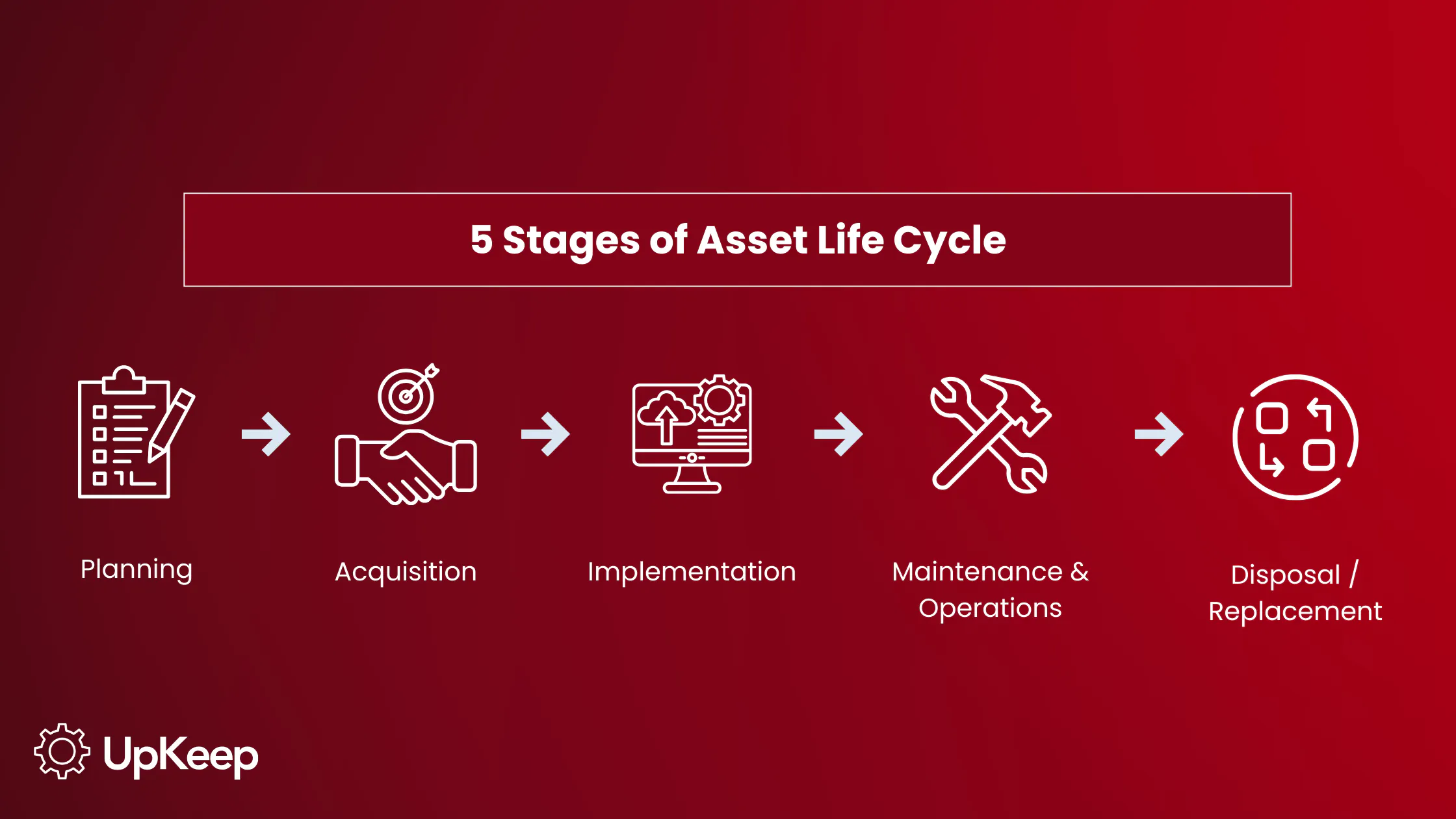
ALM encompasses five stages. Understanding each one is essential to building a strategy that holds up throughout an asset's entire lifespan.
Planning
This is the foundation of effective ALM. Organizations define asset requirements, evaluate risks, establish budgets, and set expected outcomes before any money changes hands. Strong planning reduces the risk of costly mistakes down the line by selecting the right asset for the right purpose, while ensuring the organization is financially and operationally ready to support it.
Acquisition
Once planning is complete, teams assess and select vendors, negotiate contracts, secure financial approvals, and purchase the asset. Acquisition decisions made with the full life cycle cost in mind — not just the initial purchase — set the stage for better long-term value and fewer surprises.
Implementation
This stage involves deploying the asset, training team members, and resolving any initial setup issues. It's critical to integrate the asset into existing workflows at this point to reduce disruption and ensure consistent performance from the start. A poorly executed implementation can undo even the best planning and acquisition decisions.
Operation and Maintenance
This is typically the longest phase of the life cycle, and where the bulk of activity happens. Operation includes structured workflows, continuous monitoring, and preventive maintenance programs designed to reduce downtime, improve reliability, and increase overall productivity. The shift from reactive to proactive maintenance (fixing problems before they happen rather than after) is the defining characteristic of a mature ALM program.
Disposal and Replacement
When an asset is no longer useful, look at performance data, compliance requirements, and financial impact to decide whether to retire, resell, recycle, or replace it. A deliberate disposal strategy recovers any residual value and informs the next planning cycle.
Why is Asset Life Cycle Management Important?
Organizations that treat asset management like firefighting, only addressing failures as they happen, will ultimately fall behind their competitors. An ALM strategy makes all the difference in consistently paying less and operating more reliably.
Well-executed ALM delivers:
Reduced total cost of ownership (TCO): Using operational data to optimize when to repair, upgrade, or replace assets drives down the full cost of owning and operating critical equipment.
Improved reliability and less unplanned downtime: Standardized, proactive maintenance keeps assets performing at expected levels and reduces the risk of unexpected failures that can be both disruptive and expensive to resolve.
Greater financial visibility: Centralized asset data gives leadership accurate, real-time information on asset values, depreciation, maintenance spend, and future capital expenditure needs. This enables more confident budgeting and investment decisions.
Simplified compliance management: Complete, audit-ready asset records make regulatory compliance easier to maintain and demonstrate. This is especially critical in industries like healthcare, energy, and finance, where documentation requirements are stringent.
Strategic alignment: ALM ensures asset investments support broader organizational goals, which prevents over-investment in aging infrastructure and under-investment in areas where your business needs to grow.
Common ALM Challenges
Poor ALM execution can cause unnecessary headaches and slow implementation, but is avoidable. To prepare your organization for a smoother transition, you need to be aware of some common obstacles that arise:
Incomplete or inaccurate asset data: When asset registers are incomplete, outdated, or siloed across departments, teams make maintenance and replacement decisions without an accurate idea of what’s going on. Ghost assets (items on your register that no longer work, can't be located, or are left unused) often signal this problem and can muddle budgeting and compliance reporting.
Reactive maintenance culture: Many organizations default to fixing things when they break rather than preventing failures in the first place. This approach consistently costs more, creates more unplanned downtime, and puts unnecessary strain on maintenance teams. Shifting to a proactive model requires both new tools and a change in how teams prioritize and plan their work.
Lack of end-of-life planning: Organizations often run assets well past their optimal replacement window because they don’t have a formal process to consult if and when retirement is the better option. Without defined criteria, the decision is deferred until a failure forces the issue, usually incurring an unnecessarily high cost.
10 Best Practices for an Asset Life Cycle Management Strategy That Drives Performance

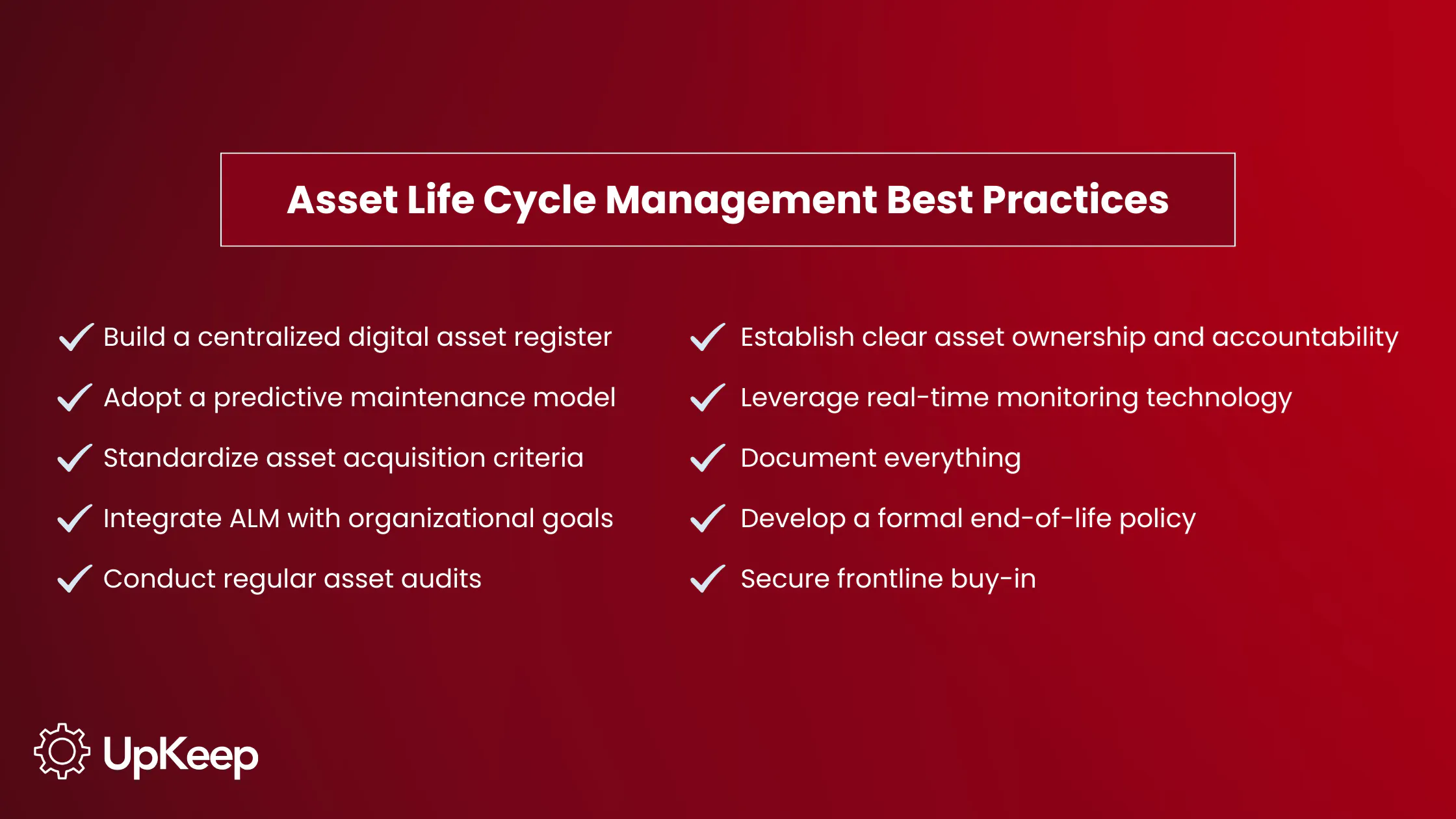
A strong ALM strategy depends on deliberate choices about how your organization tracks, maintains, and approaches decisions about its assets. These ten best practices form the foundation of a strong program and deliver measurable results:
Build a centralized digital asset register: Record all asset information, including location, condition, maintenance history, and financial data, in one accessible system of record. A single source of truth like a computerized maintenance management system (CMMS) gets rid of any visibility gaps that cause duplicate purchases, missed maintenance, and uninformed replacement decisions.
Adopt a predictive maintenance model: Consult usage data and condition monitoring to schedule interventions before failures occur. Moving from reactive to proactive maintenance reduces emergency repair costs, extends asset lifespan, and increases operational reliability.
Standardize asset acquisition criteria: Base procurement decisions on a total life cycle cost analysis rather than up-front price alone. An asset that costs less to buy but more to maintain, repair, and eventually dispose of is rarely the better investment.
Integrate ALM with organizational goals: Aligning your asset strategy with your company’s priorities ensures no asset decision is made in isolation. When maintenance, finance, and operations work from the same data, you can more effectively allocate your investment and manage risk.
Conduct regular asset audits: A consistent audit cadence helps identify ghost assets as well as equipment approaching their end of life. This keeps your asset data accurate and helps you reallocate resources before problems compound.
Establish clear asset ownership and accountability: Assign specific teams or individuals responsibility for each asset category so nothing falls through the cracks during transitions, reorganizations, or handoffs between departments.
Leverage real-time monitoring technology: Capturing continuous performance data enables faster response to anomalies and more accurate estimates of remaining useful life. A CMMS can serve as a one-stop platform that makes work orders, maintenance schedules, asset histories, and inventory data readily accessible and can integrate with Internet of Things (IoT) sensors to enable condition-based maintenance scheduling.
Document everything: Create a complete historical record of every maintenance action, repair, and modification in your asset management system. Thorough documentation informs future decisions, supports warranty and insurance claims, and provides the audit trail needed for compliance.
Develop a formal end-of-life policy: Rather than making asset retirement calls case-by-case without consistent standards, define the criteria up front, including repair cost thresholds, performance benchmarks, and age limits. A standardized policy removes ambiguity, speeds up decisions, and makes it easier to plan replacement capital expenditures.
Secure frontline buy-in: Train technicians and maintenance teams on ALM processes and tools. Even the most well-designed strategy will underperform if the people responsible for day-to-day asset care aren’t aligned with the program's goals or fail to enter the data the strategy depends on consistently.
How to Measure Your Asset Management Strategy's Success
Regularly track performance data to reduce costs, invest in assets confidently, and extend asset life. Management without concrete information is pure intuition, and that holds no weight in budget reviews or capital planning conversations.
Establishing metrics and benchmarks early in your ALM program ensures your strategy delivers financial, operational, and strategic value. When performance falls short of benchmarks, you’ll have the data needed to identify what's not working, adjust, and measure whether the changes made a difference, thus creating a feedback loop that strengthens the program over time.
A solid measurement framework requires both leading indicators, like scheduled maintenance compliance rates, and lagging indicators, like unplanned downtime hours, to give a complete picture of program health.
Asset Life Cycle Management KPIs
The core KPIs to track as part of your ALM program are:
Overall equipment effectiveness (OEE): One of the most comprehensive indicators of asset performance, this measures how productive an asset is while in use. Set a baseline for asset performance to track your maintenance strategy’s success.
Mean time between failures (MTBF): The average time an asset operates between breakdowns. Identify chronic problem assets to consider replacing versus continued repair.
Planned maintenance percentage (PMP): How much of your maintenance activity is planned versus reactive. A high PMP indicates a well-run ALM program.
Asset utilization rate: How actively your organization uses an asset relative to its available capacity. This can reveal areas to consolidate, redeploy, or retire underperforming assets.
Total cost of ownership (TCO): The total costs of acquisition, maintenance, parts and materials spend, downtime, and disposal over an asset's full life. Use this to inform repair-versus-replace decisions and justify investment.
Mean time to repair (MTTR): Also called “mean time to recovery,” this captures the average time elapsed between an asset failure and its full restoration to service. Evaluate your maintenance team’s efficiency with it and optimize preparedness.
How a CMMS Supports Asset Life Cycle Management
A CMMS is the operational backbone of a well-run ALM strategy. It eliminates fragmented spreadsheets and disconnected systems by offering a single source of truth for every stakeholder.
CMMS platforms strengthen ALM by:
Centralizing work orders, maintenance schedules, and inventory data
Automating warranty alerts, license tracking, and hardware refresh reminders to reduce compliance gaps and unexpected costs
Tracking complete asset history
Integrating with IoT sensors and SCADA systems to monitor the health of physical equipment in real time, enabling maintenance only when necessary — and before it’s too late.
A CMMS shifts maintenance from reactive to proactive. Real-time visibility into asset health allows teams to intervene before failures occur, extending asset lifespan, emergency repairs costs, and preventing stress on the team.
The reporting capabilities of a modern CMMS also give operations and maintenance leaders the data they need to make and defend critical decisions, including when to repair versus replace, how to allocate maintenance budgets, and how vendors are performing against expectations.
The latest generation of CMMS platforms leverages AI to actively work alongside your maintenance team. For example, UpKeep's Nova AI handles the repetitive, manual labor that typically slows teams down, namely, generating work orders, scheduling preventive maintenance, and flagging issues before they escalate.
Teams can also interact with the system using natural language, allowing easy changes or information extraction. This reduces the learning curve for new technicians, increases the consistency of data entry across the team, and frees up experienced staff to focus on the decisions that require human judgment.
ALM in Practice
ALM principles apply across industries but can show up differently depending on the assets and team.
Manufacturing
Production facilities use a CMMS to track every piece of equipment on the floor, such as logging maintenance history, parts spending, and performance data over time. When a conveyor system starts to show a pattern of repeat failures, the data makes the repair-versus-replace calculation straightforward. Meanwhile, preventive maintenance schedules keep the line running during planned service windows rather than unplanned shutdowns.
Facilities Management
Property management companies apply ALM to HVAC systems across a portfolio of commercial buildings. Rather than waiting for tenant complaints or system failures, condition monitoring data triggers maintenance work orders automatically, keeping equipment running efficiently and extending the time between major replacements.
Healthcare
Hospital systems use ALM to manage high-value diagnostic equipment like MRI and CT machines, where unexpected downtime has direct patient care implications. Maintenance schedules, compliance records, and replacement planning are managed centrally, ensuring equipment meets regulatory standards and capital budgets account for replacement cycles years in advance.
IT Asset Management
Enterprise IT departments leverage ALM to track purchase dates, warranty expirations, software licensing, and performance metrics for every device in their hardware fleet. Automated alerts from a CMMS can flag assets approaching their end of warranty or refresh thresholds so teams can plan replacements.
Whether you're building an ALM program from the ground up or strengthening an existing one, the practices in this guide can reduce the total cost of ownership, improve reliability, and turn asset operations into a measurable competitive advantage. By centralizing your asset data, shifting from reactive to proactive maintenance, tracking the KPIs that reflect real performance, selecting the right CMMS, and integrating tools that reinforce consistency, you can set both your teams and your business up for success.
MÁS DE 4000 EMPRESAS CONFÍAN EN LA GESTIÓN DE OPERACIONES DE ACTIVOS
Liderando el camino hacia un futuro mejor para el mantenimiento y la confiabilidad
Los datos de sus activos y equipos no pertenecen a un silo. UpKeep simplifica ver dónde se encuentra todo, todo en un solo lugar. Eso significa menos conjeturas y más tiempo para concentrarse en lo que importa.






![[Review Badge] Gartner Peer Insights (Dark)](https://www.datocms-assets.com/38028/1673900494-gartner-logo-dark.png?auto=compress&fm=webp&w=336)